Planning for Play: Balancing Curriculum & Child-Led Learning
Find the balance between play-based exploration and meeting curriculum goals in your early years classroom. Learn how to plan for play with confidence and clarity.
Planning for play-based learning should feel rewarding. The part of your week where everything clicks into place and you can finally see young children learning the way they were designed to learn. But for many early childhood teachers, the planning session feels more like a pressure cooker.
Between mandated ACARA outcomes, assessment cycles, term overviews, behaviour plans, and trying to maintain meaningful play opportunities, planning for play can quickly turn into one of the most time-consuming tasks of the week.
I know because I’ve been there!!
You sit with your planner open and think:
How do I link investigations to specific ACARA outcomes?
How do I honour my children’s interests while still covering the curriculum?
How on earth do I document all this learning?
Well I have some good news! Research across Age-Appropriate Pedagogies (AAP), Learner-Focused Practice, and the wider research on the importance of play-based learning makes one thing clear:
👉 Planning for play isn’t about creating more work — it’s about creating clearer systems.
AAP tells us that high-quality early years practice blends child-initiated play with intentional teaching, forming a responsive framework where young children have rich opportunities to explore, inquire, collaborate, persist, and construct knowledge in different ways.
Learner-Focused Practice reminds us that young learners thrive in environments where:
planning is flexible,
learning stems from children’s strengths and curiosities,
teachers use observation as data, and
decisions are made through a cycle of watch → respond → extend.
And the Importance of Play-Based Learning research reinforces that deep learning happens when play is purposeful, connected, and supported by thoughtful adult facilitation and not when we force push-down academics or overwhelm young children with formal tasks.
This blog post will help you build a planning system that:
aligns with ACARA
protects play
honours emergent curriculum
supports diverse learners, and
makes your weekly and daily planning lighter, clearer, and more intentional.
By the end, you’ll feel confident planning for play in a way that’s achievable, meaningful, and grounded in good practice. You’ll have a great way to balance curriculum expectations with the natural learning process of young children.
Intentional Teaching Meets Child-Led Learning
Planning for play-based learning isn’t about choosing between free play or explicit instruction. It’s about knowing when to guide, when to follow, and when to sit beside a child as a co-researcher.
When we plan with intention, yet respond to the children in front of us, we create a learning cycle that honours how young children learn best.
Why Play and Explicit Teaching Are Not Opposites
One of the strongest messages from the Age-Appropriate Pedagogies Foundation Paper is that the old binary - “play versus teaching” - simply doesn’t hold up.
The research shows that both playful learning and explicit instruction are effective, depending on the purpose and context. In fact, best practices suggests using a range of approaches, where teachers confidently shift along the continuum as children’s needs change throughout the day.
In my own planning, this looks like tuning-in sessions that spark curiosity, short explicit lessons that build essential skills, and long blocks of child-led investigation time where children apply and deepen their understanding through hands-on play.
Play and teaching are not competing forces — they are partners.
Linking Play to ACARA and the Curriculum with Confidence
Many early childhood teachers worry about “proving” learning during play. The good news straight from ACARA is that early years teachers are encouraged to use their professional judgement and draw on early childhood pedagogy when planning and assessing.
The Foundation Paper reinforces that teachers may flexibly apply key principles, including play, intentional teaching, and assessment for learning, in ways that reflect the developmental needs of young children.
This gives you permission to honour emergent curriculum, respond to interests, and still meet every ACARA outcome. All without pushing down academics or abandoning child-led learning.
What Intentional Teaching Looks Like in Play
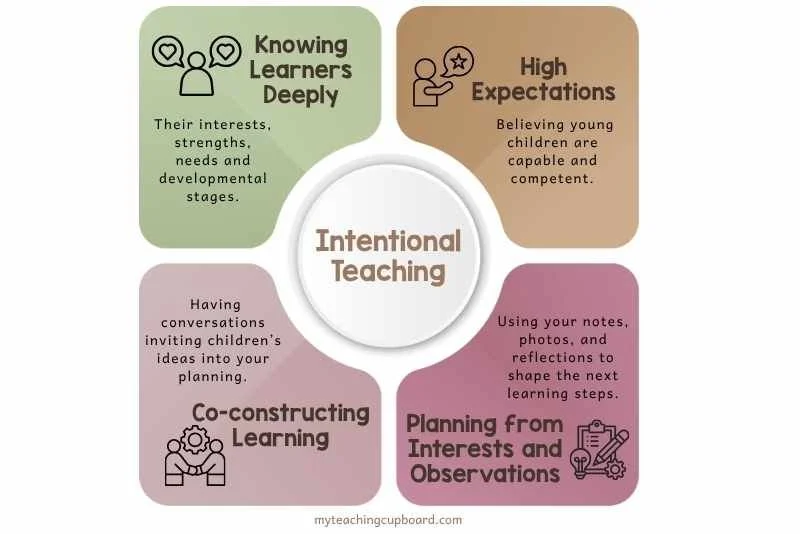
The Learner-Focused in Action guide makes it clear: intentional teaching in the early years is not about controlling learning. It’s about designing for depth.
Effective planning for play includes:
Knowing learners deeply - interests, strengths, needs, developmental stages
High expectations - believing young children are capable and competent
Co-constructing learning conversations - inviting children’s ideas into your planning
Planning from interests and observations - using your notes, photos, and reflections to shape the next learning steps
When these elements sit at the heart of your planning, you get purposeful play that is joyful, meaningful, and connected to curriculum goals.
If you’re ready to make your planning process faster, clearer, and far less stressful, these blog post guides will help:
👉 How to Write a Play-Based Learning Term Overview
If term planning feels like a huge task that eats up your weekend, this guide will help you map out your term quickly and intentionally. You’ll learn how to turn curriculum demands into a simple, achievable plan you’ll actually use.
👉 How to Write a Statement of Intent for Your Play-Based Learning Classroom
If you use (or want to use) the Walker Learning Approach, this blog post shows you how to write a Statement of Intent that brings ACARA outcomes, student interests, provocations, and explicit teaching together in one clear document.
Curriculum Connections Through Play – Literacy, Numeracy & Science in Investigations
Some educators think that planning for play is about fitting in some “extra fun” around the curriculum. But it’s really about understanding that children’s play is the learning process.
Research consistently shows that young children are active, engaged, constructive learners who thrive when content is meaningful and connected to their own investigations (AAP; Foundation Paper).
When we design a conducive learning environment and investigate alongside them, we should definitely not be stepping away from curriculum outcomes. We need to be stepping into the most effective way to help them reach them.
Why Play Is a Powerful Vehicle for Curriculum Learning
Play gives children rich opportunities to explore ideas in different ways, collaborate, build social skills, and use language with purpose. In play, children aren’t memorising facts. They’re thinking, communicating, problem-solving, hypothesising, comparing, designing, testing and reflecting.
This is why the research argues that play supports inquiry, creative thinking, social interactions, and early scientific reasoning far more effectively than push-down academics or worksheet-heavy routines.
Linking Literacy Outcomes Through Play
Literacy learning happens naturally when children are immersed in meaningful contexts:
Pretend play strengthens narrative structure, sequencing, and comprehension.
Sustained shared thinking during investigations boosts oral language, vocabulary, and expressive communication.
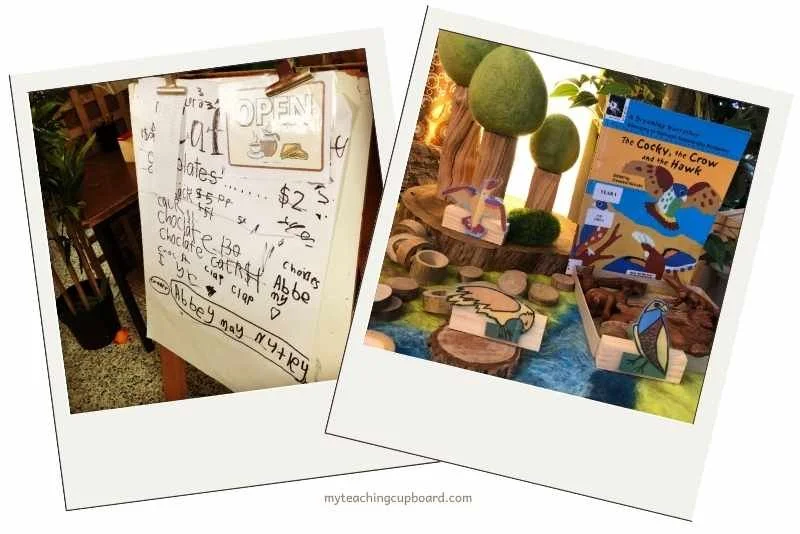
Environmental print (menus, signs, labels, maps, rosters) provides early opportunities for reading and writing that feel purposeful, not forced.
Small world play encourages children to use descriptive language and develop storylines. Perhaps one of my most favourite ways to build early literacy skills.
If you want more ideas like these for weaving literacy into your children’s play, you'll love my blog post The 10 Essential Areas of a Play-Based Classroom. It walks you through each learning zone and how it supports literacy, oral language, social development, and creativity.
Linking Numeracy Outcomes Through Play
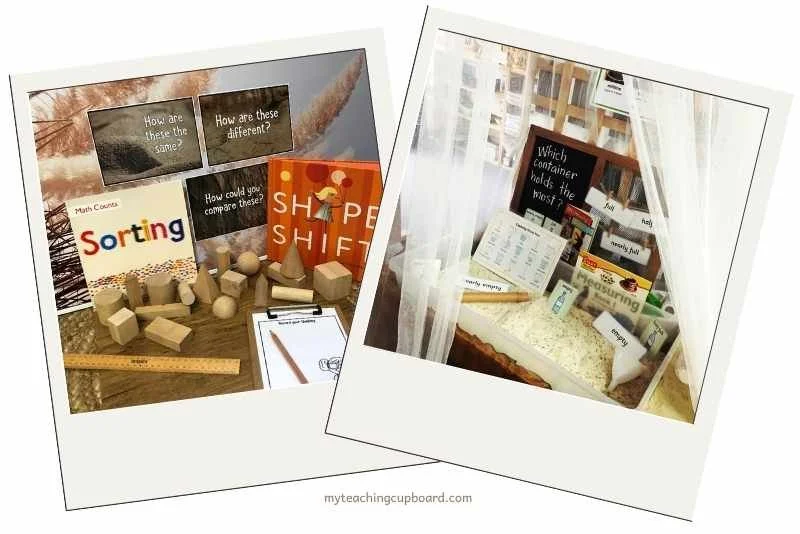
Numeracy grows through hands-on, open-ended exploration. In investigations, children naturally explore early maths concepts such as:
counting, grouping, and comparing
sorting, matching and categorising
measurement, estimation, volume and capacity
geometry, spatial language, and visualisation
Loose parts, construction, and sensory play (like water play or outdoor play) all provide rich opportunities for developing conceptual understanding in a strong, holistic way.
For practical examples and dozens of ready-to-use provocations, explore my blog post: 23 Loose Parts Ideas for Teaching Maths. It’s filled with specific activities that can turn your numeracy outcomes into purposeful play.
Linking Science Outcomes Through Play
Young children are natural scientists. When they mix, pour, test, experiment, and observe, they’re developing:
early inquiry skills
prediction and causal reasoning
data gathering and comparison
curiosity and persistence
Whether they’re exploring shadows, floating and sinking, forces, or the natural world, play-based science builds confident thinkers who can ask questions and test ideas independently. You’ll see essential skills for social studies, STEM, and long-term academic achievement.
If you’d like more examples of hands-on science provocations, visit my blog post: Teaching Science in a Play Based Classroom. It explains how play based learning and science education go hand-in-hand. I’ll also give you some educational play based science ideas you can easily implement in your own classroom.
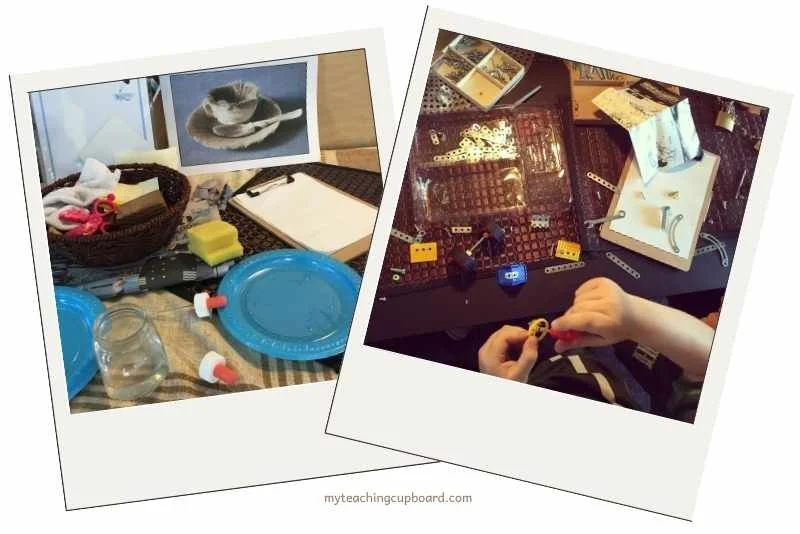
Flexible Planning Frameworks for Play-Based Classrooms
When you have a clear framework, planning for play becomes a natural rhythm. When you know how, it’s easy to honour children’s interests and keep everything aligned with ACARA.
In fact, the Learner-Focused in Action paper reminds us that “learner-focused classrooms are the result of careful decision-making, organisation and reflection.” In other words, good planning creates good play.
Below are the three planning pillars I use (and teach to other early childhood teachers) to keep play purposeful, child-led, and curriculum-aligned. And they don’t take hours of your precious time either!
Planning Tools That Work in Real Play-Based Classrooms
Every strong planning system has three layers:
1. Your Term Overview (The Big Picture)
Think of this as your roadmap. It helps you identify:
Your key ACARA outcomes
Investigation areas you’ll prioritise
Seasonal events and curriculum links
Assessment windows
This keeps your long-term direction clear while still leaving room for emergent curriculum and children’s ideas.
➡️ If writing a term overview usually takes you hours, you’ll love this comprehensive blog post: How to Write a Play Based Learning Term Overview
In it, I walk you through step-by-step how to create an outline that is fast, functional, and flexible.
2. Statement of Intent (Your Fortnightly Pathway)
This is where curriculum, children’s interests, explicit teaching, and provocations all come together. It’s the heart of planning for play.
Your Statement of Intent should reflect:
emerging interests
your explicit focus areas
the social/emotional needs in your room
planned provocations and investigation areas
documentation focus
➡️ New to writing Statements of Intent or not sure if you’re doing it right?
Read this step-by-step guide: How to Write a Statement of Intent for Your Play-Based Learning Classroom
3. Weekly Play Planner (Your Day-to-Day Anchor)
This is where the real-world magic happens.
A strong weekly plan includes:
investigation areas
provocations
explicit teaching sessions
play-based assessment focus
transition routines
reflection opportunities
Weekly planners keep you organised and help make sure you can be responsive within a structure - exactly what early childhood pedagogy calls for.
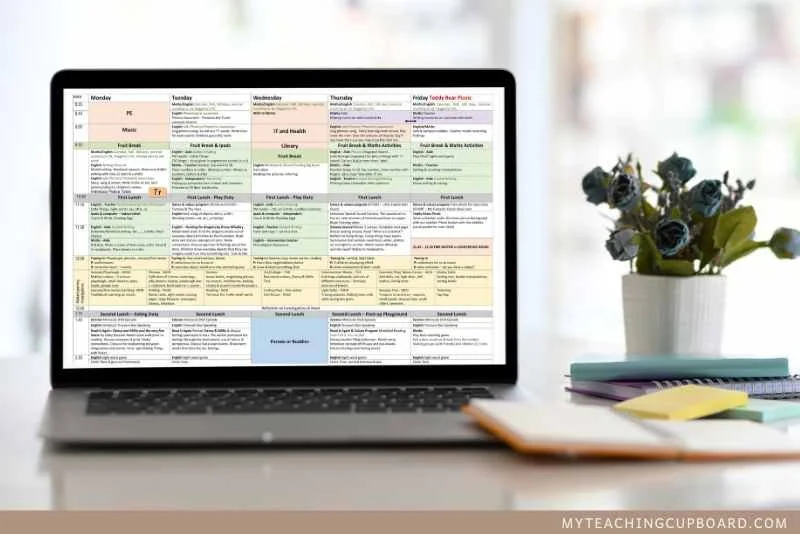
Weekly Play Planners That Save Time
A good weekly planner gives you clarity and it should show at a glance:
what investigations are open
what tools or loose parts you're adding
what your focus is for literacy, numeracy, and SEL
which routines or transitions need attention (especially at the start of the year!)
what documentation you’re collecting
Many teachers tell me that weekly planning is where they get stuck. Usually, it’s not because they can’t plan, but because they’re trying to plan everything. Your planner should support purposeful play and definitely not overcomplicate it.
How to Use Children’s Interests to Plan Investigations
This is where play becomes truly meaningful and my favourite part of the planning process.
The AAP and Learner-Focused in Action papers highlight the importance of:
agency (children directing aspects of their learning)
responsiveness (teachers planning from observations, not assumptions)
co-constructed learning (learning conversations, not “doing to”)
meaningful experiences (connected to children’s thinking, not random themes)
Here are some of the best ways I have found to incorporate my students' interests:
Document patterns you notice during play
Add provocations that extend those interests
Invite children to help plan or design areas
Keep materials flexible so learning can evolve
Want a practical example of how to do this?
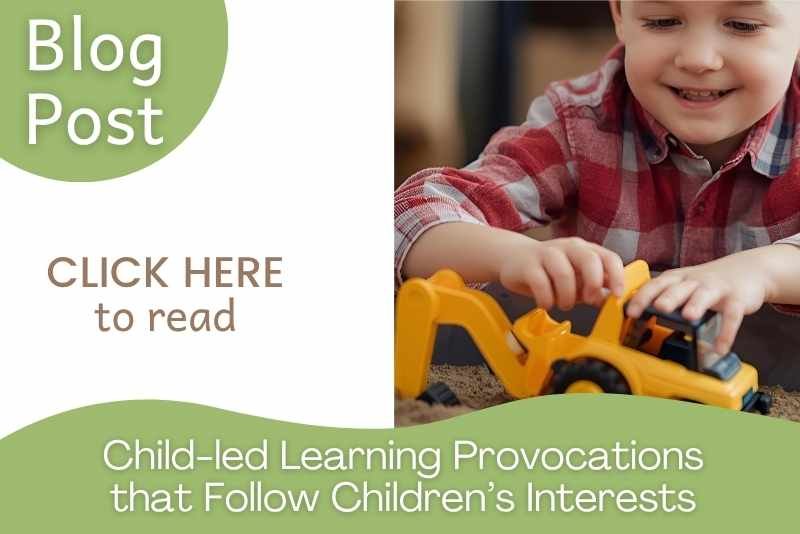
Read this blog post next: Child-Led Learning Provocations that Follow Children’s Interests. You’ll discover how to tune into your children’s emerging ideas and create provocations that naturally link to curriculum goals. There’s also a free observation checklist included.
Assessment Within Play – How to Document, Evaluate & Reflect
Please don’t let the assessment in your play-based classroom interrupt children’s play. It should not feel like “extra work,” or pull you away from the rich learning happening right in front of you.
When you understand what counts as evidence of learning and how to capture it simply, assessment becomes a natural part of the learning process rather than an add-on.
Research across early childhood education shows that assessment is most meaningful when it emerges from what young children naturally do during purposeful play.
The Age-Appropriate Pedagogies Foundation Paper emphasises that children demonstrate deep thinking, problem-solving skills, and early childhood development across multiple domains when they are engaged in hands-on investigations.
Likewise, Learner-Focused Practice in Action highlights that teachers in the early years use ongoing, informal assessment to guide intentional teaching and plan their next steps.
What Counts as Evidence of Learning in Play
During investigation time, children show the full range of developmental milestones. From social skills, early literacy, numeracy, cognitive abilities, emotional development, to fine motor control. Some of the clearest evidence of learning includes:
Sustained shared thinking - when a child and teacher (or peers) work together to solve a problem, clarify ideas, or create a plan.
Problem solving - attempts, failures, retries, and redesigned solutions.
Collaboration and social interactions - taking turns, negotiating, and supporting peers.
Exploration of materials - how children test, combine, and repurpose loose parts in different ways.
Oral language and communication - storytelling, explaining thinking, debating ideas.
Representational thinking - using drawings, symbols, maps, or models to represent their ideas.
In other words, the everyday things children say, do, build, write, and draw are all data points that demonstrate academic achievement and holistic learning.
Assessment Strategies That Don’t Interrupt the Play
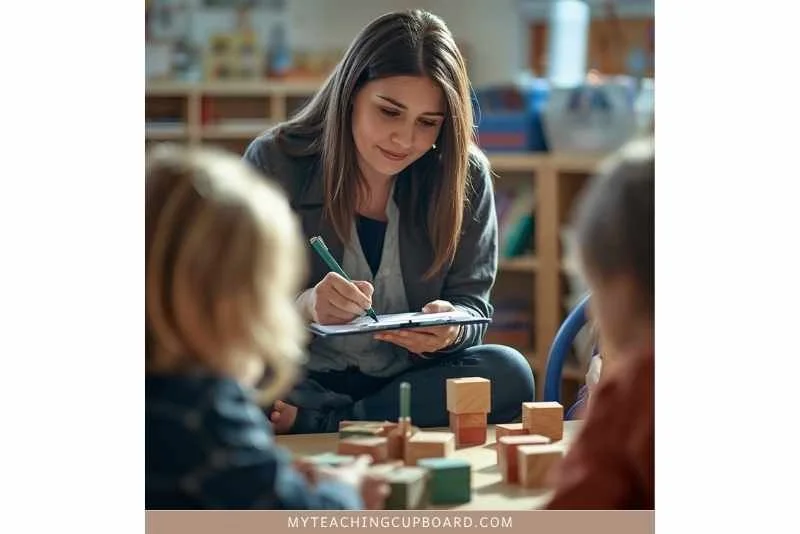
Assessment for learning in the early years must protect the integrity of play. You really just need short, purposeful ways to capture what you see.
Here are some of my low-interruption strategies that align with good practice and the expectations in early childhood settings:
Anecdotal notes: Jot quick observations of a child’s thinking, vocabulary, or strategy use.
Photo documentation: Snap a moment and pair it with a quote or caption.
Work samples: Plans, drawings, labels, or structures photographed before pack-up.
Observation checklists: Simple tools for monitoring progress in social, cognitive, and physical development.
👉 Download my free Play-Based Learning Observation Checklist to help you document your children’s play efficiently and consistently.Conversations during reflection time: These short check-ins help children articulate their learning while providing valuable insight into their understanding.
These strategies support diverse learners and protect the play while still giving early childhood teachers rich opportunities to collect meaningful evidence.
Reflection Cycles for Teachers and Children
According to the Age-Appropriate Pedagogies guidelines, reflective practice is central to high-quality early childhood education. Reflection helps you make sense of the learning evidence you’ve gathered and plan future experiences that respond to individual children.
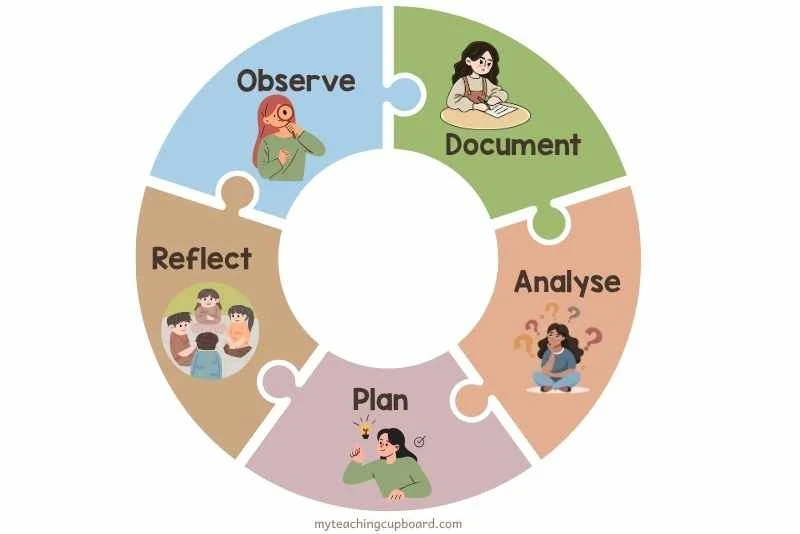
A simple reflection cycle might look like this:
Observe: Watch how children are engaging. Look at their choices, questions, frustrations, and breakthroughs.
Document: Capture one or two pivotal moments (a quote, a photo, an observation).
Analyse: Link what you’ve documented back to ACARA outcomes, developmental domains, or your Statement of Intent.
Plan: Use what you’ve learned to set up tomorrow’s provocations, adjust your lesson plans, or scaffold a specific child’s needs.
Reflect with children: Ask them to revisit their work, explain their thinking, or consider next steps. These conversations deepen metacognition, communication, and emotional learning.
This cyclical process mirrors the elements described in Learner-Focused Practice in Action, where teachers build deeper understanding through ongoing observation, responsive interactions, and intentional planning.
To help you strengthen assessment in your play-based learning program, explore this blog post next: The Teacher’s Role in Play-Based Learning: How to Observe and Scaffold Play and discover how to extend children’s thinking through purposeful prompts and interventions during play.
Pulling It All Together – Creating a Sustainable System for Play-Based Planning
Planning for play-based learning doesn’t need to feel like juggling ten things at once. When you build a simple, repeatable system that blends ACARA expectations with meaningful, child-led investigations, everything becomes lighter - your planning, your assessment, and your teaching flow.
What a Balanced Week Looks Like (ACARA + Play)
A strong planning system is one where explicit lessons, investigations, provocations, assessment, and follow-up mini-lessons all work together instead of competing with one another.
A balanced week often includes:
Explicit teaching blocks - Short, sharp lessons targeting ACARA outcomes in literacy, numeracy or science.
Investigation Time - Long, uninterrupted play sessions (at least 45 minutes a day) where young children explore, practise skills, and make connections organically.
Provocations - Curriculum-linked invitations that gently steer children toward key concepts without taking away choice or autonomy.
Assessment for Learning - Anecdotal notes, quick photos, or your observation checklist. Evidence gathered during play, not after it.
Follow-Up Mini-Lessons - Small group activities or one-to-one sessions based on what you observed: the misconceptions, the emerging interests, the children who need just a little more.
In practice, it looks like a rhythm… not a rigid timetable.
👉 Want to see how this all comes together in a real classroom?
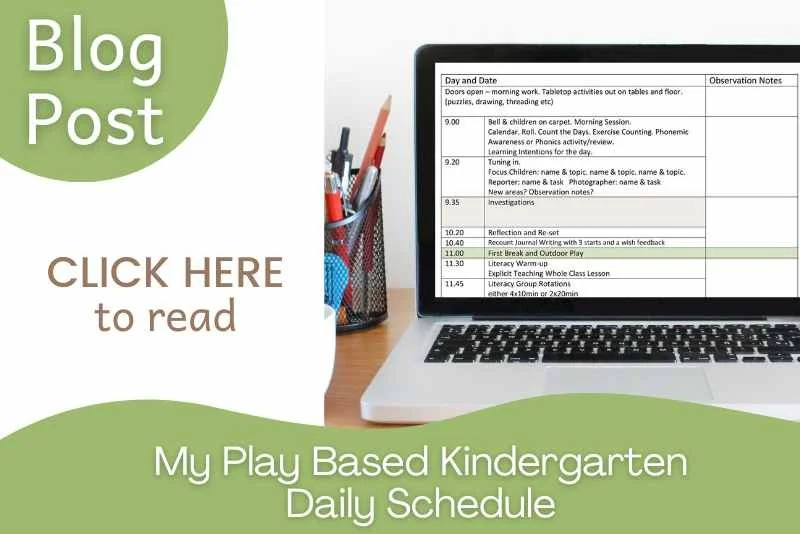
Have a look at My Play Based Kindergarten Daily Schedule. This is a practical guide that shows exactly how I combine play-based learning with explicit teaching in a way that keeps my students engaged and meeting curriculum goals. It even includes a free editable planning template so you can set up your own balanced schedule with confidence.
How This System Reduces Stress and Saves Time for Early Childhood Educators
If planning feels overwhelming, you are not doing anything wrong. You’re simply trying to plan too many things separately.
A sustainable planning system solves the biggest pain points early childhood teachers feel:
Pain Point 1: “I feel like I’m constantly planning.”
A streamlined planning cycle means you’re no longer starting from scratch every week. Your Term Overview, Statement of Intent, and Weekly Play Planner should work together, so your daily decisions are already anchored to the big picture.
Pain Point 2: “I struggle to link children’s interests to the curriculum.”
When you plan from your observations using tools like your free play-based observation checklist, interests become entry points to ACARA outcomes instead of extra work. You’re no longer guessing; you’re responding with purpose.
Pain Point 3: “I don’t know how to assess play.”
Assessment sits inside the play, not outside it.
Your planning system should include:
quick anecdotal notes
snapshots of learning
reflection time conversations
developmental checklists aligned to curriculum outcomes
This means you capture learning as it happens — naturally and meaningfully.
Together, these elements create a planning process that is intentional, achievable, and sustainable… and best of all, it frees you up to focus on what matters most:
⭐ being present with children during their play.
When you combine intentional teaching with child-led learning, the result is a thoughtful, research-backed approach that supports curriculum expectations and honours how young children learn best.
Planning for Play Doesn’t Have to Feel Overwhelming
When you have a clear framework, curriculum alignment you can trust, and an intentional teaching mindset, planning for play becomes lighter - and far more joyful.
When you weave together:
child-led investigations
intentional mini-lessons
responsive provocations
ongoing assessment for learning
…you create a curriculum that honours how your young children learn best - joyfully, curiously, and through meaningful play.
A balanced approach helps young children stay engaged, develop strong problem-solving and social-emotional learning skills, and still meet ACARA expectations with confidence.
Your planning doesn’t need to take hours. It just needs to be purposeful, responsive, and achievable.
And with the right tools, it absolutely can be.
✅ Download Your Free Play-Based Planning Templates
Make planning faster, clearer, and more enjoyable with my free editable Term Overview, Weekly Planner, and Statement of Intent templates.