
Why Play-Based Learning Isn’t Working and How to Fix It
Struggling with behaviour, transitions or chaos during play? Learn why play-based learning isn’t working and how to fix it with simple, structured strategies.
For Kindergarten & Year 1 Teachers Struggling with Behaviour, Transitions or Engagement
I still remember one particular Year 1 class I had - twenty-six children. Fourteen with developmental delays, Individual Plans, or significant additional needs. Many of them didn’t know how to play. Transitions were chaotic. Materials were misused and arguments broke out constantly.
By the end of the day, everyone was exhausted - especially me!
Have you ever tried to introduce play-based learning and thought: Why is this not working? or Why does it feel harder, not easier?
Maybe your students:
Struggle to transition between structured learning and play.
Become dysregulated or unsafe during play.
Don’t know how to share, communicate, or use materials appropriately.
Lose focus quickly during explicit teaching.
Or leave you feeling completely drained by the end of the day.
Here’s the truth most people don’t talk about: Play-based learning doesn’t automatically work just because you timetable in a play session. It requires structure, modelling, and intentional teaching - especially in classrooms with diverse learning and behavioural needs.
But I have some good news! Once you understand what’s missing (and how to fix it), everything will start to fall into place.
If you’re feeling unsure where to start, you don’t need to figure this out on your own. I’ve put together a free guide to help you set up play-based learning in a way that actually works in a real classroom. It is handy for helping you implement play based learning the right way - especially when behaviour, transitions, and engagement feel challenging.

The Real Reason Play-Based Learning Feels Chaotic
If your classroom feels out of control during play, it’s usually not because:
Your students are “too challenging”
Or play-based learning “doesn’t work”
It’s usually because play hasn’t been explicitly taught.
For many children, especially those with ADHD, autism, trauma backgrounds, or developmental delays, play is not intuitive.
And this is the part that often surprises us the most.
We assume play is something children just naturally know how to do. For some children, it is. But more and more, I’m seeing children come into the classroom who simply don’t have those skills yet.
They might not have had many opportunities to play with others.
They might have spent a lot of time on screens.
They might not have experienced open-ended materials or unstructured social play.
I remember looking around my classroom thinking, “What are they doing?” They were surrounded by engaging materials like blocks, loose parts, and a lovely dramatic play area. But instead of purposeful play, I saw:
materials being thrown or misused.
children aimlessly wandering from area to area.
arguments over resources.
some children standing on the outside, unsure how to join in.
It wasn’t that they didn’t want to play. They just didn’t know how.
That realisation changed everything for me.
Because once I understood that, I stopped expecting play to just “happen” and started teaching it in the same way I would teach reading or maths.
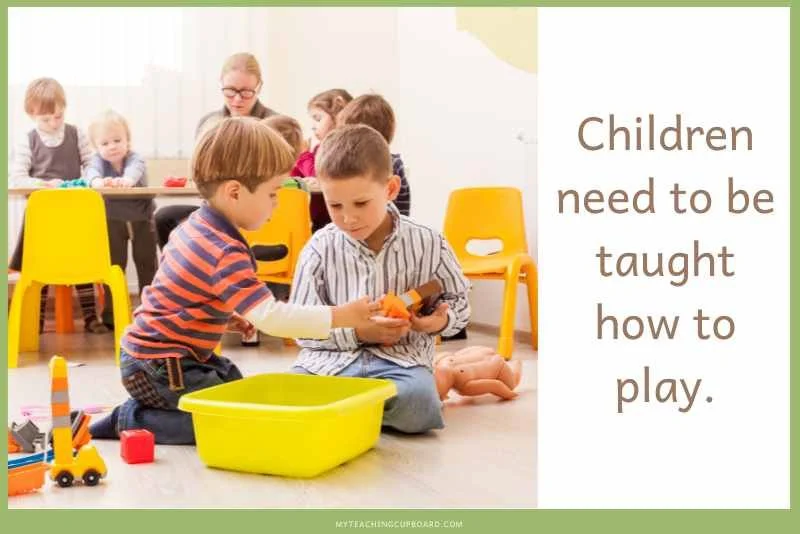
These children needed to be explicitly taught:
How to use materials.
How to take turns.
How to enter and stay in play.
How to communicate with others.
What purposeful play actually looks like.
And just like any other skill, it didn’t happen overnight. It took modelling and lots of repetition. It took stopping and showing them again and again and again!
Sometimes it meant pausing play to demonstrate:
This is how we ask to join in.
This is how we share the blocks.
This is what building together can look like.
Other times it meant celebrating the smallest wins like two children playing side by side without conflict or a child asking for a turn instead of grabbing and a group staying engaged in one activity for longer than just a few minutes.
Without this support, play can quickly become:
Chaotic
Unsafe
Socially overwhelming
Dysregulating
But when we slow down and teach these skills intentionally, something really powerful starts to happen.
👉 Play becomes calmer.
👉 Interactions become more positive.
👉 And students begin to engage in deeper, more meaningful learning.
One of the simplest ways to support purposeful, calm play is through the questions we ask. I use open-ended question prompts to guide thinking, model language, and help students stay engaged during play. I have found that many children need more support with communication and social interactions.
Another Reason Play Feels Chaotic: The Provocation Isn’t Developmentally Appropriate
There’s another reason play can feel chaotic that doesn’t get talked about enough.
And I’ve been there myself.
Sometimes it’s not just that children don’t know how to play… It’s that we’re expecting something they’re just not developmentally ready for.
I remember setting up what I thought was a beautiful, purposeful learning area. I had a clear idea in my mind of what the children would do, how they would use the materials, and what the learning would look like.
And then…
They used it in a completely different way. At first, I thought:
They’re not using it properly.
They’re missing the point.
Why is this turning into chaos?
But when I stopped and really observed, I realised something important. The problem wasn’t the children. It was the mismatch between my expectations and their developmental level.
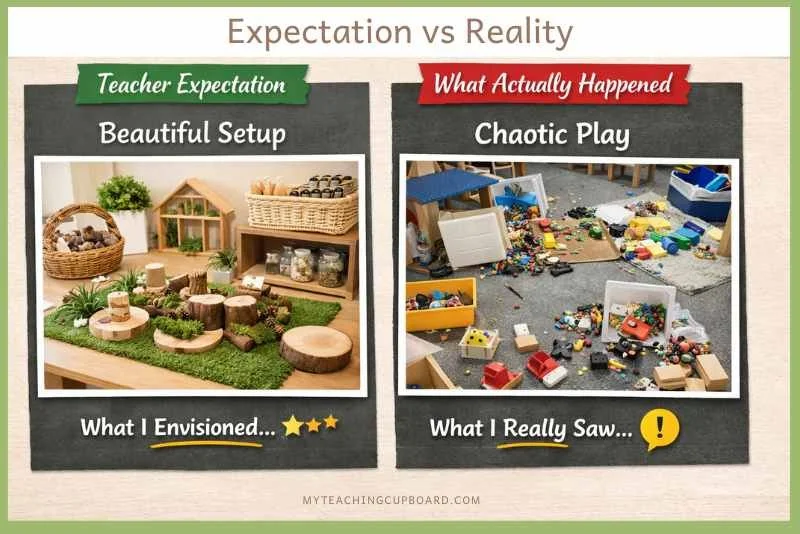
When Expectations Don’t Match Reality
When provocations are too complex, too structured, or based on what we think should happen, children can:
become frustrated
misuse materials
disengage quickly
or turn the experience into something that looks chaotic
Not because they’re doing the wrong thing, but because the task doesn’t match where they are.
What Changed Everything for Me
I shifted from asking “Are they using this the right way?” to “What are they showing me they need?” And that’s where observation became the most powerful tool in my classroom.
Start With Open-Ended Materials
The more open-ended the materials, the more accessible the play becomes. Think loose parts, blocks, natural materials and simple construction items.
These allow children to:
enter play at their own level
explore without pressure
build confidence through success
There’s no single “right way” and that immediately reduces frustration and increases engagement.

Let the Children Show You What Comes Next
Instead of setting up elaborate provocations straight away, I began by:
observing how children used simple materials
noticing their interests, skills, and challenges
watching how they interacted with others
And then I used those observations to guide my next steps.
This Is Where the Real Planning Happens
Your observations tell you:
what skills need to be taught
what materials to add or remove
how to simplify or extend an area
what your next explicit lesson could focus on
👉 Observation → Adjustment → Provocation → Learning
If you’re not sure what to look for when observing, I’ve created a simple observation checklist to help you notice patterns, behaviours, and emerging skills during play. It helps your planning feel clearer and more intentional.
👉 Download your free observation checklist and start using what you see to guide your next steps.

And if you’ve ever wondered why children keep repeating the same actions over and over again, this is where understanding play schemas becomes a game changer.
When you can recognise these patterns, you can plan provocations that truly match your students’ developmental needs and that’s when engagement and behaviour start to shift. If you would like to create an engaging and effective learning environment that aligns perfectly to the cognitive development of each child in your class, this blog post on Play Schemas in Early Childhood Education is definitely for you.

That Observation → Adjustment → Provocation → Learning cycle changed everything for me. It was a real classroom shift. I used to set up areas with a clear outcome in mind, and now, I set them up as an invitation.
And instead of asking “Did they do what I planned?” I now ask, “What did I learn about them today?”
The Key Takeaway
When provocations match the developmental level of your students:
👉 play becomes calmer
👉 engagement increases
👉 behaviour improves
👉 learning becomes more meaningful
And it no longer feels like chaos. Instead, it feels like purposeful, intentional learning.
What to Do Instead: A Structured Approach That Works
So if play-based learning has been feeling messy, overwhelming, or difficult to manage, the answer isn’t to abandon it. It’s to add the right structure around it.
Over time, I realised that successful play-based learning isn’t about letting go of control. It’s about being intentional, consistent, and explicit in how we set it up and guide it.
The following six strategies are the exact shifts that made the biggest impact in my classroom. They helped turn our chaotic play into calm, purposeful learning and gave my students the support they needed to succeed.
1. Keep Explicit Teaching (Don’t Remove It)
This is where many teachers go wrong. They think moving to play-based learning means removing structured lessons.
👉 It doesn’t.
Explicit, systematic teaching is essential for:
Meeting curriculum benchmarks.
Supporting struggling learners.
Providing clarity and consistency.
The key is not choosing one or the other. It is all about linking them together.
This is where having clear, curriculum-aligned support can make a huge difference. I use maths provocations and visual learning intentions during explicit teaching, then carry those same concepts into play so students can revisit and consolidate their learning in meaningful ways.

2. Link Play to What You Teach
Play becomes purposeful when it connects directly to your teaching.
For example, you can teach measuring with a ruler in a maths lesson and then place the rulers you used in that lesson in the block or construction area so your students revisit and practise the skill naturally.
This:
Gives play a clear purpose.
Reduces misuse of materials.
Increases engagement.
Reinforces learning.
👉 Teach → Play → Observe → Plan
This is exactly why I created my Loose Parts Mats. Students use familiar materials from our explicit lessons and then naturally revisit those skills during play. It helps in building independence, reinforcing learning, and reducing the need for constant direction from you.

3. Use a Tuning-In Session Before Play
This is one of the most powerful routines you can introduce.
A short, structured session before play helps you:
Set expectations
Model behaviour
Introduce materials
Clarify the learning focus
Prepare students for success
A tuning-in session gives your students the structure they need before play even begins. It’s a short, intentional part of your day where you model expectations, introduce materials, and clearly show what purposeful play looks like. This is where you do the groundwork so when students move into play, they feel more confident, regulated, and ready to engage in a meaningful way.
If you’re not sure how to set this up, I’ve broken it down step-by-step in this blog post: How to Run a Tuning-In Session
During tuning-in, I often model exactly what play should look like and use simple prompts to guide behaviour, language, and expectations. Having a consistent structure here makes a huge difference to how smoothly your play sessions run.
4. Make Reflection Time Non-Negotiable
This is where the real teaching happens.
After your investigations or play session, reflection time allows you to:
Reinforce positive behaviours
Teach social skills
Address challenges calmly
Link play back to learning
This is especially important for students who struggle with social interactions, communication skills, or emotional regulation.
Reflection time gives you the opportunity to slow everything down and make the learning visible. It’s where you can revisit what happened during play, model appropriate responses, and explicitly teach the social and emotional skills your students need.
Over time, this helps children make sense of their experiences and build the confidence to engage more successfully in future play sessions.
If you’re not sure how to structure this in a simple and effective way, I’ve broken it all down for you here in this comprehewnsive blog post: Reflection Time in a Play Based Classroom
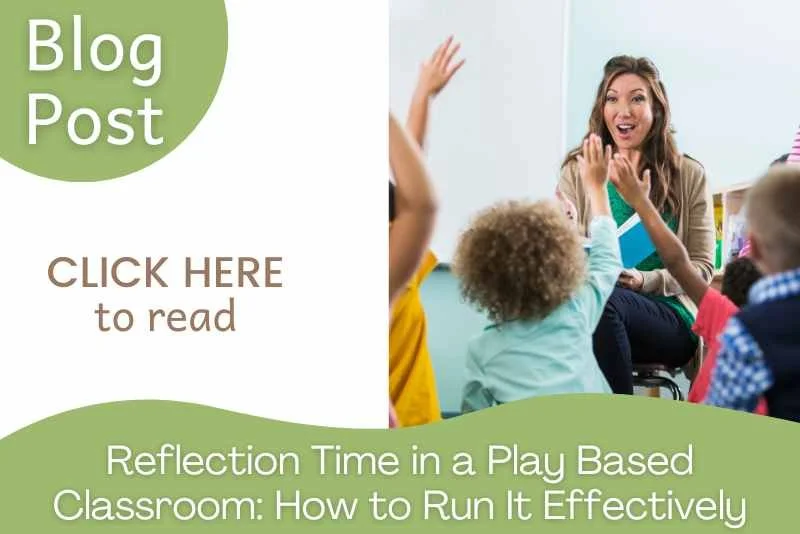
Reflection time is where so much of the real learning happens. It’s the perfect opportunity to build communication skills, reinforce positive behaviours, and support emotional development in a calm and structured way.
5. Teach Play Skills Like You Teach Literacy
If students don’t know how to share, take turns, use materials safely or communicate effectively - then this is your sign that these really need to be taught explicitly.
This was a big shift for me. I used to think, “They should know how to do this by now.” But when I really stopped and observed, I realised many of them genuinely didn’t.
I would see:
children grabbing resources instead of asking
arguments escalating quickly over simple things
materials being tipped out, thrown, or misused
some children hovering on the edge of play, wanting to join but not knowing how
It wasn’t defiance or a lack of wanting to play with purpose; it was really a lack of skills.
And once I saw it that way, everything changed.
I stopped reacting to behaviour and started teaching the skills behind it - just like I would with reading or maths.
Because as teachers, we would never say, “They don’t know how to read, so let’s just give them a book and hope for the best.”
But that’s often what we do with play.
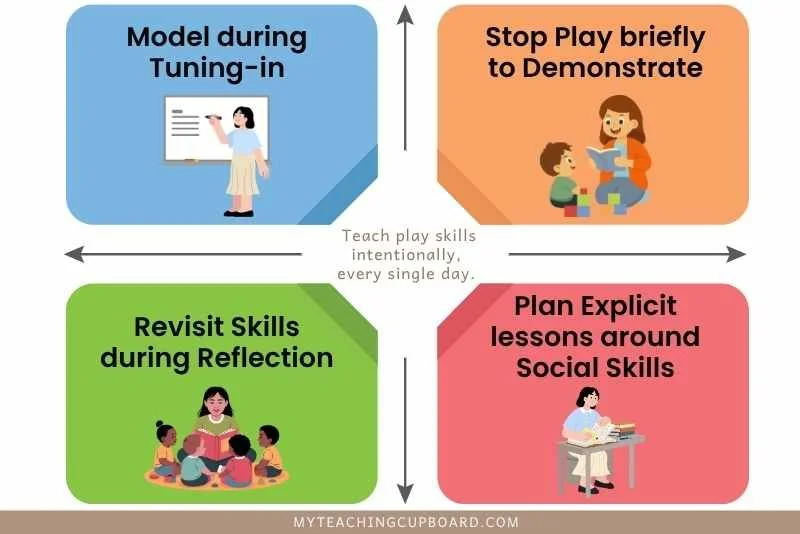
So I began to teach play skills intentionally, every single day.
This looked like:
Modelling during tuning-in - Showing exactly what sharing looks like, how to ask to join in, and how to use materials respectfully.
Stopping play briefly to demonstrate - Not as a punishment, but as a quick reset and teaching moment. “Let me show you another way we can do this…”
Revisiting skills during reflection - Talking through what worked, what didn’t, and how we can improve next time.
Planning explicit lessons around social skills - Just like I would plan a literacy or maths lesson.
And yes… it felt repetitive.
Some days I felt like I was saying the same things over and over again. But then I started to notice small shifts:
a child asking for a turn instead of grabbing it for themselves.
two children working side by side without conflict.
a group staying engaged in play for longer than a few minutes.
Those small moments? They’re huge because they showed me that the skills are starting to stick. And once those foundations are in place, everything else becomes easier. The play becomes calmer, the learning becomes deeper, and your role shifts from constantly managing behaviour to actually observing and extending learning.
It’s repetitive but it works!
6. Use Sensory Play to Support Regulation
For students with high behavioural or sensory needs, sensory play is essential - not optional.
This was one of the biggest shifts in my classroom.
I had students who were constantly dysregulated, struggling to engage, or finding transitions so overwhelming, I realised they didn’t need any more structure and instead they needed a way to regulate their bodies first.
For us, sensory play became that entry point.
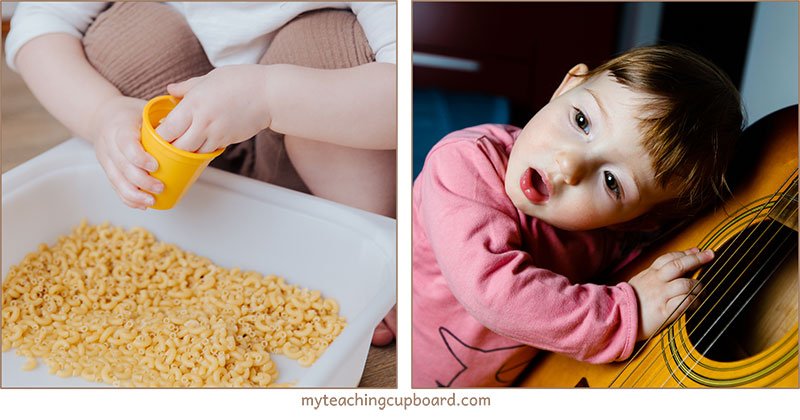
Sensory play works in a very different way to other learning areas.
It:
Calms the nervous system
Provides a safe, predictable entry into play
Supports emotional regulation
Encourages social interaction in a low-pressure way
But what makes it so powerful is this 👉 There is no right or wrong way to do it.
For children who are just learning how to play, this is everything! They don’t have to:
“get it right”, follow complex rules, worry about making mistakes or compare themselves to others.
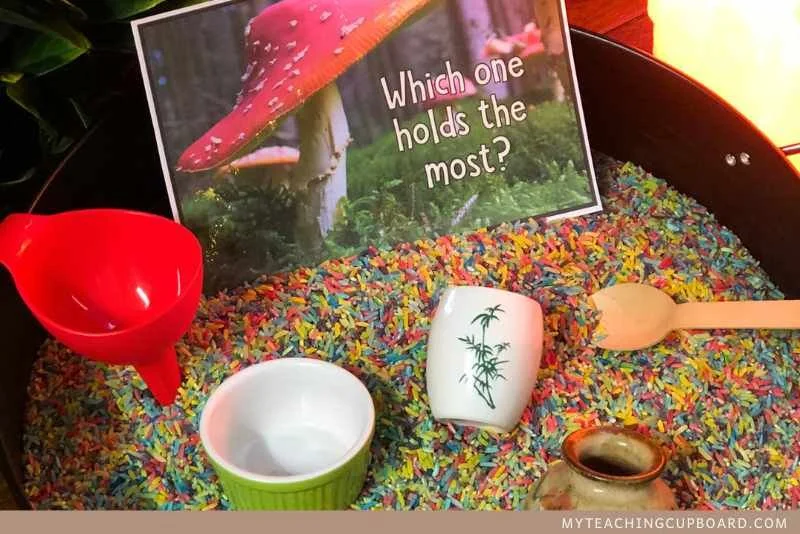
They can simply explore, touch, pour, scoop, build and repeat. i believe it’s that repetition that is the key - it’s incredibly soothing.
I often found that my most unsettled students would naturally gravitate towards these areas first. It was like a magnet. Even children who struggled to engage anywhere else would:
sit longer
focus more deeply
begin interacting alongside others
slowly build confidence
Over time, these spaces became the calmest areas in the room. They were the most engaged areas and often the starting point for children who found everything else overwhelming.

When setting up a sensory play space, use simple, accessible materials like:
Playdough
Sand
Water
Loose parts
Tactile, hands-on materials
These are regulation tools, engagement tools, and confidence-building tools all in one. And once children feel calm, safe, and successful in these spaces… That’s when they’re ready to move into more complex, social, and curriculum-focused play.
These areas are often your most successful and calmest spaces.
Why Transitions Feel So Hard (And How to Fix Them)
In a play-based classroom or not, transitions are often one of the hardest parts of the day. I remember those moments clearly.
You call the class to pack up… and some children ignore you. Some become upset because they’re not finished. Others start running, arguing, or completely disengaging.
And you’re left thinking, “Why is something this simple so hard?”
The reality is, transitions aren’t just about moving from one activity to another.
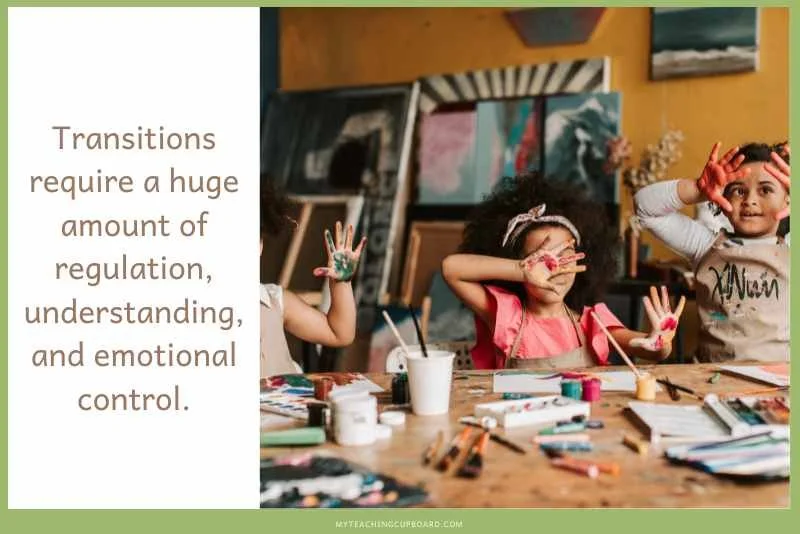
👉 They require a huge amount of regulation, understanding, and emotional control.
For many of our students (especially those with additional needs), that’s a lot to manage.
Transitions are often difficult because:
Students don’t know what to expect - If the day feels unpredictable, transitions can feel sudden and unsafe.
They’re already dysregulated - Asking a child to stop, shift, and start something new when they’re overwhelmed is incredibly difficult.
They’re deeply engaged and not ready to stop - Play is meaningful and walking away from it can feel frustrating or even distressing.
There’s no clear structure or routine to rely on - Without any consistency, every transition feels different.
What Helped in My Classroom
I didn’t fix transitions overnight. But I did start to see a shift when I changed how I approached them.
1. Prepare Before the Transition Happens
This was a big one. Instead of expecting students to switch instantly, I started giving them time to prepare.
This looked like:
“In 5 minutes, we will be packing up.”
“Start finishing what you’re doing.”
“Think about where your work will go.”
It sounds simple but it really made a huge difference. It gave students time to mentally and emotionally shift.
2. Use Tuning-In to Set the Tone
Tuning-in doesn’t just prepare students for play. It also helps with transitions throughout the day.
When students:
know the routine
understand expectations
feel grounded at the start
They are much more likely to transition successfully later on.

3. Make the Routine Predictable (Even When the Day Isn’t)
In my classroom, the order of the day didn’t always stay the same but the structure did.
For example:
tuning-in → play → reflection
clear start and finish points
consistent expectations around packing up
Even my most unsettled students began to rely on this. Predictability builds safety and safety reduces resistance.
4. Teach What “Packing Up” Actually Looks Like
This was something I hadn’t thought about early on. I assumed students knew how to:
pack away materials
return items correctly
tidy shared spaces
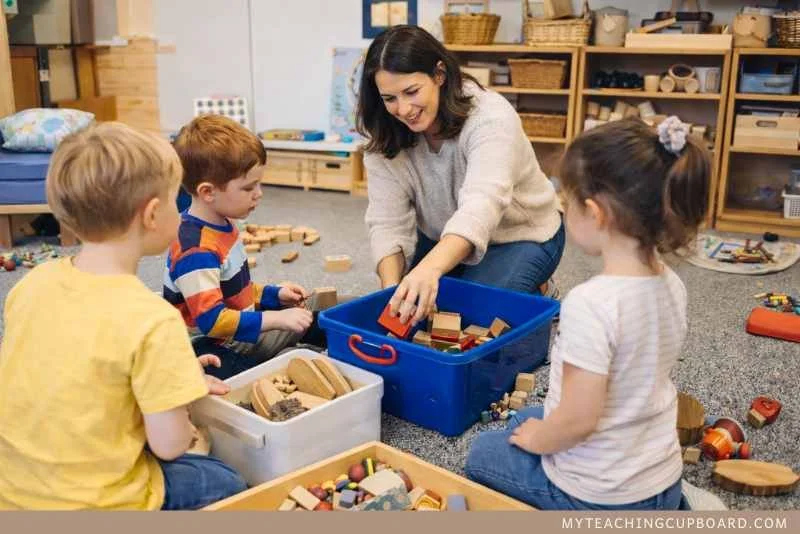
But they didn’t. So we taught it. We modelled:
how to put materials back
how to work together to clean up
what “finished” looks like
And yes… we practised it again and again!
5. Keep Play Sessions Manageable
I noticed very quickly that when our play sessions were too long (especially early on), transitions became harder. Students became overtired, overstimulated and less able to regulate.
And that’s when behaviours started to escalate.
What I’ve learned (and what many teachers experience) is that there’s a balance here. You’ll often hear that around 45 minutes is an ideal length for play, because children need time to:
choose where they want to go
settle into the space
begin exploring
and then deepen their play
There is some support for this idea in practice and research around uninterrupted play. Educators often observe that it takes children time to “get into” play before meaningful engagement happens, and that longer, uninterrupted periods allow for deeper learning and sustained attention.
In some school systems, this rhythm is reflected in how the day is structured. For example, alternating focused learning with breaks or play periods to support attention and regulation.
But Here’s the Reality in the Classroom - When you’re first introducing play-based learning—especially with students who struggle with regulation, don’t yet have play skills or find transitions difficult, 45 minutes can actually feel too long.
I remember trying longer sessions and thinking “Why is everything falling apart by the end?” The first 20–30 minutes might go beautifully… and then suddenly:
children started wandering
conflicts increased
engagement dropped
transitions became much harder
It wasn’t because play wasn’t working. It was because they didn’t yet have the stamina or skills to sustain it.
What Worked Better for Me - I started with shorter, structured play sessions and this made a huge difference. Because I noticed my students stayed more regulated, engagement stayed higher, transitions seemed smoother and I could end on a positive note.

Over time, as students developed their play skills, social skills and emotional regulation, I gradually extended the length of play.
The Key Takeaway - Yes, longer play sessions (around 45 minutes) can support deeper learning but only when your students are ready for it. In the beginning, shorter sessions are not a step backwards and are a strategy.
It’s much better to have 25–30 minutes of calm, purposeful play than 45 minutes that ends in dysregulation and difficult transitions.
6. Use Visual and Verbal Cues
Some students need more than just a verbal instruction.
In my classroom, I used:
consistent phrases (“It’s time to re-set the learning spaces”)
visual cues or signals
countdowns or timers
Over time, students began to recognise these cues and respond more calmly.
7. Expect Big Feelings (and Plan for Them)
Even with all of this in place, transitions can still be hard. Some children will still feel frustrated, become upset and need extra support. And that’s okay.
Instead of seeing this as a behaviour problem, I started to see it as part of the learning process. These young learners were learning how to cope with change.
And just like any other skill, it took time.
What I Noticed Over Time
At first, transitions felt messy and exhausting. But slowly, I started to see:
fewer arguments
quicker pack-up times
children beginning to manage themselves
a calmer shift between parts of the day
And most importantly… I wasn’t constantly managing behaviour anymore!
The Key Takeaway
When students feel safe, prepared, and know what’s coming, transitions become much smoother. Not perfect - but certainly manageable. And that makes a huge difference to the flow of your entire day.
A Gentle Truth Most Teachers Need to Hear
This takes time.
In my own classroom, it took about six months to see real, consistent results.
Before that, it felt messy, repetitive and totally exhausting.
But over time, I saw:
Better behaviour
Stronger social skills
More purposeful play
Deeper engagement
Students who could actually sustain learning
If You’re Not Sure Where to Start
You don’t need to figure this out on your own. If you’re feeling overwhelmed, I’ve broken this down step-by-step so you can build confidence and put simple systems in place that actually work, start here with these blog posts:
👉 How to Start with Play Based Learning - Build your understanding and confidence
👉 My Play Based Kindergarten Daily Schedule - See how to structure your day
👉 3 Steps to Setting Up a Learning Provocation - Learn how to set up purposeful play
Final Thoughts: You’re Not Doing It Wrong! If play-based learning feels hard right now, it doesn’t mean you’re doing it wrong and instead it is a sign that you’re in the teaching phase.
And that phase is where the real work (and the real impact) happens.
With structure, consistency, and time, you will start to see the shift. And when you do, it changes everything.
If you’re wanting more support and ready-to-use ideas to make your play-based learning easier to implement, you can explore my resources here.

Or start with my free guide to help you feel confident setting up your play based learning classroom for success.👇
