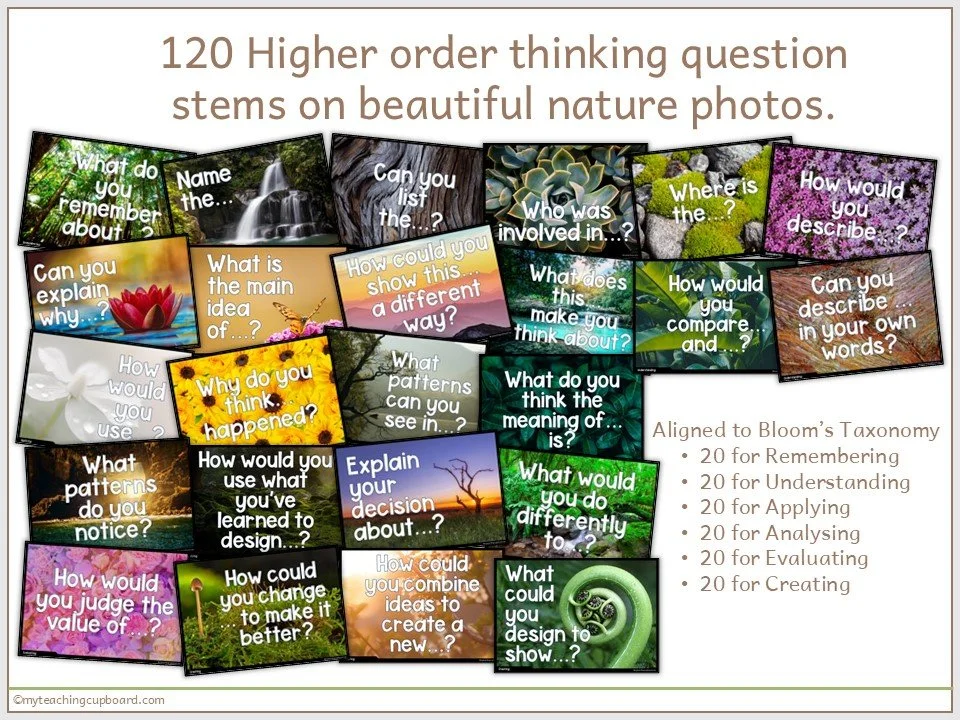
The Teacher’s Role in Play-Based Learning: How to Observe and Scaffold Play
Discover the teacher’s role in play-based learning. Learn how to observe, scaffold, co-play and use open-ended questions to deepen play and learning in the early years.
If you’ve ever sat in the middle of a play-based learning session and thought:
I’m not sure when to step in or when to step back.
How do I scaffold this play without taking over?
I’m observing… but I don’t know what to do with what I see.
…you are not alone.
Most early childhood educators know the importance of play for young children. It supports child development, executive function, social skills, motor skills, language development, cognitive development, and emotional intelligence. Yet we also face tremendous pressure to meet so many mandated academic standards, maintain calm daily routines, and show clear links to the curriculum.
And somewhere in the middle of it all sits our role - the teacher’s role - shifting constantly between observer, facilitator, and co-player.
A Personal Example — When I Stepped In Too Quickly
Years ago, I watched a small group of children at the art easels arguing over one special paintbrush. In my rush to smooth things over, I ran to the storeroom and grabbed three more identical brushes. At the time, it felt like the right thing to do.
But the moment I handed them over, I realised I had completely removed the chance for problem solving, social interaction, and negotiation — the very skills children learn naturally during children’s play. They didn’t need more art supplies. They needed time to work it out.
That moment changed the way I saw my active role in the learning process.
And Then There’s the Tower Story
One morning, during our playful learning time, a small group built a pretty wobbly block tower in the wooden block area. There was dramatic play, role play, and endless testing of ideas happening as they experimented with balance. I sat nearby, simply observing their play experience, resisting the urge to jump in with direct instruction.
Only when the tower leaned for the sixth time did I offer one, well-timed question: “What do you think you need to do to help it stay steady?”
That tiny prompt unlocked collaboration, critical thinking, and a new skill. They stabilised it together, proudly comparing versions like a little engineering team.
That is the pivotal role we play in the early years. We don’t need to direct every moment. For optimal learning, it’s important we know how and when to respond.
The Research Is Clear: Teachers Matter
According to Learner-Focused in Action, teachers in high-quality early education settings don’t just “watch play.” They listen, notice, interpret, and respond. These are all play-based methods and intentional teaching strategies that skilled teachers use together to deepen learning.
Similarly, The Importance of Play-Based Learning reminds us that play is active, agentic, collaborative, and full of meaningful learning experiences. Teachers can help sustain and extend it through language, questioning, and thoughtful scaffolds.
In other words, the teacher’s role isn’t passive.
It should be an effective method for guiding academic learning, supporting cognitive growth, and helping children develop academic skills, emotional development, communication skills, and the confidence to become lifelong learners.
In this blog post, we’ll break down the three core roles effective teachers take in any quality play-based learning:
Teacher as Observer
Teacher as Facilitator
Teacher as Co-Player
…plus I’ll give you simple open-ended questions, scaffolding strategies, and reflection routines you can use immediately in your play-based learning environment. All with no overwhelm, no overstepping, and no losing the joy of imaginative play, unstructured play, or child-directed play.
The Teacher as Observer — Notice, Document, Understand
Observation is the foundation of the teacher’s role in play-based learning. Before we scaffold, extend, or co-play, we must first understand what is really happening in the children’s play experience.
In the early years, observing young children should be an active role that reveals the student’s developmental skills, interests, social interactions, and the deeper layers of child development unfolding moment by moment.
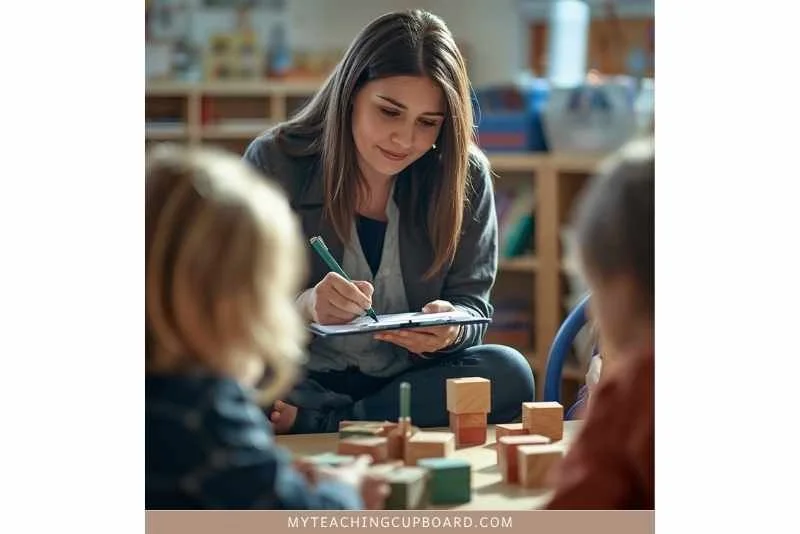
When I sit beside children during investigations, I always have my clipboard nearby.
I’m not “just watching.” I’m tuning into the language skills the kids are using, the problem-solving skills emerging as they collaborate, the emotional development behind their choices, and the cognitive growth happening as they experiment, construct, and hypothesise. My observations shape the intentional decisions I make next - what to introduce, which questions to ask, and when to step back.
What to Observe in Play
Use your professional lens to notice:
Developmental skills — fine motor control, physical development, imaginative play, language development, and social skills.
ACARA-aligned behaviours — counting collections, measuring towers, using mathematical language, and representing ideas symbolically.
Interests, play themes, and strengths — construction, role play, sensory exploration, dramatic play, board game creation.
Misconceptions — uneven counting, unclear explanations, limited vocabulary, and difficulties in cooperation.
Social groupings and engagement patterns — who leads, who follows, who plays alone, who needs emotional support.
Each of these tells you what learning is already happening and where gentle scaffolding might open new ways for children’s learning to grow.
Observation Tools That Make This Important Role Easy
You don’t need complicated systems to observe and keep track of everything. A few simple tools used consistently can capture rich evidence of learning:
Anecdotal notes – quick jottings about what children say, do, and notice.
Photo documentation – images paired with child quotes give you powerful assessment data without interrupting play.
Work samples – drawings, labels, maps, construction plans, STEM recordings.
Play-based observation checklist – a quick-glance tool for spotting emerging, developing, and secure skills (and a perfect companion for play-based assessment in the early years).
👉 Download your free Play-Based Observation Checklist HERE to make your observations faster and more intentional.

As you document children’s play, you’ll start to see patterns. You’ll see who gravitates to natural materials, who thrives in small group play, who needs support with communication skills, who shows early academic skills through unstructured play.
These insights should be used to guide your next steps.
If you want to strengthen your reflective practice once your observations are collected, I have a great blog post explaining how I use my observations to inform my teaching. In this loose parts blog post: The Teacher’s Role in Loose Parts Play you’ll discover how to balance teacher-directed play and child-directed experiences during loose parts investigations. There are heaps of examples of effective questioning and scaffolding in this blog post too.

The Teacher as Facilitator — Scaffolding for Deeper Learning
Observation tells you what children are doing, facilitation helps you decide how to gently extend their learning.
This is where the teacher’s role in play-based learning becomes visible. You don’t want to be taking over, but instead using small, intentional strategies to enrich children’s play experience, deepen their cognitive development, and strengthen their problem-solving skills.
In the Age-Appropriate Pedagogies – Explicit Instruction paper, explicit teaching is described as just one of the pedagogical approaches early childhood educators draw on. In a play-based learning environment, it is woven in flexibly and thoughtfully. You might use explicit instruction to model a skill, introduce a new tool, or pose a question just at the right moment to spark fresh thinking.
There’s a misconception that scaffolding in the early years is about directing children’s play.
Scaffolding is more about offering new ways, new language, or new perspectives that help young children stretch their thinking while still maintaining ownership of their play.
High-Impact Play Strategies
These strategies can help you extend your children’s learning while still keeping the play child-directed:
Introduce new vocabulary naturally - Use rich language during children’s play. “You balanced the ramp horizontally,” or “You used a prediction to guess what might happen next.” This supports language development, communication skills, and early academic learning.
Add a tool to deepen investigation - Place rulers, measuring cups, clipboards, timers, magnifiers, or loose parts nearby. A single tool often unlocks executive function, critical thinking, and new forms of symbolic representation.
Offer a challenge through playful prompts - These can be verbal or printable cards:
“Can you make it taller?”
“How could you make it stronger?”
“What would happen if you changed one material?”
These challenges strengthen cognitive growth, motor skills, and persistence.Ask questions that provoke higher-order thinking - Open-ended questions are a powerful and effective method for supporting children’s learning:
“What would happen if…?”
“Why do you think that happened?”
“Can you show me a different way to…?”
I absolutely love open-ended questions and rely on them heavily. They prompt reflection, creativity, and flexible thinking across so many different types of play.
These high-impact strategies respect the rights of the child, encourage active engagement, and support children to become active participants in the learning process. These are all essential characteristics of high-quality early childhood education.
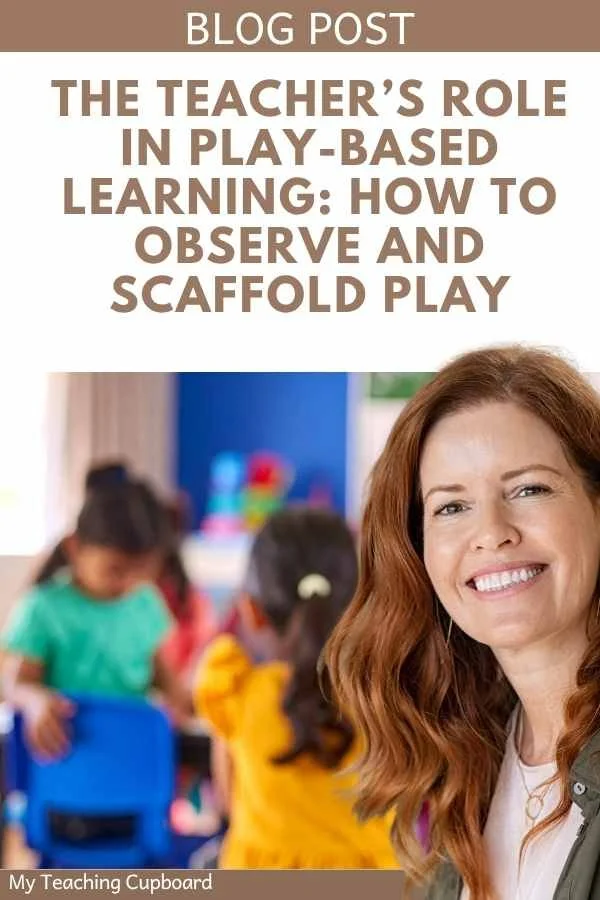
If you would like to get a printable copy of the open ended question stems I use, you can download them here: 120 Higher Order Thinking Prompts
The “I Do, We Do, You Do → Play” Framework
This simple, balanced approach blends explicit and exploratory teaching in a developmentally appropriate way:
I Do — Model Briefly - Demonstrate one small skill connected to children's play (e.g., how to measure length, how to record a tally, how to label a design).
We Do — Guided Practice - Practise the skill together later in small group rotations or as a shared experience right there during investigations. Keep it short, warm, and supportive.
You Do — Independent Try - Children try the skill independently in a way that feels meaningful and connected to their interests.
Play — Apply in Context - Children use the new skill during future, specifically designed play-based activities.
Here are just a few examples of activities that work well with this framework: measuring blocks, recording shop prices, comparing weights, drawing a simple plan or testing predictions.
The main takeaway is that the teacher moves smoothly between active support and stepping back, depending on what the developing child needs.
This is a balanced approach and gives children the strong foundation they need for academic skills but still keeps play agentic and purposeful.
The Teacher as Co-Player - Joining Without Dominating Play
Co-playing is one of the most misunderstood parts of the teacher’s role in play-based learning. Many early childhood educators worry they’ll either take over the children’s play or disrupt the imaginative play flow entirely. But when done well, co-play can shine a light on children’s ideas, strengthen their social interaction and communication skills, and deepen the play experience without diminishing agency at all.
According to The Importance of Play-Based Learning, cooperative play gives young children opportunities to practise persuasion, negotiation, reasoning, emotional intelligence, and more complex problem-solving skills. When teachers participate sensitively (as invited partners rather than leaders) we can enrich children’s play in ways that truly honours the natural way children learn.
How to Co-Play Authentically
Co-playing well requires you to be deliberate, humble, and responsive.
Here’s what that looks like in practice:
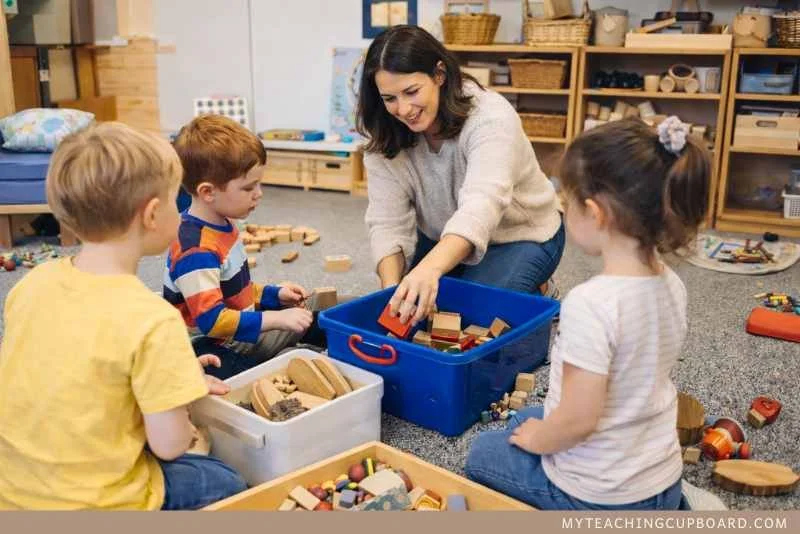
Wait for an invitation — verbal or non-verbal - This might be a child handing you a loose part, sliding over to make room, or looking up with a hopeful smile. Let the child set the direction.
Join as a learner — not the boss - Sit at their level. Follow their storyline. Enter the play world with curiosity, not control. You’re modelling what it means to be an active participant, not someone who takes over.
Narrate thinking instead of directing - Gentle language like, “I’m wondering why this tower keeps wobbling…” or “I might try adding this piece… what do you think?”
supports language development, cognitive growth, and problem-solving without slipping into direct instruction.Model persistence, creativity, and emotional regulation - Co-play is a powerful place to show children how adults handle setbacks: “Hmm… that didn’t work. I’ll try another way.” This builds emotional development and gives children a strong foundation for lifelong learning.
When NOT to Join the Play
Sometimes the most supportive thing you can do as an early childhood educator is simply to observe and let the play unfold. I try to avoid joining in when:
Children are in deep flow - If they are focused, collaborating, or fully immersed, my presence may interrupt the magic.
My involvement shifts them into “teacher pleasing” mode -I notice this when children suddenly start performing, looking for approval, or abandoning their child-directed play ideas.
My participation derails their planning or agency - If my entry changes the type of play, redirects the storyline, or makes the children dependent on mine or other adult ideas, it’s time to step back.
Co-playing in early childhood education is about respecting children’s voices, identities, and developmental needs. When you join play as a responsive guide (rather than the director), you strengthen social skills, language skills, motor skills, and the overall importance of play as a vehicle for academic learning and wellbeing.
Ask Better Questions… Why Co-Playing Isn’t Enough
Even when we co-play beautifully, there often comes a time when children need something more.
Not answers.
Not directions.
But thinking prompts.
In my play-based learning environment, open-ended questions act like gentle spotlights. They illuminate children’s thinking without taking over their play. They help young children explain ideas, strengthen language development, build critical thinking, and connect their play experience to the broader learning process.

When we ask the right questions at the right moment, we support social interaction, emotional development, and cognitive growth. It’s all about keeping play based learning balanced and respectful of child-directed play.
You might:
give children new ways to express their ideas,
help them notice patterns or problem-solving skills emerging in their play,
invite them to reflect on their decisions,
support shy children or diverse learners to participate in small group dialogue, or
deepen the academic skills already bubbling up in their imaginative play.
This is where open-ended questioning becomes one of the most powerful play-based methods an early childhood educator can use. It helps children become active participants in their own learning, strengthens communication skills, and aligns beautifully with ACARA’s commitment to purposeful play.
Use Open-Ended Questions to Deepen Learning
Open-ended questions are one of the most powerful tools we have as early childhood teachers. They turn everyday play into rich opportunities for language development, critical thinking, and social interaction.
When you use open-ended questions well, you’ll be sparking new ideas, widening perspectives, and helping your young children reflect on their own learning process. This is the essence of sustained shared thinking - a research-backed practice that strengthens cognitive development, emotional development, and communication skills.
Open-ended questions work across every type of play: dramatic play, construction, loose parts, sensory play, small group problem-solving, and even unstructured play. They’re the bridge between what children already know and the new skill, idea, or concept they’re ready to take on next.
Why The Right Questions Matter
Thoughtful questioning prompts children to:
Explain their thinking
Justify their choices or problem-solving approach
Predict outcomes and test hypotheses
Reflect on their process - “What did you do first?”
Collaborate and co-construct ideas with peers
These prompts help children stretch their cognitive abilities, show their academic learning authentically, and build lifelong learning dispositions.
Your Go-To Question Stems
Thinking & Reasoning
“What could you try next?”
“What made you choose that?”
“How else could you solve this?”
Maths & Science
“How could we measure this?”
“Why do you think it happened like that?”
“What might change if we used a different material?”
Storytelling & Literacy
“Who is involved in your story?”
“What might happen next?”
“How could you show your idea with a drawing or sign?”
SEL & Collaboration
“How did you solve that together?”
“What helped you keep trying?”
“How could we make this fair for everyone?”
These types of questions support cognitive growth, problem-solving skills, social skills, and emotional intelligence. These are all the essential elements of a strong foundation in early education. And they work beautifully during play sessions, transitions, small group work, and even outdoor play.
Get These Prompts on Hand During Your Play Sessions
You don’t have to memorise them. I’ve already done the hard work for you.
👉 Grab my 120 Higher Order Thinking Prompts HERE
These nature-themed question cards are perfect for displaying at your provocations, learning invitations, or in your play-based learning environment. They give you research-backed question stems you can use instantly to deepen your children’s learning and support purposeful play.
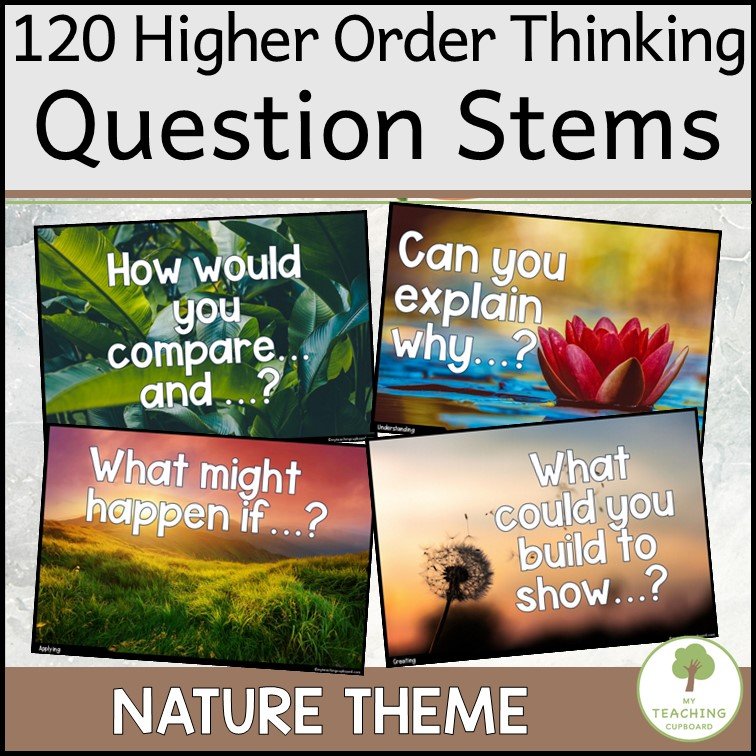
Build deeper thinking across your day with these printable higher order thinking prompts based on Bloom’s Taxonomy - perfect for Kindergarten, Prep, and Foundation teachers using play and inquiry-based learning.
Do your students give surface-level answers when you know they're capable of more? These Higher Order Thinking Prompts will help you ask the right kinds of questions – the ones that get them thinking, talking, and truly understanding.
Spark Deeper Thinking With These Higher Order Thinking Prompts
This comprehensive toolkit makes it easy to bring Bloom’s Taxonomy to life in real-world classrooms - without hours of prep or stress for you! Whether you’re guiding a maths investigation, a STEM challenge, or a group reflection session, you’ll have the perfect question ready to go.
A Time-Saving Way to Add Depth to Learning
This resource helps you move beyond “what happened?” to “why do you think that happened?” and “how could we improve it next time?”
It saves you precious planning time while also helping your students develop:
Deeper understanding across literacy, maths, and science
Richer language for sharing and justifying their ideas
Confidence to think creatively and reflect independently
Stronger reasoning and problem-solving skills
Designed for Real Classrooms and Real Conversations
You won’t find generic question posters here. These beautiful nature-themed prompts were thoughtfully written and classroom-tested during real play-based lessons, reflection times, and provocations.
Each level of Bloom’s Taxonomy is represented, from remembering and understanding to creating and evaluating. Use them flexibly - on display, in planning, or as part of inquiry-based learning.
This Higher Order Thinking Prompts Pack Includes:
120 Higher Order Thinking Posters (nature-themed, A4 size)
120 Printable Prompt Cards (four to a page)
Planning Template for intentional questioning
Teaching Notes with examples for Literacy, Maths & Science
Bloom’s Taxonomy At-a-Glance Poster
Suggested Prompts for Reflection Time
Observation Checklists for documenting student thinking
Document Wallet Label for organisation
A printable Master List of All the Question Stems
Use These Prompts to Support Deeper Conversations and Curriculum Goals
Perfect for:
Literacy, maths, and science blocks
Investigation areas and provocations
Group reflections and partner tasks
Inquiry learning, STEM, and makerspace challenges
Assessment and documentation during play
These prompts align with both the Australian Curriculum v9 and the Common Core, helping you confidently plan and assess higher order thinking skills.
Make Higher Order Thinking Part of Everyday Learning
Imagine being in the middle of a science provocation and hearing your students ask: “What would happen if we changed just one material?” That’s the power of intentional questioning - and it all starts with you.
With this set of higher order thinking prompts, you'll feel ready to guide meaningful learning through every subject, lesson, and play invitation.
Reflection and Feedback — Helping Children Make Learning Visible
Reflection is one of the most powerful (and most overlooked) parts of the teacher’s role in play-based learning. It’s where young children slow down, revisit their thinking, and put words to the discoveries they made during play.
For teachers, reflection is a goldmine!
It reveals thinking processes, problem-solving strategies, social interaction patterns, and early academic skills you can link directly to curriculum expectations.
Why Reflection Matters
Reflection strengthens so many important capabilities:
It builds metacognition — children start understanding how they learn.
It deepens language development as they describe ideas, actions, and emotions.
It consolidates emerging concepts in literacy, numeracy, science, and the arts.
It supports the ACARA General Capabilities, especially Critical and Creative Thinking, Personal and Social Capability, and Ethical Understanding.
It gives teachers clear, authentic assessment evidence without interrupting the play experience.
Reflection helps children turn their play into learning they can name, notice, and celebrate. It helps you make their learning visible.
My Simple Reflection Routines
Here are some quick and easy routines that work beautifully in small groups or whole-class reflection time:
Photo + Quote Wall - Snap a moment during play and add the child’s words. This provides evidence of cognitive development, executive function, and communication skills.
Two Stars and a Wish - Children share two things they felt proud of and one thing they’d like to try next time. A gentle way to strengthen emotional development and resilience.
Quick Sharing Circle - A 1–2 minute “What did you discover today?” is a great way to boost oral language and confidence.
Peer Noticing - Invite children to recognise each other's effort: “I saw Noah keep trying when the ramp fell over,” or “Mia shared the magnifier so we could all look closely.” This builds community, social skills, and a strong foundation for positive interactions.
If you’re ready to build a powerful reflection routine and get the most from your play based learning investigation sessions, you’ll love this blog post: Reflection Time in a Play Based Classroom: How to Run It Effectively.
It explains why reflection time is essential in any quality play-based environment and shows you how to implement Walker Learning reflection strategies that will help your children connect their play with the curriculum.
Teachers Make Play Powerful
When you observe with purpose, scaffold with intention, and co-play with warmth and purpose, play becomes one of your most powerful learning tools.
You are already doing so much of this instinctively but when you understand what you’re seeing in children’s play, and you know how to respond - everything changes!!
This blog post simply helps you name the practice, refine the moves, and use them with even greater clarity and confidence.
By tuning into your children’s ideas, asking thoughtful open-ended questions, and giving your students time and space to explore, you help build:
stronger language and communication skills
deeper critical and creative thinking
richer social interaction
confidence, independence, and emotional intelligence
the strong foundation young children need for lifelong learning
These small, intentional choices are what transform everyday play experiences into purposeful, curriculum-aligned learning.
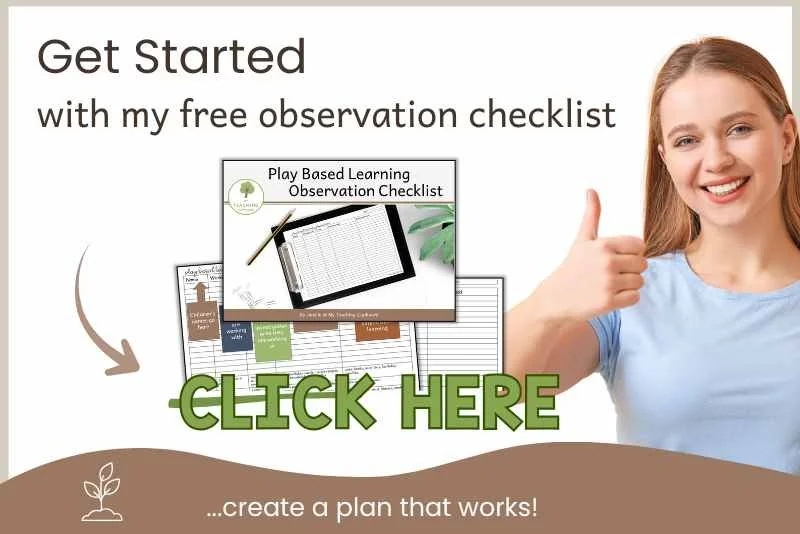
✅ FREE DOWNLOAD: Observation Checklist
Make your teacher role during play crystal clear with my printable Observation Checklist — designed specifically for early childhood educators who want to document learning as it happens.
This simple, powerful tool includes:
✔️ A place to note children’s interests
✔️ Space to record who they collaborate with
✔️ Room for anecdotal notes that link directly to ACARA outcomes
✔️ Prompts to identify next steps and possibilities for extending play
✔️ A section for noting materials or resources you may add next session
It’s everything you need to observe, interpret, and extend play with confidence.
✅ PAIR WITH THIS CLASSROOM FAVOURITE: Open-Ended Question Prompts
If you want to really elevate your scaffolding, pair your checklist with my 120 Higher-Order Thinking Prompts.
These nature-themed question stems help you ask the right questions at the right time, supporting:
deeper critical thinking
stronger language skills
richer problem-solving
greater cognitive flexibility
Perfect for:
literacy and storytelling
STEM and inquiry learning
dramatic play
loose parts provocations
small-group investigations
A must-have resource to strengthen children’s thinking across your entire day.