
What is Play-Based Learning? A Guide for Early Years Teachers
Discover what play-based learning is, why it works, and how to use it in early years classrooms. Benefits, examples, and a free teacher guide included.
Early childhood teachers instinctively know the importance of play. We see the joy, the curiosity, the way children’s eyes light up when they’re given time and space to explore their own interests.
But there’s a real challenge:
How do you channel this into a purposeful and robust play-based learning curriculum?
How do you make sure the learning experiences you offer are age-appropriate and still meet all the curriculum benchmarks?
Let’s face it - teachers today are under constant pressure to deliver mandated curriculums that show progress in literacy and numeracy. It can feel like there’s no room left for the playful learning that we know is best for young children.
The problem is that play-based learning often gets misunderstood.
Too often, people dismiss it as “just play.” In reality, a high-quality play-based approach is one of the most effective ways to support early childhood education.
It fosters social skills, emotional development, problem-solving skills, and yes - solid academic learning too!
The early years should not be about choosing between fun and rigour. It should be about combining both so that children develop the essential skills they need for school and for life.
In this blog post, I’m going to unpack what play-based learning really means. I’ll share the research, the theory, and practical strategies from my own classroom experience. By the end, you’ll feel confident in understanding why play isn’t the opposite of learning and how it’s actually the very foundation of it.
This is your starting point for diving deeper into play-based education.
From here, you’ll be guided through four core principles:
Explicit teaching and the curriculum – how to balance direct instruction with play
The play-based learning environment – how to set up spaces that encourage independence and creativity
Behaviour and social skills – how play helps children learn to regulate emotions, cooperate, and build positive relationships
Investigations and play-based learning centres – how to use centres and provocations to meet learning goals in meaningful ways
👉 Before we go any further, grab your Free Play-Based Learning Guide.
It’s the perfect companion to this blog post and will give you a simple, practical framework to start with confidence.

What is Play-Based Learning?
At its heart, play-based learning is a teaching approach that uses play as the vehicle for deep and meaningful learning.
It’s not about filling the day with random games or activities though. It’s about creating purposeful learning experiences where young children explore, investigate, and discover - while teachers guide, scaffold and extend their thinking.
Play-Based Learning vs Free Play
It’s important to note that play-based learning is NOT the same as free play or unstructured play. Free play has its place. Children certainly benefit from time to choose activities, invent their own games, and follow their imagination.
But a play-based approach in today’s classroom goes further.
It blends the joy of child-led exploration with intentional teaching moments that connect back to curriculum outcomes.
Balancing Child Agency and Teacher Intentionality
The beauty of play-based learning is in the balance.
Children take an active role in their own learning, and also follow their own interests and ideas.
At the same time, the teacher has a crucial role: observing, asking open-ended questions, modelling new skills, and gently nudging play towards rich opportunities for cognitive development, language skills, and social interaction.
This is where skilled educators make the shift into powerful, purposeful learning.

Curriculum Alignment
A high-quality play-based program isn’t a separate curriculum. Play based learning is a strategy you use to meet the curriculum.
In Australia, the ACARA Foundation curriculum specifically acknowledges the role of play in supporting academic benchmarks in literacy, numeracy, science, and the arts.
Internationally, the same approach is recognised in early childhood frameworks across the UK, Canada, New Zealand, and the US. No matter where you are, the message is clear: play is learning.
Busting the Myth: Play ≠ Not Academic
One of the biggest misconceptions I hear from teachers is that play is the opposite of academic learning. I hear this all the time and it really isn’t true!
In reality, playful learning strengthens the very academic skills children need to succeed.
When a child is building with blocks, they’re learning about spatial awareness, measurement, and problem solving. When they’re engaged in dramatic play, they’re practising communication, literacy, and social-emotional skills. Every form of play activity (from sensory play to cooking in pretend kitchens) has strong links to both early childhood development and curriculum outcomes.
👉 Ready to see how this works in practice?
Make sure you bookmark this blog post: How to Start with Play-Based Learning.
It is full of practical steps and strategies to help you begin your journey.

The Key Elements of Effective Play-Based Learning
So what makes play-based learning more than “just play”?
There are a few key ingredients that transform everyday play into purposeful play – you know, the kind that fosters real growth and development.
The 5 Essential Elements of Play-Based Learning
Researchers and educators often agree on five essential elements that define effective play-based learning:
Active Engagement – Where children aren’t passive recipients of information but take an active role in their learning instead. Whether they’re building with blocks, exploring nature, or role-playing, they’re immersed in discovery.
Joy – Play should be enjoyable. Joyful learning creates motivation, sparks curiosity, and helps young learners connect more deeply with what they’re doing.
Meaning-Making – Children bring their own ideas, knowledge, and experiences to play. They use play to make sense of their worlds and connect new learning to what they already know.
Iterative Experimentation – Play isn’t one-and-done. Children experiment, test, revise, and try again. Whether that’s balancing blocks, creating new rules for a board game, or role-playing in the dramatic play corner.
Social Interaction – Through cooperative play, pretend play, or even onlooker play, children learn to negotiate, share, problem solve, and build communication skills.
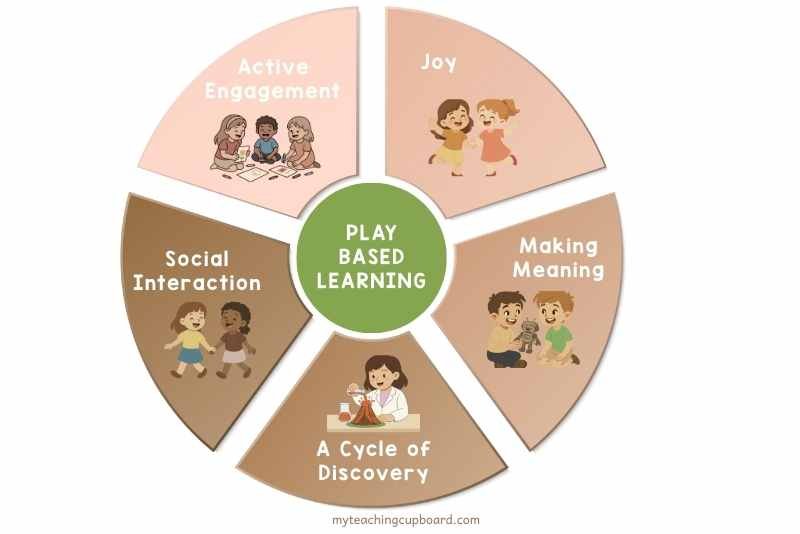
These five elements work together to make play one of the most powerful tools we have in early childhood education.
The Role of Intentionality in Play Based Learning
Effective play-based learning doesn’t just happen by chance. Intentionality is what makes the difference.
This is where we find the balance between a child’s natural curiosity and the teacher’s role in guiding it. Children might explore with open-ended materials like loose parts, sand, or water. Left to themselves, they’ll engage in valuable discovery. But when a teacher notices, listens, and asks the right questions, that discovery deepens into higher-level thinking.
This is the real strength of play-based learning. It allows space for free play while also weaving in moments of teacher-directed play that connect experiences back to curriculum goals.
The Teacher’s Role in a Play Based Classroom
In a play-based classroom, teachers wear many hats:
Facilitator – setting up rich learning environments filled with opportunities for different types of play (dramatic, sensory, physical, pretend, and cooperative).
Observer – watching carefully to see what children already know, where they need support, and what fascinates them.
Guide – gently scaffolding learning by modelling new skills, offering vocabulary, or introducing tools and materials that stretch thinking.
Balancing these roles isn’t always easy. I know the temptation to jump in and direct can be strong. But play-based teachers learn when to step back and when to step forward. It isn’t about taking over a child’s play. It’s about being present, responsive, and intentional. That’s what helps children connect their play to bigger ideas and understandings.
👉 Want to learn more about your role in a play based classroom? Head over to this blog post: How to Be a Successful Play-Based Kindergarten Teacher

The Benefits of Play-Based Learning in Early Education
The benefits of a play-based approach reach far beyond keeping children happy and busy. When done with intentionality, play drives growth across all areas of child development - academic, social, emotional, and physical. It builds the kind of essential skills that set our children up for future success.
Academic Benefits of Play Based Learning
Through play, children build the foundations of academic skills without even realising it. For example:
Literacy skills grow when children engage in imaginative play or pretend play, telling stories, writing signs for their shop, or acting out roles.
Numeracy and problem-solving skills develop through building towers from blocks, sorting loose parts, or inventing rules for board games.
Critical thinking and reasoning sharpen when children make predictions, test ideas, and adjust strategies.
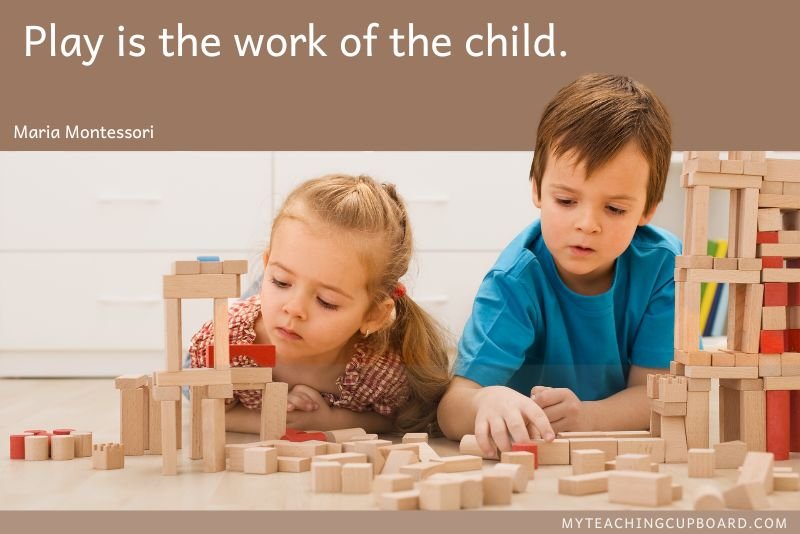
As Maria Montessori said, “Play is the work of the child.” Purposeful play makes academic learning meaningful and memorable.
Social and Emotional Growth Through Play
Play also strengthens social-emotional skills. When children collaborate in cooperative play, negotiate turn-taking in a game, or solve a disagreement, they are practising:
Social skills such as sharing, listening, conflict resolution and teamwork.
Emotional development like learning empathy, self-regulation, and resilience.
Interpersonal skills that will carry into friendships and classroom relationships.
I love the Walker Learning Approach as a play based pedagogy. It highlights that children who engage in rich play demonstrate higher levels of confidence and motivation, because their learning is deeply connected to their own interests.
Don’t Forget the Physical Development
The physical benefits of play are just as important. Every time a child stacks blocks, cuts with scissors, or threads beads, they are strengthening their fine motor skills and hand-eye coordination.
Climbing, running, and balancing during physical play builds gross motor abilities and overall physical development too.
Active play provides the physical activity children need for health and wellbeing, while also preparing them for the practical demands of writing, drawing, and self-care tasks.
Long-Term Outcomes of Play Based Learning
The impact of playful learning doesn’t end in the early years. Research into cognitive development shows that children who have opportunities for open-ended, exploratory play build stronger neural connections that support lifelong learning.
Another pedagogy I support - The Reggio Emilia philosophy reminds us that play helps children view themselves as capable learners who can take an active role in their own learning. These children often demonstrate greater independence, creativity, and persistence - traits linked to long-term academic development and personal success.
Bringing It All Together
When you step back and look at the bigger picture, the benefits of play-based learning are undeniable. It promotes holistic development, weaving together cognitive skills, language development, social interaction, and physical abilities into one powerful, integrated approach.
👉 There are more benefits. Want to see them all and discover the research and evidence? Head over to my blog post: Benefits of Play-Based Learning in Early Education.

Play-Based Learning Theories and Research
If you’ve ever wondered why play has such a powerful impact on child development, the answer lies in the work of educational theorists who shaped the way we understand children’s learning today. Their ideas continue to influence how we design play-based classrooms and how we connect play to curriculum outcomes.
Piaget – Cognitive Development
Jean Piaget showed us that young minds develop in stages and that children actively construct knowledge through hands-on exploration. Play helps children test ideas, solve problems, and make sense of their worlds. When a child sorts blocks by size or experiments with water play, they’re building the cognitive skills Piaget described as essential for moving from one developmental stage to the next.
Vygotsky – Social Constructivism
Lev Vygotsky highlighted the crucial role of social interaction in learning. His concept of the Zone of Proximal Development (ZPD) shows how children can achieve more with the support of a skilled teacher or peer than they can alone. In play, we see this when one child teaches another the rules of a game or when a teacher scaffolds pretend play to introduce new vocabulary. This demonstrates the power of play as a tool for learning and collaboration.

Montessori – The Natural Desire to Learn
Maria Montessori believed that children have an innate drive to learn when placed in the right environment. She described play as children’s “work” and emphasised the importance of play in fostering independence and self-discipline. When we give children time, space, and open-ended materials to follow their own interests, they build not just knowledge, but essential skills for life.
Reggio Emilia – The Hundred Languages of Children
Loris Malaguzzi, founder of the Reggio Emilia approach, spoke of children expressing themselves in “a hundred languages” - through art, movement, talk, building, and more.
This philosophy reminds us that young children don’t just learn through one medium. Play across different content areas like dramatic play, construction or sensory exploration gives them opportunities to explore identity, relationships, and ideas in many different forms. It’s an educational approach that values creativity and child’s development as a holistic process.
Simon Nicholson – The Theory of Loose Parts
Simon Nicholson proposed that creativity flourishes when children have access to a variety of materials - what he called “loose parts.” These are everyday items like boxes, stones, tubes, or fabric that invite experimentation and innovation. Recent research into loose parts play continues to back this up: when children have access to open-ended materials, their problem-solving skills and critical thinking reach higher levels, supporting both learning and wellbeing.

How Theories Connect to Curriculum Outcomes
What’s inspiring is how all these theories align with the demands of today’s curriculum. Each approach reinforces that play is a powerful tool for building essential skills - from literacy and numeracy to creativity, collaboration, and resilience.
By embedding these principles, we can meet all the academic benchmarks while still respecting the important role of play in the child’s development.
👉 Want to explore any of these theories and how they can guide your classroom practice? Check out this blog post: Understanding Play Theories: A Guide for Play-Based Teachers.

Potential Challenges of Play-Based Learning
As much as we know play is important and pretty powerful, implementing it in real classrooms isn’t without its hurdles. Many early childhood teachers tell me they face the same common challenges when trying to run a play-based program.
I have some good news though!! Each of these has practical solutions.
“It’s Not Real Teaching”
One of the biggest misconceptions is that play doesn’t count as “real teaching.” Parents, colleagues, or even administrators may expect to see worksheets or formal lessons to believe learning is happening.
This is where documentation becomes your best friend. Photograph children at work, collect samples of their creations, and add quick notes about the skills they’re showing. When others see the thinking behind the play, the value becomes clear.
Time and Planning Pressures
Another challenge is the feeling that there’s never enough time for play. Between mandated programs and reporting, planning for play can feel pretty overwhelming.
The key is to use intentional provocations - simple, open-ended setups that can be rotated rather than reinvented every day. With a bank of go-to provocations, you’ll save yourself time while still offering meaningful learning opportunities.

Classroom Management Concerns
Play can sometimes look chaotic. For us early childhood educators, managing the noise, movement, and multiple activities all at once can seem tricky.
The solution isn’t to stop play. It’s to establish clear routines and expectations. Visual prompts, clear boundaries for spaces, and consistent transitions all help create a calmer learning environment.
Linking Play to Curriculum Outcomes
Many teachers also worry about meeting academic benchmarks with play-based programs.
This is where balancing direct instruction and play is essential. Play doesn’t replace explicit teaching. It complements it. Whole-class or small-group lessons are still in place to introduce concepts and skills. Play provides the context where children practise, explore, and deepen their skills and understanding.
👉 For practical strategies on weaving the two together, head over to this blog post: Explicit Teaching in a Play-Based Classroom.
Supporting the Youngest Learners
Finally, in some early childhood settings, teachers worry whether their very youngest students will get enough from play. But remember: play is naturally differentiated and meets children right where they are.
With a mix of free exploration and guided experiences, even your youngest learners can thrive. It’s about observing closely and providing just enough support to move them forward in their development.
Do You Have What It Takes to Be a Play-Based Teacher?
Shifting into a play-based approach isn’t just about changing your classroom setup or the structure of your day. It’s also about adopting a mindset that values curiosity, flexibility, and reflection. The importance of the teacher’s role can’t be overstated!
You are the one who creates the conditions for meaningful play.
Traits of Successful Play Based Educators
From my experience, teachers who thrive in play-based classrooms often share these qualities:
Flexibility – letting go of rigid plans when children’s play takes learning in a new direction.
Curiosity – seeing play through children’s eyes and being genuinely interested in their discoveries.
Reflective practice – asking yourself, What worked today? What could I try differently tomorrow?
Willingness to step back – resisting the urge to control every outcome and allowing children to explore.
A Growth Mindset for Teachers
It’s natural to feel unsure at first. Moving from a traditional, teacher-led approach to one where children take more of the lead can feel uncomfortable. That’s why a growth mindset is so important.
Each time you practise guiding play activities in different ways (whether it’s as simple as asking an open-ended question or as complex as offering totally new learning materials) you’re developing alongside your students!
Practical Advice for the Shift
Start small. Choose one area of your classroom where you’ll allow more freedom and exploration. Notice how children engage, what sparks their curiosity, and how you can help them develop new skills through different roles and forms of play. Over time, you’ll build confidence in balancing structure with freedom, and your classroom will feel more alive with learning.
👉 If you’re not sure if play based learning is for you, you can learn more in this popular blog post: How to Be a Successful Play-Based Kindergarten Teacher.
Examples of Play-Based Learning in Action
It helps to see what a play-based program looks like across different year levels. Play evolves as children grow, but the general principles stay the same: purposeful play guided by curiosity, with the teacher supporting and extending learning.
Here are some snapshots of what this might look like in real classrooms.
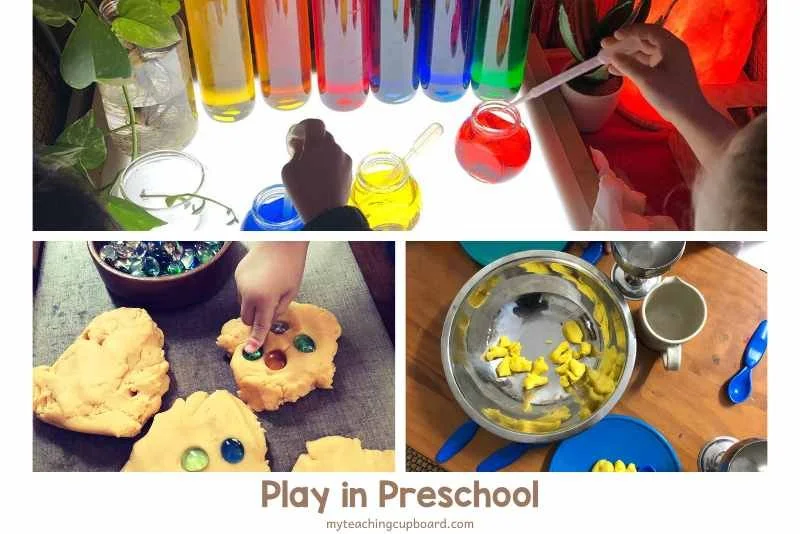
Preschool (3 to 5 year olds)
In a preschool setting, play is often about exploring the world through the senses. You’ll see:
Sensory play tubs filled with water, rice, or sand where children scoop, pour, and experiment with different textures and materials.
Dramatic play in the home corner, with little ones busily cooking in their pretend kitchens, taking on family roles, and building their social skills.
Loose parts play, where collections of shells, pine cones, or buttons become everything from a magic potion to the pieces of a castle.
Each of these example play activities gives young children space to test ideas, practise communication, and explore identity.
Kindergarten (5 to 6 year olds)
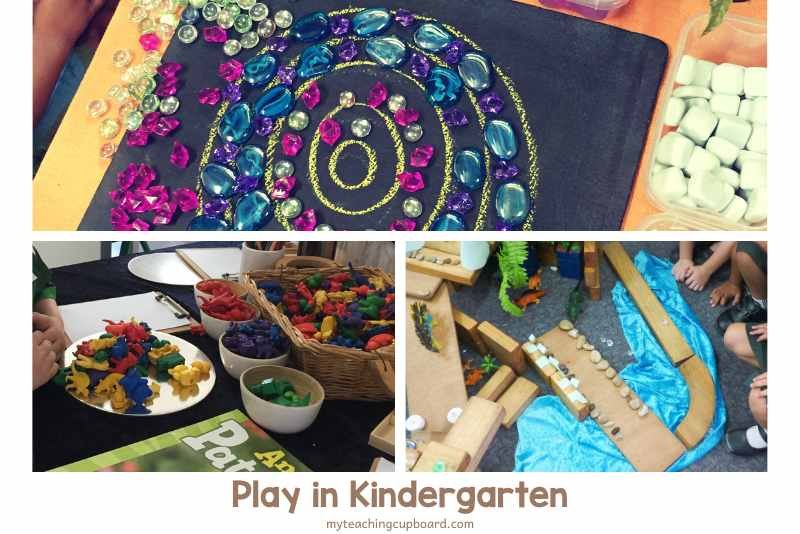
By kindergarten, play becomes more focused and often links directly to curriculum goals. For example:
During investigation time, children might build bridges out of blocks to see which designs can hold the most toy cars.
A simple learning provocation with natural objects like leaves or stones can spark counting, sorting, pattern-making, and discussions about shape and size.
Hands-on maths through play might look like rolling dice in a game and counting spaces, measuring towers of blocks, or grouping items to explore multiplication concepts.
This is where you see play connecting strongly to curriculum outcomes, while still honouring children’s curiosity and independence.
👉 Want to know more about strategies that work at this stage?
Read this blog post: Discover Play-Based Learning Strategies for Prep or Foundation Stage.
First Grade (6 to 7 year olds)
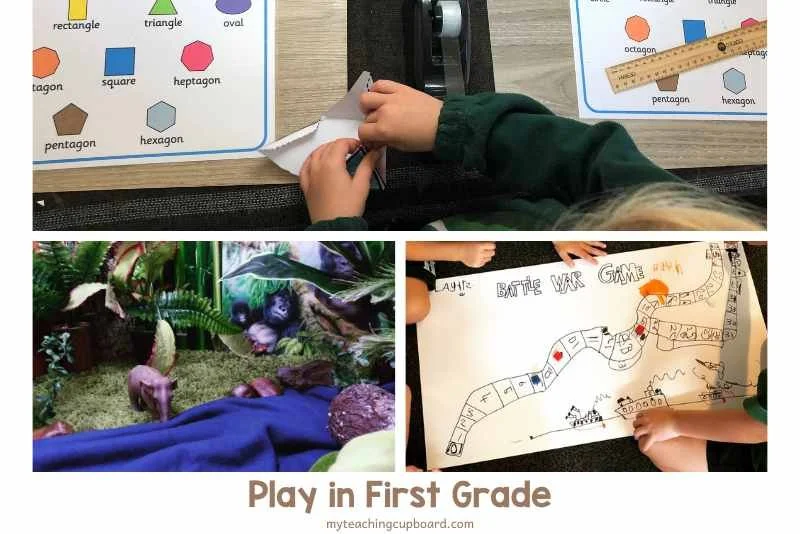
As children grow, play shifts into more complex forms of learning. In grade one, you might see:
Project work, such as researching animals and then building a model zoo with enclosures and signs.
Small groups creating board games that review maths facts, writing their own rules, and teaching classmates how to play.
Teachers weaving play into lessons by using explicit teaching to introduce new content, then stepping back to let children apply it in playful, hands-on ways through purposeful investigations.
This balance allows older children to stay engaged while still building higher-level skills and meeting strict curriculum expectations.
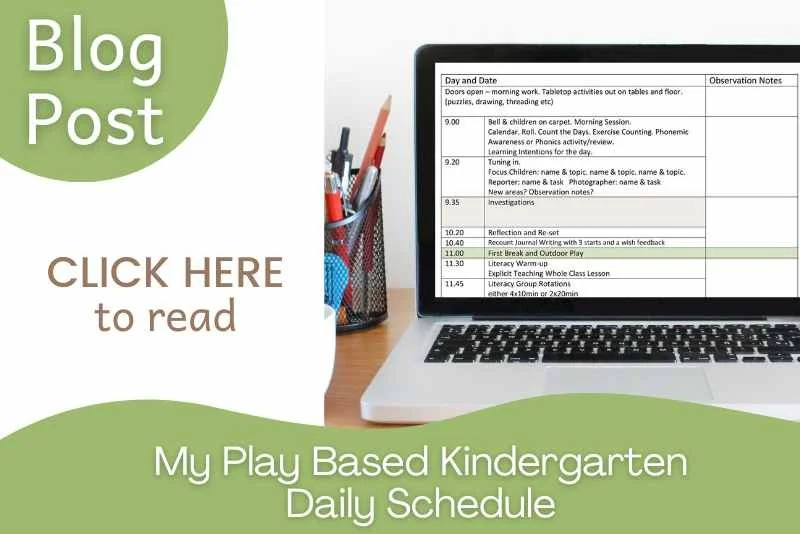
👉 For a closer look at how this balance works day-to-day, take a peek at my own Play-Based Kindergarten Daily Schedule.
Even though this blog post highlights my kindergarten schedule, I still follow pretty much the same schedule in first grade as well.
Setting Up an Ideal Play-Based Learning Environment
One of the most powerful things you can do as a teacher is design a learning environment that developmentally supports children’s learning. The environment is often described as the “third teacher” (after parents and educators), because the way you organise space, materials, and routines can either invite rich play or shut it down.
The 10 Essential Areas of a Play-Based Classroom
Here are the 10 areas that I find indispensable in my play-based classroom. I adjust provocations and resources in each area throughout the year, based on children’s interests and our curriculum goals.
👉 You can see more details in this blog post: The 10 Essential Areas of A Play Based Classroom
Carpet / Meeting Area – Large enough for the whole class to sit in a circle. This space holds my teacher chair, teaching easel or whiteboard (or interactive panel) and is used for whole-class gatherings, block play during investigations, and even small-group work during rotations.
Block Construction – A defined space with wooden blocks and loose parts. I make sure there’s enough room for 4–5 children to build alongside one another, which supports cooperation and social negotiation as well as problem-solving and spatial reasoning.
Dramatic Play – A flexible corner that can be transformed into anything from a home corner to a shop or clinic. This is where children practise oral language, social skills, and imaginative role play. I love watching how their scenarios change as we introduce new props and provocations.
Writing Table – A table or cluster of tables stocked with writing tools, paper, and prompts that children can access independently. This space targets early literacy skills and doubles as a small-group teaching space during group rotations later in the day.
Reading Area – A quiet, cosy spot with cushions, a couch and a canopy. Books are displayed invitingly and within reach so children can browse, read independently, or share stories with their friends. It also serves as a retreat space for children who need a calm down area during the day.
Science & Nature Table – A collection point for natural objects, living things, magnifying glasses, and investigation tools. Children explore patterns, changes, and discoveries here. I rotate the materials to tie into seasonal topics or current science units.
Art & Collage, Box Construction and Makerspace – An open-ended making space with recycled materials, collage supplies, paint, and drawing tools. This is where children create, tinker, and express their ideas. I often find that literacy and numeracy naturally weave into this area through labelling, measuring, and planning.
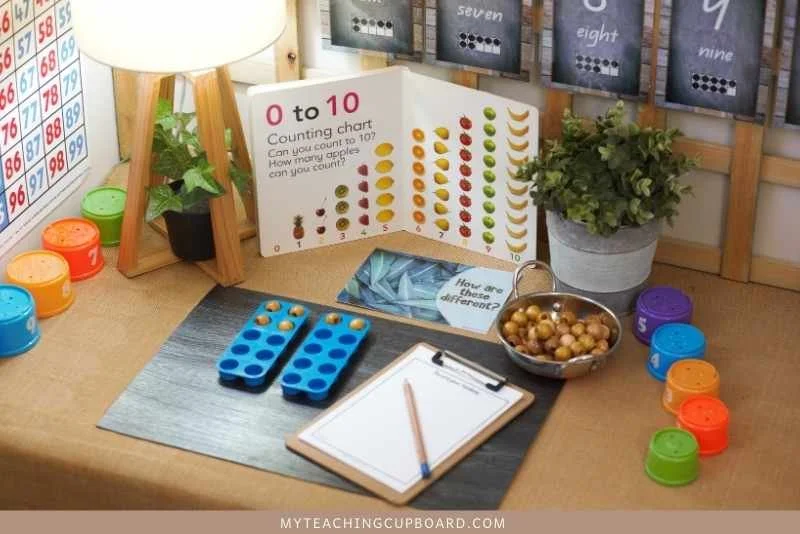
Maths Area – A dedicated space for manipulatives, counters, shapes, and measurement tools. I use this area to set up provocations that link directly to our current maths focus, while still leaving space for children to follow their own ideas.
Tinkering Area – A fine motor and engineering hub where children use Lego, Meccano, real tools, or take apart old appliances. It’s always buzzing with curiosity and invention, and it builds persistence alongside practical skills.
Sensory Play Area – A space for tactile and calming exploration. I use trays filled with sand, water, clay, or other sensory materials. This area often includes our light table too. A great space for children who need hands-on experiences to regulate and focus.

How to Make Your Environment Work
Here are practical tips based on what works in my classroom:
Clear layout: Plan placement of areas at the start of the year, thinking about traffic flow, noise and visibility. I tend not to move areas once they’re set up, but I rotate the materials and provocations within them.
Open-ended resources like loose parts: These help children make choices, try ideas out, and explore with creativity. Having a big variety of natural materials, recycled items etc., makes play based learning easy so start your loose parts collection now!
Flexible furniture & storage: Use open shelving, labelled and organised easily accessible materials so children can choose what they need and clean up independently. This fosters responsibility and engagement.
Routines that support autonomy:
Clear expectations about how to use each area.
Visual cues for clean-up, transitions, choice times.
Invite children in decision-making where possible (rotating materials and choosing provocations).
Cross-curricular provocations: Use provocations in each area that link to other content areas. For example - science items on the nature table that relate to maths measurement, or art and collage that tie into literacy themes.
Supporting social connections: Arrange spaces so children can play together, collaborate, or help one another. Encourage peer negotiation, sharing of ideas and cooperative projects.
Variety & rotation: Even in fixed areas, changing a few materials or provocations keeps interest high and learning fresh.
Resourcing Your Play Based Environment
You don’t need an endless budget to set up a great space. Some of the best resources are simple, inexpensive and even free:
Loose parts like pine cones, buttons, cardboard rolls, and fabric scraps spark imagination.
Natural materials such as wood, stones, and leaves add authenticity and invite curiosity about the world.
Flexible furniture and open shelving make it easy for children to choose what they need and return it independently.
When resources are open-ended, children can transform them into whatever their play demands, which supports creativity and problem-solving.

Classroom Routines That Foster Independence
A strong environment also relies on routines. Clear expectations about how to set up, play, and pack away make children feel confident and capable.
Use visual labels on baskets, simple charts, and consistent transitions to help even the youngest learners take responsibility.
Predictable routines create a calm rhythm to the day while still leaving room for a little spontaneous play.
When children know the routines, they can spend more energy on exploration and collaboration - and believe me - you’ll spend far less time managing behaviour!
👉 Want a step-by-step guide to transforming your classroom?
For more ideas & photo examples, you can explore this comprehensive blog post: Creating an Effective Play-Based Learning Environment

Frequently Asked Questions About Play-Based Learning
What is a play-based approach to learning?
A play-based approach is a way of teaching where play is the central tool for learning. Children explore, experiment, and create while teachers guide and extend their thinking. It’s not about replacing academics with play and it’s all about weaving literacy, numeracy, science, and social learning into meaningful play experiences.
What are the disadvantages of play-based learning?
One challenge teachers face is the perception that play isn’t “real learning.” It can also be time-consuming to plan, and sometimes it feels difficult to show evidence of progress.
The key is finding balance! Try combining direct instruction with play. Have a designated timeslot in your day for play and another for direct teacher instruction so you can ensure your children still meet mandated academic benchmarks.
Documentation (photos, notes, children’s work) is a simple way to show the depth of learning that happens during play too.

What are the 5 elements of play-based learning?
Researchers often agree on five elements that make play effective for learning:
Active engagement
Joy
Meaning-making
Iterative experimentation
Social interaction
When these are present, play becomes purposeful and supports children’s growth across all areas of development.
Why is play-based learning best?
The numerous benefits of play-based learning are backed by the latest research in early childhood education. Play builds strong foundations for literacy, numeracy, and problem-solving, while also strengthening social and emotional skills like confidence, empathy, and resilience.
It also supports physical development and wellbeing.
Most importantly, it helps children see themselves as capable, motivated learners and that’s setting them up for long-term success.

What is the teacher’s role in play-based learning?
The teacher has a crucial role in making play meaningful.
That includes:
Guiding play without taking over.
Asking open-ended questions that prompt deeper thinking.
Observing and documenting progress.
Introducing new materials or ideas to stretch children’s skills.
Fostering independence by allowing children to follow their own interests.
The teacher’s role is not to stand back entirely, but to know when to step in and when to let children take the lead.
Your Next Step
We’ve covered a lot in this guide! You now know:
What play-based learning is and how it goes beyond “just play.”
The key elements that make it effective, from active engagement to social interaction.
The many benefits - academic, social, emotional, and physical that support children’s long-term success.
The theories and research that prove the power of play.
The challenges teachers face and practical strategies to overcome them.
Real-life examples of play in action across preschool, kindergarten, and first grade.
How to set up an ideal learning environment that fosters independence and engagement.
The big important message?
Play isn’t the opposite of learning. It’s the foundation of it. With the right balance of teacher guidance and child-led exploration, you can create a classroom where your students thrive and still meet every curriculum benchmark and so much more.
👉 Before you head off, make sure you download your Free Play-Based Learning Guide.
It’s a practical, step-by-step companion to help you get started with confidence.
And when you’re ready for the next step on your journey, go to this blog post: How to Start with Play-Based Learning. It will show you how to put everything you’ve learned here into practice, with strategies and examples you can use straight away.