
Examples of Play-Based Learning: Symbolic Play in Action
Discover real examples of play-based learning and symbolic play that build literacy, numeracy, and critical thinking through active, creative, scaffolded play.
Think about those moments we all live for in a play-based classroom - when there’s that quiet hum and you see block towers stretching sky-high, menus appearing in the home corner, and children negotiating, writing, counting, and laughing all at once.
I’ve had days like this. Where a group is deeply absorbed in making “potions,” another is building an entire zoo out of blocks, and someone nearby is busy drawing maps to show how to “get there.”
It feels so wonderful… but then comes that familiar question every early-years teacher has heard before:
“But are they really learning?”
And that’s where the pressure creeps in.
You’re trying to honour your children’s interests, protect free play, and follow a play-based approach — while also ticking off curriculum outcomes, collecting assessment evidence, and honestly, just getting through the school day.
You might even have moments where you can see the play is rich and meaningful but you’re not sure how to articulate that learning to parents, leaders, or even to yourself.
This blog post will walk you through clear, practical examples of play-based learning in action - especially symbolic play, where children represent ideas, stories, characters, and new concepts through pretend play, drawing, building, and imaginative scenarios.
You’ll see how symbolic play builds social skills, cognitive development, problem-solving skills, fine motor skills, language development, emotional development, and academic skills and how you, as the teacher, can scaffold that learning with purposeful play-based learning activities.
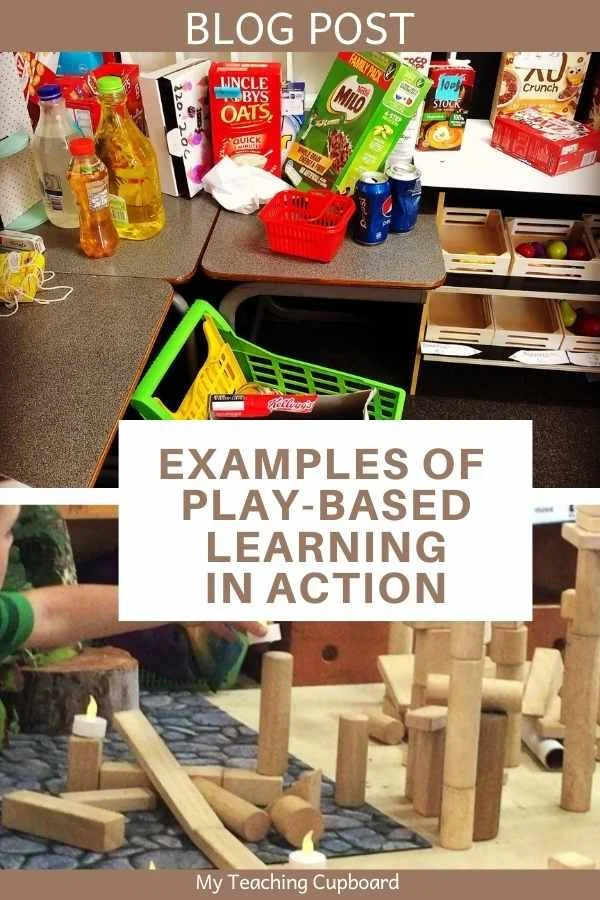
You’ll discover the different types of play that commonly appear in early childhood classrooms, how to recognise the academic learning inside everyday activities, and how to use open-ended questions, open-ended materials, and intentional teacher scaffolding to extend children’s developmental learning.
All without interrupting the magic of child-led play.
Whether you’re teaching kindergarten, preschool, or the early years of primary school, this guide will help you feel confident explaining the importance of play-based learning, identifying the learning that’s happening during investigation time, and making symbolic play a meaningful part of your play-based curriculum.
What Is Play-Based Learning? - start here with this Guide to Play Based Learning for Early Years Teachers if you’d like the foundational overview first. 👇
In this blog post you’ll discover what play-based learning is, why it works, and how to use it in early years classrooms. Benefits, examples, and a free teacher guide are all included.
What Is Symbolic Play and Why It Matters
Symbolic play is one of the most powerful forms of learning in the early years. It’s the moment a child uses an object, action, or idea to represent something else — a shell becomes a phone, a box turns into a rocket, wooden blocks become “cakes,” and a handful of counters suddenly transform into “money.”
This shift from the concrete to the abstract is huge. It’s where early literacy and numeracy first begin to grow, long before formal lessons. When children step into pretend play, dramatic play, construction, mapping, or make-believe stories, they’re actually strengthening the cognitive skills they’ll rely on for reading, writing, and mathematical thinking later on.
As educators, we know symbolic play isn’t “just play.”
It’s actually a window into problem-solving skills, language development, social interactions, creative thinking, and emotional development — all woven through meaningful learning experiences that come straight from children’s own interests.

Symbolic play gives children a safe, playful learning environment where they can test ideas, take on different roles, try new ways of solving problems, and build positive attitudes toward learning. It’s a natural bridge between unstructured play and more purposeful play-based learning activities — and it’s one of the best ways to see cognitive development unfolding in real time.
How Symbolic Play Builds Literacy and Numeracy
Symbolic play links beautifully to curriculum outcomes because children are already using the same thinking processes required for academic learning — just in a more engaging, natural way.
Literacy development
Children use symbols, drawings, and early writing to communicate ideas during play. They label buildings, write menus, create signs, “take orders,” and tell stories. You’ll often hear new words pop up as they narrate, negotiate roles, or describe what they’re building. These early language skills are so important because they form the backbone of strong communication.
Numeracy development
Counting, measuring, grouping, estimating, and patterning all appear naturally as children organise, arrange, and compare their materials. A child adjusting a tower notices balance, height, and shape. Another child running a “shop” sorts items, handles “money,” and calculates who gets what. These are genuine mathematical concepts. They are just happening in a more playful way than a worksheet ever could.
Critical thinking and problem solving
Symbolic play gives children space to hypothesise (“What if it doesn’t balance?”), test ideas, adjust, fail safely, and try again. You’ll see executive function, persistence, and active engagement flourish because the problem-solving is meaningful to them.
Social and emotional learning
When children engage in imaginative play together (whether it’s a tea party, a construction site, or a pirate ship), they develop communication skills, take on different roles, negotiate, compromise, and express empathy.
The Five Characteristics of Effective Play in Action
When we talk about high-quality play in early childhood education, we’re not talking about chaos, aimless wandering, or even “just free play.”
The Age-Appropriate Pedagogies framework identifies five characteristics that show when play is purposeful, meaningful, and deeply connected to children’s development.
These characteristics are the lens I use every day during investigation time. Once you know what to look for, you’ll start seeing rich learning everywhere.

1.Active Play — Children Think With Their Hands
Active play is hands-on and minds-on. You’ll see young children manipulating materials, testing ideas, making predictions, and adjusting their designs in active play.
Here’s an example of Active Play: A child builds a tower, notices it wobbles, pulls it apart, and rebuilds it with a wider base. They’re engaging in problem solving, mathematical language (“It’s too tall”), physical skills, and critical thinking. This is open ended play and not a planned activity.
2. Agentic Play — Children Make Choices and Lead the Learning
Agentic play happens when children demonstrate autonomy and ownership. They decide how to use materials, what roles to take on, and how their storyline will unfold.
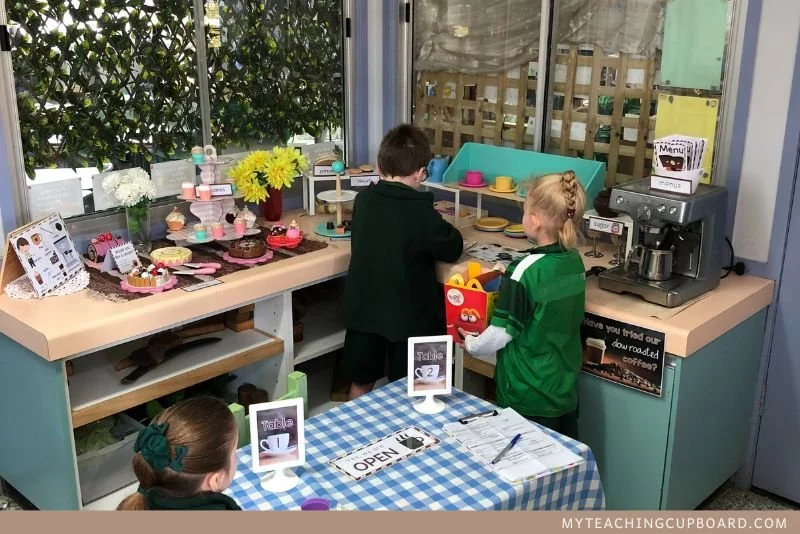
Here’s an example of Agentic Play: A group plans a dramatic play cafe. They choose the menu, arrange the space, and set their own “shop rules.” When children have an active role in shaping the play, their engagement (and persistence) skyrockets.
3. Collaborative Play — Children Learn With and From Each Other
Play becomes richer when children cooperate, negotiate, and take on different roles. In Collaborative play, social interaction and communication skills naturally strengthen through shared experiences.
Here’s an example of collaborative Play: A small group constructs a zoo using blocks, loose parts and toy animals. They discuss where the animals live, how to keep them safe, and which materials belong in each habitat. You’ll see language development, teamwork, and higher-order thinking all woven into one meaningful learning experience.
4. Creative Play — Children Invent, Imagine, and Transform
Creative play is where symbolic play blossoms. In this type of play, children use open-ended materials in unique and unexpected ways, showing imagination, flexible thinking, and cognitive growth.
Here’s an example of Creative Play: Buttons become “coins,” leaves become “plates,” blocks become “beds,” and a scrap of fabric becomes a superhero cape. This is the moment where literacy, numeracy, communication skills, and emotional development thrive through imaginative play.
5. Scaffolded Play — Teachers Extend, Support, and Deepen Learning
Scaffolding is where teacher expertise shines. It’s not so much about taking over or directing play but intentionally nudging children’s thinking with tools, prompts, and the right questions.
Here’s an example of Scaffolded Play: You add rulers, tally sheets, or clipboards to a construction area to introduce measurement or recording. You ask an open-ended question that helps a child move from trial-and-error to critical thinking. You model language or demonstrate a new skill to support the desired learning process.
💡 Noticing vs Nudging: How to Decide When to Step In
Before stepping in, pause.
Noticing happens first — watching, listening, and interpreting what the child is trying to do.
Nudging happens only when it serves the child’s development — adding a resource, posing a question, modelling a skill, or offering vocabulary.
If the play is already purposeful, rich, and deeply engaging, your best move might be to stay back and let the learning unfold.
How the Teacher Can Turn Play into Progress
One of the most common concerns I hear from early childhood educators is:
“I’m not sure when to intervene or how to make the learning visible.”
You’re not alone.
In a busy play-based learning environment, it can feel tricky to know when to step back and when to scaffold. Your goal isn’t to take over the play. Your goal should be to gently shape the learning so you can meet desired curriculum expectations while still honouring the child’s agency, creativity, and developmental learning.
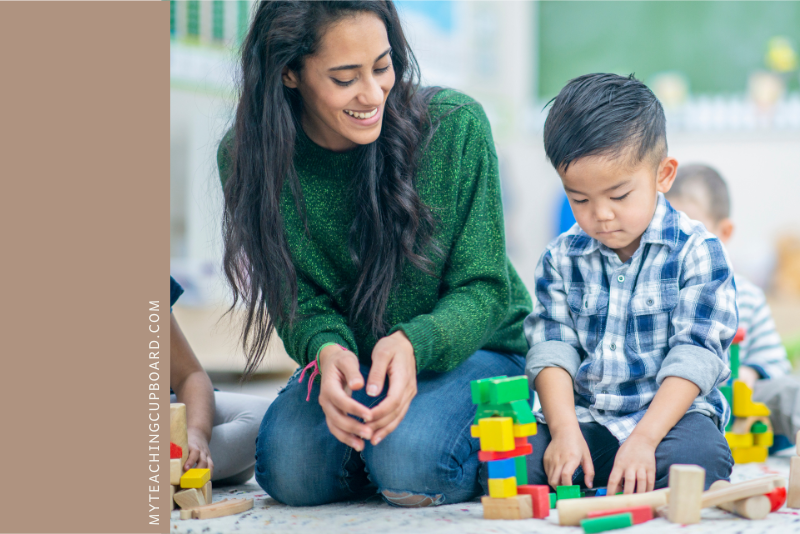
Here are 3 simple, intentional ways you can guide play without hijacking it...
1.Try These Open Ended Language Stems
Open-ended questions are one of the most powerful tools we have. They support communication skills, problem-solving skills, cognitive development and help make thinking visible in the classroom.
With the right scaffolding and questions, you can do all this without interrupting the flow of play.
Here are a few favourites that work beautifully during symbolic play:
“What did you change? What happened?” - Encourages reflection, resilience, and critical thinking by helping children verbalise cause and effect.
“How could you show that with a sign or number?” - A natural way to integrate literacy and numeracy into everyday play. These types of questions are perfect for shop play, block building, or small-world scenes.
“What would make it stronger, fairer, clearer?” - Invites children to test hypotheses, redesign structures, and negotiate solutions during collaborative play.
Here are five real examples from my Higher Order Thinking Prompts Pack that you could use straight away in your next investigation session:
What could you change to make this work even better?
Would it be better if…?
Why do you think this happened when you tried that?
What does this remind you of?
How could you test your idea to see if it will work?
These prompts are designed to create richer conversations and support deeper thinking across all areas of learning. They sound natural in play and help children share their reasoning in meaningful ways.

2. Add-A-Tool Strategy
Sometimes one simple resource is all it takes to extend the learning.
Adding a new tool to a learning provocation can help children shift from unstructured play to purposeful play without turning it into a completely teacher-directed task. It gives them just enough structure to access literacy, numeracy, and STEM thinking in natural ways.
Try introducing these powerful learning tools:
rulers
ten-frames
clipboards
tally sheets
price labels
menus or sign templates
These tools blend seamlessly into a play-based learning environment and give children ways to represent, record, measure, count, and communicate their ideas using open-ended materials.
I often keep a little “scaffolding basket” nearby during investigation time so I can quietly place a new tool within reach when I see the opportunity.
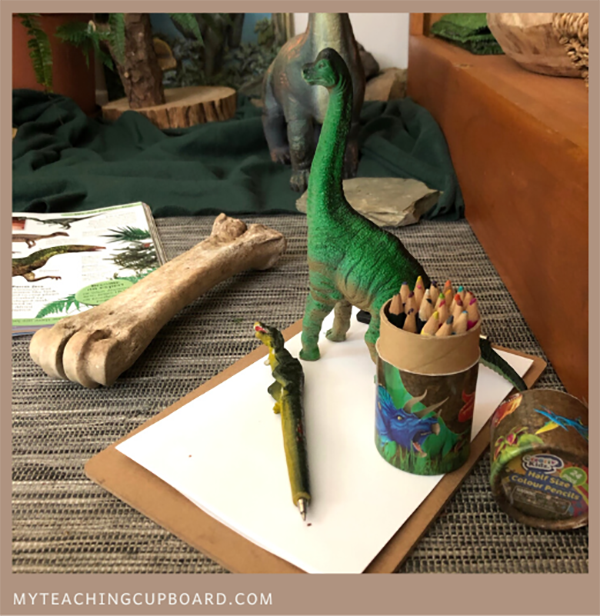
3. Model, Then Release and Play
You’ve probably heard the explicit teaching sequence I do → We do → You do, but in a play-based classroom, there’s an extra step:
I do → We do → You do → Play
This cycle respects the need for short, sharp, explicit direct instruction while still giving young children enough time for active engagement and experimentation.
Here’s how it works:
Model a skill quickly: “Watch how I write a price tag for the shop.”
Guide one shared example: “Let’s write one together so we know how much the apples cost.”
Release children to explore it in their own play: They take the idea and run with it. You might use this strategy to help them write menus, label their creations, or record measurements on a clipboard.
This is the sweet spot where intentional teaching meets authentic learning experiences.

Literacy Through Symbolic Play – Real Classroom Examples
Symbolic play is one of the richest doorways into early literacy because you’ll see how children naturally begin to represent ideas, stories, and meanings through play. When you watch closely, you’ll see reading and writing happening long before any formal pencil-to-paper tasks.
Below are some of the most powerful literacy moments you’ll see during the school day, and how you can support them without interrupting the flow of play.
Play Restaurant - Children write menus, signs, and receipts; they negotiate roles and practise procedural and persuasive texts (“today’s special!”, “please wait to be seated”etc).
Block Play - Children draw plans, label structures, and sketch maps. These experiences build visual literacy, spatial language, and the confidence to record ideas symbolically.
Small World Play - Rich storytelling, dialogue, sequencing, and new vocabulary emerge naturally as children build worlds and “live inside” their stories.
Art & Design - Drawing, collage and construction become powerful forms of symbolic expression. Children design, draft, reflect, and explain their thinking using emerging writing and oral language.

As teachers, our role is to notice these moments and nudge them gently. A single prompt like, “Would a sign help people understand your idea?” often leads to writing that is meaningful and self-motivated. This is powerful and the type of literacy learning that sticks.
Numeracy Through Symbolic Play – Turning Everyday Play into Maths Learning
Maths learning is woven through symbolic play in ways that feel natural, joyful, and developmentally aligned. When young children act out ideas, compare quantities, solve problems, and use loose parts creatively, they’re building real numeracy skills. Some people might think the children are just “playing shops” but they really are doing so much more than that.
Here are some examples that show how everyday play transforms into authentic mathematical thinking.
Block Play - Measurement, counting, patterning, sorting, position, and location. Add loose parts and you’ll instantly introduce grouping, balancing, estimating, and problem-solving.
Dramatic Play - Number and operations are everywhere in dramatic play. Children use loose parts as “money,” take orders, total amounts, compare quantities, and negotiate turn-taking.
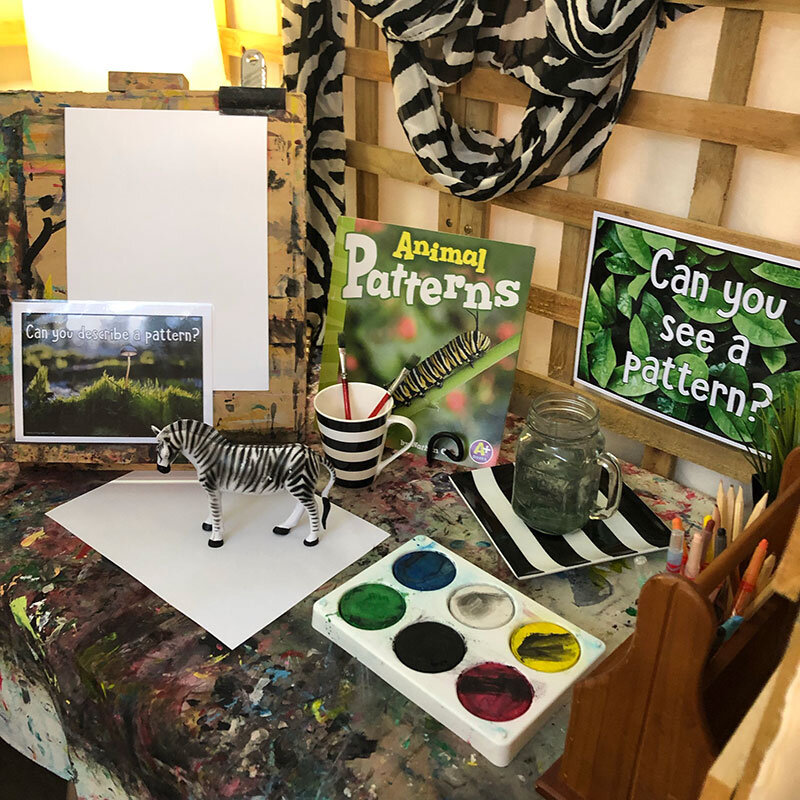
Art & Design - Patterns and geometry emerge naturally: repeating bead patterns, mandalas, flags, symmetry, shapes, and mark-making.
Science Table - Children sort, classify, measure, compare, and record observations, which are all aspects of early data, measurement, and analytical thinking.
Board Games - Counting, adding, subtracting, subitising, and early probability. Class votes and weather charts become simple data displays, tally marks, and picture graphs.

If you’re ready to take the maths you see in play and turn it into clear, purposeful learning, you’ll love my Math Provocations for Number and Algebra – Foundation Stage. These ready-to-use provocation prompts are fully aligned with ACARA V9 and give you hands-on, open-ended ideas that slot straight into your investigation time. They make it easy to extend counting, sorting, comparing, and problem-solving in ways that feel natural to young children and purposeful for you.
Assess Without Worksheets – Making Learning Visible
One of the biggest challenges in a play-based classroom is not whether children are learning. It is actually how to capture that learning in a way that’s meaningful, manageable, and aligned with curriculum expectations.
You don’t need piles of worksheets to prove growth. What you do need is a simple system that makes thinking visible and keeps assessment authentic to the play-based environment you’ve worked so hard to create.
Quick Learning Evidence You Can Capture
Here are some fast, low-prep strategies that give you reliable snapshots of children’s literacy, numeracy, problem-solving skills, and symbolic play – all without interrupting the flow of play.
Photo + sticky note + child quote: Snap the moment, jot a quick note, and record the child’s exact words. This creates powerful evidence of communication skills, symbolic representation, and critical thinking.
Anecdotal record: A simple sentence or two capturing what the child said or did that demonstrates a curriculum-linked skill. Here’s an example: “Used tally marks to count how many ‘tickets’ were sold in the dramatic play area.”
Student reflection prompts: Short, intentional questions help children articulate their learning and let you capture deeper thinking:
“What did you try more than once?”
“How did your label help someone?”
“What changed when you added that piece?”
These moments tell you far more than any worksheet ever could, and they also preserve the integrity of play-based learning.
Use My Observation Checklist as a Quick-Look Tool
I have the perfect checklist for you. It has checklist headings that will give you a simple structure for gathering meaningful evidence during investigations or play based learning sessions AND you can even use it across the whole school day!
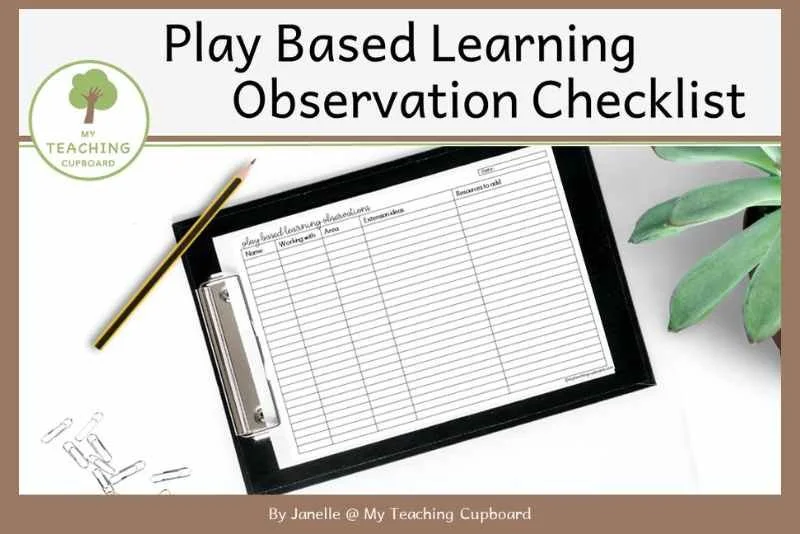
Here’s how the sections can look in action:
✅ Where the Child Worked: Block Area – building a “zoo” with friends.
✅ Who They Worked With: Interacted with Eli & Harper; negotiated roles (“You be the ticket person”).
✅ Learning Behaviours: Sustained focus for 18 minutes. Re-entered play after a challenge (tower collapse) — strong problem-solving skills. Used mathematical language: “taller”, “shorter”, “fits here”.
✅ Social Interactions: Turn-taking and sharing loose parts confidently. Resolved disagreement using words (“Let’s move this piece instead”).
✅ Oral Language: Explained design choices clearly (“This fence keeps the animals safe”). Used new vocabulary from recent explicit instruction (“habitat”, “protect”).
✅ Literacy & Numeracy Links: Created a zoo map using symbols. Counted the number of animals in each enclosure.
✅ Possible Next Steps: Explore measurement prompts (“How long/wide is this enclosure?”). Add persuasive writing to the provocation (“Why should people visit your zoo?”).
These quick notes took me less than a minute but gave me so much rich evidence tied to curriculum expectations, intentional teaching, and my upcoming planning for play.
Your Free Tool to Make Documentation Easier
👉 Download My Free Play-Based Learning Observation Checklist HERE
This is the exact checklist I use every day to track learning during investigations. It is simple, fast, and designed for real early years classrooms.
You’ll find it perfect for documenting cognitive development, social skills, language development, problem-solving skills, and symbolic play.

Quick & Easy Play Setups You Can Rotate All Term
One of the biggest barriers teachers face when implementing a play-based program is time. Time to plan, time to set up, time to reset.
The good news? You don’t need elaborate Pinterest-perfect displays to create rich learning experiences. A few intentional materials (refreshed weekly or fortnightly) can completely transform your play-based learning environment.
Here are five simple setups that build literacy, numeracy, problem-solving skills, and creative thinking without adding to your workload.
1. Makerspace: Maps, Routes & Symbols
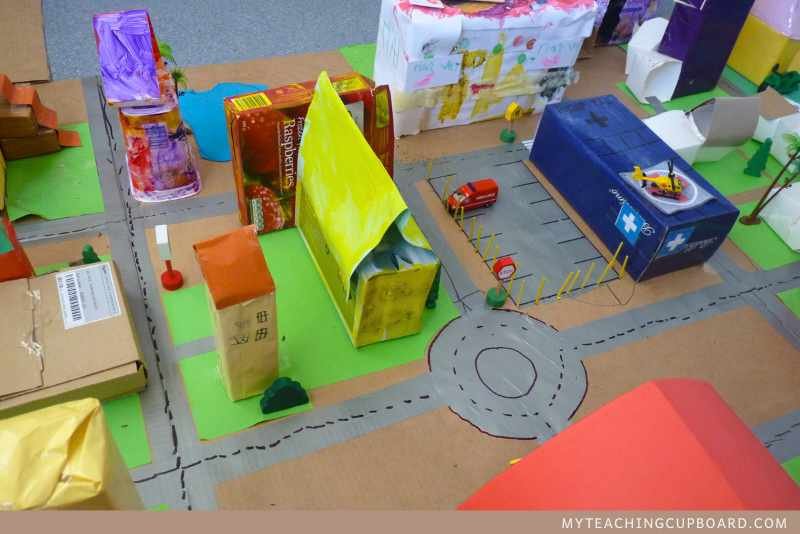
Collage materials like paper strips, arrows, dot stickers, small boxes and textured paper become powerful tools for symbolic representation. Children naturally create maps, routes, road signs, and labels, which strengthens early writing, spatial reasoning, and communication skills.
2. STEM Corner: Bridges, Balance & Design Thinking
Offer cups, craft sticks, pegs, rubber bands, and jute string.
You’ll instantly see problem-solving skills, critical thinking, and cognitive development as children test, redesign, and strengthen their constructions. This type of setup supports both fine motor skills and executive function. You could even leave it out all term.
3. Dramatic Play: Everyday Maths in Action
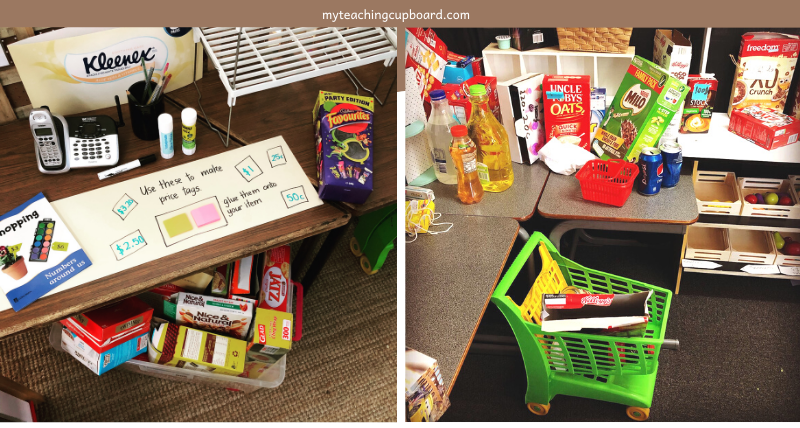
Add loose parts and sticky notes and watch your children invent menus, write prices, calculate totals, and give change. This is one of the easiest ways to bring numeracy, symbolic play, and imaginative play together.
Your role? Add a clipboard or a tally sheet occasionally, then step back and observe the rich language development and social interactions taking place.
4. Small World Play: Dialogue & Storytelling
Introduce toy figures, vehicles, animals, and blank speech bubbles.
Children will instantly create dialogue, negotiate characters, sequence events, and build storytelling stamina. This setup supports oral language, social skills, and cognitive skills, while giving you plenty of quick evidence for literacy outcomes.
5. Block Play: Building to Specification
Add tape measures, small rulers, simple planning sheets, and loose parts such as lids, shells, or natural materials. Children will love to compare, measure, problem solve, and redesign. These resources are ideal for mathematical language, spatial literacy, and critical thinking.
You can quickly scaffold by asking: “How could you show your plan?” or “What will you need to make it stronger?”
If you’re ready to transform your learning environment, I have a detailed blog post you’ll find so useful. 10 Essential Areas of a Play-Based Classroom is a blog post outlining my ten must-have areas. They make my play-based classroom flow. From dramatic play to loose parts, it will help you create engaging, flexible spaces that support meaningful learning through play.

Troubleshooting Common Play-Based Challenges
Even in the most beautifully designed play-based learning environment, challenges pop up. There’s noise, repetition, disengagement, or that moment where every child suddenly “forgets” how to write a sign.
These issues don’t mean play isn’t working.
They simply signal it’s time to adjust the scaffolds.
Here are some real classroom problems I’ve come across and the simple, purposeful ways to respond.
“It’s too noisy or chaotic.” - Add clear roles (builder, designer, photographer, organiser), introduce gentle time limits, and use purpose cards so children know the goal of the space. Clear social structures reduce overwhelm and increase collaboration.
“They ignore the writing prompts.” - Model first and not during play. Model beforehand, either during tuning-in or in a small literacy group rotation, so children see exactly what the prompt looks like in action. Display real examples, add clipboards within reach, and give the writing a genuine audience (a “parent gallery,” a class noticeboard, or even your principal).
“The same play repeats over and over.” - Repetition is learning. Children build confidence through doing something many times. But if it continues for weeks with no extension, simply rotate one tool (add tape measures to blocks, add labels to shop play, add characters to small world) or invite an “expert” student to demonstrate a new idea.
💡 Teacher Tip: Sometimes the most effective scaffold is stepping back.
Observe first. Document what you see. Nudge only when curiosity peaks or when a new tool could genuinely extend the learning.
✅ Download My Free Observation Checklist
Use this checklist to track engagement, social interactions, symbolic thinking, and individual learning behaviours during investigations or play based learning time. It takes seconds to use and honestly makes your assessments meaningful, objective, and easy to share with families and leadership.
Bringing Symbolic Play to Life
Symbolic play is where imagination meets intention - and where so much real learning quietly happens. When you tune in, observe closely, and use a few simple scaffolding moves, you’ll help your young children:
shift from concrete experiences to abstract thinking,
connect their play to meaningful literacy and numeracy goals, and
build the confidence, curiosity, and collaboration skills that carry them far beyond the early years.
These are powerful learning experiences that grow social skills, cognitive development, communication skills, and problem-solving in ways worksheets never will.
And the best part?
You don’t need to overhaul your whole classroom.
Small, intentional choices, the right prompt, the right tool at the right moment can transform the learning already happening in your play-based classroom.
👉 Next Steps to Bring This Learning to Life
✅ Download your free Play-Based Learning Observation Checklist
Start noticing patterns, tracking progress, and collecting meaningful evidence of learning — without interrupting the play.
✅ Explore this related blog post guide to strengthen your practice:
Each one will help you refine your planning, scaffolding, and assessment so symbolic play becomes purposeful, visible, and curriculum-aligned.
Want Support for Questioning and Documentation?
Pair your free checklist with my Open-Ended Question Prompts Pack or my Higher Order Thinking Prompts on Nature Photos— both powerful tools for sparking deeper thinking, richer language, and more intentional play-based learning.
Together, they give you everything you need to scaffold learning confidently and document growth in a way that aligns with ACARA and still feels natural in a play-based program.