
Implementing a Play Based Learning Curriculum that Works
Discover how to build a play based learning curriculum that balances play and academic benchmarks with practical tips, classroom examples, and teacher strategies.
As early childhood educators, we know that play-based learning is best practice. The research is clear, and our own experience with young children shows us the power of play. But there’s a common struggle: how on earth do you fit a play-based learning curriculum into an already jam-packed day?
AND how can you be confident that it’s purposeful and not “just another thing” to squeeze in between direct instruction and assessment deadlines?
Well I have some good news for you - you don’t have to choose between play and everything else!
A well-implemented play-based curriculum can give you both -
a joyful classroom where children are deeply engaged
and a structured approach that ensures they meet all those curriculum requirements and academic benchmarks.
Please don’t think it has anything to do with throwing out explicit teaching altogether. It is really about finding a way to weave playful learning experiences into your daily routine so that your children build strong foundations while still enjoying their early years of schooling.
Play isn’t “just play.” It’s a powerful tool for early childhood education, backed by decades of research and supported by theorists like Montessori and the Reggio Emilia approach.
It gives children the best of both worlds: the chance to develop creativity, social skills, problem-solving abilities, and critical thinking while also making measurable progress towards academic success.
As we go through this blog post, I’ll share the strategies I’ve used in my own classroom, plus I’ll give you examples and practical tips that you can apply in your classroom straight away.
My goal is to show you how a play-based curriculum doesn’t compete with your teaching - it complements it.
What is a Play Based Learning Curriculum?
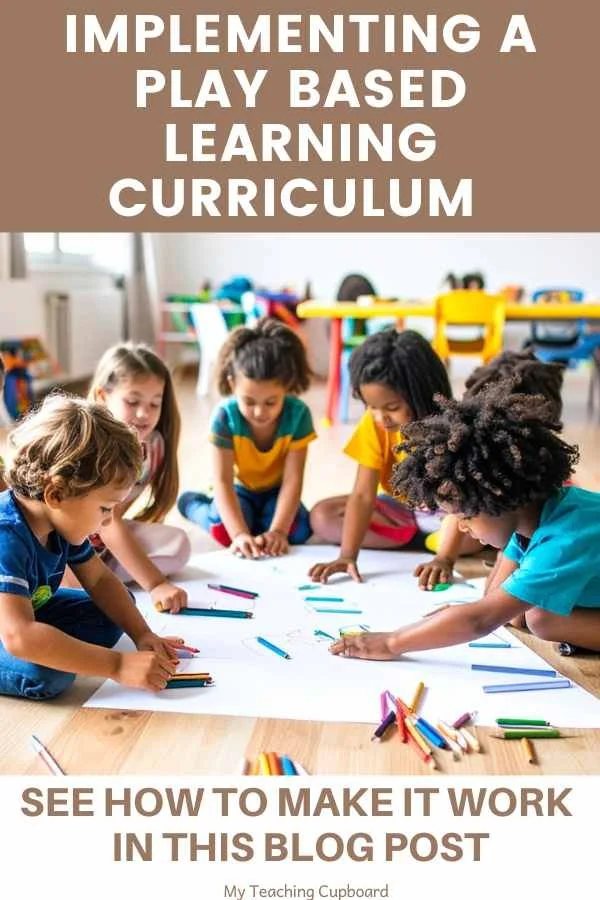
If you’ve ever wondered “What is a play-based curriculum?” the simplest answer I can give you is this: it’s an educational approach where children learn key skills and concepts through meaningful play experiences.
Instead of separating “learning” and “play” into two different categories, a play-based curriculum recognises that children’s play is their learning.
Maria Montessori summed this up beautifully when she said, “Play is the work of the child.”
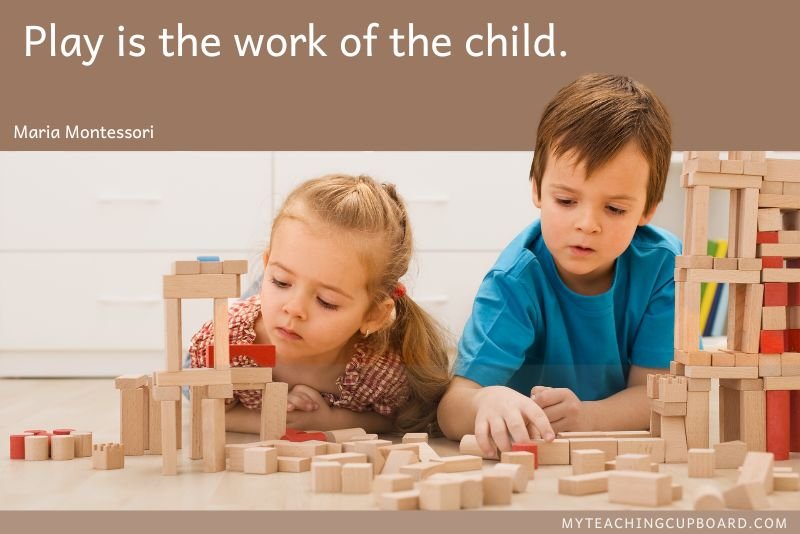
And Loris Malaguzzi, the founder of the Reggio Emilia philosophy, spoke of children as strong, capable learners who make sense of the world through play.
These perspectives remind us that play isn’t “just fun”. It’s really the foundation of how young children build knowledge and understanding in the early years.
In practice, a play-based preschool curriculum or play-based learning environment looks very different from a purely traditional model. In a more traditional setting, lessons are often driven by direct instruction (the teacher at the front of the room, students completing tasks, and assessment used to measure outcomes).
In contrast, a play-based approach blends intentional teaching with children’s play so that academic content is woven into playful learning experiences.
For example, a block corner is not seen as “free play” without purpose. It is in fact, an early childhood setting where children explore maths concepts like balance, spatial awareness, and problem-solving skills.
The latest research supports this balance. Studies show that children in play-based environments not only develop social and emotional skills more effectively, but they also achieve academically. They gain strong foundations in literacy and numeracy, while at the same time building creativity, executive function, and life skills that carry them far beyond the preschool year.
Here are some specific research studies & sources that support the claim that children in high-quality, play-based environments develop social and emotional skills more effectively and also make academic gains (literacy, numeracy, executive function etc.)
👉 Promoting Executive Function Skills in Preschoolers Using a Play-Based Games Program (Gibb, Coelho, Van Rootselaar, Halliwell, MacKinnon, Plomp & Gonzalez)
A programme: Building Brains and Futures for 3-5 year olds using 10 interactive games including pretend play, block building, and rule-based games to build executive function found that preschoolers improved in executive functions, which are strong predictors of later academic and life success. (Frontiers)
👉 Block Play and Early Mathematics in Australia (NUMBBA Thesis, Grimmond)
A study looking at block play in early childhood settings using the Early Years Learning Framework (Australia) that particularly measured how children’s block play relates to numeracy and maths capabilities found that block play was shown to be strongly associated with the development of early maths skills (spatial awareness, problem solving, counting, patterns) in preschoolers. (University of Wollongong)
👉 Play-Based Learning – Australasian Research Summaries / Evidence for Learning Toolkit
This synthesis of various studies on communication and language, and other learning in early childhood settings in Australia & NZ shows that rich play-based environments boost communication, vocabulary, storytelling etc., which feed directly into literacy and children’s learning outcomes. (E4L)
👉 Play-Based Strategies to Support Executive Function (recent studies)
These studies looked at early years settings that use both structured and unstructured play, games etc., to build EF skills (working memory, inhibitory control, cognitive flexibility) in young children. They report significant gains in EF, which strongly correlates with academic success in literacy and numeracy later on. (SpringerLink)
So you can see, recent research, both in Australia and internationally, shows that children engaged in play-based curricula don’t just gain soft skills. They make real progress in literacy, numeracy, and executive function.
So, what makes a play-based curriculum work?
It’s not about choosing between direct instruction and playful learning.
It’s about combining the best of both.
A strong play-based approach gives children the chance to experiment, imagine, and take on different roles, while teachers weave in explicit learning intentions and lessons.
The result is a rich, research-backed educational approach that sets children up for academic success while still protecting the joy of childhood.
The Benefits of Play-Based Learning
So now you know that a play-based learning curriculum is more than just fun and is a research-backed, purposeful approach that nurtures the whole child. From sparking creativity to laying the foundations for literacy and numeracy, play offers children meaningful learning experiences that set them up for success in school and beyond.
Let’s take a closer look at just some of the benefits.
Play Promotes Creativity and Imagination
One of the first things you notice in a play-based classroom is the creativity bubbling up. Through imaginative play, creative arts, and dramatic play, children experiment with ideas, explore different roles, and express themselves in unique ways.
When I’ve set up a simple dramatic play area (like a post office, a vet, or a home corner), the children have amazed me with the creative innovation they bring to their play. They build stories, problem-solve together, and often surprise us with the connections they make to the wider world.
Giving children space to imagine and create not only fosters a love of learning but also builds flexibility and resilience and these are skills they’ll need for lifelong learning in the 21st century.

Play Develops Critical Thinking and Problem-Solving Skills
Play also nurtures critical thinking, problem-solving skills, and executive function. When children build with blocks, set up a water table experiment, or negotiate the rules of a new game, they are analysing, testing, and adapting their ideas.
I’ve often seen a group of children spend over half an hour building a bridge from blocks and other loose parts, only to watch it tumble down. Instead of giving up, they re-think their design, try again, and eventually succeed. That persistence is the essence of critical thinking and resilience.
Children engaged in play-based activities show greater gains in executive function. These skills are closely linked to higher achievement in literacy and maths later in school.

Play Enhances Social and Emotional Development
The social-emotional skills children develop through play are just as critical as their academic learning. Especially in our modern classrooms where children can be dysregulated or overwhelmed.
Through play, children can practise social interaction, communication skills, empathy, and conflict resolution in safe, authentic and meaningful ways.
The American Academy of Pediatrics has emphasised that play is vital for healthy child development, not only promoting life skills but also supporting emotional wellbeing.
In my own classroom, I’ve watched children learn to share, take turns, and resolve disagreements during cooperative play. I have noticed these skills seem to transfer directly into their relationships and help to build our classroom community - and that benefits everyone!
This is where play becomes so much more than a teaching tool. It’s such an effective way of nurturing confident, capable young learners who feel safe, valued, and connected.

Play Builds Academic Foundations in Literacy and Numeracy
Finally, let’s not forget the academic success children achieve in play-based environments. Activities like storytelling, block building, and sensory play are just some of the activities that provide strong foundations in literacy, numeracy, and cognitive development.
When children retell a story in dramatic play, they’re strengthening their language development and literacy skills.
When they sort natural materials by size or explore patterns with loose parts, they’re engaging in early maths concepts like spatial awareness, measurement, and problem-solving.
Children in play-based settings often have stronger vocabulary too. They often have better comprehension, and deeper number sense than their peers in more traditional, worksheet-driven classrooms.
In fact, one Australian study on block play demonstrated a strong link between free play with construction materials and early mathematics achievement.
Want to see all the other benefits of play based learning? I’ve written more about this in my post on the Benefits of Play Based Learning in Early Education.

Incorporating Play-Based Learning into a Traditional Curriculum
One of the most common questions teachers ask me is, “If I make time for play, will my students still meet all their curriculum goals?”
The short answer is yes.
You don’t need to choose between direct instruction and play. A strong play-based learning curriculum balances both.
As teachers, we know there’s real pressure to cover content areas and tick off achievement standards.
Whether you’re teaching to ACARA here in Australia or working with Common Core elsewhere, it can feel like the curriculum is an endless checklist. But here’s what I have found - children develop their foundational skills most effectively when learning is purposeful, engaging, and connected to their world. And that’s exactly what purposeful play delivers.
Let’s see how…
Weaving Play into Literacy
Play can be the most natural way to build literacy skills. Storytelling in dramatic play, writing “shopping lists” in the home corner, or labelling block structures all give children meaningful opportunities to practise reading and writing.
When I’ve introduced simple literacy props like clipboards or blank books, environmental print like menus or related picture books to a play provocation, the children are often motivated to write, usually with more enthusiasm than in a formal writing block too.

Weaving Play into Numeracy
Maths concepts can be embedded into the process of play just as easily.
Measuring towers in the block area, counting shells at the sensory table, or creating repeating patterns with loose parts all address early academic skills while keeping the children actively engaged.
I’ve often noticed that children who struggle with maths in formal lessons thrive when those same concepts are explored through hands-on activities in play.

Weaving Play into Science and HASS or Social Studies
Science is full of opportunities for purposeful play. Water play, sand tables, and simple STEM provocations allow children to explore cause and effect, physical properties, and real-world phenomena.
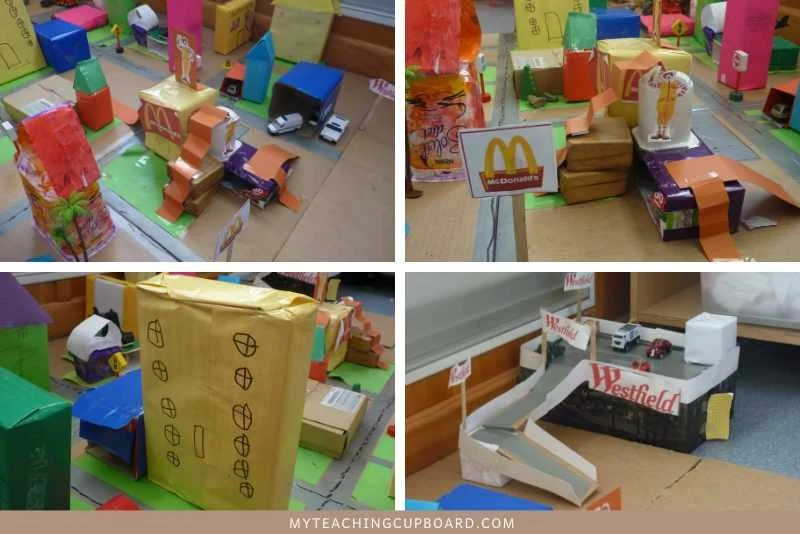
For HASS or social studies, dramatic play can bring big concepts down to a child’s level. There’s nothing like building a box town, running a post office, caring for animals in a play vets, or exploring cultural traditions through food and dress-up to consolidate real-world HASS concepts.
These types of play scenarios help children build knowledge of their world in ways that are age-appropriate and meaningful.
Finding Balance with Direct Instruction
Of course, this doesn’t mean abandoning all your teacher-led lessons. Direct instruction still has its place in introducing new concepts and guiding learning.
The balance comes when explicit teaching is followed by, integrated with and consolidated through playful learning experiences. Hands-on playful experiences that give children the chance to apply and explore those new ideas.
This is exactly the philosophy behind the Walker Learning approach here in Australia, where curriculum outcomes are woven into play-based investigations, ensuring alignment without losing the joy of play.
When we see play and explicit teaching as partners rather than opposites, we give our students the best of both worlds - a curriculum that supports academic success while nurturing the whole child.

If you’re keen to see how this works in practice, I’ve shared more ideas in two other blog posts. Check out How to Start with Play Based Learning and Play-Based Learning Strategies for Prep or Foundation Stage. Both posts are full of practical examples you can take straight into your classroom.
4 Practical Tips for Combining the Two Approaches
It’s one thing to understand the value of a play-based learning curriculum, but another to know how to make it work alongside our heavy curriculum demands.
Here are four practical strategies that make it easier to weave play into your daily routine, without it feeling like “one more thing.”
1. Start with Investigation Areas
A strong play-based classroom begins with well-designed investigation areas. These can be just corners for unstructured play but for ensuring your play based learning links to your curriculum, they should be intentionally designed spaces where your children can engage in hands-on activities, meaningful learning experiences, and play-based activities linked to your specific curriculum goals.
Adding natural materials, real-world tools, and open-ended resources will all help to give your children the opportunity to take ownership of their learning in a safe space that still feels purposeful.
For more information, I’ve outlined the areas you need to create in your classroom for optimal engaging and educational investigation spaces in this blog post: 10 Essential Areas of a Play-Based Classroom

If you’re looking for ready-to-use ideas and done-for-you printables you can use to set up engaging and purposeful investigation areas, you should explore my Investigations Resources - a thoughtful collection designed to save you time.
2. Use Open-Ended Provocations
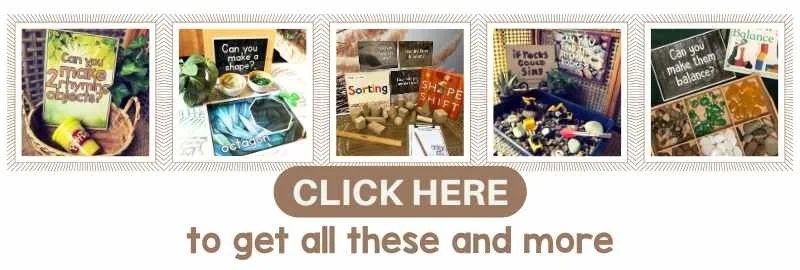
One of the best ways to spark curiosity and extend children’s play is through open-ended provocations. Whether it’s a tray of shells, a collection of loose parts, or a simple water table setup, these types of invitations encourage unstructured play, open ended play that leads to discovery, questioning, and problem-solving.
Open ended provocations also give children the freedom to explore their own learning pathways at their developmental level. The beauty of these types of learning provocations is that you will be differentiating the curriculum content to specifically suit your students.
If this sounds like something you are interested in but aren’t too sure what a good learning provocation looks like, check out this blog post: What is a Learning Provocation?

And if you already know all about learning provocations and learning invitations, you’ll discover my 3 easy steps to creating intentional, engaging spaces that focus on the curriculum AND children’s developmental needs in this blog post: 3 Steps to Setting Up Learning Provocations for Play based Learning.

3. Balance Teacher-Led and Child-Led Learning
A play-based environment works best when there’s a balance between explicit instruction and child-led exploration. Teacher-led lessons can introduce new concepts, while child-led play gives your students the opportunity to apply and extend that knowledge in ways that make sense to them.
In my classroom, this balance has always been central to our daily routine. You can see what I mean and how I structure our day here in this blog post: My Play-Based Kindergarten Daily Schedule.
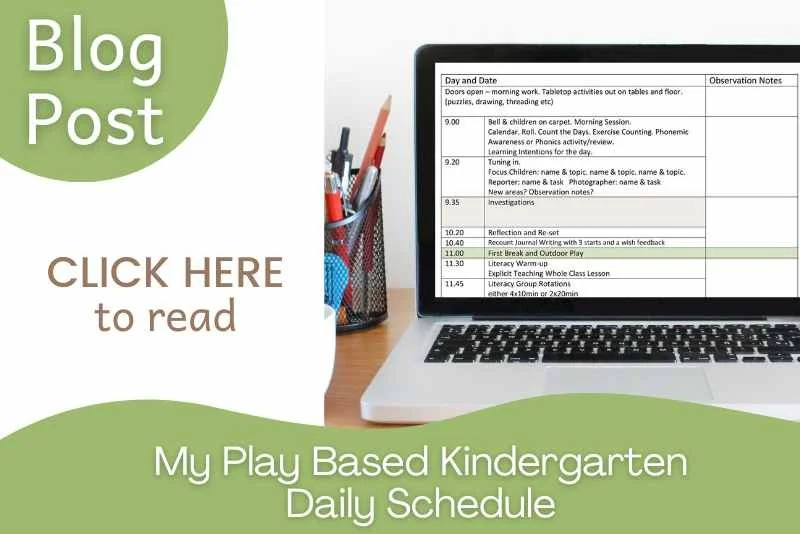
For more on finding that balance in your own teaching style, you might also like this blog post: How to Be a Successful Play-Based Kindergarten Teacher.

4. Document Learning for Accountability
Play should not mean you lose track of where your children’s learning outcomes are at. In fact, documenting your children’s play-based activities makes it so much easier to show how all the learning that is happening links back to curriculum benchmarks.
Photos, work samples, and anecdotal notes are all valuable tools. Another powerful strategy I’ve used is my simple teacher observations.
By using an observation checklist, you can track progress, guide your next steps, and feel confident that every playful learning experience is building towards measurable goals.
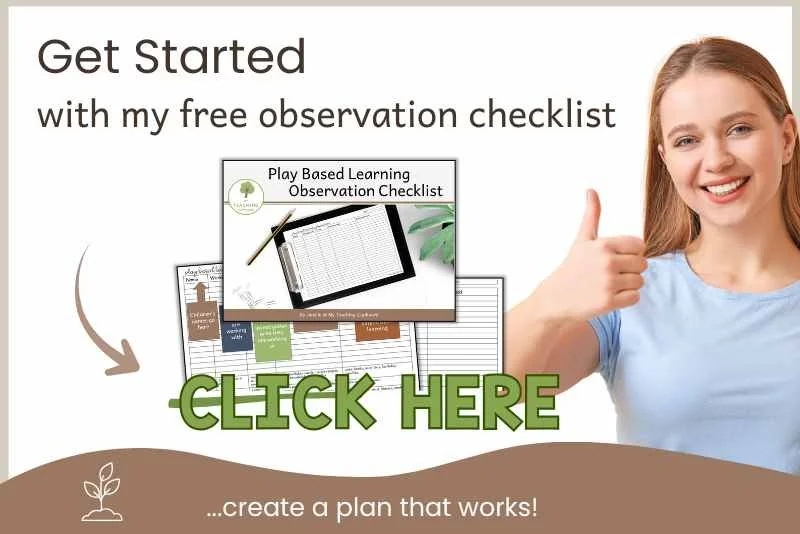
Want to take these ideas even further? Head over to my other blog post on Creating an Effective Play Based Learning Environment where I share eight proven strategies to transform your classroom into an inspiring space for learning.
From setting clear expectations to fostering collaboration and creativity, this comprehensive blog post will help you build a play-based environment that enhances student engagement and supports academic success.

Examples of Play-Based Learning Activities that Meet Curriculum Goals
One of the best things about a play-based learning curriculum is how easily it connects to curriculum goals AND keeps young children motivated and engaged.
Here are some quick wins you can try in your classroom straight away…
Literacy Through Play
Playdough phonics – invite children to make letters and words in playdough. This builds fine motor skills while reinforcing sound–letter connections.

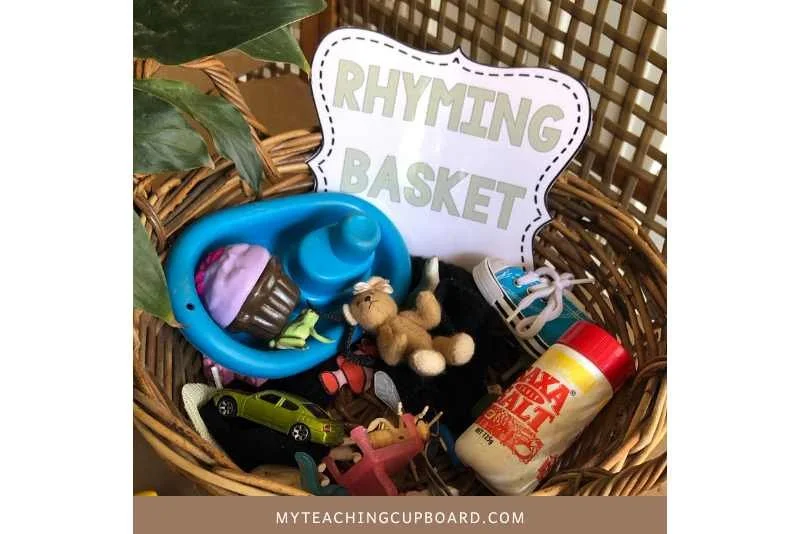
Rhyming baskets – fill baskets with objects or picture cards that rhyme (cat, hat, bat). A perfect activity for younger children exploring phonological awareness.
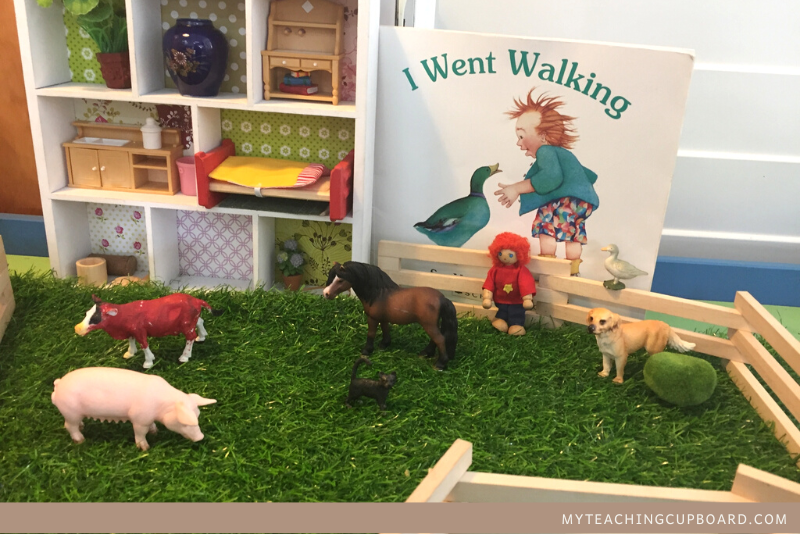
Story retelling with props – use puppets, small worlds, felt boards, or dramatic play to bring familiar stories to life. This encourages language development and comprehension.
Numeracy Through Play
Loose parts maths – provide shells, stones, counters or buttons for counting, sorting, and pattern-making. These hands-on activities are ideal for early childhood development in beginning math concepts.
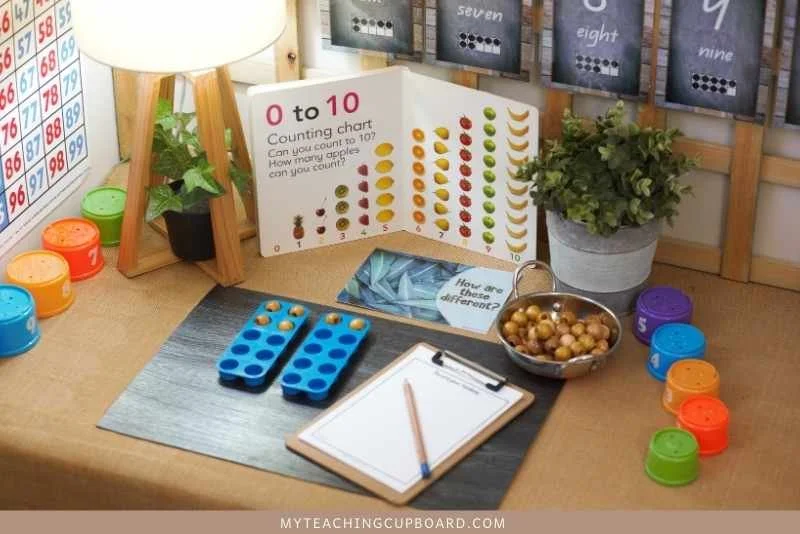
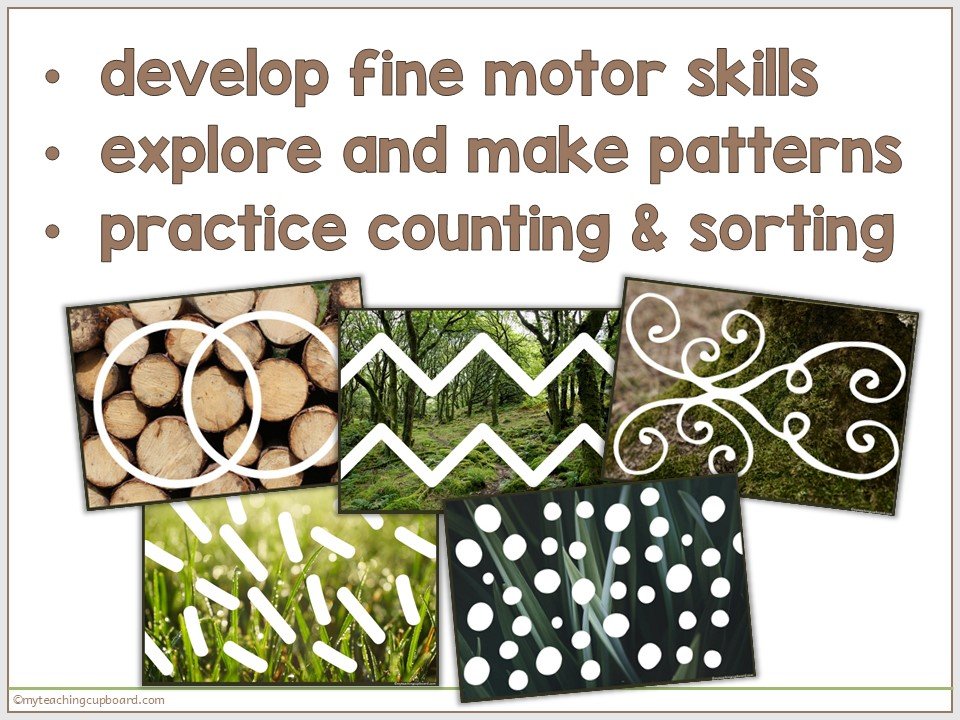
Pattern mats – children can create sequences with loose parts on specially designed mats, building academic skills in sequencing and problem-solving.
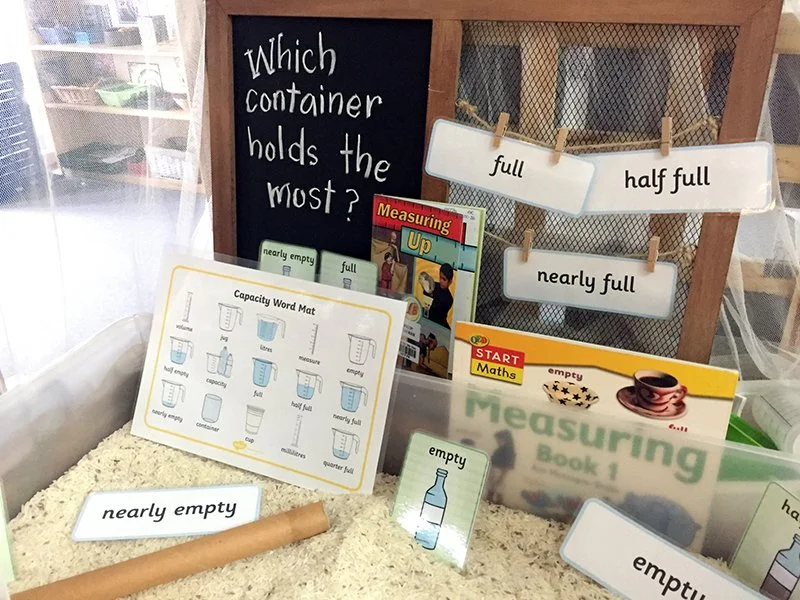
Measurement provocations – set up a water table or sensory tray with different containers to compare capacity, or use blocks for measuring height. These playful setups help children easily grasp real-world maths concepts.
Science and HASS Through Play
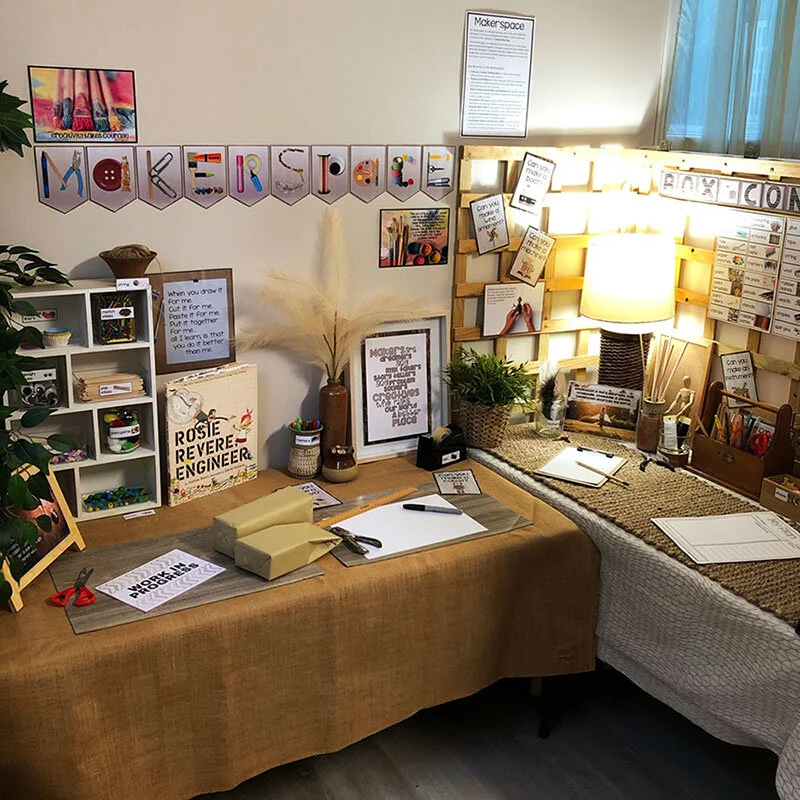
Makerspace explorations – offer cardboard, tape, and recyclables to inspire building and design. This fosters creative innovation and inquiry.
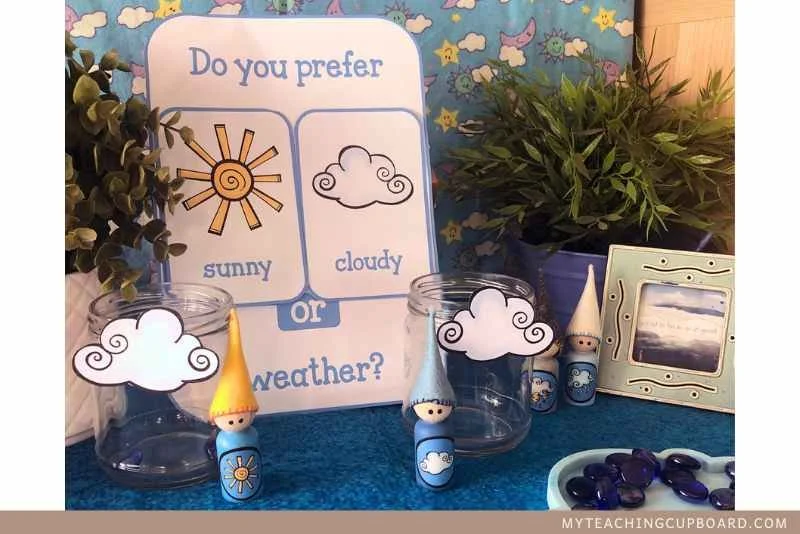
Weather gnomes – children can track the weather daily and collect data with props or costumes, linking science with observation skills.
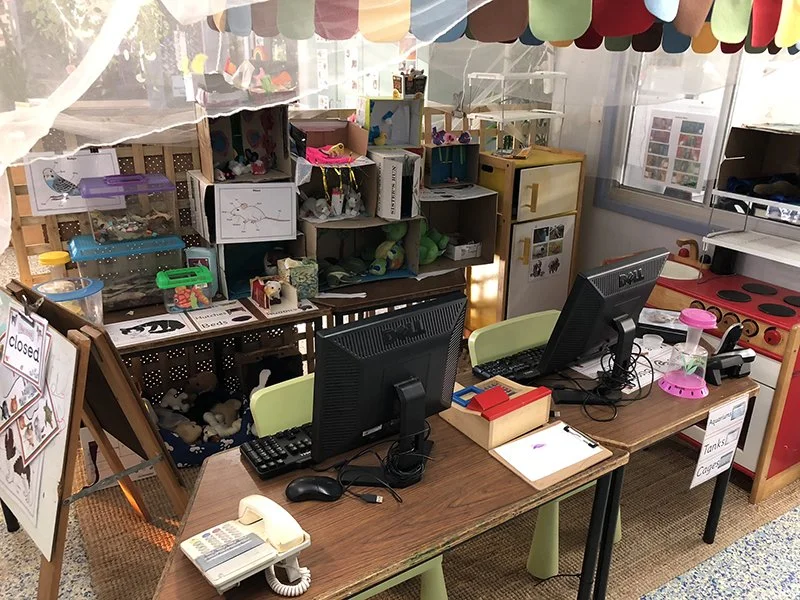
Dramatic play baby clinic – children take on different roles as doctors, nurses, and parents. This play scenario links directly to social studies and children’s learning about health and community.

Cross-Curricular Play
Dramatic play – home corners, shops, or post offices allow children to practise literacy (lists, labels), numeracy (money, counting), and social skills (turn-taking, sharing).
Art and creative play – painting, collage, or clay work connects to self-expression while building fine motor control.

Inquiry investigations – simple provocations with natural materials or specially designed resources encourage observation, questioning, and critical thinking across multiple content areas.

Outdoor play – obstacle courses, sandpit construction and mud kitchens, or cooperative play games all strengthen gross motor skills and teamwork.

Types of Play in Action
All these activities are just a few examples from my classroom that highlight the many forms of play that support early learning:
Pretend play – story retelling, dramatic play clinics.
Sensory play – water table, playdough phonics.
Cooperative play – outdoor games, group block building.
Parallel play – younger children side-by-side in the block area.
Onlooker play – observing peers at the art table before joining in.
Each type of play contributes to early childhood development, helping even the youngest students grow in confidence and build a strong foundation for future learning.
Ensuring Balance in Your Play-Based Learning Curriculum
It’s easy to picture a play-based classroom as free play all day long - but that’s really not what effective early childhood education looks like.
Balance is what makes a play-based learning curriculum truly work. Without intentional planning, things can quickly slide into chaos. With structure, however, play becomes purposeful and powerful.
As early childhood teachers, our role is to create a rhythm for the day that supports both child-led play and explicit teaching. In my own classroom, I’ve found three strategies particularly helpful:
Daily routines – predictable schedules help children feel safe and secure, giving them the confidence to fully engage in play.
Group rotations – small groups ensure targeted teaching alongside opportunities for exploration.
Reflection time – building in moments for children to share and discuss their play helps connect experiences back to curriculum goals.
Want to see exactly how I do this? Check out this blog post: My Play-Based Kindergarten Daily Schedule and Discover how to create a balanced kindergarten daily schedule that combines play-based learning with explicit teaching. You’ll get tips, practical ideas, and even a free editable planning template to keep your students engaged and meeting curriculum goals!
So are you wondering (like many other early childhood educators)…
But what if my students fall behind without enough direct instruction?
Research consistently shows that children in play-based environments don’t just keep up - they often do better!!
A study from Taylor & Boyer (2019) - Play-Based Learning: Evidence-Based Research to Improve Children’s Learning Experiences in the Kindergarten Classroom, found that balanced play-based programmes lead to deeper learning experiences than either pure direct instruction or free play alone. It includes findings that children engaged in play-based learning develop better problem-solving, communication, and the ability to make mistakes and try again. Play supports academic success and delivers meaningful social benefits, giving children both the knowledge and the skills to thrive.
Finding balance doesn’t mean splitting your day 50/50 either. It’s about knowing when to timetable in explicit teaching and when to step back to let children take ownership of their learning. When play is structured intentionally, it becomes the best choice for building a strong foundation across all areas of child development.
A Play-Based Learning Curriculum That Works
We’ve explored
how a play-based learning curriculum benefits children
how it can be integrated with traditional teaching
how simple strategies make it practical in your classroom
some examples from my play based classroom
We’ve also looked at the importance of balance - because together, purposeful play and direct instruction strengthen curriculum requirements
Here’s the takeaway: you don’t have to choose between meeting academic benchmarks and giving children joyful, meaningful learning experiences. With the right approach, play can be the best way to build a strong foundation of knowledge, social skills, and life skills. Play gives children opportunities to practise new skills, connect learning to real-world scenarios, and develop the confidence to take a closer look at the world around them.
As early childhood teachers, we all want the best ways to help our children learn. A play-based curriculum really is the best choice - for academic achievement, social benefits, and lifelong learning.
Your Next Steps
Download my free guide to getting started with play-based learning – it’s full of practical ideas for implementing a play based curriculum that you can use straight away.
Explore my Investigations resources – designed to save you time and support your play-based learning curriculum with purposeful, ready-to-go activities.
👉 Let’s give our children what they deserve: a play based learning curriculum that’s engaging, age-appropriate, and effective.
