
Teaching Phonological Awareness and Phonemic Awareness
Discover essential strategies for teaching phonological and phonemic awareness in early childhood education. This guide outlines the developmental stages and suggests practical teaching ideas and engaging activities to develop these important early literacy skills in preschool and kindergarten children.
With over 25 years of experience teaching young children to read and write, I’ve had the privilege of watching countless students reach and even exceed literacy curriculum benchmarks.
This success stems from three key practices:
Building a strong foundation for phonological and phonemic awareness.
Implementing explicit and targeted literacy lessons.
Incorporating play-based learning experiences that provide authentic opportunities to practice reading and writing skills.
Every school year, my literacy focus for the first term is on concepts of print, and phonological and phonemic awareness. Initially, I was concerned about dedicating so much time to these foundational skills, especially when other teachers were swiftly moving on to teaching alphabet letters and phonics.
However, year after year, the investment in developing strong phonological and phonemic awareness paid off. I repeatedly saw my students making excellent progress and, in most cases, surpassing benchmarks by the end of the year.
This guide is a culmination of everything I’ve learned over the years, supported by the latest research in the science of reading. It includes the most effective phonological awareness and phonemic awareness activities and strategies that have consistently worked in my classroom. I am thrilled to share this knowledge with you.
I wish I had a guide like this when I first started teaching reading and writing all those years ago.

Many teachers confuse the terms phonological awareness and phonemic awareness so let’s get super clear on these two literacy terms and eliminate any confusion right from the start.
Understanding the Basics: Phonological Awareness vs. Phonemic Awareness
Before diving into the specific strategies and activities, it’s essential to understand the foundational concepts of phonological and phonemic awareness. Although these terms are often used interchangeably, they refer to different aspects of early literacy development. Grasping the distinction between them will help you better support your students' literacy journey.
What is the Difference Between Phonological Awareness and Phonemic Awareness?
Phonological awareness encompasses a broad range of skills related to the awareness and manipulation of sounds in language (the larger units like syllables, words and phrases).
Phonemic awareness specifically focuses on the ability to identify and manipulate individual phonemes (the smallest units of sound) within words.
The main difference lies in the size of the speech patterns we are teaching.

What is Phonological Awareness?
Phonological awareness is the ability to recognise and manipulate the spoken parts of sentences and words. Put simply, phonological awareness is understanding that sentences are made up of words and spoken words are made up of individual sound parts.
Phonological awareness is a broad umbrella term that covers a range of skills related to recognising and manipulating the sound units of language, including:
Single and compound words
Syllables
Rhymes
Onset and rime
Individual phonemes (sounds)
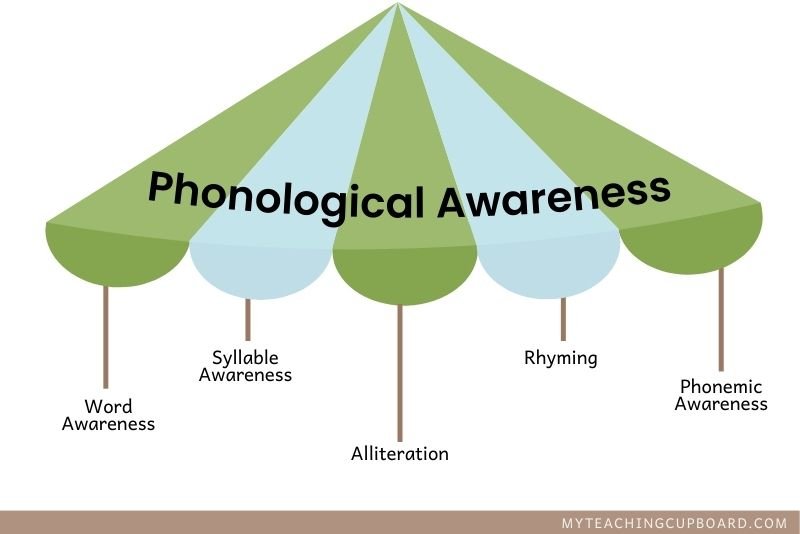
Some examples of phonological awareness tasks include:
Breaking down sentences into individual words
Identifying syllables in words
Identifying words with the same beginning sound
Recognising words that rhyme
Blending and segmenting onset and rimes
Phonological awareness is a precursor to building a solid understanding of graphophonic relationships, which involves printed language and alphabet letters.
How Does Phonological Awareness Develop?
For children to develop phonological awareness, they need to have some foundational skills in place:
Basic listening skills and the ability to recognise basic environmental sounds.
A vocabulary of several thousand words to draw from.
The ability to imitate and produce basic sentences.
The ability to use language to express needs, react to others, comment on experiences, and understand others' intentions.
These are prerequisite skills.
It is important for children to have a basic mastery of the spoken language before progressing through the four levels of phonological awareness.
The four levels of phonological awareness are:
Word Awareness: where children can hear and identify the individual words within spoken language.
Syllable Awareness: consists of segmenting words into syllables and blending syllables together to form words.
Intra-Syllable Awareness: narrowing words down into the units we often refer to as onset and rime. This level includes blending onsets and rimes to form words and segmenting the onset from the rime in words. It includes adding, deleting, or changing the onset and rime in a sound cluster or word.
Phonemic Awareness: is the most advanced and final stage of phonological awareness. It has four major sub-skills: hearing, focusing on, and manipulating sounds.
It is best practice to view the levels of phonological awareness as overlapping stages. They are not sequential so your kids don’t have to master any one skill before they can move on to the next.
Nevertheless, there is agreement that some aspects of phonological awareness appear to be more difficult than others.
Research from a study titled: A Developmental Continuum of Phonological Sensitivity Skills states that children should be taught that spoken language can be broken into parts to recognise similarities and differences in those parts and then to manipulate those parts before teaching children how to hear and manipulate individual sounds in words.
The study found that children must grasp the lower-level phonological awareness skills before they can succeed in the higher-level phonemic awareness skills.
It was also discovered that within each sound unit (e.g., word or syllable), children are generally able to recognise phonological information before they can manipulate it, and they can usually blend phonological information before they can segment it. Finally, the study suggests that children should manipulate initial sounds before final sounds.
Factors Influencing Phonological Development
Phonological awareness is especially important in the earliest stages of reading development in preschool, kindergarten, and first grade.
Children will start school with diverse levels of phonological awareness and there are several factors that can influence their development:
A Language-rich Environment: Regular exposure to a wide range of spoken and written language from an early age can significantly boost phonological awareness. This includes reading aloud, storytelling, and engaging in conversations.
Direct Instruction and Practice: Explicit teaching in rhyming, syllable counting, and phoneme manipulation play a vital role in developing these skills so make sure to include plenty of phonological awareness activities in your school day. Explicit teaching of phonological awareness in the early years can eliminate future reading problems for many students. If you have students struggling with decoding, working on their phonological awareness will help them, especially if they have problems in blending or segmenting phonemes.
Individual Differences: I don’t need to tell you how every child is unique. Factors like a child’s natural ability to distinguish and manipulate sounds, their overall language skills, and even their enthusiasm for learning can affect how quickly they develop phonological awareness.
Socio-cultural Factors: The linguistic environment at home and in the community, including the languages spoken and the value placed on literacy, can also impact the development of these skills.
Understanding the development of phonological awareness and the factors influencing a child’s development can help us provide effective instruction.
Observe your children and provide tailored support if you want to build a strong foundation for their reading and writing skills.

Now let’s dive a little deeper into the stages of phonological awareness and explore some practical activities to help you teach it.
Sound Discrimination
Hearing non-speech sounds is pretty easy for most students starting preschool and kindergarten—that is if they are paying attention.
Paying attention? Now, that’s something we early childhood educators are constantly working on.
Sound discrimination activities are important for helping your students learn to pay attention and for developing phonological awareness skills.
What is Sound Discrimination?
Sound discrimination is the ability to recognise similarities and differences between sounds. It relates to both speech and non-speech sounds.
The sounds could be nonspeech sounds like animal calls and musical instruments or speech sounds like words, syllables, and phonemes.
Sound discrimination is one of the essential skills that our kids need before they even start learning to read. It is super important because it helps kids break down words into their basic sound components. This ability improves their spelling and reading abilities.
Sound discrimination activities play a crucial role in any phonological awareness program. Activities designed to help students distinguish and isolate different sounds should be your first step in teaching phonological awareness.
Examples of Sound Discrimination
Animal Sounds: Children can engage in activities where they listen to and distinguish between different animal sounds. For example, they might recognise a cow's moo versus a sheep's baa.
Musical Instruments: Sound discrimination can be fostered through exposure to musical instruments, like when children distinguish between the sound of piano keys being struck and the sound of a guitar string being plucked or recognise the beat of drums compared to the melody of a flute.
Rhyming Games: Playing with rhyme helps children distinguish the sound structure of words. Nursery rhymes, rhyming poems, and rhyming stories are loved by young children and are the perfect resource for exploring rhyme and rhythm.
Why Sound Discrimination is Important
In any early childhood classroom, one constant challenge is getting our students to pay attention. We are always working on teaching our kids to truly tune in and actively listen. Sound discrimination activities can help us. They sharpen phonological and phonemic awareness and help students develop their listening skills.
When your students participate in sound discrimination activities, they are learning not just about sounds but also the art of listening.
At the foundational level, students begin by recognising and distinguishing between environmental sounds. Some sounds to include would be
animal noises
sounds from musical instruments
household sounds
nature sounds
Being able to discriminate environmental sounds sharpens listening skills and heightens awareness of the sounds in your surroundings.
Sound discrimination activities are important phonemic awareness activities. They teach students to listen and really pay attention.
If you are interested in learning more about sound or auditory discrimination, you should check out this blog post: 9 Practical Sound Discrimination Activities - Fun and Easy
It contains nine practical auditory or sound discrimination games and activities to help you teach this skill to your kindergarten or preschool children.

Word Awareness
Word awareness is a key part of phonological awareness. It's about knowing that sentences are made up of individual words. Even though children hear and use words all the time, it doesn't automatically mean they understand what a word is or can tell where one word ends and another begins.
What is Word Awareness?
Word awareness is the most basic level of phonological sensitivity and involves recognising that a sentence or phrase is made up of individual words. When listening to the English language, children with strong word awareness can easily identify where one word ends and another begins. Word awareness also helps when they start reading and writing.
For Reading: Students need word awareness to decode words. They need to be able to break words into smaller chunks, like syllables and sounds, for effective decoding. Without word awareness, this task would be impossible.
For writing: Students need word awareness if they are to write coherent sentences. They need to be able to recognise words and appropriately space them. Not that my students have got this yet. “Where are your finger spaces?” seems to be on repeat in my classroom 🤣
When children have word awareness, they can isolate words within sentences, manipulate these words, and track the word sequences in sentences. These skills are essential for sentence segmentation and word manipulation. These skills also help students see that sentences are constructed from individual words.

Why is Word Awareness Important?
While word awareness is an important semantic language skill, it's worth noting that it is less directly predictive of reading success than other phonological skills.
However, recognising words as separate units in spoken language is definitely a precursor to reading and writing. Word awareness contributes significantly to vocabulary development, comprehension, and overall language proficiency.
The 3 Stages of Word Awareness
Word awareness has three progressive stages.
Word Isolation and Identification: where students isolate single words in short phrases and compound words.
Sentence Segmentation: where students recognise each word as its own unit and can count the words in a sentence.
Sentence Production: In this higher-level stage, students create their own sentences with a specified number of words.
Teaching Word Awareness Effectively
As an experienced teacher, I have found that hands-on learning activities are the most effective way to teach word awareness to young children.
Here are a couple of some fun and engaging activities that I have tested and found to be successful in my classroom:
Listening to Words in Sentences
To develop word awareness in your students, start by developing their listening skills. Encourage them to listen to sentences and try to identify the separate words. This can be done through simple exercises like repeating sentences and clapping for each word.
I like to do this during a read-aloud. Every now and then, stop to focus on the words in a sentence from the story. Count the words together by getting your students to clap for each word they hear. Want to add a bit of movement and get the wiggles out? Instead of clapping, get your students up and ask them to jump for each word they hear.
Squash the Words
I love using my Nursery Rhyme Playdough Mats to teach word awareness. Each mat features a familiar sentence from a popular nursery rhyme.
You give each student some play dough to roll into small balls. The kids place the playdough balls on the designated circles beneath each word in the sentence on their mat. As they say each word, they develop one-to-one correspondence and word awareness by squashing the corresponding playdough ball.
This simple yet highly effective activity will help young children see and hear word boundaries. It reinforces one-to-one correspondence, builds fine motor skills, and promotes counting practice. Such a fun and engaging way to develop word and phonological awareness skills.

Teach word awareness with these hands-on playdough mats. The concept of a word is a basic phonological awareness skill we need to explicitly teach preschool and kindergarten kids. Using a popular and familiar Nursery Rhyme theme will keep your students engaged while they learn to segment the words in a sentence.
Hands-on Literacy Learning
Using active learning resources like playdough to teach early literacy skills is a winner in any early childhood classroom. I’ve combined the benefits of playdough (sensory and fine motor skills) with literacy-rich nursery rhymes (fun and familiar language) to encourage active learning and boost engagement in what can sometimes be boring routine word awareness practice.
A Versatile Word Awareness Resource
I wanted a hands-on word awareness activity that could be used in various classroom learning experiences. After all, if you go through the trouble of printing and laminating playdough mats, you want to be able to use them more than once!
You can use these Nursery Rhyme resources over and over! Use them:
In hands-on literacy investigation areas
At literacy centers
For fine motor activities
During small group literacy rotations
For independent word work
In morning tubs
As busy bags
For early finishers
As homework tasks
Or for informing your assessment grades
This Word Awareness Playdough Resource Contains:
35 Nursery rhyme Playdough Mats
My best-ever playdough recipe
35 Nursery rhyme cards with the lyrics for your reference. I like to add mine to a binder ring.
3 Learning Prompts
A teacher checklist to track students' progress and understanding of word awareness.
2 Student recording sheets
A document wallet label to print and help you keep the resources organized.
There’s so much more than printable Nursery Rhyme playdough mats in this comprehensive resource.
How to Use These Nursery Rhyme Playdough Mats to Teach Word Awareness
Each of the 35 Playdough Mats features a familiar sentence from a popular nursery rhyme.
Give each student some play dough and a nursery rhyme mat.
They develop those essential fine motor skills as they roll the playdough into small balls.
Next they place the playdough balls on the designated circles beneath each word in the sentence on their mat.
As they say each word, they develop one-to-one correspondence and word awareness by squashing the corresponding playdough ball.
This simple yet highly effective activity will help young children see and hear word boundaries. It reinforces one-to-one correspondence, builds fine motor skills, and promotes counting practice. Such a fun and engaging way to develop word and phonological awareness skills.
I love hands-on learning activities like these because fun and meaningful learning activities mean the learning will stick.
With colourful visuals and an easy-to-follow format, these nursery rhyme themed word awareness play dough mats will become a go-to resource in your early year’s classroom year after year.
These hands-on playdough mats are a fun way to teach the concept of a word. I have found that using popular and familiar Nursery Rhymes keeps my students engaged and on task. Familiar nursery rhymes take the pressure off their short-term memory, so they can focus their thinking on learning to segment the words in the sentences.
Want More Engaging Word Awareness Activities?
Discover all my engaging word recognition activities, teaching tips and instructional practices for this basic phonological awareness skill here in this blog post: 22 Word Awareness Activities to Develop Phonological Awareness
This blog post is a practical guide to developing word awareness through playful, hands-on strategies and is perfect for kindergarten, preschool, and first-grade teachers looking to teach the concept of a word.

Syllable Awareness
Understanding syllables is an important phonological awareness skill.
What is a Syllable?
A syllable is a unit of sound in speech. It is a part of a word typically made up of a vowel sound with or without surrounding consonants. For example, the word banana has three syllables: ba-na-na.
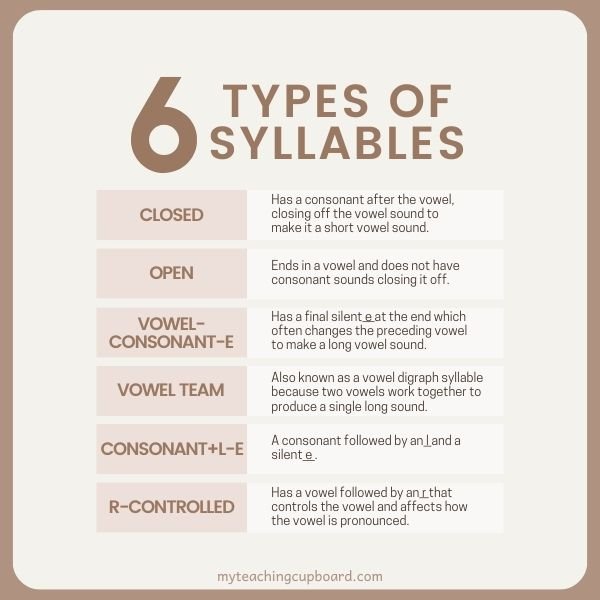
There are six different types of syllables:
A closed syllable: It has a consonant after the vowel. The consonant at the end of the syllable closes off the vowel sound, making it a short vowel sound. In the English language, examples of closed syllables include cat, sit, and top.
An open syllable: These types of syllables end in a vowel and do not have consonant sounds closing it off. A consonant sound does not follow the vowel sound, so it remains "open" and typically produces a long vowel sound. In English, examples of open syllables include no, be, and she.
A vowel-consonant-e syllable: This is sometimes known as a silent-e syllable or magic-e syllable. This syllable type is typically found at the end of a word. The final “e” at the end of the syllable is silent and often changes the pronunciation of the preceding vowel, making it a long vowel sound. For example, in the word cake, the "e" at the end is silent, but it changes the pronunciation of the vowel "a" from a short /æ/ sound to a long /eɪ/ sound.
A vowel team syllable: Also known as a vowel digraph syllable, occurs when two vowels work together to produce a single long sound. These combinations of vowels are often referred to as vowel teams. A vowel team appears in the same syllable, and together they represent one sound. Examples of vowel teams include: "ai" in rain, "ea" in team, and "oa" in boat.
A consonant+l-e syllable: Also known as a final stable syllable, is a syllable pattern consisting of a consonant followed by the letter "l," and then the letter "e." In this syllable pattern, the "l" is preceded by a consonant and followed by a silent "e." Examples of words with consonant+l-e syllables include table, apple and bubble. In each of these examples, the "l-e" combination forms a syllable with the preceding consonant, resulting in the final stable syllable pattern.
An r-controlled syllable: This syllable type contains a vowel followed by the letter “r”. The “r” controls the vowel and affects how the vowel is pronounced. Some examples of r-controlled vowels include: “ar" as in car, "er" as in her, "ir" as in bird, "or" as in for and “ur" as in fur.
What is a Syllable Awareness?
Syllable awareness is the ability to identify and manipulate the beats (syllables) within words. It includes activities like counting, tapping, segmenting words into their syllables, as well as blending them to form words.
Why is Syllable Awareness Important?
Syllable awareness is a foundational skill in learning to read. Recognising syllable boundaries, counting the number of syllables in words, and blending separate syllables to make words are all part of syllable awareness.
Understanding syllables supports a student’s ability to blend and segment sounds. These skills are essential decoding strategies for young readers and also help students learn to spell accurately.
If students know how to identify syllables and break down words into syllables, they will be able to apply spelling rules and decoding strategies to the different segments of a word.
Words Can Be Monosyllabic or Multisyllabic
Monosyllabic words have one syllable. Some examples of one-syllable words are: cat, jump, and thought. CVC words (consonant-vowel-consonant) are common single-syllable words.
Multisyllabic words or Multi-syllable words are longer words and have more than one syllable.
They can be:
Multisyllabic: Disyllabic: have 2 syllables like sun/set, ba/by, pen/cil
Multisyllabic: Trisyllabic: have 3 syllables like i/mag/ine, di/no/saur, cam/er/a
Multisyllabic: with 4 or more syllables like cat/er/pill/ar, u/su/al/ly, i/ma/gin/a/tion
When introducing syllables, it is best practice to use disyllabic words first, then monosyllabic words, and finally, other multisyllabic words.
How Many Syllables is a handy website tool you might like to use. It's totally free! You type in any word, and it will show you how many syllables it has, how to break it down into syllables, and even highlight the primary and secondary ones to make pronunciation a breeze.
When teaching syllable awareness, start with compound words or disyllabic (2-syllable) words like baby or snowman. Then move on to monosyllabic and longer multisyllabic words.
I like to start with compound words, which combine two separate words to create a new word. Some examples of compound words are sunflower, playground and bookshelf.
Compound words are a great place to start if your students struggle with syllable awareness.

Do you have kids struggling to blend and segment syllables? Start with compound words. This interactive compound words activity is perfect for developing basic phonological awareness skills. Students will gain confidence, fluency and feel successful when they practice segmenting and blending compound words using the real-life pictures in this resource.
Teach Phonological Awareness with Compound Words
Once students understand that sentences are made up of individual words, they are ready to start blending and segmenting syllables. That’s where compound words come in. Compound words are made of two smaller words, combined to make a new word with a new meaning.
This makes them perfect for teaching young children the concepts of blending and segmenting – a basic phonological awareness skill.
If your students find blending, segmenting and manipulating syllables difficult, you need to take a step back and work with compound words. It is much easier for students to blend and segment compound words than it is to blend and segment syllables.
When they have mastered blending, segmenting and manipulating compound words, they can progress to syllables and, eventually single sounds or phonemes.
Oh - It’s great for vocabulary development as well.
Why Use Compound Words with Pictures?
Phonological awareness is about recognising and manipulating the spoken parts of sentences and words. It does not include written words and letters – that’s phonics!
Always avoid resources heavy with text when teaching phonological or phonemic awareness. That's why I designed this resource using only pictures to illustrate the compound words. Your students will practise HEARING the words (phonemic awareness) rather than thinking about the letter-sound correlations of phonics.
This picture-based compound word activity is designed with young learners in mind. There’s no complicated clipart – just easy-to-recognise real life photos so your students can easily identify them. The use of real-life pictures also makes learning more engaging for young children.
Talk about engaging! My kids love these flip cards.
How To Use These Pictures of Compound Word Flip Cards
Your students can use these cards to practice both blending or segmenting compound words. Each card has 2 sides. One side has a compound word picture, and on the other side, there are 2 pictures illustrating the 2 parts.
Use These Compound Word Picture Cards 2 Ways
Students practice hearing the 2 word parts of the compound word and then blending these parts together to make the complete compound word.
Students practice hearing the complete compound word and then segmenting it into the 2 parts.
They love working with a friend to practice, but it also makes for a great independent activity as well. The hands-on nature of flipping and manipulating the cards adds an interactive element that will keep students interested and motivated.
How My Students Independently Practice Blending and Segmenting with These Compound Word Picture Cards
First the kids pair up with a buddy.
If I want them to work on blending, they look at the card showing two pictures and say out loud the two words so that they blend them together to make a new compound word. If I want them to practice segmenting, they look at the picture card showing a compound word and say out loud the two smaller words that come together to make the word in the picture.
Their buddy listens and if they think it was done correctly, they will say, “Flip it!"
Now the card is flipped over to reveal the matching picture on the back. I love that these cards are self-correcting. No more kids interrupting my small group literacy instruction lessons. EMOJI
Finally, the kids swap! The listener becomes the blender or segmenter, and their partner has their turn to listen and the activity continues.
There are 40 compound words included in this resource so there’s plenty to keep the kids on task. I’ve included a heap of bonus features for you as well.
This Blending and Segmenting Compound Word Resource Contains:
40 Illustrated compound word flip cards for learning to both blend and segment compound words
A Compound Words Poster to help your students understand compound words
3 Learning Prompt Posters in case you want to set up a compound word learning center
2 Student Recording Sheets for evidence of learning
Teacher Assessment Recording Sheets – to keep those essential teacher observations organised
Task Card Box Label for storing and organising the flip cards
The key to successful phonological awareness instruction is to make it engaging and enjoyable for your students. Incorporating games and hands-on activities like this will capture your students’ interest and motivate them to develop their phonological and phonemic awareness.
Following a bit of guided practice with these cards, your students will be able to remember the routine and practice independently or with a friend. You will be able to use these versatile cards over and over again.
There are even printables included in this compound word PDF that you can use to help you set up a quick and easy literacy center or phonemic awareness investigation area.
This Independent Self-checking Compound Word Activity is Perfect for:
small group literacy rotations
guided reading instruction
buddy reading
independent reading
hands-on literacy centers
homework
reading stations
morning tubs
early finishers
word work
reading intervention
or to inform your assessment grades
An Easy To Prep Compound Word Activity
These cards are super simple to make.
Print the cards onto paper and cut out the strips.
Fold each strip in half and laminate to make the flip cards. You’ll have a picture on the front and self-checking pictures on the back.
Easily hole punch each card using the guide marks included.
Thread the cards onto a binder ring.
So, if you have been struggling to find the right tools for teaching basic phonological awareness skills, these interactive compound word flip cards can help you.
Instantly download this resource to help your kids find success and ensure your phonological and phonemic awareness instruction is complete and comprehensive.
Specially designed for kindergarteners and early primary students. They provide a fun and effective way for students to practice blending and segmenting compound words.
Ensure your students have no gaps in their phonemic awareness skills by investing in the targeted practice of segmenting and blending compound words.
This interactive compound words activity is perfect for developing basic phonological awareness skills.
Students will gain confidence and fluency and feel successful when they practice segmenting and blending compound words using the real-life pictures in this resource.

Looking for a fun way to develop your students' phonological awareness? My Compound Word Clip Cards are the perfect addition to your literacy centers and lessons! Designed with beginner-level phonological awareness in mind, these picture cards help preschool, kindergarten and first-grade students master the skill of blending and segmenting compound words.
These Compound Word Clip Cards are:
Engaging and Interactive: These compound word activities are hands-on and super fun. Students will love using the real-life photos to practice hearing and identifying individual words and combining them into a single compound word.
Educational and Effective: With 80 clip cards, this set includes everything you need to teach blending and segmenting compound words. The activities focus on hearing the words rather than thinking about letter-sound correlations, making them ideal for developing phonemic awareness.
A Versatile Learning Tool: Perfect for small group activities, guided reading, independent work, and more. These cards can be used in various settings, including literacy centers, reading investigation areas, and even for homework or early finishers.
2 Sets of Compound Word Clip Cards and More
40 Clip Cards for Blending Compound Words: Each card shows two separate images. Students say each word and blend them into a longer word, clipping a clothespin onto the matching compound word.
40 Clip Cards for Segmenting Compound Words: Each card features a compound word picture. Students say the compound word, then segment it - split it into two parts, clipping the clothes pegs onto the matching pictures.
Heaps of BONUS Resources: A Compound Words Reference Poster, Learning Prompt Posters, Student Recording Worksheets, Teacher Assessment Sheets, and Task Card Box Labels to keep everything organized.
Why Teach Compound Words?
Your students must develop their phonological and phonemic awareness skills before you can expect them to segment and blend phonemes – a vital skill needed to decode and spell words and something we spend alot of time teaching in Prep and kindergarten.
It is best to start with activities designed to first practice segmenting and blending words and syllables because it is much easier for children to hear the bigger units of language, like syllables, than it is to differentiate individual phonemes in a word.
That’s why I designed these fun activities using 40 different compound words.
This resource is 100% picture-based so you can focus on teaching phonological awareness - an auditory skill.
With the two versions in this resource, your students can use them to practice both blending or segmenting compound words.
Perfect for Various Phonological Awareness Activities:
Small Group Literacy Rotations
Guided Reading Instruction
Independent Reading Activity
Morning Tubs and Early Finishers
Homework and Reading Intervention
Word Work and Reading Stations
Easy and Fun to Use
These clip cards are designed to be self-correcting, making them easy for students to use independently. They’re a great way to keep students on task and motivated to develop their phonological awareness.
Boost Your Students’ Language Skills
With two types of activities and 40 different compound words in each set, these cards provide a fun activity for your students to practice their knowledge of compound words.
Whether it’s for a whole group game or independent practice, they are the best way to give students that little extra practice they need.
Transform your literacy instruction with these engaging and interactive activities. They’re the perfect tool for helping students develop their phonological awareness and language skills.
Use these compound word clip cards to teach phonological awareness. There are 2 sets of cards in this beginner-level hands-on activity.
One set blends compound words, and another segments compound words. They are ideal for kindergarten or first and second-grade intervention.
Want Help Understanding Syllables and Teaching Syllable Awareness?
Clapping the syllables in words for your literacy warm-up gets a bit boring after a while. So before you have to face another dreaded eye-roll, check out this blog post: Activities for Teaching Syllables and Phonological Awareness

This comprehensive blog post will help you teach your students all about syllables. There are twelve engaging syllable awareness activities your students will love in this comprehensive blog post. Use them in your classroom and your students will master blending and segmenting syllables in no time!
Rhyme and Alliteration
These skills focus on recognising and producing rhyming words and identifying words with the same initial or final sounds.
Recognising and Producing Rhyming Words
The ability to recognise rhyme precedes the ability to produce rhyme.
Recognising rhyming words and words that do not rhyme is a crucial part of this phonological skill. For example, children with rhyme awareness can identify the rhyming words from this group: cat, hat, tap.
Note: Looking at written words is not part of this skill. Written words will come later when you are teaching phonics. In phonological awareness lessons, use only spoken words or pictures.
Producing rhyming words requires students to think of words that rhyme with a given word. For example, given a group of rhyming words like mat, rat, and hat, children might be asked to come up with another rhyming word like pat. Some rhymes are more difficult than others, especially those with more complex syllable types or multiple syllables.
Understanding Syllables and Rime
As already discussed, every word can be broken down into syllables. Each syllable has at least a nucleus or vowel. Most syllables also have an onset (consonants before the vowel) and a coda (consonants after the vowel). The nucleus and coda together make up the rime of the syllable. This rime is the part that rhymes.
For example, the following words have multiple syllables in the rhyming part of the word:
One Syllable Rhyme (with syllable breaks): week, sneak, streak
Two Syllable Rhyme (with syllable breaks): nation, dalmatian, frustration
Three Syllable Rhyme (with syllable breaks): serious, mysterious
Alliteration using Initial and Final Sounds
Students learning about initial and final sounds often have them sorting words by their beginning and ending sounds.
It is not about the initial or final letter so when organising resources and preparing activities using initial and final sounds, I like to say the words aloud and listen to the spoken words. This ensures the words have the same phoneme and not just the same letter.
For example, phone and photo are not related to the /p/ sound. They are part of the /f/ sound group. And words like shark or shop are not part of the /s/ sound group. They would come up when you explore /sh/ words.
3 Activities for Recognising Rhyming Words
Read Aloud Rhyming Picture Books: When reading picture books, choose ones that feature rhyming words so you can discuss the rhymes and rhythms of the read-alouds.
I’ve got an impressive collection of picture books to teach rhyming words. If you need to add to your collection, check out this blog post: 79 Rhyming Books for Kindergarten and Preschool
Play Rhyming Splat: This super fun game is perfect for small groups. You'll need some rhyming picture cards and 2 fly swats. The rhyming pictures are randomly placed on a table and the children sit around the table with the teacher. Two children take a fly swat each.
The teacher says a word that rhymes with one of the pictures on the table, and the children with the fly swats race to SPLAT the matching rhyming picture. The child who splats the correct picture first keeps the fly swat for another turn. The other child passes their fly swat to the child next to them, and the game continues.
Want the pictures I use to play Rhyming Splat? Download them from my FREE Resource Library.

3. Use a Rhyming Basket: To make a rhyming basket, put a collection of small rhyming objects into a basket for the children to investigate. It makes a great addition to an investigation area or literacy centre.
You can read more about my rhyming basket HERE. In this blog post, you will also get a list of easy-to-find rhyming objects you can add to your class rhyming basket.

3 Activities for Producing Rhyming Words
Rhyming I Spy: This is similar to the classic game of I Spy but it has a rhyming twist. To play, the first child gives a rhyming word as the clue instead of the traditional first letter.
For example, if the child chooses chair, they say, 'I spy with my little eye something rhyming with bear. The other children then take turns to guess the rhyming answer. Allow the children to invent rhyming nonsense words to make the game easier to play.
Rhyming Obstacle Course: Use outdoor play equipment like climbing frames, balance beams, stepping buckets, jumping hoops, etc. to create an obstacle course. Stick a rhyming word picture onto each piece of equipment. As the children make their way through the course, they must produce a word that rhymes with the picture on their piece of equipment.
Innovate on Nursery Rhymes: Create innovations on familiar nursery rhymes by changing the rhyming words. For example, Humpty Dumpty sat at the beach could become Humpty Dumpty was eating a peach. Young children love innovations.
Want more activities to teach rhyming? You will love this blog post: 43 Rhyming Activities for Kindergarten
Yes, you read that right. This blog post has 43 rhyming games and hands-on activities for you. They are all tried and tested. These educational activities are guaranteed to develop rhyming skills and your students will have heaps of fun doing it!

There are a heap of resources to help you teach rhyming words in my store.
Want more rhyming activities?
Rhyming is such a foundational skill in early literacy.
We have a whole term dedicated to learning about rhyming words and word families in Prep. That's why I have so many interactive rhyming games and activities in my store.
If you are looking for effective rhyming activities that will keep your students engaged and excited to learn, check out my Rhyming and Word Family Resources.
Give your students the tools they need to succeed!

We have discussed most of the levels of phonological awareness in depth but there’s one final level – Phonemic Awareness. It’s a big one!
Most kindergarten and Prep teachers spend the start of the school year on phonological awareness instruction and one critical skill taking up a good chunk of our literacy block is phonemic awareness!
Teaching phonemic awareness is certainly a priority in the early years of schooling.

In my teaching, the phonological awareness and phonemic awareness activities in this guide have proven to be not just educational, but also incredibly engaging for my students.
My kindergarten students love the interactive, playful activities in this guide. Not only are these literacy activities engaging but since implementing the ideas in this guide, I've seen remarkable progress in their understanding and use of language as well.
It's a reminder of how learning through play can be so effective.
So download this free guide and choose from all the examples of phonological awareness activities in this comprehensive selection of play-based ideas.
What is Phonemic Awareness?
Phonemic awareness is the final skill that falls under the broad umbrella of phonological awareness.
Phonemic awareness strategies focus on identifying and manipulating the smallest unit of sound (phoneme) in a spoken word.
Before children can grasp the alphabetic principle, they need to understand that the sounds (phonemes) associated with alphabet letters (graphemes) are the same sounds used in spoken language.
While it might seem basic, many students do not inherently understand that spoken language is made up of sequences of small sounds. These small sound units are called phonemes, and phonemic awareness involves recognising that words consist of distinct sounds and being able to manipulate these sounds.
Phonemic awareness includes activities such as blending sounds into words, segmenting words into sounds, and deleting and substituting sounds in spoken words.
Let’s look at the word fishing as an example:
Phonological Awareness: The word can be broken down into syllables: fish and ing.
Intra-Syllables: Within these syllables, we can identify the intra-syllables as /f/ (onset) and -ishing (rime). This is still part of the phonological awareness umbrella.
Phonemic Awareness: The individual phonemes in fishing are /f/i/sh/i/ng/. This is a phonemic awareness skill because we are working with phonemes.
It's important to remember phonemes represent sounds, which may not always align one-to-one with letters or the word's spelling. In fishing, there are 7 letters but only 5 phonemes.
Phonemic awareness, like phonological awareness, is about speech sounds, not written representation, which is covered by phonics.
Phonics instruction involves teaching the relationships between letters and their corresponding sounds.
Phonemic awareness can be developed without prior knowledge of letters and phonics.

Why is Phonemic Awareness Important?
I know phonemic awareness is extremely important because I have seen first-hand how it influenced my student’s abilities to learn the basic literacy skills we teach in kindergarten and grade one. All that time invested in building our phonological awareness and, more specifically, our phonemic awareness skills in these early years of schooling built the foundation for many pre-reading and pre-writing skills.
When I saw other kindergarten classes starting formal reading and writing lessons, I used to worry that I was wasting valuable teaching time. My fears were forgotten when I saw how quickly and easily my students picked up phonics, decoding, and phonetic spelling.
Phonemic awareness will help your students develop and learn:
Decoding Skills: Decoding is the ability to match sounds (phonemes) to letters (graphemes) and then blend these sounds to form words. Phonemic awareness provides the groundwork for decoding skills because it helps early readers to recognise and manipulate individual phonemes.
Your students need phonemic awareness if you want them to be able to decode unfamiliar words and sound out words they encounter when reading.
For example, blending the sounds /c/ /a/ /t/ into the word cat is an example of a phonemic awareness task. If students can blend the word, they can then read the word.

Decoding skills are also essential for building reading fluency and comprehension in your students. The whole purpose of learning to read is comprehension, and it all starts with phonemic awareness and decoding.
Spelling Proficiency: When students are aware of the individual sounds in words, they can transfer that knowledge to spelling. Phonemic awareness activities will help your students to understand the relationship between sounds and letters.
For example, segmenting the word cat into the sounds /c/ /a/ /t/ is an example of a phonemic awareness task. If students can segment the word, they can then spell the word.
Kids need to be able to map phonemes to corresponding letters or letter combinations if they are going to have any chance of accurately spelling words. Strong phonemic awareness supports spelling proficiency and reduces the old reliance on rote memorisation.
Vocabulary Development: Phonemic awareness can help develop children’s vocabulary. It can help students break down new words into phonemes so that they can more easily recognise and remember them. The ability to manipulate sounds in words helps expand a young child’s vocabulary and can promote word comprehension too.
Reading Comprehension: Phonemic awareness contributes to reading comprehension because it helps to build reading fluency. By mastering phonemic awareness skills, your students will be able to competently identify and distinguish the sounds that make up words, and that leads them to efficient word decoding. This in turn, will build reading fluency so that they can comprehend and derive meaning from the text.
Language Acquisition: Phonemic awareness is closely tied to language development.
By engaging in activities that promote phonemic and word awareness, learners become more attuned to the sounds and nuances of spoken language. This heightened awareness enhances their overall language skills, including listening, speaking, and even understanding grammar.
Early Literacy Success: Phonemic awareness is considered a strong predictor of early literacy success. Research has consistently shown that children who possess solid phonemic awareness skills are more likely to become proficient readers and writers.
By establishing a solid foundation in phonemic awareness, your students will be equipped to tackle the challenges of learning to read and write.

If explicit phonemic awareness instruction is not provided, many students will not grasp the concept that words are made up of individual sounds. Instead, they may think that words are whole units that need to be memorised visually.
Although children naturally learn about language by listening to speech and words, they don’t naturally hear the individual sounds within words. When we speak, we don't make individual sounds. Instead, we blend the sounds together to make entire words. So, if we just jump straight into teaching letters and their sounds without any phonemic awareness instruction, our students may struggle to comprehend the logic behind phonics.
Phonemic awareness is like a gateway to unlocking the complexities of reading and writing for our little ones. Don’t worry that any phonemic awareness activity or lesson will be a waste of time. Know that it is, in fact, building the strong foundation your students need.
And it is all backed by research. Recent research in the Science of Reading supports teaching phonemic awareness to students learning to read and write.
How Does Phonemic Awareness Develop?
Students learning about initial and final sounds often has them sorting words by their beginning and ending sounds.
It is not about the initial or final letter so when organising resources and preparing activities using initial and final sounds, I like to say the words aloud and listen to the spoken words. This ensures the words have the same phoneme and not just the same letter.
For example, phone and photo are not related to the /p/ sound. They are part of the /f/ sound group. And words like shark or shop are not part of the /s/ sound group. They would come up when you explore /sh/ words.
Initially, students explore the concept that words consist of smaller units known as phonemes. They then develop the ability to recognise each phoneme's distinct identity, allowing them to distinguish and differentiate these individual sounds.
Key Factors in Phonemic Awareness Development
Articulation: It's easier for students to distinguish between different phonemes by feeling them in their mouths rather than just hearing them. Emphasise lip and tongue placement, mouth shape, and voiced vs. unvoiced sounds.
Lip and Tongue Placement: Explore how lips and tongue position affect sound production (e.g., /p/ vs. /b/ and /t/ vs. /d/).
Mouth Shape: Discuss mouth shapes influenced by lip and tongue placements (e.g., long /ee/ vs. short /oo/).
Voiced and Unvoiced Sounds: Teach the difference by focusing on vocal cord vibrations (e.g., voiced /v/ vs. unvoiced /f/).
Phonemic awareness includes four main sub-skills: isolating, blending, segmenting, and manipulating phonemes. While these sub-skills can overlap, research suggests some are more challenging to master than others so I like to follow this progression:
Recognise and Isolate Individual Phonemes: hearing the initial, medial and final sounds in words and identifying the position of a specific sound in a word.
Blend Phonemes into Words: combining individual sounds to form a word, like /c/ /a/ /t/ to make cat.
Segment Words into Phonemes: separating a word into its individual sounds, like cat pulled apart makes /c/ /a/ /t/.
Manipulate the Phonemes in Words: deleting or substituting phonemes to make new words.
Phonemic awareness is a gradual developmental process. Using classroom observations and research from the Science of Reading, I've developed a phonemic awareness continuum to help guide instruction and activities tailored to my students' needs.
Now let’s explore these four sub-skills in detail.
Recognise and Isolate Individual Phonemes
When children can recognise and isolate individual phonemes, they can hear the initial, medial and final sounds in words. They can also identify the position of a specific sound in a word.
Discriminating Individual Phonemes
Phoneme discrimination involves hearing and isolating sounds at the beginning, middle, and end of a word, often referred to as initial, medial, and final sounds.
Examples:
The word cup has /k/ as the first sound,/p/as the final sound, and/u/as the medial or vowel sound.
In the word shark – the first sound is /sh/, the final sound is /k/ and the middle sound is /ar/.
Teaching Tips:
Work with single-syllable (monosyllabic) words in the beginning stages of phonemic awareness.
I like to start with the initial sounds in words because it is easier for students to hear them.
Final consonants are quite difficult to isolate. Unfortunately, most speakers do not enunciate the final sounds in words, so it is particularly difficult for children just learning about phonemes to hear them. Make sure to clearly articulate your words and pay particular attention to your final sounds.
Start with Onset-rime Segmentation
Segmenting larger chunks of words can help students who have difficulty isolating individual phonemes. Try getting students to segment words into onset (initial consonant sound) and rime (remaining phonological unit).
Examples:
The word sand can be segmented into /s/ and /and/. You can make a new word – and when you delete the initial sound /s/.
For the word bump, concentrate on isolating the first sound so it becomes b-ump. You can begin manipulation exercises and make new words by substituting the initial/b/ sound with other sounds like /h/ or /th/.
5 Activities to Teach Phoneme Isolation
1.Hand-held Mirrors: Give children hand-held mirrors to explore the articulation of phonemes. As you practice saying different sounds, discuss the position of their mouths, lip and tongue placement and airflow.
2. Picture Sorts: These are great for targeted phoneme practice. Begin by collecting two sets of pictures, with each set representing a different phoneme. For example, if you want to focus on the initial /s/ and /t/ sounds, gather pictures of items like a snake, the sun, a sandwich, and a seal for the /s/ sound.
Then, prepare another set of pictures for the /t/ sound, including a turtle, tiger, table, and a tent.
Start by identifying and discussing each picture and ensure your students understand the connection between the pictures and the phonemes they represent. Then model how to sort the pictures.
Picture sorts can be done by initial or final sounds. Do picture sorts regularly, and soon, your students will be able to do them with a friend and eventually independently.
Don’t have time to gather up a collection of pictures for sorting? Grab my already done-for-you set of initial sound picture sorts HERE.

Develop your students' phonemic awareness skills with these engaging Initial Sounds Picture Sorts. Based on the Science of Reading, these phonetic picture sorts teach sound recognition and develop strong alphabet letter-sound correspondence. Designed for beginning and emergent readers, this hands-on phonemic awareness activity is a must-have for kindergarten and preschool teachers seeking to practice isolating phonemes and strengthening alphabet letter sounds.
THIS SET CONTAINS:
26 Alphabet letter labels to make sorting mats.
up to 12 easily recognised photos for each of the 26 initial sounds.
Printable Title Cover Label for easy storage.
A word list answer key.
Bonus A4 Alphabet Poster.
2 printable Learning Prompts.
IDEAS FOR USE:
Picture sorts are one of my favourite ways to help students hear and identify beginning sounds in words. They help students turn abstract listening into a concrete activity so they can learn by doing.
I first model how to do a picture sort with my children. Working together, we say the letter name and sound on 2 of the labelled A4 cards. I then introduce the corresponding little picture cards. One at a time, we name the picture and listen to the initial sound before deciding on which labelled card it belongs.
At the end of the guided sorting, the children are ready to sort the pictures individually or with a friend.
To become fluent readers, children must become fast and accurate with their phonemic awareness. These picture sorts will help your children get there. Put a timer on and have a sorting race—your children will love it.
DIFFERENTIATE:
I love these picture sorts as they allow me to easily differentiate my teaching. I can individualise the activity by giving each child the sorts for the letter sounds they need to learn.
I start them on a 2-sound sort that has a sound they already know and a sound they need to learn.
For more able children, I might give them up to 4 picture sorts at once. They love the challenge.
CLEAR PHOTO VISUALS:
The visually appealing pictures in the sorts are real-life photos so your students can easily relate to them.
ALL ALPHABET LETTER SOUNDS INCLUDED:
This phonemic awareness resource includes pictorial sorts for all 26 alphabet letters. Each alphabet letter sound is represented with up to 12 relatable sorting pictures. Bonus matching alphabet letter labels, clear and detailed instructions for using the cards and learning activities, and a storage label are also included.
Please Note: Some picture sort letter cards do not contain 12 pictures. Some letters (like letters o, x, u, y and z) just don’t like to play the game and their initial sounds cannot be represented pictorially 12 times.
ALIGNED WITH THE SCIENCE OF READING:
Initial Sound Picture Sorts align with the Science of Reading research and develops phonological awareness skills in your students.
Teach foundational reading skills by integrating this resource into your curriculum.
You can be confident that you’ll be providing your students with targeted instruction that meets essential literacy standards with these Initial Sound Picture Sorts..
Based on the Science of Reading, these phonetic picture sorts teach sound recognition and develop strong alphabet letter-sound correspondence. Designed for beginning and emergent readers, this hands-on phonemic awareness activity is a must-have for kindergarten and preschool teachers seeking to practice isolating phonemes and strengthening alphabet letter sounds.
3. I Spy: My students love this classic game and it’s perfect for learning about sounds in words. To play, one person secretly selects an object in the environment. They provide a phonemic clue by saying "I spy with my little eye something that begins with the sound /s/."
Everyone takes turns guessing the secret object. As they listen and guess, children develop their ability to identify and differentiate phonemes in spoken words. I spy can also be used to learn about the final sounds in words.
For this version, the clue would be "I spy with my little eye something that ends with the sound /s/." You will quickly learn who understands phoneme isolation when you observe a game of I Spy.
4. Phoneme Scavenger Hunt: Hide picture cards representing two specific phonemes around your classroom or outdoor play area. If you have my Initial Sounds Picture Sorts, you can use the picture cards in this resource.
Divide the class into two teams and tell the students to only find and collect the picture cards beginning with their target phoneme. The team that finds the most cards within a set time wins.
5. Phoneme Memory Game: Create a memory game with cards featuring pictures with the same initial sound. Again, use the cards in my Initial Sounds Picture Sorts. Just print 2 sets of cards representing any phoneme you are working on. Students take turns flipping over cards to find matching pairs.
Blend Phonemes into Words
Being able to blend sounds is an important skill that directly correlates to phonic decoding.
In blending lessons and activities teaching blending to your students, you will provide the phonemes and the students blend these phonemes to make a whole word.
If you want your students to master this skill, there are some prerequisites. Students must be able to hear and isolate sounds spoken aloud and have a clear understanding of the concepts of a word and how it is made up of individual sounds.
Examples:
You would provide the sounds /s/ /u/ /n/ for students to blend into the word sun.
Or /b/ /r/ /e/ /d/ to make bread.
Remember we are working with speech sounds.
Teaching Tips:
I like to incorporate a motor-memory movement routine whenever we are blending sounds. To do this, the kids clap their hands with each sound and then make a sweeping motion with their hands together to signify the blending technique.
Ensure your kids correctly articulate their speech sounds. To help them, use visual aids like illustrated speech-sound cards with pictures of a mouth making each sound.
Research on phonological and phonemic awareness instruction suggests starting with a consonant-vowel (CV) pattern before a vowel-consonant (VC) pattern, and then moving to consonant-vowel-consonant (CVC) patterns.
Here is a progressive set of steps to follow:
Start with Short Words with Two phonemes: Start with a CV blend like /m/ /ee/ and then introduce a VC blend like /ee/ /l/.
Use Continuous Sounds. Sounds like /m/ /v/ and /s/ are continuous sounds. These are sounds that can be held for a beat or two without distorting the sound. Your students will find it easier to practice blending and segmenting words with these types of sounds.
They can hold the sounds using a method called continuous blending or continuous phonation. Words like “mmmmeeee ... me” are perfect.
Introduce Stop Sounds. These are phonemes that cannot be held. Ensure your students articulate the sounds correctly. Keep a look out for the dreaded /uh/ or schwa sound often added to the ends of the /t/ and /b/ phonemes.
Words with a stop sound at the end are easier for children to blend so avoid words with the stop sound at the beginning. Words like at, up, or add are examples of words with the stop sound at the beginning.
Introduce Three-Phoneme Words: When your students become more confident, you can introduce words with three phonemes. Try to blend 3-phoneme words like mum that have a continuous sound at the beginning. Avoid words like hop that have the stop sound at the beginning.

5 Activities to Teach Phoneme Blending
1. Elkonin Boxes and Manipulatives: These are great tactile learning tools. The manipulatives you use with these boxes should represent each sound in a word. For this reason, some teachers call them sound boxes. When you use manipulatives with Elkonin boxes, it gives students the opportunity to physically touch or move the tiles as they blend the sounds to form the word.

This comprehensive set of sound boxes has over 200 Elkonin boxes printable cards, learning prompts, and teacher assessment checklists for teaching blending and segmenting phonemes. Your students will find the real pictures representing words with 2, 3, 4 and 5 phonemes easy to recognise and relate to.
Perfect for developing phonemic awareness skills like phoneme segmentation, segmenting words, and blending sounds. Informed by the Science of Reading research, this early literacy resource is perfect for word mapping too!
Using Elkonin boxes (also called sound boxes ) to develop phonological awareness will help young children learn to segment words into individual sounds and also blend sounds into words.
Easy to Differentiate
This colour-coded set of Elkonin boxes makes differentiation easy.
If your students struggle to segment and blend three sounds, reduce their cognitive load by giving them words with two phonemes. When they master two and three phoneme words, it’s easy to extend their phonemic awareness. This set has four and five phoneme words for extension.
With practice, your students will be able to blend and segment the words independently and the visual aids like the boxes and pictures can be phased out.
This Elkonin Boxes Printable Contains:
A differentiated word list - answer key
28 red cards for words with 2 phonemes
88 blue cards for words with 3 phonemes
56 green cards for words with 4 phonemes
32 brown cards for words with 5 phonemes
3 Printable Learning Prompts
2 Printable I can Statements
2 teacher checklists to track students' segmenting and blending progress
2 Student recording sheets
And to help you organise everything there is a document wallet label and a task card box label to print
With over 200 illustrated printable Elkonin boxes and all the extra resources in this set, you’ll have a visual and hands-on activity that you can use over and over in your classroom.
More Than One Use
Our literacy focus at the start of kindergarten is phonemic awareness. Boost these skills by using the printable Elkonin boxes to practice segmenting and blending words orally.
For phoneme segmentation, students pick a card, name the picture, and segment each sound in the word. Then they can represent the sounds by placing a counter into each box on the card.
For phoneme blending, students slide their finger, from left to right, on the arrow provided and blend all the sounds back together.
These versatile cards can be used again when your students are ready for phonics instruction and word mapping activities. It’s an easy transition because your students will be familiar with the cards.
For writing, the students already know how to name the picture and break it apart into sounds, so writing the graphemes (letters or groups of letters that make each sound) becomes the focus.
I like to keep it interesting, so we practice with a variety of manipulatives. You can use letter tiles, alphabet beads, or magnetic letters to make the words.
For some reading practice, the students can then blend the letters together to read the word.
This Versatile Resource is Perfect for:
hands-on literacy investigation areas
literacy centers
small group literacy rotations
morning tubs
busy bags
early finishers
or for informing your assessment grades
Download these Elkonin boxes printables – they will become a valuable addition to your literacy tool kit!
This comprehensive set has over 200 Elkonin boxes to print, learning prompts, and teacher assessment checklists for teaching blending and segmenting phonemes.
Your students will find the real pictures representing words with 2, 3, 4 and 5 phonemes easy to recognise and relate to.
They are perfect for developing phonemic awareness skills at the word level. You can use them to teach skills like phoneme segmentation, segmenting words, and blending sounds. Informed by the Science of Reading research, this early literacy resource is perfect for word mapping too!
2. Simon Says: This classic game has a blending twist. The leader, known as Simon, gives children phonemes or individual sounds to blend into words instead of complete actions.
For example, instead of saying "Simon says touch your toes," Simon would say /t/ /oe/ /s/. The children would need to blend the sounds correctly in order to identify and perform the action.
3. The Mystery Bag: This is one of our favourite blending games.
Put a few objects in a pillowcase so they can’t be seen. The children need to guess the secret object, but instead of describing what it is, you say the phonemes - sound by sound.
When a child blends the sounds correctly, you can bring the object out of the bag and give it to that child to hold until the end of the game.
4. Phoneme Bingo: Bingo is always a class favourite so make some bingo cards with pictures of simple 3-phoneme words like hat, bike, and shop.
Instead of calling out the words, you call out the individual phonemes that make up each word. The kids must blend the sounds to identify the corresponding picture on their bingo card.
Don’t have time to make the bingo cards?
You can download my Phoneme Bingo Game already done for you HERE.

This phoneme bingo game has been designed to help you build phonemic awareness in your beginning readers. Help your students to differentiate between sounds, letters and words.
Use this fun phonemic awareness game to teach your early literacy students to blend and segment phonemes - the sounds within words.
Research indicates that phonemic awareness in young students is one part of an effective reading program. The teaching of phonemic awareness is most successful when there is an explicit focus on recognising and manipulating sound units— phonemes. This game has helped the students in my class recognise and manipulate phonemes. They love playing this game. It has been great to see them gain confidence and experience success with their phonemic awareness skills.
THIS SET CONTAINS:
Phoneme Bingo Game Cover
Playing instructions
Differentiation Ideas
21 Phoneme Bingo cards
35 labelled calling cards
This game is easily differentiated to suit the developmental level of your students. Ideas for differentiation are included.
USEFUL FOR:
Whole class phonemic awareness lessons
Literacy group rotations
Word work activities
Reading intervention
This phoneme bingo game has been designed to help you build phonemic awareness in your beginning readers.
Help your students to differentiate between sounds, letters and words and use this fun phonemic awareness game to teach your early literacy students to blend and segment phonemes.
This game is easily differentiated to suit the developmental level of your students. Click the picture to see how.
5. Blending Sounds Scavenger Hunt: Hide objects and toys around the classroom. Try to hide items that can be segmented into 3 phonemes. These will be easier for your students to blend into words.
After you give your students the 3 segmented sounds as their clue, they must blend the sounds to make a word. This is the name of the object they need to search the room to find.
More Blending Activities and Ideas
Want more ideas to teach blending to your students? You will like this blog post: Fun Phoneme Blending Activities to Build Phonemic Awareness

In this blog post, I share all the tried-and-tested activities my students love and have had great success with.
Empower your young learners with strong phonemic awareness using this comprehensive guide to phoneme blending.
Segment Words into Phonemes
Segmenting is a skill that directly correlates to encoding or spelling. Unlike blending, which involves combining sounds to form words, segmenting is about breaking words into their individual phonemes or sounds.
Children with this skill know how to isolate the individual phonemes (sounds) that make up a spoken word and can separately pronounce each sound in order.
Examples:
You would give the students a whole word like sun and they would be able to segment it into the sounds /s/ /u/ /n/.
Or in the word shop, the students would be able to break the word up into the three phonemes - /sh /o/ /p/.
Why is Phoneme Segmentation Difficult?
Phoneme segmentation can be a challenging skill for young learners.
Phonemes are the smallest speech sounds. They don't hold meaning on their own like words do, and that can make them hard for children to grasp.
When words are spoken quickly, distinguishing these individual sounds becomes even more difficult. I have found some of my children find it hard to recognise the distinct sounds in words, partly because phonemes can sound slightly different depending on who says them or the words they're in.
This variability makes phoneme segmentation seem unnatural and tricky to learn. Word segmenting difficulties can significantly impact a child's literacy development.
When children experience difficulties in word segmenting, it can directly affect their ability to write words phonetically and decode and comprehend texts. Having difficulties in this key skill may even lead to slower progress in acquiring english language arts skills and understanding how to read and write.
However, with the right activities and consistent practice, you can provide tailored interventions and implement various strategies to address these challenges effectively.
I know your students can learn to master this important skill.
Teaching Tips:
Just like I like to include a movement routine whenever we are blending, I also include a similar movement routine for segmenting. If you also want to do this, you’ve got two options.
This option reinforces the idea that segmenting and blending are related. The kids make a sweeping motion with their hands as they say the whole word and then chop their hands from left to right to signify the segmenting technique.
The second option is useful when children start writing. You can introduce the routine during your phonemic awareness lessons so it will be a natural progression when they start writing and spelling. The children represent the word segments with their fingers. This allows children to attach a phoneme to the visual of a finger. I like this method because students can easily see how many phonemes are in the word.
Correct articulation of speech sounds is vital. Visual aids like illustrated speech-sound cards depicting mouth formations for each sound can be invaluable in ensuring speech accuracy.
Consolidate the Term to ensure your students understand what you mean by word segmenting.
Use visual tools like Elkonin boxes to help students visualise and segment sounds within words.
Follow the gradual progression of skills. Scaffold learning by gradually increasing the complexity of word segmenting tasks as students progress.
If you are at your wits end trying to teach word segmenting to your students and looking for effective strategies to help your kids improve their word segmenting skills, I've got you covered!
I have tried and tested various segmentation activities and strategies with my kindergarten students until I found the best ways to teach this important skill. In this blog post: 11 Teaching Tips to Overcome Word Segmenting Difficulties in Kids, I share my eleven practical and proven teaching tips.

The Progression for Teaching Segmenting
Segmenting is more difficult than blending.
Following these progressive steps will help:
Start with Short Words with Two Phonemes: Choose words beginning with a CV word like bee before introducing a VC word blend like eel.
Begin with Stop Sounds: Words with stop sounds like /c/ /d/ /g/ /b/ /p/ /t/ or /k/ are easier to segment than words with continuous sounds like /m/, /v/, and /s/.
Introduce Continuous Sounds Gradually: Ensure students articulate these sounds accurately. Watch children are not using the schwa sound (/uh/) to the ends of /t/ and /b/ phonemes.
Progress to words with three and four phonemes: Explore words like dot and clock, where a stop sound appears at the beginning. For students having difficulty, avoid words with continuous sounds at the beginning, such as sad or shadow.
Teaching word segmenting can be tricky, especially for kids who are just starting to grasp phonemic awareness. Effective strategies and the right instruction play a significant role in helping children overcome word segmenting difficulties.
So, if you have students struggling with word segmentation, don’t forget to check out this blog post: 11 Teaching Tips to Overcome Word Segmenting Difficulties in Kids.
Some children may struggle to segment words, even after learning all the 44 speech sounds so I’ve put together all my practical teaching tips in this blog post.
5 Activities to Teach Phoneme Segmenting
1.Stretch the Word: You can talk about segmenting a word into phonemes as stretching the word. Visual and tactile support for this concept is saying the word with hands together, palms inward, and moving them out from each other as each sound in the word is said.
Putting an elastic band around your student’s hands allows the stretch to be felt more easily. I also love using a slinky to demonstrate how to stretch out a word.
2. Robot Talking: This is a popular way to play with segmenting because when you segment a word, it sounds chunky and a bit robotic. Your students will not only love practising segmenting when they use a robot voice, but this chunky style of speaking naturally invites word segmenting.
You might like to use a robot puppet or toy to help younger children remember to talk like a robot.

3. Head, Shoulders, Knees, and Toes: This fun movement activity works best with 2 to 4 phoneme words. The students can do this activity sitting or standing. Give the kids a word and have them touch their heads, shoulders, knees, and/or toes as they say each of the sounds in the word.
For example, the word green would be /g/ (head), /r/ (shoulders), /ee/ (knees) and /n/ (toes).
4.Count and Sort the Sounds: You will need a set of segmenting pictures representing objects with different numbers of phonemes. Show one of the pictures to the students and ask them to segment the word and count the sounds they hear.
Then, give the students a few picture cards to sort based on the number of sounds they contain. This activity not only strengthens segmentation skills but also reinforces counting and sorting.
At the start of the year, my students need lots of sorting and counting practice, so this phonemic awareness activity is always a winner!
Because this activity covers so many kindergarten learning objectives, such as sorting, counting, and phonemic awareness, we always do this one at the beginning of the school year.
Here’s the segmented picture cards I use for our phoneme picture sort activity.

If you are teaching your students how to count phonemes in a word, you’ll love this resource. It has 72 phoneme counting picture cards young children will instantly recognise and relate to. This comprehensive set features real-life photos perfect for a phonemic awareness picture sort.
Save Time Searching for Suitable Word Segmenting Images
These carefully curated cards are print-and-go. I’ve done the searching for you and hand-picked, high-quality photo images representing words with 2, 3, 4, and 5 phonemes.
I've also included a heap of BONUS resources in this resource so you can use these cards for a variety of different learning activities.
I’m always looking for age-appropriate resources that cover multiple learning objectives because – well, how else do you fit everything in! I love this set.
It aligns with both the numeracy and literacy curriculum so I can use them repeatedly in our lessons and activities.
This Comprehensive Set of Phoneme Picture Cards Contains:
72 Labelled Vocabulary Cards representing objects with different numbers of phonemes: I’ve designed them so you can easily cut off the labels if you want a set of just pictures. The full set of 72 cards contains 18 picture cards with two phonemes, 18 picture cards with three phonemes, 18 with four phonemes and another 18 pictures representing five phoneme words. They all come in 2 sizes, so you have the option of large or small cards. Choose the size to best fit your teaching needs.
4 Sorting mats: There are four labelled phoneme sorting mats in a full-colour nature theme. They will help your students remember the sorting categories.
Ink-saving Sorting Mat Labels: Don’t want to print out the full-colour sorting mats? Use these labels to make your ink-friendly set. Just print the single page of blackline labels. Glue each phoneme number label to the top of a plain coloured card, and you’ll have instant phonemic category sorting mats.
A Sorting Information Poster: This poster defines sorting as grouping objects based on their attributes. Use it to inform parents and other educators, to illustrate your learning intentions and as a visual reminder for students learning how to sort.
A Phoneme Information Poster: This poster defines phonemes as the smallest unit of sound in spoken words. Phonemic awareness terminology can be tricky for both your students and other educators working in your classroom. This poster can help them and it can also illustrate curriculum learning intentions. It’s a handy visual reminder for students too.
2 Sorting Learning Prompt Posters: These printable prompts make setting up a hands-on investigation area or sorting activity super easy.
2 Phoneme Counting Prompt Posters: These picture cards have been designed for students to practice segmenting words and counting the sounds they hear in words. If you are looking for an engaging phonemic awareness learning center or investigation area, use these printable prompt posters to target the learning.
2 Student Recording Sheets for Recording Sorts: Including a way for children to record their sorting will give you valuable evidence of learning. Use this information to inform your planning. (It comes in handy as an assessment piece, too!) I’ve included 2 sizes of these sheets for you to choose from.
Teacher Assessment Recording Sheet: I like to keep track of my students' progress. This recording sheet makes it easy. There’s a place to enter a sorting score and a space for short observational notes.
Task Card Box Label and Document Wallet Label: If you keep your resources organised you are much more likely to use them. That’s why I included these storage labels. Ensure your resources are always at hand and organised. The picture cards can be kept in a task card box but if you want to keep all the printables together, I suggest storing them all in a document wallet. That’s what I do. I put the picture cards inside a clip-lock bag and store it with all the other printables in a clear document wallet.
Increase Engagement and Learn About Segmenting Phonemes
If you want to boost engagement, make your learning experiences hands-on and purposeful.
Use the comprehensive bundle of phoneme counting and sorting resources in this pack to create educational and interactive learning activities your students will love. These resources will bring learning about individual sounds and words to life and help you teach numerous skills, from sorting and counting to categorisation skills and phonemic awareness.
Easy to Differentiate with 2, 3, 4, and 5 Phoneme Words
Tailor your activity to your students' learning needs. For those students just starting to segment words, start with a selection of five or six cards from the two- and three-phoneme sort. Build their confidence before adding a few cards representing four-phonemes.
These labelled phoneme sorting cards can be used for:
Word walls – for spelling or phonemic awareness
Vocabulary work and discussion starters
Phonological awareness – phonemic awareness
Spelling cards – fold the labels to the back to make them self-correcting
Card games like Memory, Go-fish or Snap
Writing Centers – as story starters and spelling aids
Math Activities – for sorting and counting
Science – for categorising skills
Integrate Maths and English
This fun hands-on activity strengthens segmentation skills in English and reinforces counting and sorting in Math. My students need lots of sorting and counting practice at the start of the year, and all early childhood educators know how important phonemic awareness is. It's the foundation for teaching reading and writing!
That’s why I designed this integrated activity.
There’s so much to teach in our jam-packed curriculum, so anything that covers multiple learning objectives is always a winner!
Use it to teach so many kindergarten learning objectives like sorting, counting, and phonemic awareness.
Download these Counting Phonemes Picture Sorts, and you’ll have an educational resource you can use over and over!
If you are teaching your students how to count phonemes in a word, you’ll love this resource. It has 72 phoneme counting picture cards young children will instantly recognise and relate to.
These carefully curated cards are print-and-go. I’ve done the searching for you and hand-picked, high-quality photo images representing words with 2, 3, 4, and 5 phonemes.
I've also included a heap of BONUS resources in this resource so you can use these cards for a variety of different learning activities.
5. Piggy Bank Segmenting: For this activity, you will need counters, bingo chips, toy gold coins, and a small piggy bank. You will give the child a word to segment, and they will place a counter or coin in the piggybank slot for each sound said.
Give the students a word with 2-5 phonemes and have them pick up a coin while they say each sound. Then, the sounds can be said again as each coin is placed in the piggy bank.
A Bonus Segmenting Activity
I love using PowerPoint presentations as literacy warm-ups so I thought you might too. I use this engaging Segmenting Warm-up PowerPoint presentation with pictures and segmenting dots to practice our phonemic segmentation skills.

This PowerPoint lesson is an engaging and effective way to teach segmenting words and phonemic awareness. It is designed for kindergarten and grade one students to practice breaking down words into individual phonemes. With 90 differentiated slides featuring real-life photographs, you'll have plenty of word options to choose from. The included pictures represent words with 2, 3, 4, and 5 phonemes. This resource makes teaching phoneme segmentation fun and easy.
Foundations of Phonemic Awareness
Phonemic awareness is an important skill that forms the foundation of phonics and reading development. It is the ability to focus on and manipulate individual phonemes in words. Phonemes are the smallest units of sound in a word that can change the word's meaning. For example, the word cat has three phonemes: /k/ /æ/ /t/. By manipulating these phonemes, you can create new words like bat, rat, and hat.
Phoneme segmentation is a critical component of phonemic awareness. It involves breaking down words into individual phonemes. It helps students learn the decoding skills required for reading and writing.
This PowerPoint can help you explicitly teach how to segment words into phonemes and it will give your students plenty of opportunities to practice phoneme segmentation.
Self-Checking Slides
The PowerPoint includes self-checking slides to help monitor student’s segmenting skills.
Each slide presents a picture for children to segment. Once they have segmented the word, a mouse click reveals the correct number of phonemes (represented in dots). Your students can practice subitising and counting, as well as phoneme segmentation!
I like that the self-checking feature also helps to build students' confidence. They can see their progress and feel a sense of accomplishment.
Optional Brain Breaks Included
You can easily delete the brain break slides if you don’t want this option. I find these quick and simple breaks add a bit of movement and fun. They are perfect for keeping students engaged and learning.
Keep Students Engaged
Keep your students engaged and interested in learning phoneme segmentation. With visually appealing real-life photographs and interactive slides, students will easily recognise and relate to the slides.
This Segmenting Words PowerPoint Lesson Includes:
An introduction to segmenting words and phonemes
Followed by 20 slides with pictures representing 2 phonemes
30 slides with pictures representing 3 phonemes
20 slides with pictures representing 4 phonemes
And 20 slides with pictures representing 5 phonemes
2 review summary slides
Oh and of course, this lesson also includes brain break slides throughout. These slides provide a fun and interactive way for students to take a break from the main content and refresh their thinking.
Save on Planning Time
With this Segmenting Words PowerPoint, you can save a significant amount of time on lesson planning. You no longer need to spend hours creating your own presentations or searching for suitable images online. The PowerPoint is a ready-to-use resource that is easy to integrate into your daily lessons.
You can focus more on teaching and less on preparation. It is a user-friendly PowerPoint, with a clear and simple layout that makes it easy for you to navigate. The clear design also makes it easy for young children to use the resource independently if you are looking for a literacy rotation idea.
A Versatile Resource
I designed this PowerPoint as a literacy warm-up but it can also be used for
whole-class explicit lessons
assessment
transitions
targeted segmenting practice
literacy revision and intervention
ANYTIME you want to build phonemic awareness!
Easy Differentiation
With the comprehensive collection of slides in this resource, you can easily differentiate your instruction to meet the needs of your students.
For students who are struggling to segment three-phoneme words like CVC words, you can use the presentation's 2-phoneme slides to develop beginner segmenting skills. The 2-phoneme slides provide a solid foundation for students to build upon as they progress to more complex words.
Once your students have mastered 2 and 3 phoneme words, you can challenge them with the PowerPoint's 40 extra slides containing 4 and 5 phoneme words. These advanced slides provide a great opportunity for students to apply their segmenting skills to more challenging words.
Download this Segmenting Words PowerPoint lesson and confidently use this resource to help your students develop their phoneme segmentation skills. It’s a valuable addition to your literacy toolkit.
This PowerPoint lesson is an engaging and effective way to teach word segmenting.
With 90 differentiated slides featuring real-life photographs, you'll have plenty of word options to choose from.
The included pictures represent words with 2, 3, 4, and 5 phonemes. This resource makes teaching phoneme segmentation fun and easy.
A Word on Elkonin Boxes
Elkonin Boxes are a visual aid many teachers use to support students' learning to blend and segment words.
They are a grid of boxes with each box representing a sound in a word. Start with just two boxes and add more as students work with longer words.
Here’s how to use them for blending:
First, say a word that you want your students to segment. For example: cat.
The student repeats the word and then places a manipulative (a toy or a counter) into the first box as they say the first /k/ sound in the word.
Then they would say /a/ while placing a manipulative in the next box.
Finally, they would place a manipulative in the third box as they make the /t/ sound.
Here’s how to use them for segmenting:
First, say a word that you want your students to segment. For example: cat.
The student repeats the word and then places a manipulative (a toy or a counter) into the first box as they say the first /k/ sound in the word.
Then they would say /a/ while placing a manipulative in the next box.
Finally, they would place a manipulative in the third box as they make the /t/ sound.
For each sound, a manipulative is placed in one box while the student makes that sound. You can move from manipulatives like counters or bingo chips to letter tiles and eventually have students write or read the corresponding letters in the boxes.

Don’t forget to grab my big set of over 200 Elkonin boxes to use in your literacy instruction.
There are heaps of other resources like learning prompts, worksheets, teacher assessment checklists and more in this resource.
I use these printables over and over in my classroom – year in, year out for phonemic awareness, phonics and word mapping activities. It’s an easy transition from phonemic awareness to phonics because my students are so familiar with the cards.
More Ideas and Activities to Teach Segmenting
In this blog post: 22 Phoneme Segmentation Activities for Phonemic Awareness, I share my favourites. Over the years, I’ve tried and tested many segmenting activities, but these are the ones I fall back on over and over. They are easy to implement AND they work!

Manipulate the Phonemes in Words
Phoneme manipulation is an important aspect of phonemic awareness. Developing this critical skill helps children to break down and construct words and paves the way for successful decoding and encoding.
What is Phoneme Manipulation?
Phoneme manipulation is changing the individual phonemes or speech sounds in a word to create a new word. The new word is sometimes a nonsense word or a made-up word.
This skill is one of the more challenging literacy learning objectives in kindergarten.
To prepare your students for phoneme manipulation, ensure they have practiced syllable manipulation first. The processes of adding, deleting, and substituting syllables will make the transition to phonemes easier.
3 Types of Phoneme Manipulation
1. Manipulating Initial Phonemes
Adding an ending sound to make a new word: Add /b/ to /-at/ and the word is? bat
Deleting an initial sound from a word: Say cup without the /k/ and what is left? up
Substituting an initial sound: The word is big. Change /b/ to /p/ and the word is? pig
2. Manipulating Final Phonemes:
Adding a final sound to make a new word: Add /d/ to the end of see and the new word is? seed
Deleting a final sound from a word: Say cart without the /t/ and what is left? car
Substituting a final sound: The word is bug. Change /g/ to /s/and the word is? bus
3. Manipulating Middle Phonemes: Adding or deleting middle sounds to form new words is not something typically practised in kindergarten, but substituting the middle phonemes can be introduced. This is quite an advanced skill.
I have found that most kindergarten children find this quite difficult as a phonemic awareness activity. It becomes easier once we have started phonics activities and the children have a good understanding of graphemes (letters).
Here are some examples of changing the middle sound:
The word is pen. Change the /e/ to an /i/, and the word is? pin
The word is shop. Change the /o/ to /i/, and the word is? ship
The word is boat. Take away the /oa/ and replace it with an /u/. The new word is? but
The word is boat. Change the /oa/ to /ee/, and the word is? beat

You might have many students ready to work on phoneme manipulation, but you will probably need to differentiate the types of words you use.
Most children master advanced techniques by the end of grade three.
Research suggests phoneme manipulation is a pre-requisite to blending and segmenting and a predictor of word-level reading proficiency.
However, there is some evidence to suggest that deletion and manipulation of phonemes are skills that develop as a result of learning to read and so can be seen as mutually advantageous to reading skills rather than prerequisites.
Some children find deletion and manipulation of sounds easier when they use manipulatives like letter tiles. This supports the research showing that phonemic awareness training is most effective when combined with phonics.
While young children need to understand sounds in words and develop their phonemic awareness skills, they don't have to fully grasp it before you start teaching about letters and phonics.
Phonemic awareness continues to develop as children are exposed to language orally and in print.
It’s OK to start adding graphemes (letter symbols) once children are able to recognise the beginning sounds of words.
Phonological awareness skills involving phoneme manipulation and other literacy skills related to reading, writing, and spelling will all develop together. It’s a symbiotic relationship—they will all support each other's growth.
So - Should You Teach Phoneme Manipulation?
Yes. Phoneme manipulation is critical in developing students' phonemic awareness and essential for learning to read and spell.
Just remember to keep the sessions engaging and support students patiently until the concept 'clicks'.
I find working with small groups to be the most effective. A small group ensures I can monitor everyone carefully and also allows for individualised support should the need arise.
There's no doubt focusing on exercises that reinforce phoneme manipulation strengthens the foundation for proficient reading. Ongoing practice and gradual increases in difficulty will yield the best literacy outcomes for your students.
Phonemic awareness activities involving phoneme manipulation exercises, while oral in nature, are preparing students for the essential task of transferring these auditory discrimination skills to reading and spelling.
Remember as students develop their phonemic awareness, it's okay to start phonics lessons. This will give you an opportunity to link the specific phonemes the students are working with to their corresponding letters and spelling patterns. This balanced literacy approach reinforces the interplay between phonemic awareness and phonics.

In essence, phoneme manipulation should not be seen as an isolated skill. It is part of a much bigger proficiency. Your role is to guide your students with clear instruction and practice with a gradual increase in complexity.
5 Activities to Teach Phoneme Manipulation
1.Make a Silly Word: This activity is quick and easy phoneme addition activity. Just say a base word, and the students add any sound to make a new nonsense word. It can be tricky for them to think of sounds on the spot, so I usually suggest they refer to our sound wall to get ideas for sounds to add.
You can practise adding sounds to the beginning, middle, or end. Children have a lot of fun with nonsense words.
2. Sound Step: In this phoneme addition movement game, children add an initial or final sound to a base word. Each time an initial sound is added, they take a step forward, and if a final sound is added, they take a step back.
This game is also an excellent way to practice phoneme segmentation and to build longer words progressively.
3. What's Missing?: This is a fun guessing game that can be played for both phoneme addition or deletion. The teacher says two words for comparison and asks the children to identify the missing phoneme.
For example, "Listen to these two words: eat and meat. What sound is missing in eat that you can hear in meat?" Identifying the missing phoneme is the first skill children need to master before they can delete phonemes independently.
4. Sound Shaker: This is a fun way to practice phoneme deletion. Give each child a small container with objects or pictures representing different words. Have them shake the container, take out an object, and say the new word without the initial or final sound.
The new word will more than likely be a nonsense word, but that just adds to the fun.
5. Where Did the Sound Change?: One way to develop phoneme substitution skills is by teaching students to identify where the sound changes in two words. Say or show picture cards of two different words, like cat and cab. The students have to identify where the sounds in the words changed.
It can be time-consuming searching for suitable picture cards to use for this activity, so I have created a done-for-you set. My Phoneme Substitution Cards will save you heaps of prep time and you can use them year after year.

Looking for phoneme substitution activities? These Phoneme Substitution Cards are for students learning to change the sound in words. Designed to build essential phonemic awareness skills, these cards are the perfect tool for phoneme manipulation activities, teaching children how to substitute initial, medial, and final sounds to create new words.
This comprehensive resource contains 90 phoneme substitution task cards:
30 Beginning Sound Cards
30 Medial (middle) Sound Cards
30 Ending Sound Cards
The cards are illustrated with real-life pictures, so your students will easily recognise and relate to the images.
PLUS, there are other BONUS resources in this pack!
Keep Your Kindergarten Students Engaged
This hands-on phoneme manipulation activity keeps students actively engaged. Using these cards is pretty straightforward but highly effective in holding student interest.
They are a fun way to learn how to substitute sounds in words.
This important skill lays the foundation for strong writing and reading skills so use these cards to help your students develop a deeper understanding of how to manipulate the sounds in words and have fun doing it. .
Build Phonemic Awareness and Phoneme Substitution Skills
Phoneme manipulation is a phonemic awareness skill that covers adding, deleting and substituting the sounds in words. It is a critical step in building phonemic awareness. This important skill requires students to change the individual phonemes or speech sounds in a word so they can create a new word.
The differentiated picture cards in this resource will give your students practice changing the sounds at the beginning, middle, or end of words.
Your students will practice
phoneme deletion
phoneme addition
phoneme substitution
Phoneme substitution is one of the more difficult phonemic awareness skills so your students will need lots of practice. That’s why I designed this set of Phoneme Substitution Cards. They are a practical and hands-on way for students to practice deleting a sound from a word and then changing it with a new sound to make a new word!
The Science of Reading research explains phonemic awareness as an oral and auditory skill, so these cards contain only pictures—no written words.
This Phoneme Substitution Resource Contains:
30 cards for initial sound substitution
30 cards for medial sound substitution
30 cards for final sound substitution
Answer key
4 Printable learning prompts
4 printable recording sheets
No more trying to think up suitable words on the spot or trying to source suitable images.
Download this set of 90 phoneme manipulation cards, and you’ll have plenty to choose from.
Differentiate Your Literacy Instruction
The various photo illustrations on these cards make differentiation easy..
The colour-coded cards help you find the perfect task for your students. Use the green cards if you are looking at initial phonemes or sounds in the beginning of words. They are perfect for initial sound deletion exercises.
Working on vowel sounds in the middle of words? Use the brown cards to challenge students to substitute either long and short vowel sounds.
Of course you can work on final phonemes too. Just use the green cards if you want to focus on final letter sounds.
This phonemic awareness resource not only includes a variety of CVC words with short vowel sounds but also features images representing long vowel sounds, blends, and common digraphs.
This resource is a comprehensive tool for diverse learning needs.
Perfect for:
hands-on literacy investigation areas
a literacy center
small group literacy rotations
literacy intervention
morning tubs
busy bags
early finishers
homework
or to inform your assessment grades
2 Ways to Use These Phoneme Substitution Cards
Orally in small groups: Use the cards to say the name of each picture with the students. Ask them what sound changed in the word: beginning, middle or ending sound?
Hands-On Independent Work: Use the cards in literacy centers or investigation areas. To build phonemic awareness, students manipulate the individual sounds orally using the pictures. More advanced students can progress to writing the new word or making it with letter tiles or magnetic letters.
Use these phonemic awareness task cards in your phonemic awareness lessons and phonemic awareness activities.
Then use them again when you start your phonics instruction and focusing on phonics skills. I love a resource that you can use over and over in the classroom.
These Phoneme Substitution Cards are for students learning to change the sound in words. Designed to teach children how to substitute initial, medial, and final sounds to create new words.
This comprehensive resource contains 90 phoneme substitution task cards:
30 Beginning Sound Cards
30 Medial (middle) Sound Cards
30 Ending Sound Cards
Phoneme Manipulation Teaching Tips:
Explicit Modelling: Provide clear and explicit modelling. Ensure you are pronouncing the individual sounds correctly and demonstrate how to manipulate them. Place an emphasis on the smooth transition between sounds. Using visual aids like hand gestures can go a long way to helping struggling children.
Use a Multi-Sensory Approach: Engage multiple senses during manipulation activities. Use visual, auditory, and kinesthetic elements to help reinforce the process. For example, use manipulatives, sound cards, songs, and movement to make phoneme manipulation more interactive and memorable.
Focus on Sounds: Have students close their eyes and focus only on the sounds, using only their hearing senses.
Gradual Progression: Start with simple and familiar single sounds and gradually introduce more complex blends. Scaffold your students' learning by providing ample opportunities to practice and heaps of opportunities for repetition at each stage before even thinking about moving on to more challenging blends.
Chunking Strategies: Go right back to basics by manipulating word chunks or syllables. Teach your students to identify syllables or word parts and manipulate them first. For example, start with compound words like snowman where children can add snow to man, delete snow from the snowman and change man to ball to make snowball.
Then move on to syllables like mon and key for monkey and Tues and day for Tuesday. You’ll usually be working with nonsense words because there are not enough examples of proper words for these types of activities. My kids love nonsense words – the funny words we make keeps them engaged.
Use Visuals and Manipulatives: See if pictures or other visuals, like Elkonin boxes, help. I have also found hands-on manipulatives like little blocks, counters, or even small toys helpful.
Remember to provide ample opportunities for extra practice, reinforce positive efforts, and create a supportive learning environment where students feel comfortable taking risks and seeking help when needed. Patience, repetition, and targeted instruction are the keys to mastering any skill in kindergarten and grade one.

Phoneme manipulation is one of those phonemic awareness tasks we spend a lot of time teaching in kindergarten - but why?
Well, it is an important foundational literacy skill! It can be a bit tricky for some students, which is maybe why so much time is devoted to teaching it.
In this blog post, I’ll show you why this skill is soooo important and share 21 phoneme manipulation activities to help you teach this important phonemic awareness skill here in this blog post: 21 Activities for Teaching Phoneme Manipulation

Phonemic awareness is such a vital skill our kindergarten students need to master. If you want your students to reach their reading benchmarks and have success learning to read and write, you really need to know the best strategies for teaching this foundational literacy skill.
More Phonemic Awareness Activities and Tips
Want More Activities and Tips to Develop Phonemic Awareness?
I have a blog post with twelve teaching strategies for phonemic awareness. If you want your students to reach their reading benchmarks and have success learning to read and write, you can never have enough ideas and you really need to know the best strategies for teaching this foundational literacy skill.
The phonemic awareness teaching strategies in this blog post are all backed by recent research like that found in the Science of Reading. This research shows that strong phonemic awareness skills lay the foundation for children to successfully learn how to read and write.
So, if you are wondering what the most effective strategies are, head over to this blog post: 12 Effective Strategies for Teaching Phonemic Awareness

Phonics vs Phonemic Awareness
Phonics involves understanding letter sounds and using that knowledge to decode and spell written words. It's all about connecting letters to sounds.
On the other hand, phonological awareness and phonemic awareness focus on oral language and sounds within speech, involving recognising and manipulating sounds when speaking and listening.
Phonics and phonemic awareness are distinct but interconnected skills in literacy development. The critical relationship between phonological awareness and phonics happens when a child understands that words are made up of sounds.
Graphemes or alphabet letters and the teaching of phonics make no sense to a child who does not understand that words are made up of sounds. Once phonological awareness is established however, children begin to understand the relationship between speech sounds and print.
While both phonics and phonological/phonemic awareness play crucial roles in reading, they are very separate skills. A child might very well excel in one but struggle in the other.
For example, a child who can identify letter sounds but has trouble blending them to form complete words has a phonological/phonemic awareness challenge.
However, a child who can blend spoken sounds and has difficulty writing phonetically or representing sounds with alphabet letters might have a phonics issue.
The English alphabet has 26 letters, representing 44 distinct speech sounds (phonemes). This complexity is why we need to explicitly teach our children phonological awareness, phonemic awareness, and phonics.

Insights from The Science of Reading Research
Educational research related to learning to read, often referred to as The Science of Reading, provides us with valuable insights into the significance of phonological and phonemic awareness.
Numerous studies highlight how these skills are essential for early literacy development.
Phonological Awareness: A Strong Predictor of Success
Recent research suggests:
The best predictor of reading difficulty in kindergarten or first grade is the inability to segment words and syllables into constituent sound units (phonemic awareness). (Lyon)
The ability to hear and manipulate phonemes plays a causal role in the acquisition of beginning reading skills. (Smith, Simmons, & Kame'enui)
There is considerable evidence that the primary difference between good and poor readers lies in the good reader's phonological processing ability. (Smith, Simmons, & Kame'enui)
The effects of teaching phonological awareness and learning to read are mutually supportive. Reading and phonemic awareness are mutually reinforcing: Phonemic awareness is necessary for reading, and reading, in turn, improves phonemic awareness still further. (Shaywitz)
Phonological awareness is teachable and promoted by attention to instructional variables. (Smith, Simmons, & Kame'enui)
Early intervention in developing phonological and phonemic awareness significantly improves a child's reading abilities. (Tom Nicholson)
Equity in Education: Teaching phonological and phonemic awareness is a pathway to ensuring equitable access to literacy. It empowers all students, regardless of their backgrounds, with the foundational skills needed for reading and writing. (Australian Curriculum)
It makes sense. Think about a young child learning to read. They come across the word bus. To decode this word and read it fluently, they must be able to sound out the individual phonemes: /b/, u/, and /s/. But how can they do that if they can't hear and manipulate these individual sounds in isolation?
As an experienced educator, I have seen firsthand how essential teaching phonological and phonemic awareness is for my students. Throughout my teaching experience, I have seen struggling readers become confident and proficient, thanks to targeted phonological and phonemic awareness instruction.
Steps for Teaching Phonological Awareness and Phonemic Awareness
Considering the research and the role phonological awareness and phonemic awareness play in building the foundation of reading, it is clear we need explicit and systematic instruction.
Key findings:
The report of the National Reading Panel, Teaching Children to Read (NICHD, 2000) states that phonemic awareness can be taught and can be learned.
Phonemic awareness instruction helps children learn to decode, read and spell. It is most effective when it focuses on only one or two types of phonemic manipulation at a time.
Segmenting and blending are the most critical phonemic awareness skills but phonemic awareness instruction is most effective when children are eventually taught to manipulate phonemes by using alphabet letters in phonics lessons.
The report also supports the teaching of phonological awareness in the Prep or kindergarten classroom. Children need to be engaged in systematic, developmentally appropriate activities aimed at facilitating shallow levels of phonological awareness like rhyme and alliteration.
Activities like segmenting and blending that aim to achieve deeper levels of awareness by the end of the Prep year are more appropriate.
Therefore, those children who are not demonstrating phonological awareness by the middle of the year should be identified and targeted for explicit intervention.
The Basic Steps and Best Practices for Phonological and Phonemic Awareness Instruction
Begin with Phonological Awareness: Start with compound words, syllables, and onset-rime for younger learners. Allow them to blend, segment, and manipulate parts of words before introducing phonemes.
Progress to Phonemes: Transfer the blending, segmenting and manipulating to the phoneme level. This level is crucial for learning to decode and read and for learning to write and spell.
Teach the Three Levels of Skills: Phonological and phonemic awareness skills can be divided into three levels: early (related to compound words, syllables, and onset-rime), basic (focused on blending and segmenting), and advanced (specifically manipulating individual phonemes). Many teachers focus on the basic level only. While basic skills like blending and segmenting are important for decoding and encoding, they alone are not enough to create proficient readers. Early and advanced phonemic awareness instruction is just as important.
Short and Focused Instruction: Phonemic awareness instruction doesn't need to be lengthy. Dr. Heggerty's short lessons provide effective practice and repetition for proficiency. Follow these lessons up with hands-on practice and you’ll have a complete program targeting all learners.
Daily Practice: Include all 8 phonological and phonemic awareness skills in daily lessons, progressing from compound words to the phoneme level. This repetition and practice will consolidate learning and ensures children develop that strong literacy foundation they need.
Follow the Gradual Release Model: When explicitly teaching specific skills, use the gradual release model.

I do = teacher demonstrates skill
We do = students repeat with the teacher
You do = student completes example independently.
By following these steps, you will provide intentional and effective instruction in phonological and phonemic awareness.
How Do You Assess Phonological and Phonemic Awareness?
Assessing phonemic awareness, especially in a play-based setting, can be done effectively and efficiently.
Instead of formal one-on-one assessments that can be time-consuming, you can integrate assessments into your daily activities:
Listen and Observe: Pay close attention to your students' responses during instruction. If you have short whole-class carpet lessons, you can work your way through groups of students. When they are sitting on the carpet, have a few children from the whole class to focus on each day. If you follow the Walker learning approach to teaching like I do, you will already have designated focus children each day. You’ll be able to assess your entire class over the course of a couple of weeks.
Group Rotations: During literacy rotations, you can really hone in on specific children and observe their phonemic awareness skills.
Learning Invitations: Create learning invitations focusing on phonemic and phonological awareness in your investigation areas. These hands-on, interactive activities provide opportunities to observe children's skills while they play and learn. It's a natural and easy way to assess their developing phonemic awareness.
By incorporating assessments into your daily routines and play-based activities, you can gain valuable insights into your students' phonemic awareness development without the need for time-consuming, one-on-one assessments.

In Conclusion
Now you know all about phonological awareness and phonemic awareness and just how important these skills are in early childhood education. The knowledge you've gained from this guide can shape the way you approach literacy instruction in your classroom.
If your literacy focus for the first term is phonemic awareness, don’t worry like I did. You will see colleagues pushing ahead to teach the alphabet letters and phonics, but your students won’t fall behind.
Spending time explicitly teaching these foundational skills will pay off. Learning to read and write should not be a race!
Rest assured, your focus on phonemic awareness is a strategic and educated strategy based on sound educational research. Build this foundation, and I know your students will develop strong reading and writing abilities.
Enhance Your Teaching with Hands-On Resources
Using hands-on and engaging resources are a great way to ensure your phonological and phonemic awareness activities are effective and enjoyable. Visit my store to find a variety of literacy resources designed to support your teaching. These resources are created to help you save time and provide your students with interactive and fun learning experiences that work.

So take the next step and use these engaging resources in your literacy instruction. You'll enhance your students' learning journey and ensure they develop strong phonological awareness and phonemic awareness skills.

Sharing insights and strategies can help create a richer, more supportive community focused on elevating literacy skills in early childhood so please consider sharing this blog post on phonological and phonemic awareness.
Just CLICK the sharing box below.👇