
22 Phoneme Segmentation Activities for Phonemic Awareness
Segmenting phonemes is an important phonemic awareness skill. Use my 22 tried and tested phoneme segmentation activities and download the free phoneme segmentation word list to teach your kindergarten and first-grade students how to segment words into phonemes.
In this blog post, I’m sharing 22 of my favourite phoneme segmentation activities with you. Over the years, I’ve tried and tested many segmenting activities, but these are the ones I fall back on over and over.
They are easy to implement AND they work!
Use my tried-and-tested phoneme segmentation activities, and your students will master this important early literacy skill in no time.

What is Phoneme Segmentation?
Phoneme segmentation is the process of breaking down words into their individual different sounds, or phonemes. A phoneme is the smallest unit of sound.
It helps students learn the relationships between letters, letter patterns, and sounds. Segmenting is an important phonemic awareness skill and also one of the more difficult ones to learn.
Children who struggle with phoneme segmentation have difficulty hearing the individual sounds in words. It can be taught and mastered with practice and the right activities.
In this blog post, we'll explore plenty of tips and activities you can use to teach this skill to your students.
Effective Teaching Strategies for Phoneme Segmentation
According to recent research in the Science of Reading, phoneme segmentation is a critical skill that helps students develop their phonological and phonemic awareness skills.
In this section, we will explore some of the proven strategies that you can use in the classroom to teach phoneme segmentation.
How to Teach Phoneme Segmentation
Teaching phoneme segmentation is best done through systematic and explicit instruction.
Early in your phonological awareness lessons, teach children to segment syllables and compound words. Have your students say the full word while making a sweeping motion with their hands together. Then, they can segment the word into syllables by clapping their hands for each syllable.

When children have mastered segmenting compound words into syllables, they can move on to isolating the initial sound (onset and rime) and then onto simple, two and three-sound words.
Short words are easier to segment.
Words like bee, cat, or shop are ideal. Pronounce each word clearly and slowly and model how to segment them into their separate phonemes: /b/ /ee/, /k/ /a/ /t/, and /sh/ /o/ /p/. Use the same clapping and sweeping techniques.
Remember it is crucial to teach children to articulate speech sounds correctly. Visual aids like illustrated sound cards with pictures of a mouth making each sound can help ensure children pronounce the phonemes correctly.
One of the most effective ways to teach phoneme segmentation is by using hands-on manipulatives and play-based strategies. You can use items such as counters, blocks, or even small toys to help your students break down words into individual sounds.
As outlined in the research, Sound Boxes or Elkonin boxes are an effective tool for visually representing individual phonemes. You can draw the boxes or use templates.
You just need to make sure you have a box to represent each sound.
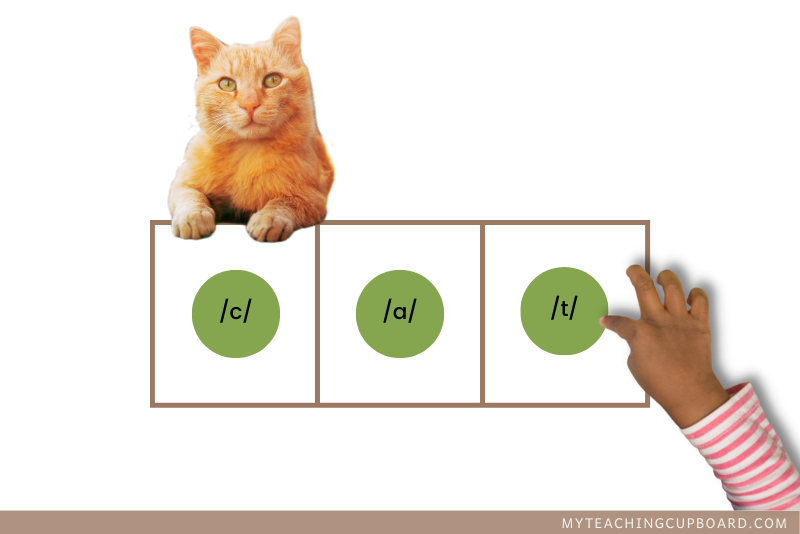
For example, for the word cat, you would draw three boxes, one for each of /c/ /a/ and /t/. If you were segmenting the word cow, you would only draw two boxes: one for /c/ and another for /ow/.
Remember, we are working with sounds and oral language and not print and letters, so don’t be tempted to write the graphemes in the boxes just yet. That will come later in your phonics lessons.
I say the word and then have the children point to each empty box while they segment the sounds. Of course, you can substitute the boxes for anything:
magnets that slide on a magnetic board
beads on a string
balls of playdough the kids squash as they segment
fingers tapped on the table
Segmenting Progression to Follow
Teaching phonemic segmentation requires a thoughtful progression of skills, moving from simpler tasks to more complex ones.
1. Segmenting Sentences: Developing the concept of segmenting starts with segmenting sentences into words. Before you think about segmenting the sounds in words, introduce the concept of segmenting by breaking up sentences and phrases.
Start with very short sentences and build up to longer sentences. My sentence segmentation counting mats can help you. These word-counting mats are great for a small reading group or whole-group literacy activities. Sentence segmenting is the first level of phonological awareness, and this activity makes teaching it super easy.

Teach sentence segmentation with this activity for counting words in sentences. Use the printable word counting mats and example simple sentences for small groups or whole group literacy activities. Sentence segmenting is the first level of phonological awareness, and this activity makes teaching it super easy.
Because phonological awareness is about auditory and oral language skills, there are no printed sentences for the children to read in this activity.
Easily Teach Word Awareness
Word awareness, or knowing that sentences are made up of individual words, is a prerequisite skill for reading and writing. This crucial skill needs to be explicitly taught. It comes before syllable awareness, onset and rime and phonemic awareness in the phonological continuum.
When teaching students how to count words in a sentence, use activities like this one so they recognise each word as its own unit. To do this, begin with segmenting short three and four-word sentences and use manipulatives like counters or blocks to represent the words.
Using hands-on activities with manipulatives keeps students engaged and on task. With this in mind, I designed a collection of printable word-counting mats that can be used with manipulatives like blocks or counters. Students represent and count the words in each sentence with the manipulatives and the printable mats in this comprehensive resource.
This Sentence Segmentation Resource Contains:
10 word counting mats.
84 sentences organised in a progressive list ranging in length from 3 to 6 words per sentence. The words in this easier set of sentences consist of only monosyllabic words.
60 sentences organised in a progressive list ranging in length from 3 to 6 words per sentence. The words in this second, more difficult set of sentences, consist of a combination of monosyllabic and multisyllabic words.
A simple lesson plan and teaching notes for teaching sentence segmentation.
A teacher checklist to track students' progress and understanding of word awareness.
A document wallet label to print and help you keep the resources organised.
Move from Simple to Complex Sentences
To teach word awareness, start with simple 3-word sentences with monosyllabic words. Then progress to more complex, longer sentences with multisyllabic words. I've made this research-backed process easy for you. In this resource, there’s a progressive list of 144 sentences to guide you.
NOTE: Since this activity focuses on phonological awareness, it is important not to show the written sentences to the children.
The length of your sentence and the number of syllables in your words affect how difficult sentence segmentation is for students. Not only is there a progressive list of sentences, but I have also included teaching tips and a simple, easy-to-follow step-by-step lesson to help you.
Differentiate Your Sentence Segmentation Activities
The objectives of this word awareness activity are for children to:
use manipulatives as visual aids
hear spoken sentences
use a counter to represent each sentence word
count the number of words in the sentence
This activity for recognising and counting the words in sentences can easily be differentiated.
For Intervention: If you have a child who displays difficulties or inconsistent skills, use the two-word and three-word sentences included in the resource and explicitly follow the lesson script and steps consistently. I have found some children need more practice until the concept of a word is understood.
For Extension: If you have children who need extending, here's a simple activity to further enhance their word awareness. Say one of the included sentences with a missing word and ask your students to fill in the blank. An oral cloze activity consolidates the concept of a word and encourages children to think about the structure and meaning of the sentence.
Your students will quickly learn the concept of a word and know that sentences are made up of individual words when you give them practical examples and a clear progression from simple to more complex sentences. Following the approach outlined in this activity will help young learners develop a solid understanding of word awareness and sentence segmentation.
Word awareness, or knowing that sentences are made up of individual words, is a prerequisite skill to phoneme segmentation and comes before phonemic awareness in the phonological continuum.
If you are interested in learning more about word awareness, this blog post, 22 Word Awareness Activities to Develop Phonological Awareness, explains it in detail and offers a heap of effective activities you can use in your classroom.

NOTE: Because phonological awareness is about auditory and oral language skills, printed sentences should not be given to the children to read in these activities.
When your students are ready to segment words, it is best to begin segmenting two-phoneme words and then move on to three-phoneme words.
Start with short words like consonant-vowel (CV) words or vowel-consonant (VC) words. When your students have mastered two-phoneme words, move on to three-phoneme words like CVC words and then four and five-phonemes like CCVC, CVCC, and CCVCC words.
If students don’t quite understand what you mean by segmenting or breaking up the word, tell them to stretch the word out into its individual sounds. This seems to help some of my struggling students.
2. Segmenting Compound Words and Syllables: To introduce the concept of segmenting or breaking words apart, start with compound words and syllables.
Start with one-syllable words and two-syllable words, then two- and three-syllable words and so on.
You can emphasise the link to rhythm by asking students to clap the beat or use a musical instrument to play the syllables. If you want more ideas to teach your students how to segment words into syllables, this blog post, Activities for Teaching Syllables and Phonological Awareness, will help you. It has all my tried and tested syllable segmentation activities. Teaching syllables is so much more than clapping the beats in words!

TEACHING TIP: Try not to have children clap for segmenting both syllables and sounds. I have found if you use clapping for both, some children then struggle to differentiate a syllable from a sound. I like to clap the syllables and tap the sounds.
3. Segmenting First Sound and Onset-rime: Children find it easier to identify the initial sound in a word before jumping straight into whole-word segmenting. Some educators call this process sound-to-word matching.
You can teach your students how to identify the initial sound in a word by showing them a picture and asking them to identify the correct word out of three. For example, show them a picture of a bee and ask, “Is this a /d/-og, a /b/-ee, or a /c/-at?"
Alternatively, you can focus on word families by asking, "Is this a /k/-ee, a /b/-ee, or /m/-ee?"
Want more rhyming and word family activities? I have a heap of rhyming games and activities in my store.

Another strategy is to ask if the word contains a particular sound. For example, "Is there a /b/ in bee?" And finally, ask, "Which sound does bee start with — /d/, /sh/, or /b/?"
It is easiest for children to hear continuant sounds (letters that make continuous sounds) because they can be exaggerated and prolonged to heighten the sound input.

4. Segmenting Individual Sounds: At this stage, your students will be ready to hear a word and break it into individual sounds. I like to use the gradual release model for teaching sound segmentation. For this teaching model, the teacher first models the segmentation (the I do part), then we do it together (the we do part) before students do it independently on their own (the you do part).

use the gradual release model to teach phonemic awareness
Ensure students respond with the appropriate sound(s) and not the letter. At this stage, it is all about practice. Practice, practice, practice until your students can fluently segment words accurately.
Once students understand the concept, you can introduce games and activities to help them independently segment words. In the next section, there are 22 fun and effective strategies to help you.
22 Activities for Teaching Phoneme Segmentation
Now we know how important phoneme segmentation is for early literacy and how to best teach it, let’s explore some fun and engaging activities that will help your students develop and practice this skill.
Here are 22 of my favourite activities for teaching phoneme segmentation:
1.Stretch the Word
You can talk about segmenting a word into phonemes as stretching the word.
Visual and tactile support for this concept is saying the word with hands together, palms inward, and moving them out from each other as each sound in the word is said in the order.
Putting an elastic band around the hands allows the stretch to be felt more easily. I also love using a slinky to demonstrate how to stretch out a word.
2. I Spy
This segmenting game is just like the traditional game of I Spy, but instead of focusing on the first sound, the child segments the clue. For example, “I spy with my little eyes something that I can see. It is a c-l-o-ck.”
3. Robot Talking
This is a popular way to play with segmenting because when you segment a word, it sounds chunky and a bit robotic. Your students will not only love practising segmenting when they use a robot voice, but this chunky style of speaking naturally invites word segmenting.
You might like to use a robot puppet or toy to help younger children remember to talk like a robot.

4. The Secret Object Game
For this beginner segmenting game, you will need a variety of objects or pictures of objects.
First display 3 objects or pictures and secretly choose one.
Then model segmenting by orally segmenting the secret object.
Next, the children blend the segmented sounds to discover the correct object.
While the children are blending with this activity, they are also listening to the teacher model segmenting. Encourage the children to echo your segmenting using their robot voices.
Confident children can take turns being the teacher and segmenting a secret object for the class to find. This activity is great for practising both blending and segmenting.
Looking for pictures to use in this activity? I have a growing collection of printable vocabulary cards perfect for this Secret Object Game.

5. Segmenting Pictures
Providing children with segmenting picture cards is a great way to teach phoneme segmentation.
Make picture cards showing phoneme dots or Elkonin boxes under each picture. The number of dots or boxes represents the number of phonemes for that spoken word.
Children segment the word as they point to each dot or box.
For some added fine motor practice, give the children some clothespegs. Ask them to repeat the segmenting but this time, they attach a peg to each box or dot.
To save yourself some time, grab my set of Segmenting Pictures already done for you.

This comprehensive set of sound boxes has over 200 Elkonin boxes printable cards, learning prompts, and teacher assessment checklists for teaching blending and segmenting phonemes. Your students will find the real pictures representing words with 2, 3, 4 and 5 phonemes easy to recognise and relate to.
Perfect for developing phonemic awareness skills like phoneme segmentation, segmenting words, and blending sounds. Informed by the Science of Reading research, this early literacy resource is perfect for word mapping too!
Using Elkonin boxes (also called sound boxes ) to develop phonological awareness will help young children learn to segment words into individual sounds and also blend sounds into words.
Easy to Differentiate
This colour-coded set of Elkonin boxes makes differentiation easy.
If your students struggle to segment and blend three sounds, reduce their cognitive load by giving them words with two phonemes. When they master two and three phoneme words, it’s easy to extend their phonemic awareness. This set has four and five phoneme words for extension.
With practice, your students will be able to blend and segment the words independently and the visual aids like the boxes and pictures can be phased out.
This Elkonin Boxes Printable Contains:
A differentiated word list - answer key
28 red cards for words with 2 phonemes
88 blue cards for words with 3 phonemes
56 green cards for words with 4 phonemes
32 brown cards for words with 5 phonemes
3 Printable Learning Prompts
2 Printable I can Statements
2 teacher checklists to track students' segmenting and blending progress
2 Student recording sheets
And to help you organise everything there is a document wallet label and a task card box label to print
With over 200 illustrated printable Elkonin boxes and all the extra resources in this set, you’ll have a visual and hands-on activity that you can use over and over in your classroom.
More Than One Use
Our literacy focus at the start of kindergarten is phonemic awareness. Boost these skills by using the printable Elkonin boxes to practice segmenting and blending words orally.
For phoneme segmentation, students pick a card, name the picture, and segment each sound in the word. Then they can represent the sounds by placing a counter into each box on the card.
For phoneme blending, students slide their finger, from left to right, on the arrow provided and blend all the sounds back together.
These versatile cards can be used again when your students are ready for phonics instruction and word mapping activities. It’s an easy transition because your students will be familiar with the cards.
For writing, the students already know how to name the picture and break it apart into sounds, so writing the graphemes (letters or groups of letters that make each sound) becomes the focus.
I like to keep it interesting, so we practice with a variety of manipulatives. You can use letter tiles, alphabet beads, or magnetic letters to make the words.
For some reading practice, the students can then blend the letters together to read the word.
This Versatile Resource is Perfect for:
hands-on literacy investigation areas
literacy centers
small group literacy rotations
morning tubs
busy bags
early finishers
or for informing your assessment grades
Download these Elkonin boxes printables – they will become a valuable addition to your literacy tool kit!
6. Phoneme Fingers
Ask students to segment given words and get them to put up a finger for each phoneme in the word. This simple activity is great for transitions or any time you have a couple of minutes to spare. Being able to attach a phoneme to the visual of a finger really helps a lot of children because they can see how many phonemes are in the word.
7. Light it Up
Battery-operated push lights (affiliate link) are a fun way to get reluctant students engaged. Line up the lights and say a word you want the student to segment. As they say the sounds in the word, they touch the lights to turn them on.
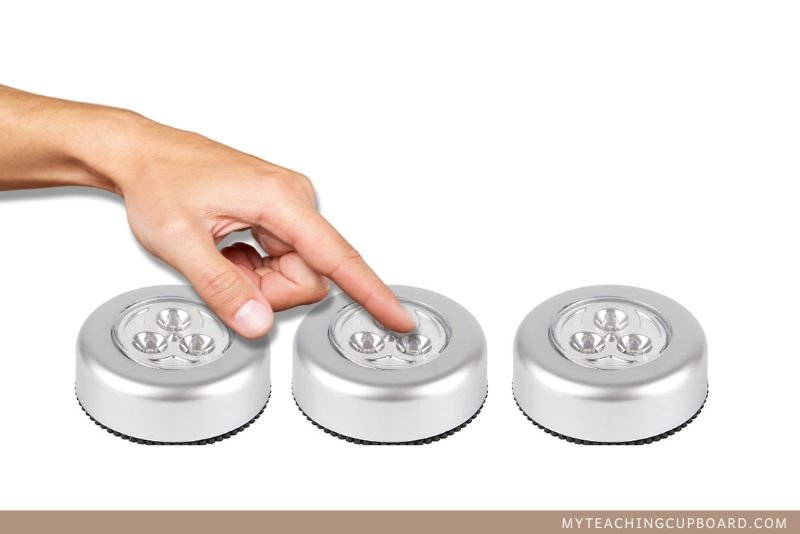
Get the student to do it again, but the second time, they say the sounds while they turn off the night lights. Make sure the lights are lit up from left to right to help with directionality when reading.
8. Segmenting Board Game
Download my FREE Game Board and a set of picture cards for this fun segmentation activity. We play this game in small groups. It is perfect for literacy group rotations.
To play, the first child starts by selecting a picture card from the pile. They say the name of the picture out loud and then segment it. They move their counter along the board based on the number of phonemes in their word. The game continues like this with each child having a turn until a child reaches the finish and is the winner.

9. Elkonin or Sound Boxes
Elkonin boxes are a visual aid used by many teachers to support students learning to segment words into individual sounds. They are a grid of boxes with each box representing a sound in a word. Start with just two boxes and add more as students work with longer words.
Here’s how to use them.
First, say a word that you want your students to segment. For example: cat.
The student repeats the word and then places a manipulative (a toy or a counter) into the first box as they say the first /k/ sound in the word.
Then they would say /a/ while placing a manipulative in the next box.
Finally, they would place a manipulative in the third box as they make the /t/ sound.
For each sound, a manipulative is placed in one box while the student makes that sound.

You can move from manipulatives like counters or bingo chips to letter tiles and eventually have students write the corresponding letters in the boxes.
Print out my done-for-you Sound Boxes. There are over 200 words in this resource, progressing in difficulty from 2-phoneme words up to 5-phoneme words. I love this set because I use them so often. They are great for phonemic awareness and phonics lessons, as a literacy group activity and also in literacy centers or investigation areas.

10. Stop and Segment
When reading picture books, occasionally stop reading to segment words from the story. You can model segmenting a word and ask children to work out the word by blending the segments.
If your students are ready for segmenting practice, you can ask them to segment a given word from the story.
Segmenting practice is easy to include throughout your school day. On walks around the school, during lesson transitions, and in literacy warm-ups, stop and segment things you see in your environment, children’s names, or words from environmental print.
11. Head, Shoulders, Knees, and Toes
This fun movement activity works best with 2 to 4 phoneme words. The students can do this activity sitting or standing.
Give the kids a word and have them touch their heads, shoulders, knees, and/or toes as they say each of the sounds in the word.
For example, the word green would be /g/ (head), /r/ (shoulders), /ee/ (knees) and /n/ (toes).
12. Tap the Word
This simple activity is another great one for when you have a few minutes to fill. You say a word or show a picture of it, and the students segment the word by tapping out the sounds.
Tapping out sounds is something we will do all the time when we start spelling and writing new words so getting used to tapping out words now will pay off later.
Students can tap on their arms or desks as they say each sound in a word. For example, with the word dog, students would tap their thumb on the desk while saying /d/, then tap their pointer finger while saying /o/, and finally tap their middle finger on the desk while saying /g/. Using one finger for one sound helps children learn to count the phonemes in words.
13. Stomp the Word
Instead of tapping, you can have students stomp their feet to represent the number of sounds in each word.
This kinaesthetic activity is the perfect movement break - great for getting the wiggles out! You can even have the students jump or hop for each sound.
They can jump on the spot, or you can place a few hoops or small mats (we use sit spots) in a line on the floor. Such a quick and easy way to make your own floor sound boxes. The kids can say the sounds as they jump from mat to mat.
14. Pop the Word
Another variation on tapping and stomping the word is popping the word. You will need those fun fidget-popping toys (affiliate link). My kids love these tools, so it is good to harness their interest into a segmenting activity. They work just like Elkonin boxes.
The children pop a bubble down for every sound they hear in a word.
After practising this segmenting activity together, I set up a quick and easy literacy investigation area for independent practice. Just add some picture cards, and you’ll be all set.

15. Bead Slide
For this segmenting activity each student will need a pipe cleaner threaded with 5 or 6 beads. Students slide a bead along the pipe cleaner for each sound said when segmenting a word.
You can call out words or give students picture cards to segment on their own. The threaded pipe cleaner would also be a perfect addition to your segmenting investigation area or literacy center.
16. Tower Crumble
Use connecting blocks like Unifix cubes or Lego for students to make word towers.
Students build towers representing words, with each block symbolising a phoneme. As students segment the word and count the sounds they hear, they add corresponding blocks to their tower.
This hands-on activity offers a visual representation of phonemes and reinforces word segmentation skills in a hands-on way.
After segmenting and building their word towers, students can break down their towers, repeating the segmenting process as they break off each block in their tower.
17. Count and Sort the Sounds
You will need a set of segmenting pictures representing objects with different numbers of phonemes. Show one of the pictures to the students and ask them to segment the word and count the sounds they hear.
Then, give the students a few picture cards to sort based on the number of sounds they contain. This activity not only strengthens segmentation skills but also reinforces counting and sorting. At the start of the year, my students need lots of sorting and counting practice, so this phonemic awareness activity is always a winner!
Because this activity covers so many kindergarten learning objectives, such as sorting, counting, and phonemic awareness, we always do this one at the beginning of the school year.
Here’s the segmented picture cards I use for our phoneme picture sort activity.

If you are teaching your students how to count phonemes in a word, you’ll love this resource. It has 72 phoneme counting picture cards young children will instantly recognise and relate to. This comprehensive set features real-life photos perfect for a phonemic awareness picture sort.
Save Time Searching for Suitable Word Segmenting Images
These carefully curated cards are print-and-go. I’ve done the searching for you and hand-picked, high-quality photo images representing words with 2, 3, 4, and 5 phonemes.
I've also included a heap of BONUS resources in this resource so you can use these cards for a variety of different learning activities.
I’m always looking for age-appropriate resources that cover multiple learning objectives because – well, how else do you fit everything in! I love this set.
It aligns with both the numeracy and literacy curriculum so I can use them repeatedly in our lessons and activities.
This Comprehensive Set of Phoneme Picture Cards Contains:
72 Labelled Vocabulary Cards representing objects with different numbers of phonemes: I’ve designed them so you can easily cut off the labels if you want a set of just pictures. The full set of 72 cards contains 18 picture cards with two phonemes, 18 picture cards with three phonemes, 18 with four phonemes and another 18 pictures representing five phoneme words. They all come in 2 sizes, so you have the option of large or small cards. Choose the size to best fit your teaching needs.
4 Sorting mats: There are four labelled phoneme sorting mats in a full-colour nature theme. They will help your students remember the sorting categories.
Ink-saving Sorting Mat Labels: Don’t want to print out the full-colour sorting mats? Use these labels to make your ink-friendly set. Just print the single page of blackline labels. Glue each phoneme number label to the top of a plain coloured card, and you’ll have instant phonemic category sorting mats.
A Sorting Information Poster: This poster defines sorting as grouping objects based on their attributes. Use it to inform parents and other educators, to illustrate your learning intentions and as a visual reminder for students learning how to sort.
A Phoneme Information Poster: This poster defines phonemes as the smallest unit of sound in spoken words. Phonemic awareness terminology can be tricky for both your students and other educators working in your classroom. This poster can help them and it can also illustrate curriculum learning intentions. It’s a handy visual reminder for students too.
2 Sorting Learning Prompt Posters: These printable prompts make setting up a hands-on investigation area or sorting activity super easy.
2 Phoneme Counting Prompt Posters: These picture cards have been designed for students to practice segmenting words and counting the sounds they hear in words. If you are looking for an engaging phonemic awareness learning center or investigation area, use these printable prompt posters to target the learning.
2 Student Recording Sheets for Recording Sorts: Including a way for children to record their sorting will give you valuable evidence of learning. Use this information to inform your planning. (It comes in handy as an assessment piece, too!) I’ve included 2 sizes of these sheets for you to choose from.
Teacher Assessment Recording Sheet: I like to keep track of my students' progress. This recording sheet makes it easy. There’s a place to enter a sorting score and a space for short observational notes.
Task Card Box Label and Document Wallet Label: If you keep your resources organised you are much more likely to use them. That’s why I included these storage labels. Ensure your resources are always at hand and organised. The picture cards can be kept in a task card box but if you want to keep all the printables together, I suggest storing them all in a document wallet. That’s what I do. I put the picture cards inside a clip-lock bag and store it with all the other printables in a clear document wallet.
Increase Engagement and Learn About Segmenting Phonemes
If you want to boost engagement, make your learning experiences hands-on and purposeful.
Use the comprehensive bundle of phoneme counting and sorting resources in this pack to create educational and interactive learning activities your students will love. These resources will bring learning about individual sounds and words to life and help you teach numerous skills, from sorting and counting to categorisation skills and phonemic awareness.
Easy to Differentiate with 2, 3, 4, and 5 Phoneme Words
Tailor your activity to your students' learning needs. For those students just starting to segment words, start with a selection of five or six cards from the two- and three-phoneme sort. Build their confidence before adding a few cards representing four-phonemes.
These labelled phoneme sorting cards can be used for:
Word walls – for spelling or phonemic awareness
Vocabulary work and discussion starters
Phonological awareness – phonemic awareness
Spelling cards – fold the labels to the back to make them self-correcting
Card games like Memory, Go-fish or Snap
Writing Centers – as story starters and spelling aids
Math Activities – for sorting and counting
Science – for categorising skills
Integrate Maths and English
This fun hands-on activity strengthens segmentation skills in English and reinforces counting and sorting in Math. My students need lots of sorting and counting practice at the start of the year, and all early childhood educators know how important phonemic awareness is. It's the foundation for teaching reading and writing!
That’s why I designed this integrated activity.
There’s so much to teach in our jam-packed curriculum, so anything that covers multiple learning objectives is always a winner!
Use it to teach so many kindergarten learning objectives like sorting, counting, and phonemic awareness.
Download these Counting Phonemes Picture Sorts, and you’ll have an educational resource you can use over and over!
18. Segmenting Warm-up
I love using PowerPoint presentations as literacy warm-ups. Use this engaging Segmenting Warm-up PowerPoint presentation with pictures and segmenting dots to practice phonemic segmentation skills.
Students will easily relate to the real-life pictures and use the featured sound dots to self-check or prompt their phoneme segmenting.

This PowerPoint lesson is an engaging and effective way to teach segmenting words and phonemic awareness. It is designed for kindergarten and grade one students to practice breaking down words into individual phonemes. With 90 differentiated slides featuring real-life photographs, you'll have plenty of word options to choose from. The included pictures represent words with 2, 3, 4, and 5 phonemes. This resource makes teaching phoneme segmentation fun and easy.
Foundations of Phonemic Awareness
Phonemic awareness is an important skill that forms the foundation of phonics and reading development. It is the ability to focus on and manipulate individual phonemes in words. Phonemes are the smallest units of sound in a word that can change the word's meaning. For example, the word cat has three phonemes: /k/ /æ/ /t/. By manipulating these phonemes, you can create new words like bat, rat, and hat.
Phoneme segmentation is a critical component of phonemic awareness. It involves breaking down words into individual phonemes. It helps students learn the decoding skills required for reading and writing.
This PowerPoint can help you explicitly teach how to segment words into phonemes and it will give your students plenty of opportunities to practice phoneme segmentation.
Self-Checking Slides
The PowerPoint includes self-checking slides to help monitor student’s segmenting skills.
Each slide presents a picture for children to segment. Once they have segmented the word, a mouse click reveals the correct number of phonemes (represented in dots). Your students can practice subitising and counting, as well as phoneme segmentation!
I like that the self-checking feature also helps to build students' confidence. They can see their progress and feel a sense of accomplishment.
Optional Brain Breaks Included
You can easily delete the brain break slides if you don’t want this option. I find these quick and simple breaks add a bit of movement and fun. They are perfect for keeping students engaged and learning.
Keep Students Engaged
Keep your students engaged and interested in learning phoneme segmentation. With visually appealing real-life photographs and interactive slides, students will easily recognise and relate to the slides.
This Segmenting Words PowerPoint Lesson Includes:
An introduction to segmenting words and phonemes
Followed by 20 slides with pictures representing 2 phonemes
30 slides with pictures representing 3 phonemes
20 slides with pictures representing 4 phonemes
And 20 slides with pictures representing 5 phonemes
2 review summary slides
Oh and of course, this lesson also includes brain break slides throughout. These slides provide a fun and interactive way for students to take a break from the main content and refresh their thinking.
Save on Planning Time
With this Segmenting Words PowerPoint, you can save a significant amount of time on lesson planning. You no longer need to spend hours creating your own presentations or searching for suitable images online. The PowerPoint is a ready-to-use resource that is easy to integrate into your daily lessons.
You can focus more on teaching and less on preparation. It is a user-friendly PowerPoint, with a clear and simple layout that makes it easy for you to navigate. The clear design also makes it easy for young children to use the resource independently if you are looking for a literacy rotation idea.
A Versatile Resource
I designed this PowerPoint as a literacy warm-up but it can also be used for
whole-class explicit lessons
assessment
transitions
targeted segmenting practice
literacy revision and intervention
ANYTIME you want to build phonemic awareness!
Easy Differentiation
With the comprehensive collection of slides in this resource, you can easily differentiate your instruction to meet the needs of your students.
For students who are struggling to segment three-phoneme words like CVC words, you can use the presentation's 2-phoneme slides to develop beginner segmenting skills. The 2-phoneme slides provide a solid foundation for students to build upon as they progress to more complex words.
Once your students have mastered 2 and 3 phoneme words, you can challenge them with the PowerPoint's 40 extra slides containing 4 and 5 phoneme words. These advanced slides provide a great opportunity for students to apply their segmenting skills to more challenging words.
Download this Segmenting Words PowerPoint lesson and confidently use this resource to help your students develop their phoneme segmentation skills. It’s a valuable addition to your literacy toolkit.
19. Squash It
For this fun, hands-on phonemic awareness activity, you will need a little ball of play dough for each student.
Playdough is a wonderful tactile tool and perfect for developing fine motor skills.
In this segmenting activity, the students roll up a small playdough ball for each phoneme they can hear in a word. As they segment the word, they squash a ball for each phoneme they say.
My printable Elkonin Boxes ( done-for-you Sound Boxes) are perfect for this activity. See - I told you we use this set a lot!

20. Segmenting Toss
You’ll need 4 or 5 bean bags and a basket or hoop for this fun game.
Place the bean bags in a pile in front of the student and position the basket or hoop a few steps away. Say a word with 2 – 5 phonemes for the student to segment.
As they say the segmented word, they attempt to throw a bean bag into the basket (or hoop) for each sound they hear and say.
I have found this is quite a difficult activity as children need to concentrate on two tasks – segmenting and throwing so make sure they are saying the sounds as they throw each bean bag.
21. Sound Scavenger Hunt
Give the children a word to segment. They segment the word and count the phonemes they can hear.
Now for the scavenger hunt part, they need to find an object in the classroom that has the same number of sounds as the word they segmented.
For example, if the word they segmented was horse (3 phonemes), they might find a pen, a cup, or a book - also with 3 phonemes.
22. Piggy Bank Segmenting
For this activity, you will need counters, bingo chips, toy gold coins, and a small piggy bank.
You will give the child a word to segment, and they will place a counter or coin in the piggybank slot for each sound said.
Give the students a word with 2-5 phonemes and have them pick up a coin while they say each sound. Then, the sounds can be said again as each coin is placed in the piggy bank.
These activities will help develop your students' phonemic awareness and phoneme segmenting skills. Based on recent research and best practices, these engaging activities will teach your students to listen to words and how to break them down into their individual phonemes. They are educational and tons of fun.
Nothing beats learning through fun, hands-on activities like these.
Phoneme Segmentation Word List
Now you have a heap of ideas for teaching your students how to segment a word into phonemes, you will need a list of suitable words to practice with. Don't worry - I've got you!
I used to spend precious teaching time trying to think of suitable segmenting words in the midst of a busy reading group lesson 🤦♀️ Not the best use of my time! So I created a handy word list to refer to.
I'm happy to share it with you.
In my FREE Resource Library, you'll find the perfect tool to support your segmenting lessons: a Phoneme Segmentation Word List.
This free segmentation resource is a list of words organised by the number of phonemes—from two to four phoneme words, along with a special section of extension words with five or more phonemes.
Take the stress out of on-the-spot brainstorming of suitable words to segment and add this free phoneme segmentation word list to your phonemic awareness tool kit.

Assessment and Intervention
Assessing phoneme segmentation skills is essential if you want to identify students who are at risk of mastering beginning reading skills. You can use a combination of informal and formal assessments to monitor your student's progress and determine if they need intervention.
Monitoring Word Segmenting Skills
Teacher observation is an informal method of assessing phoneme segmentation skills and an assessment method I use often in my classroom. I observe my students during whole class lessons, small group lessons and investigative play sessions.
I am constantly observing and recording my students and recording their progress.

Phoneme segmentation checklist from the 200 Elkonin Boxes download
Conferencing is another useful informal method of assessing student’s understanding.
Having one-on-one conversations with students to assess their phoneme segmentation skills is an extremely valuable way to discover exactly what a student knows about segmenting phonemes.
There are many formal standardised tests available too. Here are three that are commonly used in our early years classrooms:
Dynamic Indicators of Basic Early Literacy Skills (DIBELS): Phoneme Segmentation Fluency (PSF): The DIBELS PSF is a short, standardized test designed to measure a child’s ability to fluently segment three- and four-phoneme words into their individual phonemes accurately. This assessment is timed and gives educators a quick insight into a student’s phonemic awareness, which is predictive of later reading success. It's widely used across many educational settings due to its reliability and ease of administration.
Comprehensive Test of Phonological Processing (CTOPP-2): The CTOPP-2 assesses phonological processing abilities. It includes a Phoneme Segmentation test among its subtests, specifically designed to measure the ability to separate sounds within words. This test is part of a larger suite that deeply evaluates various phonological skills, making it an extremely comprehensive tool for identifying students who may need intensive support in any area of phonological processing.
Quick Phonological Awareness Screening (QPAS): is another widely used assessment that offers a quick assessment focusing on key early literacy skills, including phoneme segmentation. It is designed for educators to obtain a quick overview of a student’s phonological awareness skills. By administering this tool to an entire class or targeted group of students, the scoring response form provides a visualisation of trends in performance, both within a specific student’s skills as well as across an entire class or group.

Advancing Beyond Phoneme Segmentation
Phoneme segmentation is a fundamental skill that plays a crucial role in developing encoding skills and reading fluency. However, phoneme segmentation is just the beginning.
In this section, we will explore your next steps and ways students will develop spelling, writing, reading comprehension, and fluency skills.
From Segmenting to Spelling and Writing
Segmenting words into phonemes is the first step towards spelling and writing.
Children should already be proficient at phoneme isolation and phoneme blending.
After mastering phoneme segmentation, students can move on to more advanced skills like phoneme manipulation, which includes skills like phoneme addition, deletion, and substitution.
These important skills, along with orthographic mapping (the ability to connect phonemes to their corresponding written symbols or graphemes), help students learn to spell words accurately and ultimately write sentences fluently.
To improve spelling and writing skills, you can use a variety of strategies and techniques such as:
Word Families: Word families are groups of words that share the same root word. For example, the _og word family includes words such as log, dog, hog and the word frog.
By learning about phoneme manipulation and studying word families, your students will improve their vocabulary and spelling skills.
Teaching about rhyming and word families comes towards the end of kindergarten and is covered again with first graders. It is a really important component of understanding the structure and patterns within words.
Rhyming introduces learners to the idea that words can share similar groups of letters and ending sounds. Exploring rhyming words lends itself perfectly to exploring phoneme manipulation. When a child can see that hat, cat, and bat rhyme, they are more likely to understand how to manipulate initial sounds to create new words.
This foundational skill lays the groundwork for effective spelling strategies and helps students to make connections between sounds and letter combinations.
Activities that focus on word families will help children understand that changing the initial phoneme can create a new word with a similar spelling structure. This understanding is key to developing spelling and writing skills, as students learn to apply these patterns when encountering new words.
I have a wide range of resources designed to support teaching rhyming and word families. These resources are designed specifically for kindergarten and first-grade students and incorporate hands-on and play based learning ideas.

Interactive Word Games: Word games like Scrabble and Boggle can help students to improve their spelling and writing skills.
If you are interested in other hands-on and educational spelling ideas, I have compiled 100 Fun Spelling Activities for your whole class, small group and individual spelling lesson plans. These are my favourite spelling games and activities, and with 100 ideas to choose from, you're sure to find some that will become your favourites, too.

100 spelling activity cards to teach spelling words from any list.
Tired of the standard spelling lessons?
Learning should be fun so I have compiled my all time favourite spelling activities for whole class, small group and individual spelling practice.
YOU WILL RECEIVE THREE FILES
Version with AUS/UK spelling
Version with USA spelling
FREE BONUS Spelling Banner for your Literacy Area
EASY TO ORGANISE
Each file is ready for you to print onto A4 sized card or paper. There are 4 spelling task cards to each A4 sheet. Each file contains a total of 100 different spelling activity cards. They are ready to be used as is or trim and laminate them so you will have a set of Spelling Activity Cards ready to use throughout the year.
COLOUR CODED FOR EASY REFERENCE
· 64 RED Cards with activities suitable for individuals to do on their own. These red activities may also be done in a small group or as a whole class.
· 12 BLUE Cards with activities designed specifically for small groups. These blue activities may also be done as a whole class.
· 24 GREEN Cards where you will require a large group or the whole class for these activities.
USEFUL FOR:
Whole class spelling lessons
Literacy group rotations
Word work activities
Literacy centers
Spelling homework
Early finishers
Developing Reading Comprehension and Fluency
Phoneme segmentation is also an essential skill for effective decoding. We place a big emphasis on decoding in kindergarten, but reading is so much more than decoding words.
It is also about understanding the meaning of the text and making connections between ideas. Don’t overlook the importance of reading comprehension and fluency.
To improve reading comprehension and fluency skills, you can use a variety of techniques such as:
Vocabulary Building and Oral Language: Building students' vocabulary is a priority. It will help them understand the meaning of the text and make connections between ideas.
You can use various techniques, such as reading books, playing word games, using word walls, and my favourite—play-based learning.
Did you know play-based learning is multidimensional in its contribution to oral language? Check out this interesting article on Oral Language Play and Learning to learn more.
Sheena Cameron Comprehension Strategies: If you want to teach reading strategies you can't go past Sheena Cameron.
Key comprehension strategies like activating prior knowledge, self-monitoring, predicting, questioning, making connections, visualising, inferring, summarising, synthesising, skimming, scanning and building vocabulary knowledge are all covered in her amazing book: Teaching Reading Comprehension Strategies (affiliate link)
Conclusion
In this blog post, we explored phoneme segmentation as an important phonemic awareness skill for children learning to read and write. We also discovered 22 interactive and fun activities we could use in the classroom to learn and practice phoneme segmenting.
The ability to segment words into phonemes plays a critical role in developing strong reading skills and phonemic awareness. If you want to reach your phonological awareness benchmarks, phoneme segmentation needs to be explicitly taught and practised. It really does help set the foundation for future literacy success.
You have a crucial role to play in guiding and supporting your students as they learn to segment phonemes.
Remember to create a positive and encouraging atmosphere where your children feel comfortable seeking help, taking risks, and building their confidence in segmenting sounds.
Don’t forget to download your Free Phoneme Segmentation Word List from my FREE Resource Library.
If you found this blog post on phoneme segmentation informative and added some useful phoneme segmentation activities to your phonemic awareness toolkit, please consider sharing it…
Just CLICK the sharing box below.👇