Activities for Teaching Syllables and Phonological Awareness
Teach syllables and phonological awareness with these engaging activities for kindergarten and preschool children. Teaching syllables is so much more than clapping the beats in words! I’ve got a selection of hands-on games and activities your students will love. They will master blending and segmenting syllables in no time.
Feeling stuck teaching syllables and phonological awareness to your preschool and kindergarten students? Clapping the syllables in words for our literacy warm-up got a bit boring after a while. If I was bored with it, my students must have been too. So before I had to face the dreaded eye-rolls, I created some engaging activities that are both fun and effective.
In this blog post, you’ll discover the six types of syllables, what syllable awareness is and why teaching syllables is so important for phonological awareness. I’ve also got 12 practical activities and games you can use in your classroom to teach this basic phonological awareness skill.

An Introduction to Syllables
A syllable is a unit of sound in speech. It is a part of a word typically made up of a vowel sound with or without surrounding consonants. For example, the word banana has three syllables: ba-na-na.
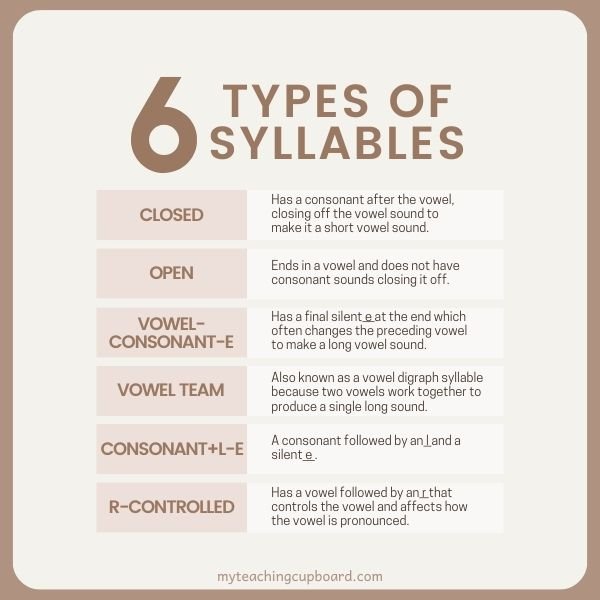
6 Different Types of Syllables
A closed syllable has a consonant after the vowel. The consonant at the end of the syllable closes off the vowel sound, making it a short vowel sound. In English, examples of closed syllables include cat, sit, and top.
An open syllable ends in a vowel and does not have consonant sounds closing it off. A consonant sound does not follow the vowel sound, so it remains "open" and typically produces a long vowel sound. In English, examples of open syllables include no, be, and she.
A vowel-consonant-e syllable is sometimes known as a silent-e syllable or magic-e syllable. This syllable type is typically found at the end of a word. The final “e” at the end of the syllable is silent and often changes the pronunciation of the preceding vowel, making it a long vowel sound. For example, in the word cake, the "e" at the end is silent, but it changes the pronunciation of the vowel "a" from a short /æ/ sound to a long /eɪ/ sound.
A vowel team syllable, also known as a vowel digraph syllable, occurs when two vowels work together to produce a single long sound. These combinations of vowels are often referred to as vowel teams. A vowel team appears in the same syllable, and together they represent one sound. Examples of vowel teams include: "ai" in rain, "ea" in team, and "oa" in boat.
A consonant+l-e syllable, also known as a final stable syllable, is a syllable pattern consisting of a consonant followed by the letter "l," and then the letter "e." In this syllable pattern, the "l" is preceded by a consonant and followed by a silent "e." Examples of words with consonant+l-e syllables include table, apple and bubble. In each of these examples, the "l-e" combination forms a syllable with the preceding consonant, resulting in the final stable syllable pattern.
An r-controlled syllable contains a vowel followed by the letter “r”. The “r” controls the vowel and affects how the vowel is pronounced. Some examples of r-controlled vowels include: “ar" as in car, "er" as in her, "ir" as in bird, "or" as in for and “ur" as in fur.
Words can be Monosyllabic or Multisyllabic.
Words are made up of one or more syllables.
Monosyllabic words have one syllable. Some examples of one-syllable words are: cat, jump, thought. CVC words (consonant-vowel-consonant) are common single syllable words.
Multisyllabic words or Multi-syllable words are longer words and have more than one syllable.
They can be
Multisyllabic: Disyllabic: have 2 syllables like sun/set, ba/by, pen/cil
Multisyllabic: Trisyllabic: have 3 syllables like i/mag/ine, di/no/saur, cam/er/a
Multisyllabic: with 4 or more syllables like cat/er/pill/ar, u/su/al/ly, i/ma/gin/a/tion
When introducing syllables, use disyllabic words first. Then add monosyllabic words and finally other multisyllabic words.
How Many Syllables is a handy website tool you might like to use. It's totally free! You type in any word, and it will show you how many syllables it has, how to break it down into syllables, and even highlight the primary and secondary ones to make pronunciation a breeze.
Spoken and Written Syllables are Different
When you are teaching syllables as a phonological awareness skill, you won’t be using written words with your students. Phonological awareness is an auditory skill. Phonics involves the written representation of sounds.
But it is still important for you - the teacher, to understand how spoken and written syllables differ. A knowledge of syllable types will help you.
Try saying these word pairs out loud:
bridle – middle
table – tatter
even – ever.
Did you notice where the syllables break when you say them?
When we speak, syllables are based on vowel sounds. Each word in the examples above has two syllables. You can feel this by putting your hand under your chin and noticing how many times your jaw drops. It drops for each vowel sound.
However, how we say syllables aloud doesn't always match how we write them down. Take the first word pair, bridle and middle, for example.
You might naturally split bridle into bri-dle and middle into mi-ddle. But there's a rule at play here: a syllable with a short vowel, like "mid," needs to end with a consonant, making it a closed syllable. It would be written “mid-dle”. On the other hand, "bri" has a long vowel sound, so it's an open syllable and should be written as it is said: bri-dle.
This difference in spoken and written syllables leads to spelling conventions. It explains why middle has a double "d" but bridle doesn't. These conventions help students know how to pronounce and spell words later in their schooling when they see them written down.
Phonological Awareness and Syllable Awareness
Understanding syllables is an important phonological awareness skill.
Phonological awareness is the understanding that spoken language is made up of individual words and that these words can be broken down into a variety of smaller sound units.
Children with phonological awareness understand
words can be segmented into syllables
each syllable begins with a sound (onset) and ends with another sound (rime)
words consist of small sound units (phonemes)
phonemes can be manipulated to form different words.
Phonological awareness is about understanding and manipulating the sound structures of our spoken language. It is an auditory and oral language skill that plays a critical role in literacy development. Research suggests it is a strong predictor of later success in reading and spelling.
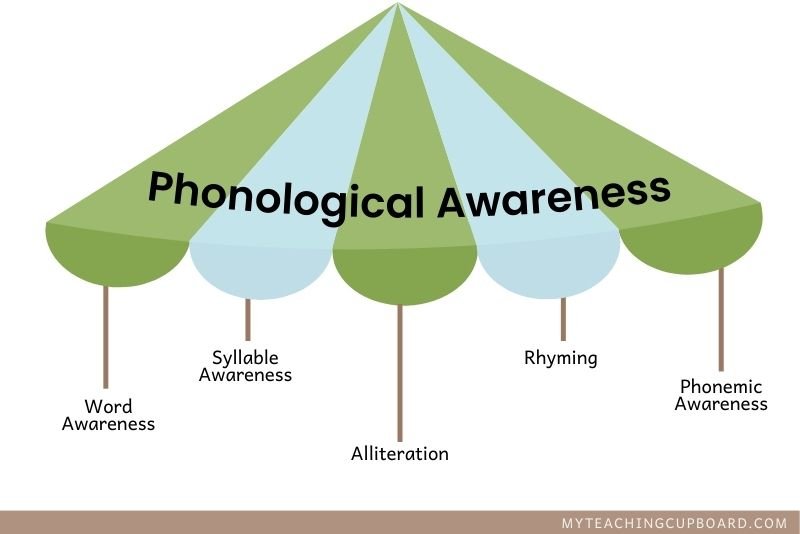
The Phonological Awareness Umbrella
Phonological awareness is a broad umbrella term covering four subskills:
Word Awareness: Recognising whole words as individual units within spoken sentences.
Syllable Awareness: Identifying and manipulating syllables within a spoken word.
Intra-syllable Awareness or Onset-Rime Awareness: Distinguishing the first sound - the initial consonant sound (onsets) from the remaining phonetic unit (rime) in a syllable or word.
Phonemic Awareness Skills: Recognising and manipulating individual phonemes - the individual sounds in words.
Do you confuse phonemic awareness and phonological awareness?
The difference between these two lies in the size of the speech sound unit. Phonological awareness activities involve spoken sentences, words and syllables, whereas phonemic awareness activities are at the phoneme level and work with the 44 speech or letter sounds.
Want to learn more about phonological and phonemic awareness? I’ve got a comprehensive blog post to help you: Teaching Phonological Awareness, Syllables and Phonemic Awareness

The first and most basic phonological skill is word awareness. This is followed by syllable awareness. Syllable awareness is all about identifying and manipulating the syllables found in a spoken word. It helps young children understand the rhythm and structure of spoken language and is an essential early literacy skill.
Syllable Awareness
Syllable awareness is the ability to identify and manipulate the beats (syllables) within words. It includes activities like counting, tapping, or segmenting words into their syllables and also blending them to form words.
Why Teach Syllable Awareness
Syllable awareness is a foundational skill in learning to read. Recognising syllable boundaries, counting the number of syllables in words, and blending separate syllables to make words are all part of syllable awareness.
Understanding syllables supports a student’s ability to blend and segment sounds. These skills are essential decoding strategies for young readers and also help students learn to spell accurately.
If students know how to identify syllables and break down words into syllables, they can apply spelling rules and decoding strategies to the different segments of a word.

12 Activities to Teach Syllables in Kindergarten and Preschool
Remember, teaching syllables in order to develop phonological awareness needs to be an auditory activity. I like to use pictures instead of written words in my syllable awareness games and activities. These syllable practice activities are suitable for whole class or small group lessons. They make great warm-up activities and can easily be added to explicit teaching lessons.
1.Clap the Syllable
Invite children to clap out the syllables in their names, as well as in common objects and animals. You can use any words you like!
2. Guess My Name
Clap the syllables in a student’s name and have the students try to guess whose name it could be.
3. Story Time
Integrate syllable awareness into your story time. For example, pause to clap the syllables in a character’s name or in a new vocabulary word discovered in the picture book when reading aloud.

4. Singing Syllables
Use percussion instruments to represent syllables while singing or reciting your favourite preschool songs and rhymes.
5. Syllable Sort
Provide picture cards or objects for children to group according to their syllable count. This activity is not only fun but also helps develop vocabulary, syllable segmentation skills and early counting practice. I have created sets of picture cards perfect for this activity.

6. Move to the Syllable Beat
Use a variety of movements like stomping, clicking, or tapping the desk to demonstrate the syllables in given words.
7. Counting Syllables
Give each child a marker and a piece of paper. Say a word, and the young learner draws a line on the paper every time they hear a syllable in the word. Afterwards, they can count the lines to find out how many syllables the word has.
8. Syllable Mix-up
Play a fun game where your children rearrange mixed-up syllables to make words. Mix up the syllables of a word by saying bow/rain, and ask your students to figure out the word. It’s rainbow by the way. 🌈 Move from compound words to more difficult multisyllabic words as your students learn syllable manipulation. Mix up hospital into al/hos/pit. This will really challenge them!
9. Missing Syllable
Say a word with three, four, or more syllables but leave off the ending syllable. Make sure to segment the word by leaving small gaps between each syllable, like /com/, /pu/… The children have to say /ter/ to complete the word. I have found children find it more difficult to work out the first syllable so start with omitting the last syllable.

10. Syllable Hopscotch
Create a short hopscotch grid with chalk on the concrete or use small hoops on the carpet if you want an indoor activity. The children jump into one space for each syllable in the word. For even more movement, they could even say the word and clap out the syllables as they jump.
11. Segmenting Puppets
My kids love using puppets to segment syllables in spoken words. They open and close the puppet's mouth for each syllable.
12. Syllable Towers
Provide children with building blocks. Say a word and clap the syllables as you say them. Then, have the children build towers or structures using one block for each syllable in the word. For example, for the word el/e/phant, the children would build a tower with three blocks, one for each syllable.
Teaching Tip
Start with disyllabic (2-syllable) words like baby or sunset, then move on to monosyllabic and longer multisyllabic words.
Have students struggling with syllable awareness?
Start with compound words. These are words that combine two separate words to create a new word. Some examples of compound words are: sunflower, playground, bookshelf, snowman.
Compound words are a great place to start if your students struggle with syllable awareness.

Do you have kids struggling to blend and segment syllables? Start with compound words. This interactive compound words activity is perfect for developing basic phonological awareness skills. Students will gain confidence, fluency and feel successful when they practice segmenting and blending compound words using the real-life pictures in this resource.
Teach Phonological Awareness with Compound Words
Once students understand that sentences are made up of individual words, they are ready to start blending and segmenting syllables. That’s where compound words come in. Compound words are made of two smaller words, combined to make a new word with a new meaning.
This makes them perfect for teaching young children the concepts of blending and segmenting – a basic phonological awareness skill.
If your students find blending, segmenting and manipulating syllables difficult, you need to take a step back and work with compound words. It is much easier for students to blend and segment compound words than it is to blend and segment syllables.
When they have mastered blending, segmenting and manipulating compound words, they can progress to syllables and, eventually single sounds or phonemes.
Oh - It’s great for vocabulary development as well.
Why Use Compound Words with Pictures?
Phonological awareness is about recognising and manipulating the spoken parts of sentences and words. It does not include written words and letters – that’s phonics!
Always avoid resources heavy with text when teaching phonological or phonemic awareness. That's why I designed this resource using only pictures to illustrate the compound words. Your students will practise HEARING the words (phonemic awareness) rather than thinking about the letter-sound correlations of phonics.
This picture-based compound word activity is designed with young learners in mind. There’s no complicated clipart – just easy-to-recognise real life photos so your students can easily identify them. The use of real-life pictures also makes learning more engaging for young children.
Talk about engaging! My kids love these flip cards.
How To Use These Pictures of Compound Word Flip Cards
Your students can use these cards to practice both blending or segmenting compound words. Each card has 2 sides. One side has a compound word picture, and on the other side, there are 2 pictures illustrating the 2 parts.
Use These Compound Word Picture Cards 2 Ways
Students practice hearing the 2 word parts of the compound word and then blending these parts together to make the complete compound word.
Students practice hearing the complete compound word and then segmenting it into the 2 parts.
They love working with a friend to practice, but it also makes for a great independent activity as well. The hands-on nature of flipping and manipulating the cards adds an interactive element that will keep students interested and motivated.
How My Students Independently Practice Blending and Segmenting with These Compound Word Picture Cards
First the kids pair up with a buddy.
If I want them to work on blending, they look at the card showing two pictures and say out loud the two words so that they blend them together to make a new compound word. If I want them to practice segmenting, they look at the picture card showing a compound word and say out loud the two smaller words that come together to make the word in the picture.
Their buddy listens and if they think it was done correctly, they will say, “Flip it!"
Now the card is flipped over to reveal the matching picture on the back. I love that these cards are self-correcting. No more kids interrupting my small group literacy instruction lessons. EMOJI
Finally, the kids swap! The listener becomes the blender or segmenter, and their partner has their turn to listen and the activity continues.
There are 40 compound words included in this resource so there’s plenty to keep the kids on task. I’ve included a heap of bonus features for you as well.
This Blending and Segmenting Compound Word Resource Contains:
40 Illustrated compound word flip cards for learning to both blend and segment compound words
A Compound Words Poster to help your students understand compound words
3 Learning Prompt Posters in case you want to set up a compound word learning center
2 Student Recording Sheets for evidence of learning
Teacher Assessment Recording Sheets – to keep those essential teacher observations organised
Task Card Box Label for storing and organising the flip cards
The key to successful phonological awareness instruction is to make it engaging and enjoyable for your students. Incorporating games and hands-on activities like this will capture your students’ interest and motivate them to develop their phonological and phonemic awareness.
Following a bit of guided practice with these cards, your students will be able to remember the routine and practice independently or with a friend. You will be able to use these versatile cards over and over again.
There are even printables included in this compound word PDF that you can use to help you set up a quick and easy literacy center or phonemic awareness investigation area.
This Independent Self-checking Compound Word Activity is Perfect for:
small group literacy rotations
guided reading instruction
buddy reading
independent reading
hands-on literacy centers
homework
reading stations
morning tubs
early finishers
word work
reading intervention
or to inform your assessment grades
An Easy To Prep Compound Word Activity
These cards are super simple to make.
Print the cards onto paper and cut out the strips.
Fold each strip in half and laminate to make the flip cards. You’ll have a picture on the front and self-checking pictures on the back.
Easily hole punch each card using the guide marks included.
Thread the cards onto a binder ring.
So, if you have been struggling to find the right tools for teaching basic phonological awareness skills, these interactive compound word flip cards can help you.
Instantly download this resource to help your kids find success and ensure your phonological and phonemic awareness instruction is complete and comprehensive.
Specially designed for kindergarteners and early primary students. They provide a fun and effective way for students to practice blending and segmenting compound words.
Ensure your students have no gaps in their phonemic awareness skills by investing in the targeted practice of segmenting and blending compound words.
One more tip: Try putting your hand under your chin to count the number of syllables in words. The number of times your chin drops when you’re saying a word is the number of syllables the word has.
Blending, Segmenting, and Manipulating Syllables
Syllable blending and segmenting are regularly covered in most phonological awareness routines but don’t forget about syllable manipulation. This involves syllable addition, deletion and substitution.
You should include syllable manipulation activities in your lessons if you want to prepare students for phoneme manipulation.
Syllable Blending: Begin with activities that blend common two-syllable words like compound words. Start with blending sun and flower to create the word? Sunflower.
Then move onto blending disyllabic words like blending mon and key to create the word? monkey.
Finally, teach students how to combine multiple syllables to form complete words. For example, blend hos-pit-al to create the word? hospital.
Syllable Segmenting: Routinely practice segmenting whole words into syllables. Start with compound words like scrapbook and show students how to break it down into scrap and book. Then move on to words with 2 distinct syllables (baby into? ba-by) before practising with multisyllabic words like: calendar into? cal-en-dar.
Syllable Addition: Again, start with compound words. Add rain to the start of bow to make? rainbow. Don’t forget to add syllables to the end as well. Add shine to the end of sun to make? sunshine.
When students have mastered this skill, move on to disyllabic words. Add bas to ket to make? basket. Add ow to the end of pill to make? pillow.
Syllable Deletion: To practice deleting syllables, again start with compound words. Take away cup from cupcake to leave? cake Also practice taking away the last syllable. For example, take room away from bedroom to leave? bed
Then move on to disyllabic words. Take sleep from sleeping to leave? sleep. Take er from sister to leave? sis.
Syllable Substitution: This time students will replace one syllable with another.
For example, take away bath from bathroom and add bed to make? bedroom. Take away coat from raincoat and replace it with bow to make? rainbow.
This can also be done with disyllabic words, but it takes some thought to find words that work. I tend to work with inflections (er, ed, ing, est). For example, take away shout from shouting and put in swim to make? swimming.
Syllable manipulation is worth the practice. My students had tremendous success with their phonological awareness development once I added this simple routine to our morning sessions.
Manipulating phonemes is a big part of learning to read and write. Syllable manipulation sets the stage for later phoneme manipulation. Exploring syllables like this also helps students to dissect and understand the structure of more complex words. It’s great for vocabulary development as well.
Foster Confidence and Participation
Build your students' self-assurance in syllable recognition by focusing on consistent repetition and practice. Every early childhood teacher knows repetition is the key to mastering any literacy skill, and learning about syllables is no different.
If you want your learners to gain confidence, introduce a daily practice routine where the kids can segment words into syllables and blend syllables into words. Use hands-on, interactive activities like those above to boost engagement and encourage participation.

Teaching syllable awareness and phonological skills to young learners is not just about breaking down words and clapping the beats in words. With the interactive games and engaging activities we've explored in this blog post, you can say goodbye to eye-rolling and bored kids staring out the window.
From closed to open syllables and everything in between, we have explored how syllable awareness plays a crucial role in literacy development. By incorporating the syllable games and activities in this blog post into your literacy block, you will have an engaging and fun way to build syllable knowledge and lay the foundation for your students to become confident readers and spellers.
Remember to begin with something familiar – like compound words to ease your students into syllable practice. Use my Compound word Flip Cards to help your children segment and blend syllables and build the confidence they need for more complex syllable division.