F to 2 Australian Curriculum English V9.0 Explained
Discover how to teach F–2 Australian Curriculum English with confidence. Clear guidance, practical examples, and resources to support student learning.
Teaching English in the early years can feel so overwhelming.
Between phonics, reading groups, writing lessons, exploring literature, AND all the assessments it often seems like there are never enough hours in the day.
On top of that, the Australian Curriculum (V9.0) is packed with detailed codes, content descriptions, and achievement standards that can leave any Prep to Year 2 teachers asking: What exactly do I need to teach, and how do I fit it all in?
The study of English is at the heart of our school curriculum because it’s the national language of Australia and the foundation for learning across all other learning areas. It’s all about shaping the development of young Australians into confident communicators, imaginative thinkers, and critical thinkers who can engage with the world around them.
English plays a key role in helping our children connect with the aspects of Australian life that matter most: identity, relationships, and community.
It’s also an important part of preparing them for the academic journey they have ahead.
That’s where this blog post comes in. My aim is to take the complexity of the Australian English Curriculum and break it down into clear, teacher-friendly language.
I’ll show you how the strands, content, and expectations translate into practical classroom teaching - whether you’re running small-group phonics, guiding whole-class discussions, or weaving literature into play-based learning.
By the end, you’ll not only understand how the three strands of English (Language, Literature, and Literacy) fit together, but you’ll also see how they link directly to your everyday teaching, investigation areas, and explicit lessons.
What Is the Australian Curriculum English?
At its core, the Australian Curriculum English Subject recognises English as the national language of Australia and the foundation for success in every other subject. It plays a central role in the school curriculum, not only teaching children how to read and write but also how to think, communicate, and engage with the world around them.
The purpose of the study of English in the early years is to create confident communicators, critical thinkers, and informed citizens.
From Foundation through to Year 2, children are introduced to the knowledge and skills that will support their learning across all other learning areas.
The aims of the English curriculum are clear. It ensures that students learn to:
purposefully read, write, speak, listen, and view across a growing range of contexts
understand how Standard Australian English works in both its spoken and written forms
develop an informed appreciation of literature from a wide variety of cultural and historical contexts
use the power of the English language in different ways to express ideas, form connections, and engage with others.
Literacy is the essential knowledge that underpins learning in mathematics, science, the arts, and more. When our children develop strong literacy skills in the early years, they are better prepared to meet the demands of the wider school curriculum and to participate fully in the life of a diverse, modern Australia.
The Structure of the Curriculum – Three Strands Explained
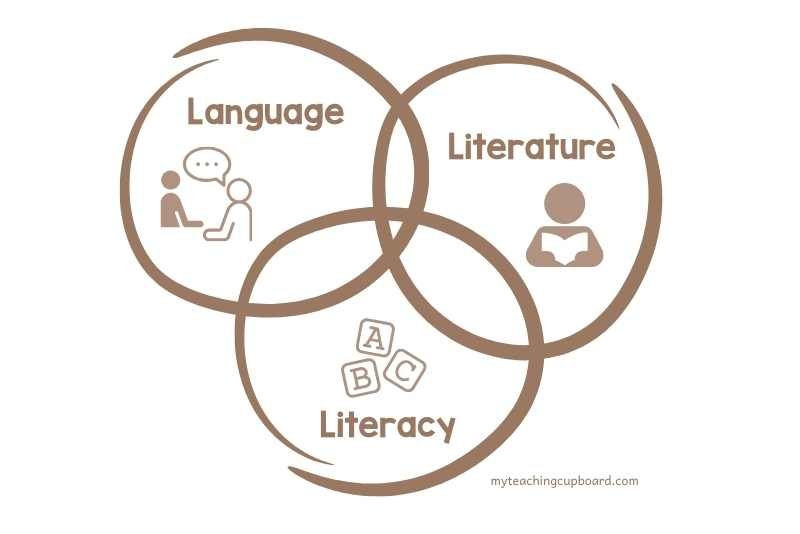
The English curriculum is built around three strands: Language, Literature, and Literacy. Each has a different focus, but they work together to give children the knowledge and skills they need to learn, communicate, and express themselves.
Rather than teaching them in isolation, these strands are designed to overlap. A single lesson might involve learning new vocabulary (Language), exploring a story (Literature), and retelling it in writing (Literacy). This integration is what makes English such a strong foundation for all other areas of learning.
The Language Strand
The Language strand focuses on building children’s knowledge of how English works. It gives them the tools they need to understand and use language in different ways - from conversations with peers to writing sentences that make sense on the page.
At its heart is oral language.
Speaking and listening are the foundations for literacy. Research consistently shows that strong oral language in the early years directly supports reading and writing development. The Australian Council for Educational Research (ACER) highlights that oral language competence is “the driver of literacy competency” and predicts later success in reading comprehension and written expression.
When children can talk about ideas, ask questions, and explain their thinking, they are better prepared to decode text, understand stories, and organise their own writing.
This is why oral language can’t be left to chance. It needs to be deliberately fostered through classroom discussions, play-based learning, and opportunities for children to use language in meaningful contexts.
One of the main reasons I adopted the Walker Learning Approach was because it prioritises oral language as a foundation for literacy. During investigation time, children learn to articulate their ideas, explain processes, and listen to the perspectives of others. These are essential skills for literacy growth.
Within the Language strand, there are three sub-strands that guide what we teach:
Language for Interacting with Others – recognising context and audience, such as how a child might speak differently to a friend, a teacher, or during a presentation.
Text Structure and Organisation – understanding how different texts are shaped, from signs and instructions to stories and digital texts.
Language for Expressing and Developing Ideas – building vocabulary, grammar, and sentence structures so students can clearly express their thoughts.
When we see oral language as the foundation and intentionally teach these areas, we’re not only supporting our children to meet curriculum expectations, but are also giving them the confidence to engage with the world through spoken and written communication.

The Literature Strand
The Literature strand is about engaging with and creating texts that hold cultural and personal value. Through stories, poems, plays, and digital texts, children explore big ideas like family, identity, and belonging.
They also encounter literature that stretches beyond their own experiences, giving them insight into different times, places, and perspectives.
A key part of this strand is exposure to a wide range of voices, including First Nations storytelling, Australian authors, and world literature. These texts are essential to helping children connect with the richness of culture while also sparking imagination and creativity.
This strand is divided into four sub-strands:
Literature and Contexts – linking stories to cultural and historical backgrounds so children can see how texts reflect and shape society.
Engaging with and Responding to Literature – encouraging students to share feelings, ideas, and connections with characters and events.
Examining Literature – analysing how authors use language and style to create meaning.
Creating Literature – giving children opportunities to write and perform their own stories, poems, and plays.
One of the biggest challenges teachers face here is finding meaningful literature units. Ones that children can truly relate to and that can be differentiated for all abilities in the classroom.
Without careful planning, it’s easy to end up with units that are too hard for some, or too simplistic for others. Choosing the right texts and designing flexible activities is what makes this strand successful in ensuring every child can see themselves as a reader, thinker, and creator.

The Literacy Strand
The Literacy strand is where children apply their knowledge of language and literature to create meaning in real contexts. It covers the practical skills of reading, writing, speaking, listening, and viewing. Everything our little ones need to become confident and capable users of English.
This strand includes the foundational skills of early literacy: phonics, decoding, comprehension, and writing sentences. These are the stepping stones that allow our children to move from learning how to read, to reading in order to learn.
The five sub-strands are:
Texts in Context – understanding audience and purpose in different types of texts.
Interacting with Others – building oral language skills through discussions, presentations, and collaboration.
Analysing, Interpreting, Evaluating – using comprehension strategies to make meaning from texts.
Creating Texts – producing written, spoken, and multimodal texts for a range of purposes.
Phonic and Word Knowledge – developing phonemic awareness, learning CVC words, spelling, and building fluency.
This is also where many teachers feel the most pressure, as they juggle phonics, fluency, and comprehension alongside curriculum requirements and english assessments.
You need a strong sequence of explicit teaching, combined with play-based learning opportunities, to ensure that literacy skills develop in meaningful and engaging ways.
If you’re looking for more practical support in this area, I’ve written blog posts on phonological awareness and phonemic awareness that break down these skills and show how they can be taught step by step in the classroom.

Why English Plays a Central Role in the Australian Curriculum
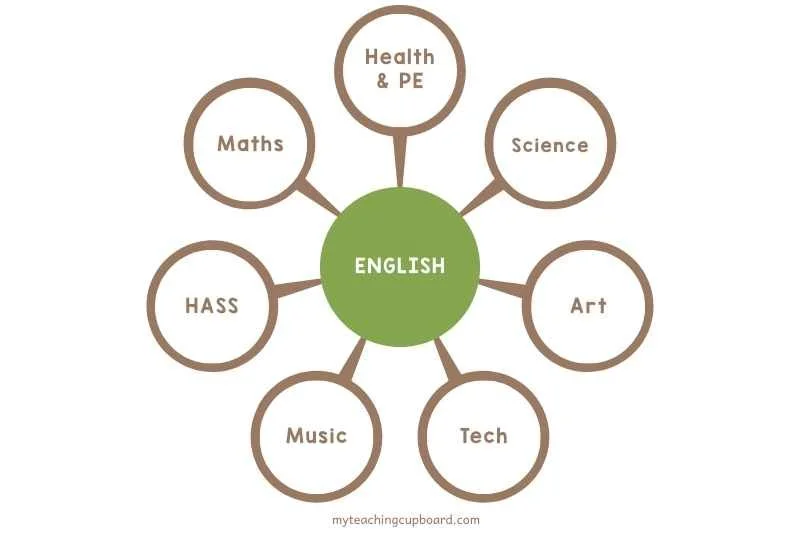
English is the foundation of all learning. Every subject, from science to the arts, relies on students having the language tools to access, understand, and express content. This is why English receives the most teaching time of any learning area. It underpins success across the entire curriculum.
The role of English goes far beyond reading and writing though.
It shapes children’s sense of identity, supports communication, and allows them to participate fully in society. Through literature and real-world texts, our students encounter diverse perspectives, global issues, and important aspects of the human experience.
They learn to explore interpersonal relationships, think critically about ethical dilemmas, and develop an informed appreciation of literature from a wide range of voices, including those from our diverse country.
The Australian Curriculum English also links directly to cross-curriculum priorities and general capabilities.
English provides the space to develop ethical understanding, social capability, and intercultural knowledge. These are all skills that help children connect with both their immediate world and broader social sciences.
For students learning English as an additional language, or those who bring rich home languages with them, English lessons become a bridge to learning and participation.
For many teachers, the challenge is time. With so much content to cover, it can feel impossible to give English the focus it deserves.
The important thing to remember is that prioritising English isn’t optional - it’s expected. And with the right planning, it doesn’t have to be overwhelming. My literacy planning resources are designed to help you map out content in a way that’s both manageable and effective, so you can meet curriculum requirements while keeping your lessons engaging and meaningful.

Key Considerations for Planning and Teaching English F–2
Planning for English in the early years can feel daunting. With so many content descriptions and achievement standards to cover across an academic year, it’s easy to wonder how everything will fit into your timetable.
Thoughtful planning (supported by flexibility and integration) makes it all manageable. Here are five key considerations…
1. Integrating the Strands
The three strands — Language, Literature, and Literacy — don’t need to be taught separately. In fact, the curriculum is designed for them to be integrated.
For example, during a science unit, your children might
observe a plant (Language for developing vocabulary),
read an informational text about how plants grow (Literature in context),
and then create a labelled diagram or short written explanation (Literacy through creating texts).
Many teachers ask, “How do I fit it all in?” The answer lies in integration.
Instead of treating each descriptor as an isolated task, look for ways to bring them together. This saves time while still supporting student progress across all areas of English.
2. Language Modes
Listening, speaking, reading, viewing, and writing are not separate skills. They are interrelated processes.
A strong activity will address more than one mode at a time.
For example, students might
listen to a story,
discuss it with a partner,
then write about the main character.
This integrated approach not only builds efficiency but also mirrors how our children actually use language in real life. Strong student learning comes from repeated opportunities to apply these modes in connected ways.
3. Text Selection
Choosing the right texts is critical. Teachers can draw on oral storytelling, visual texts, digital texts, and multimodal learning resources.
Including real objects, photographs, and even props can support children who need alternative ways of accessing meaning.
Texts should represent a range of perspectives - from First Nations stories to contemporary works, and from imaginative narratives to informative and persuasive texts. By doing this, we expose our children to a breadth of literature while still keeping it all accessible and engaging.
4. Meeting the Needs of Diverse Learners
Every class is different, and adjustments are often necessary to ensure all students can access the curriculum. This is especially true for EAL/D learners, who may bring rich home languages but need specific support in building Standard Australian English.
Practical strategies include
using multimodal resources
peer-assisted learning
flexible assessment options
and offering choices between oral and written tasks
Effective formative assessment also helps identify what students need and ensures teaching is responsive. These types of adjustments support inclusion and keep children on track with the required outcomes.
5. Broader Curriculum Connections
English is at the heart of developing the general capabilities. Through discussions, presentations, and text analysis, children build critical thinking, ethical understanding, intercultural awareness, and even digital literacy when using technology to create and share texts.
Numeracy also plays a role. Students interpret charts, statistics, and number-based information embedded in texts, learning to question how data is presented and what it means.
By weaving these broader skills into English lessons, you’ll prepare your children for literacy success and for participation across the whole curriculum as well as later key stages of schooling.

Foundation to Year 2 – What Students Actually Learn
The early years of school are where children build the essential knowledge that will carry them through their whole learning journey. The achievement standards for each year level - Foundation, Year 1 and Year 2 give us a clear picture of what students should know and be able to do by the end of each academic year.
They also remind us that progress isn’t always linear. Every child arrives with different experiences, strengths and challenges. Careful text selection, meaningful activities, and ongoing formative assessment all help us track student learning and support student progress.
These early years also set the scene for later success. The foundations built here prepare our children not only for upper primary but also for the demands of secondary school and the next key stages of their education.
Foundation (Prep)
In the Foundation year, the English curriculum builds directly on the Early Years Learning Framework and children’s prior experiences. Students come to understand that English is the shared language of the classroom, used to interact with others and to communicate for different purposes.
A text-rich environment is key.
Children engage in shared reading, viewing, and storytelling. They enjoy spoken, written and multimodal texts - from picture books and rhymes to oral traditions and simple films. Importantly, they begin with decodable texts that match their phonics development, alongside authentic texts with simple language and familiar content.
Foundation students also:
develop phonics and phonemic awareness, practising how to blend and segment sounds
begin to identify letters and sounds, connect print to meaning, and retell familiar stories
create short texts using words, drawings, and spoken language
practise forming letters and experimenting with basic punctuation.
The achievement standard expects children to listen to texts, retell stories, share ideas, recognise rhymes and letter–sound patterns, and begin to read and write simple words and sentences.

Year 1
By Year 1, many children are ready to move towards independent reading. They continue with decodable texts but also engage more with authentic texts that introduce new ideas, language features and vocabulary. They begin to see themselves not just as learners of reading, but as readers.
Year 1 students also:
write simple sentences, recounts, and descriptions
practise using capital letters and full stops consistently
learn to retell and adapt familiar stories, and express opinions about texts
engage with a wide range of text types — imaginative, informative and persuasive — including poetry, non-fiction, and short films.
The achievement standard highlights that students can read and comprehend familiar texts, use sentence boundary punctuation, blend short and long vowels, and spell most one-syllable words. They also begin to use topic-specific vocabulary in their writing.
A challenge for teachers is ensuring that every student has access to texts at the right level. Some will still rely on decodable readers, while others are ready for more complex authentic texts. Here, student workbooks, guided reading groups, and ongoing formative assessment help you to differentiate effectively.

Year 2
Year 2 is the transition point for our young people to become fully independent readers. Students now tackle more complex texts, including early chapter books and multimodal texts with diagrams and varied sentence structures.
Year 2 students also:
create longer written pieces, including imaginative, informative and persuasive texts
begin to use compound sentences and a wider range of punctuation
apply phonic and morphemic knowledge to spell unfamiliar words
read with increasing fluency, recognising both literal and inferred meaning.
The achievement standard expects students to comprehend more challenging texts, make inferences, describe how texts are structured, and create their own stories, reports, and explanations.
They should be able to punctuate sentences, use topic-specific vocabulary, and spell words with regular patterns and some less common ones.
By the end of Year 2, students are not only readers and writers. They are becoming independent learners who can express their ideas with growing confidence. These skills are the springboard for the next key stage of schooling.

Key Considerations for Teachers
Planning to teach English across Foundation to Year 2 has many moving parts. There’s different strands, modes, and texts - and the question I hear most often is: “How do I plan all this?” T
Well the good news is that the curriculum is designed to work together, not in pieces. Here are some key considerations to keep in mind.
Integrating the Strands
The strands of Language, Literature, and Literacy are not meant to be taught in isolation. They overlap naturally, and the most effective lessons draw on more than one at a time. For example, a single task might involve listening to a story, discussing new vocabulary, and then writing a short response.
Language Modes
Listening, speaking, reading, writing, and viewing are interdependent. Strength in one area often supports growth in another. A classroom discussion, for instance, builds oral language while also helping children clarify ideas they will later record in writing.
Text Selection
Texts should be carefully chosen to reflect the needs and interests of your students. This includes oral storytelling, digital and multimodal texts, and literature that represents First Nations voices and diverse cultural perspectives. The right texts not only support literacy growth but also help children see themselves and others reflected in their learning.

Meeting Diverse Learners’ Needs
No two classrooms are the same. Some children need additional support, such as EAL/D learners who are building English while also learning through English. Others may benefit from multimodal approaches, peer support, or alternative ways of showing what they know. Inclusive practices ensure that every child can access the curriculum and make progress.
Making Planning Manageable
With so much content to cover, planning can feel like the hardest part.
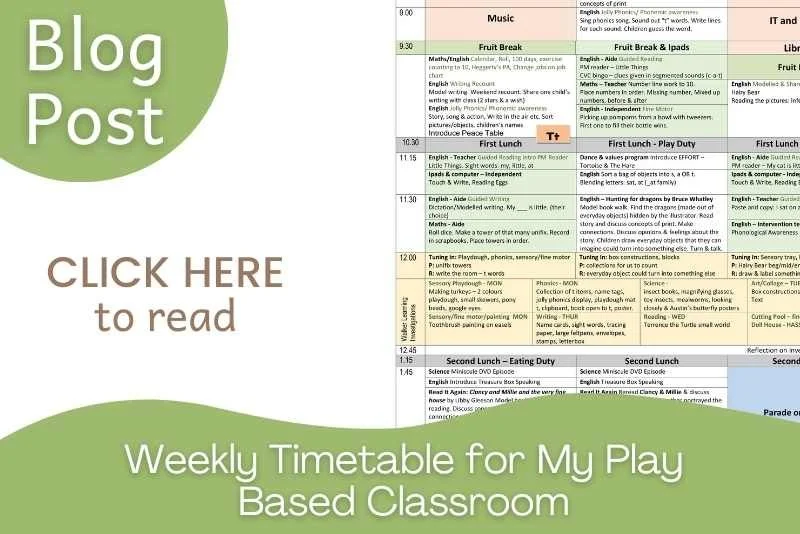
The key is structure and simplicity. You don’t need to reinvent the wheel each week. Check out my blog post on how I plan for play based learning and download my planning templates and literacy resources to help you. They are designed to give you a clear starting point while still leaving room to adapt for your students’ needs.
Making the Curriculum Work in Your Classroom
One of the biggest challenges teachers face is finding the balance between explicit teaching and play-based learning.
The Australian Curriculum English expects us to cover such a wide scope of skills, but our children also need opportunities to explore, talk, and make sense of language in meaningful contexts.
Both are important! And when they work together, the results are powerful.
Literacy Rotations
Short, focused rotations with small groups gives my students targeted practice with key skills like phonics, spelling, and comprehension. This is where I like to use student workbooks, decodable readers, and small-group activities to address specific content descriptions and track progress through formative assessment.
Using Literature for Provocations
Quality literature can be the spark for deep discussion and exploration. A picture book, poem, or short film can become a provocation that encourages your children to ask questions, share opinions, and connect texts to their own experiences. This approach also makes text selection more meaningful because I have found that children are more engaged when texts reflect their world and expand their perspectives.

Writing Through Investigations
Writing tasks don’t need to be limited to the writing block. Integrating authentic writing opportunities into play and investigations makes literacy authentic and purposeful.
I like using our Photographer and Reporter roles to give my children opportunities to write captions, record observations, and create reports that link back to real classroom experiences.
This ensures writing feels authentic while still addressing all those achievement standards.
For more ideas, you might like these posts:

Bringing It All Together
The Australian Curriculum English for Foundation to Year 2 is broad and detailed, but at its heart it’s about helping children build strong literacy foundations.
It aims to develop confident communicators who can listen, speak, read, write, and create with purpose.
For teachers, the challenge is real. There’s so much content and only so much time. But with a clear understanding of the strands, achievement standards, and key considerations, you can plan in a way that feels manageable and meaningful.
When you balance explicit teaching with play-based learning, you’ll see your children not only meeting benchmarks but also enjoying the process of learning.
With the right planning tools and resources, you’ll feel more confident, less stressed, and able to create the kind of literacy-rich classroom that sets your students up for success – both now and in their future schooling years.
If you’d like support with planning and resourcing, explore my literacy resources collection.
They’re designed to save you time, simplify your planning, and give you confidence that you’re meeting ACARA expectations. And of course, you’ll be keeping learning engaging and play-based.
