
F to 2 Australian Curriculum Maths V9.0 Explained
Discover how to teach Australian Curriculum Maths F–2 with clear aims, six strands explained, and play-based strategies that save you prep time.
Feeling overwhelmed trying to unpack ACARA’s Version 9 Maths curriculum for Foundation to Year 2?
Well, you’re not alone!
So many teachers feel lost in the maze of content strands, achievement standards, and curriculum language. The documents can feel heavy and hard to translate into practical classroom practice.
It often leaves you asking:
How do I balance curriculum expectations with play-based pedagogy?
How do I make sure my students are meeting the benchmarks, while still keeping learning age-appropriate and hands-on?
I remember not that long ago, sitting with a pile of ACARA documents, highlighters everywhere, wondering how on earth I was going to pull this together into lessons that my students would actually enjoy.
It felt like I was either going to drown in planning or risk missing key outcomes.
Over time, I found that breaking the Australian Curriculum Maths down into teacher-friendly chunks and linking it back to the way children learn best - through play, investigation, and real-world connections was the solution I needed.
That’s exactly what this post will do for you.
I’ll walk you through the essentials of the F–2 maths curriculum in simple language, highlighting the content descriptions, proficiency strands, and how the curriculum connects to your everyday classroom practice. You’ll see how to link the learning area of mathematics to your daily routines, investigations, and provocations without losing sight of the bigger picture.
My goal is to give you clarity and confidence so you can spend less time decoding the curriculum and more time teaching it - in ways that spark curiosity and build strong student outcomes.
By the end of this blog post, you’ll have a clearer sense of the curriculum content, how it’s structured across each year level, and practical ways to approach planning and assessment.
Most importantly, you’ll know that it’s possible to meet the achievement standards while still protecting the joy of learning maths in the early years.
What is the Australian Curriculum Maths V9.0?
The Australian Curriculum, Assessment and Reporting Authority (ACARA) is the national body responsible for developing and maintaining the Australian Curriculum. Its role is to set consistent expectations across the country, so that no matter where a child goes to school, they are learning to the same current standards.
In Version 9, the Mathematics curriculum has been updated to reflect the skills and knowledge young Australians need in today’s world.
It is structured as a learning area with content descriptions, achievement standards, and proficiency strands that work together to guide teaching and assessment.
V9 Mathematics aims to ensure that students:
Become confident, proficient and effective users and communicators of mathematics, who can investigate, represent and interpret practical situations in their personal and work lives, think critically, and make choices as active, engaged, numerate citizens.
Develop proficiency with mathematical concepts, skills, procedures and processes, and use them to demonstrate mastery as they pose and solve problems, and reason with number, algebra, measurement, space, statistics and probability.
Make connections between areas of mathematics and apply mathematics to model situations in various fields and disciplines (such as science, design, and digital technologies).
Foster a positive disposition towards mathematics, recognising it as an accessible, useful, and enjoyable discipline to study.
Acquire specialist mathematical knowledge and skills that underpin numeracy development and lead to further study in mathematics and professional applications of mathematics in other fields.
These aims connect directly to the Early Years Learning Framework (EYLF), which underpins the early years of Australian education.
Both ACARA and the EYLF highlight the importance of play-based learning as the most natural and age-appropriate way for children to build numeracy skills.
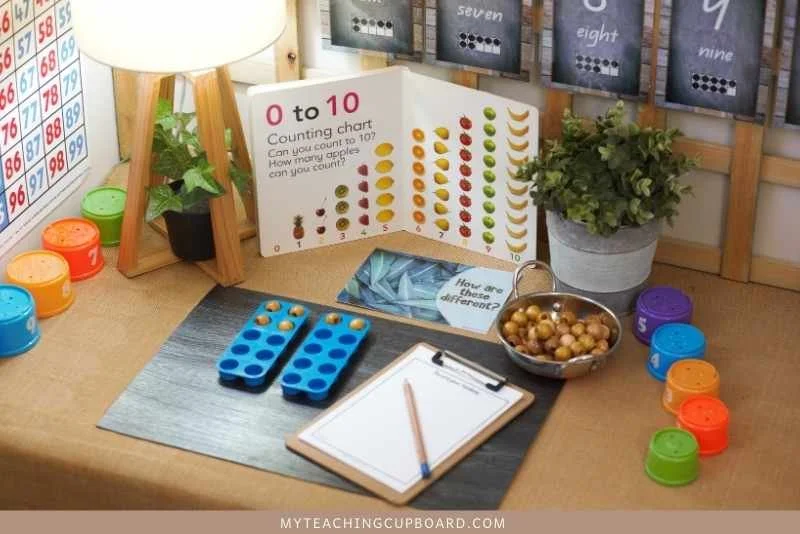
From sorting bundles of familiar everyday objects to exploring patterns, measuring through play, or solving simple mathematical problems, children can use play to make sense of mathematical concepts long before they meet them formally in the classroom.
This natural progression from play in the early years into the structured curriculum content of school gives teachers a powerful bridge. By embedding play-based provocations into your maths lessons, you can meet the expectations of the curriculum while also engaging your children in ways that are meaningful to them.
👉 For more on how to do this in your own classroom, read my other blog post: Teaching the F-2 ACARA Math Learning Intentions Through Play.

How the F–2 Australian Curriculum Maths is Organised
The Australian Curriculum Maths (F–2) is organised by year level, so you can clearly see the curriculum content and expectations for Foundation, Year 1, and Year 2. Each year builds on the last, supporting continuity in student learning and ensuring children develop the essential mathematical skills they need for future success.
Within each year level, the content is structured around six strands:
Number
Algebra
Measurement
Space
Statistics
Probability
At first glance, this can feel like you’re juggling six separate subjects. It might feel overwhelming to track progress across so many areas of mathematics, but the truth is these strands are designed to connect naturally. And that = saving you time in your planning and teaching.
The Natural Connections Between Strands
The content of these strands is interrelated and reinforces itself in different ways:
Number and Algebra build on an understanding of number systems and the properties of operations. Together, they help students describe relationships, see patterns, and begin to generalise through arithmetic operations and algebraic expressions.
Statistics and Probability are tightly linked. Students learn to collect and analyse data values, interpret patterns, and use that knowledge to predict outcomes in practical situations.
Measurement and Space are also connected, but Measurement underpins all strands. It gives students a way to quantify, compare, and communicate what they observe in everyday activities - from tracking regular events in a daily routine, to building a tall tower out of blocks and discussing its height.
Combined with Number, Measurement allows students to make sense of the world through simple additions, familiar fractions, and related division facts, applied to everyday experiences and the immediate environment.
By drawing out these natural connections, maths becomes less about ticking off separate boxes and more about building a rich, interconnected web of mathematical understanding. When you teach this way, you’re not only saving yourself time but also giving your students a deeper appreciation of how mathematics is used in daily life and across different disciplines.

Foundation to Year 2 Content Overview (What Teachers Need to Know)
The Australian Curriculum Maths in the early years is designed to gradually build students’ mathematical understanding step by step.
Each year level sets clear achievement standards, but in practice, it’s about providing developmentally appropriate opportunities for children to explore number, patterns, measurement, and more through everyday activities and play.
Here’s a quick overview of what you’ll be teaching from Foundation to Year 2.
Foundation: The Building Blocks
In the Foundation year, the focus is on developing early number sense. Students learn to count, recognise groups of objects, compare quantities, and begin to understand arithmetic operations in simple contexts. They explore patterns with colours, sounds, and shapes, and they start to measure using informal units (like comparing the length of two sticks or pouring sand into different-sized containers).
Classroom example: Children might use bundles of familiar everyday objects like straws or counters to represent numbers. Singing number rhymes or exploring shapes during everyday experiences (like snack time) helps embed maths in their immediate environment.
Year 1: Consolidating and Extending
By Year 1, students consolidate their number knowledge and begin working with simple additions and related division facts in practical situations. They’re introduced to familiar fractions (like halves and quarters) and start measuring with standard units - such as centimetres for length or litres for capacity.
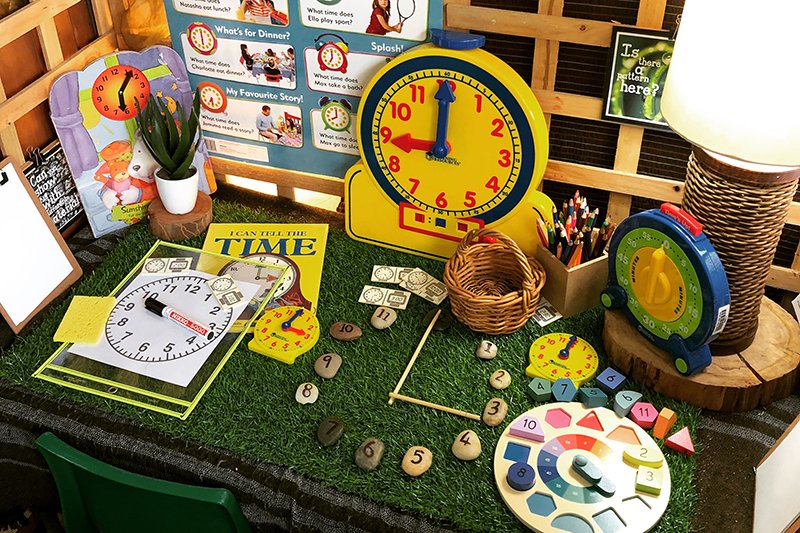
Students also learn to describe shapes and their features, and they develop an awareness of time through regular events in their daily routine (for example, morning tea happens before lunch).
Classroom example: You might explore halves by cutting fruit during snack time or use a clock to explore the quarter hour. Graphing the class’s favourite fruit is also a simple way to begin a statistical investigation.
Year 2: Building Confidence and Connections
In Year 2, the curriculum takes another step forward. Students extend their understanding of place value, moving from tens into hundreds (recognising that ten tens make 100). They develop a range of addition and subtraction strategies, are introduced to the basics of multiplication (often as repeated addition), and begin solving simple mathematical problems involving unknown quantities. Students also start to collect and interpret data, exploring chance in playful contexts.
Classroom example: This is the perfect time for bundling sticks into groups of ten or using base-ten blocks. Asking students to build a tall tower with blocks and then comparing heights provides opportunities to connect measurement attributes (like height and width) with number.

By understanding the focus of each year level, teachers can see how the curriculum content gradually develops from individual objects and simple counting in Foundation through to large numbers, operations, and data value in Year 2.
More importantly, it reassures us that small, playful steps (like sharing blocks or sorting shapes) are laying the foundation for future mastery in the study of mathematics.
What Students Achieve by the End of Each Year Level
The achievement standards in the Australian Curriculum Maths give us a clear picture of what student learning should look like at each year level.
Here’s a breakdown of the essentials for Foundation through to Year 2.
Foundation
By the end of Foundation, students are building strong early number sense.
They:
connect number names, numerals, and position in the sequence to at least 20
use subitising and counting strategies to quantify collections
compare the size of collections to at least 20
partition and combine collections up to 10 in different ways, representing these with numbers
solve simple mathematical problems like equal sharing, adding to, and taking away from collections up to 10
copy and continue repeating patterns
identify and compare the attributes of mass, capacity, length, and duration
sequence familiar events to the time of day
name, create and sort familiar shapes, giving reasons for their choices
describe the location and position of objects and people in relation to one another
collect, sort, and compare data in familiar contexts
Year 1
By the end of Year 1, students are moving into larger numbers and new mathematical processes.
They:
connect number names, numerals and quantities, and order numbers to at least 120
partition one- and two-digit numbers in different ways, including into tens and ones
skip count by 2s, 5s, or 10s to quantify collections up to 120
solve addition and subtraction problems to 20 using mathematical modelling
use numbers, symbols and objects to create and extend skip counting and repeating patterns
compare and order objects by length, mass, capacity and duration, explaining reasoning
measure objects with uniform informal units
classify and describe the features of shapes and objects
give and follow directions to move people and objects within a space
collect and record categorical data, create simple one-to-one displays, and compare results

Year 2
By the end of Year 2, students demonstrate stronger fluency and reasoning skills. They:
order and represent numbers to at least 1000
apply place value to partition, rearrange, and rename two- and three-digit numbers
regroup numbers to assist with calculations
solve practical additive and multiplicative problems (including money) using mathematical modelling
identify and represent halves, quarters, and eighths in measurement contexts
describe and continue patterns that increase or decrease by a constant amount, identifying missing elements
recall and demonstrate proficiency with addition/subtraction facts to 20 and multiplication facts for 2s
use informal units to measure and compare shapes and objects
use calendars to calculate the number of days between events
read time on an analogue clock to the hour, half hour, and quarter hour
compare and classify shapes, using formal spatial language
follow and describe directions and pathways on two-dimensional representations
collect, record, and interpret categorical data
📌 Tip for teachers: Reading through these achievement standards can feel like a lot to manage, but when you connect them back to play, provocations, and everyday activities, they become much easier to embed in your daily routine. Think “counting during roll call” or “measuring towers in block play” These everyday experiences add up to powerful maths learning.
The Six Strands of the Australian Curriculum Maths Explained (F–2)
The Australian Curriculum Maths is organised into six content strands. Each one has its own focus, but remember, they are also deeply connected to each other.
When you teach across the strands in a hands-on, integrated way, you’ll save time and give your students a deeper mathematical understanding.
Here’s what each strand looks like in Foundation to Year 2, with classroom examples and ideas for play-based learning.
1. Number
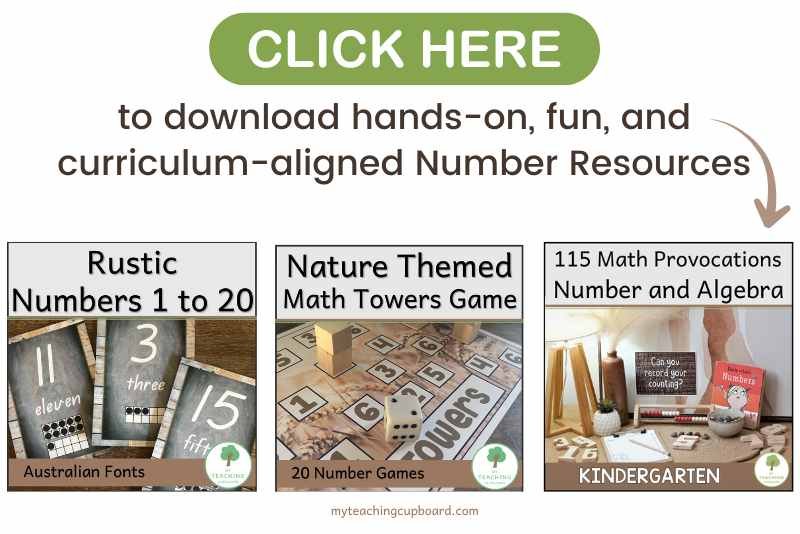
The Number strand is at the heart of maths in the early years. It’s about learning to count, order, and compare, as well as building place value knowledge and confidence with early arithmetic operations. Students use counting strategies, group objects, and explore how numbers represent real-life situations.
Numbers have a wide-ranging application: from quantifying everyday objects, to measuring, to solving simple mathematical problems. Developing strong number sense sets your students up to be financially literate, confident decision-makers, and engaged citizens.
Common pain point: Students often learn to skip count but don’t understand what the numbers actually mean. Without a strong sense of quantity, they struggle later with multiplication and division.
Play-based examples: Use loose parts like counters, ten-frames, or bundles of familiar everyday objects (like sticks or buttons) to model numbers. Subitising games, number rhymes, and simple “shop play” with coins are all effective ways to build strong foundations.
🔗 Resource link: My Loose Parts Number Mats and Math Number Provocations packs are designed to make teaching Number hands-on, fun, and aligned with ACARA.
2. Algebra
In the early years, Algebra is not about solving equations but more about exploring patterns, relationships, and generalisations. Students notice what repeats, grows, or changes, and they begin to represent these relationships with numbers, objects, and symbols.
Algebra builds the foundation for later understanding of algebraic expressions and the concept of equivalence. It connects symbolic, graphic, and numeric representations, which is why hands-on experiences are so powerful at this stage.
Play-based examples: Encourage your children to create repeating patterns using loose parts or explore growing patterns with pattern mats. You might also ask them to describe patterns they see in their immediate environment (like tiles on the floor or stripes on clothing).

3. Measurement
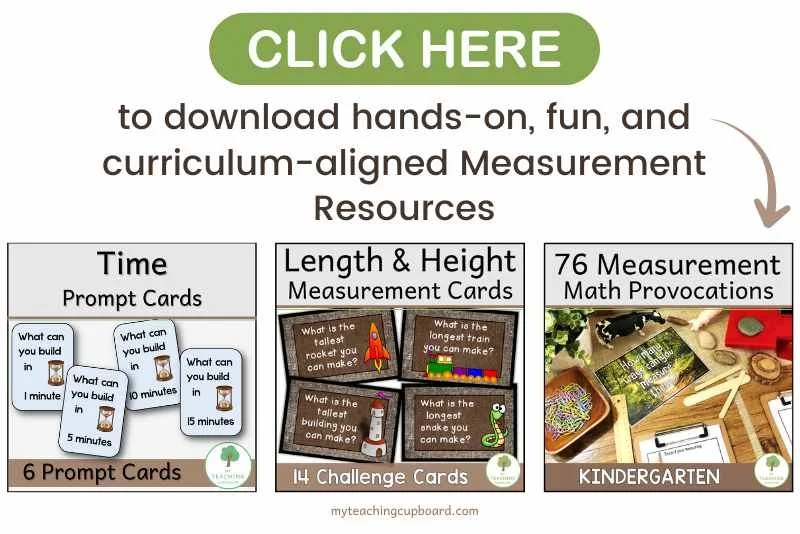
The Measurement strand develops ways of quantifying the world around us. Students compare objects by length, mass, capacity, and duration. They gradually learn to use standard units. Measurement connects strongly to daily life, from timing how long it takes to run across the playground, to pouring juice into different-sized cups.
Measurement underpins many professional applications of mathematics. From science and agriculture to health and engineering. In the early years, it’s about building familiarity through real-world play.
Play-based examples: Set up water play stations for capacity, use balance scales to compare the weight of toys, or measure block towers during construction play. These types of fun everyday activities bring measurement alive for young learners.
4. Space
The Space strand is about visualising and working with shapes, objects, and locations. Students explore 2D shapes, 3D objects, position, and transformations (like flips, slides, and turns). They also begin to use formal spatial language to describe features and locations.
This strand lays the foundation for geometry as well and links strongly to art, design, and everyday experiences like following directions or reading maps.
Play-based examples: Provide block play to build and compare structures, set up treasure hunts where students follow directional clues, or map out familiar classroom spaces together. Encourage them to use words like “next to,” “between,” and “under.”

5. Statistics
The Statistics strand develops ways of collecting, recording, and interpreting data values. In Foundation to Year 2, this starts with asking simple questions, sorting and classifying, and representing data in basic graphs or charts.
Statistical literacy helps children make sense of information and supports creative thinking and decision-making. Even at this stage, students can begin to notice different ways of representing data and discuss which ones make the most sense.
Play-based examples: Tally up favourite fruits in the class, use blocks to make a simple bar graph, or use counters to tally up simple yes/no questions and talk about the results. These small-scale statistical investigations connect maths directly to children’s everyday activities.
6. Probability
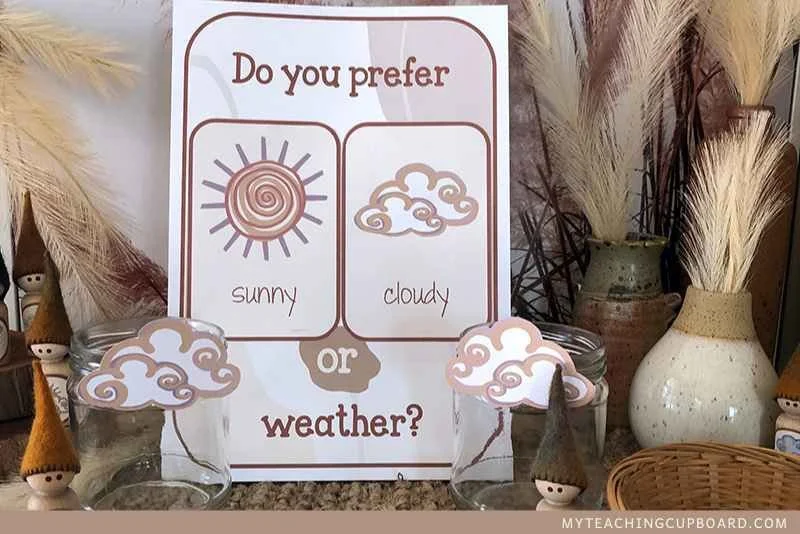
The Probability strand helps students understand and describe uncertainty and chance. In the early years, this begins with everyday language (likely, unlikely, certain, impossible). Later, it grows into experiments and basic simulations.
Probability is not only important in games but also in making informed decisions in areas like health, science, and even future-focused fields like computer science and artificial intelligence.
Play-based examples: Use spinner games or dice to talk about what might happen next. Ask questions like, “What are the chances it will rain today?” or “Do you think the spinner will land on red?” This helps children link chance concepts to their daily routine and immediate environment.
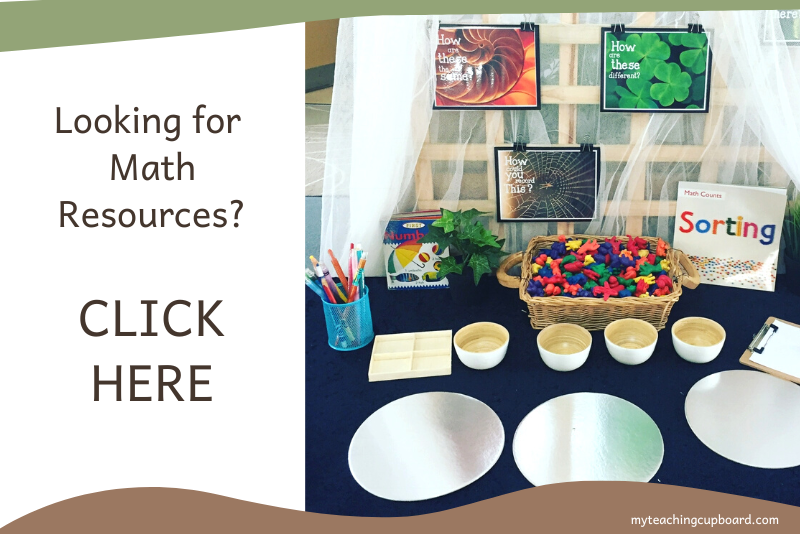
👉 By weaving these strands together through hands-on learning and everyday experiences, it won’t feel like you’re teaching six separate subjects. You’ll be creating an interconnected approach to maths that makes sense to young children.
Key Considerations for Teaching Australian Curriculum Maths F–2
Beyond the content descriptions and achievement standards, the Australian Curriculum Maths highlights a set of key approaches that underpin how mathematics should be taught and experienced in the classroom.
These considerations are sometimes called the proficiency strands and mathematical processes, and they help bring the curriculum to life in ways that are meaningful for young children.
Proficiency in Mathematics
Students need proficiency, not just rote recall. This means being able to confidently use maths in both familiar and unfamiliar contexts.
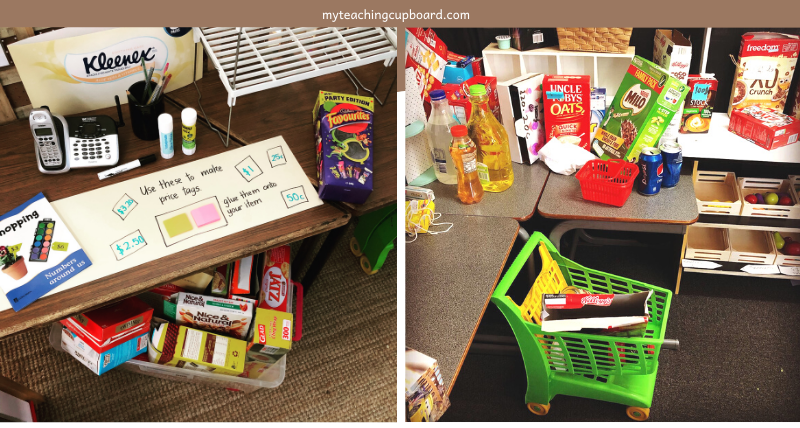
👉 Teaching Tip: If you have students that can answer a problem when it looks exactly like the example you’ve practised together, but freeze when the numbers or layout change – try to provide varied opportunities through play-based investigations, provocations, and real-world problems. This builds adaptable problem-solvers who can transfer their skills. Exposing children to maths in a variety of settings (play-based investigations, routines, small group work) helps them adapt strategies when the problem looks a little different from what they’ve seen before.
Understanding
Understanding in maths means children know not only how to solve a problem but also why the strategy works. Conceptual understanding allows students to make connections between related ideas, describe their thinking, and apply their knowledge in new contexts. When students are encouraged to represent concepts in different ways, spot similarities and differences, and use appropriate mathematical language, their understanding becomes stronger and more transferable.
👉 Teaching Tip: Use concrete materials like counters, blocks, and loose parts to model ideas and then move gradually to pictorial and abstract representations. Encourage children to explain their thinking in their own words. Sometimes their explanations reveal far more about their understanding than the answer itself.

Fluency
Some teachers think fluency is about “fast facts.” But it is really more about being able to choose efficient strategies, carry them out accurately, and apply them appropriately. Students are fluent when they can confidently shift between different methods, use representations flexibly, and recognise efficient ways to answer questions.
👉 Teaching Tip: Offer multiple representations of number and operations. Ten-frames, number lines, and base-ten blocks are excellent tools for building fluency. Giving your children time to compare different strategies helps them see that there are many ways to solve the same problem - and some are more efficient than others.
My Math Provocations are designed to support fluency in engaging, hands-on ways.

115 Reggio Math Provocations to teach ALL the Number and Algebra content descriptions for ACARA Foundation Stage. These hands-on learning invitations will make your play based math investigation areas quick and easy to set up.
NOW ALIGNED TO VERSION 9 OF The Australian Curriculum - ACARA.
YOU WILL RECEIVE:
32 Prompts to name, represent and order numbers including zero to at least 20, using physical and virtual materials and numerals (AC9MFN01)
3 Prompts to recognise and name the number of objects within a collection up to 5 using subitising (AC9MFN02)
15 Prompts to quantify and compare collections to at least 20 using counting and explaining or demonstrating reasoning (AC9MFN03)
8 Prompts to partition and combine collections up to 10 using part-part-whole relationships and subitising to recognise and name the parts (AC9MFN04)
10 Prompts to represent practical situations involving addition, subtraction and quantification with physical and virtual materials and use counting or subitising strategies (AC9MFN05)
10 Prompts to represent practical situations that involve equal sharing and grouping with physical and virtual materials and use counting or subitising strategies (AC9MFN06)
17 Prompts to recognise, copy and continue repeating patterns represented in different ways (AC9MFA01)
12 reproducible recording sheets to fit A5 clipboards
2 Bonus ten frame and part-part-whole templates
Instructions to tile print the prompts so you can change the printout size to suit your centers
Inspiring photos for ideas on how to set up your learning invitations
Lists of possible hands-on resources you can add to each center
All the math provocation prompts you need to set up hands-on Number and Algebra investigation areas in your Kindergarten or Prep classroom.
EASY TO PREP AND ORGANISE
A total of 115 different provocation prompts ready for you to print onto A4 sized card or paper. There is one prompt to each A4 sheet—instructions included for the option to print 2 or 4 to each sheet .
Inspirational photos included to help you set up engaging age appropriate learning invitations which are easy and quick to set up.
USE FOR:
hands-on math investigation areas
math centers
whole class or small group math lessons
as a circle time activity
busy bags
early finishers
informing assessment grades
These are for the Number and Algebra strand. There are also prompt Packs for the Measurement and the Geometry strands.
Math Provocations - Measurement Activities for Foundation Stage
Reasoning
Reasoning is central to working mathematically. It involves comparing, justifying, and explaining strategies, rather than focusing only on the correct answer. When students reason, they generalise, adapt known strategies to new problems, and reflect on the choices they’ve made.
👉 Teaching Tip: Build in regular opportunities for children to talk about their thinking. Not just at the end of a task, but during the process. Group discussions, reflection time, and open-ended questioning all encourage children to prove, justify, and evaluate their ideas.
For ready-to-use prompts, try my Open-Ended Questions resources.

Problem Solving
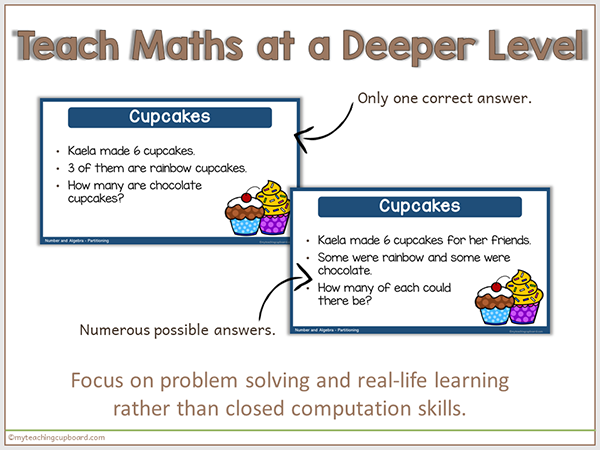
Problem solving allows students to use mathematics in meaningful ways. It includes both routine problems, with one correct solution, and non-routine problems, which may have many valid answers. Through problem-solving, children learn to plan, apply strategies, review their solutions, and justify their reasoning.
👉 Teaching Tip: Pose problems that can be solved in multiple ways. For example, “How many ways can we share 12 counters between 3 friends?” These types of problems prompt exploration, conversation, and creative thinking.
My Open-Ended Maths Problems packs are full of rich, hands-on tasks that help uncover student thinking while keeping them super engaged.
Mathematical Processes
Mathematical processes are the skills of thinking, reasoning, communicating, modelling, and investigating. They run through all strands of the curriculum and grow in complexity across the years of schooling. These processes show that maths is not just about answers, but about how students think and work mathematically.
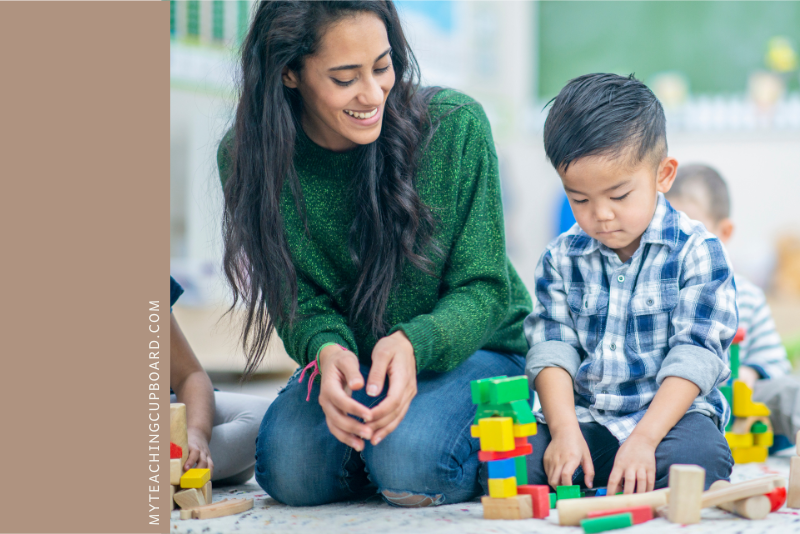
👉 Teaching Tip: Draw attention to the process as much as the outcome. Highlighting when a child explains clearly, represents an idea in a new way, or makes a useful generalisation builds their confidence as mathematicians.
Mathematical Modelling
Mathematical modelling is about using maths to represent and predict real-world situations. It allows students to see mathematics as a practical tool for making sense of their lives and the world around them.
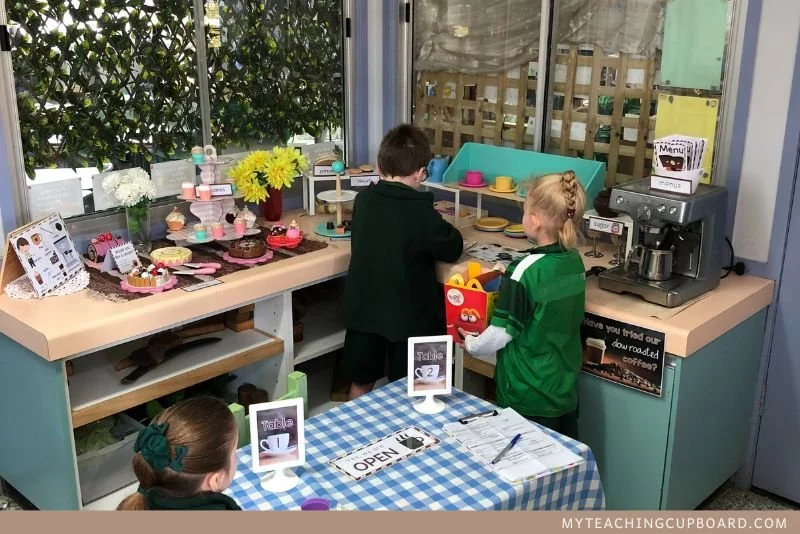
👉 Teaching Tip: Use everyday classroom examples. If you’re planning for an event, ask: “We have 15 chairs. How many more will we need if three more visitors arrive?” Questions like this make maths authentic and naturally link to children’s experiences. Dramatic play spaces are perfect for modelling mathematics in real-world situations. It is one of the reasons we always have a dramatic play space up and running in our classroom.
Computational Thinking
Computational thinking involves breaking down problems, recognising patterns, following steps, and working with algorithms. Even in the early years, children show these skills when they spot a repeated sequence or describe the steps of a process.
👉 Teaching Tip: Try unplugged activities like sequencing cards, following instructions to build a tower, or recognising repeated actions in songs and dances. These lay the groundwork for later digital coding activities, while keeping maths tangible and age-appropriate.
Statistical Investigation
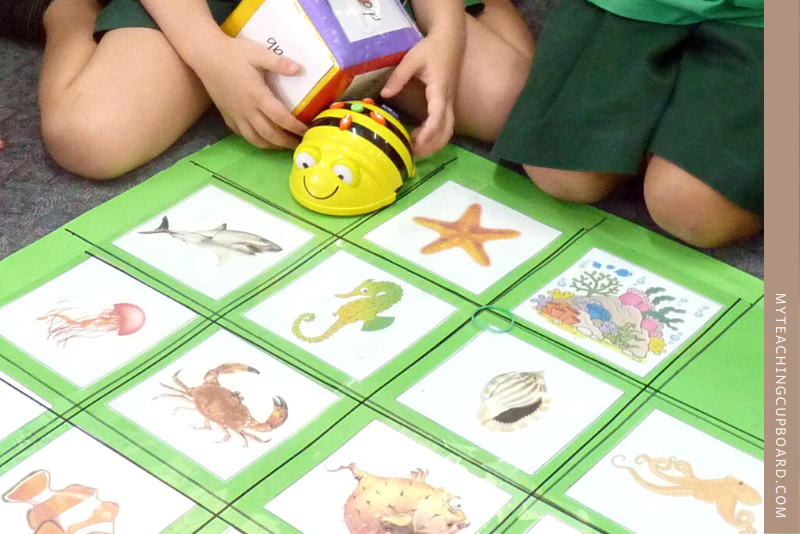
Statistical investigation begins simply in the early years: asking questions, collecting data, and making sense of what the results show. Over time, this builds into formal graphing and interpreting more complex data.
👉 Teaching Tip: Keep data investigations relevant to the children. Graph the pets they have at home, their favourite playground game, or the weather over a week. When the questions matter to them, the data has meaning and the maths sticks.
Probability Experiments and Simulations
Probability helps children understand and describe uncertainty. In Foundation to Year 2, this often looks like playful predictions and simple experiments.
👉 Teaching Tip: Use dice, spinners, or everyday conversations: “Do you think it’s likely to rain today?” Introducing language like always, sometimes, likely, and impossible helps children connect probability to their daily lives.
Computation, Algorithms and Digital Tools
Digital tools (from calculators to tablets) can support learning when used appropriately. They allow students to explore mathematical patterns, test ideas, and visualise problems in new ways.
👉 Teaching Tip: Introduce digital tools alongside hands-on exploration. For example, measure with both a ruler and a digital measuring tool, then compare results. This reinforces the idea that technology supports, but doesn’t replace, concrete mathematical experiences.
Protocols for Engaging First Nations Australians
The curriculum highlights the importance of respectful engagement with First Nations Australians. This means following approved protocols, consulting local communities, and using culturally appropriate resources.
👉 Teaching Tip: Incorporate authentic contexts into your lessons. For an example, explore symmetry in weaving patterns or when mapping land features. Always ensure that the resources you use have been approved or developed in consultation with local First Nations groups.
Meeting the Needs of Diverse Learners
Mathematics should be inclusive and accessible for all students. The curriculum encourages flexible approaches so children can engage with content regardless of their background, language, or ability.
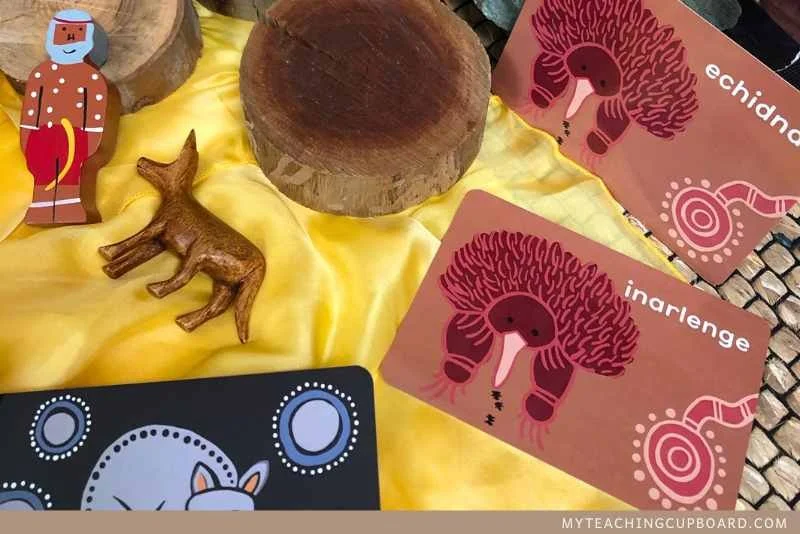
👉 Teaching Tip: Use familiar objects such as coins, counters, and buttons to make abstract ideas concrete. Open-ended resources like my Loose Parts Mats will allow your students to explore maths at their own level, giving you some purposeful learning provocations without extra preparation.

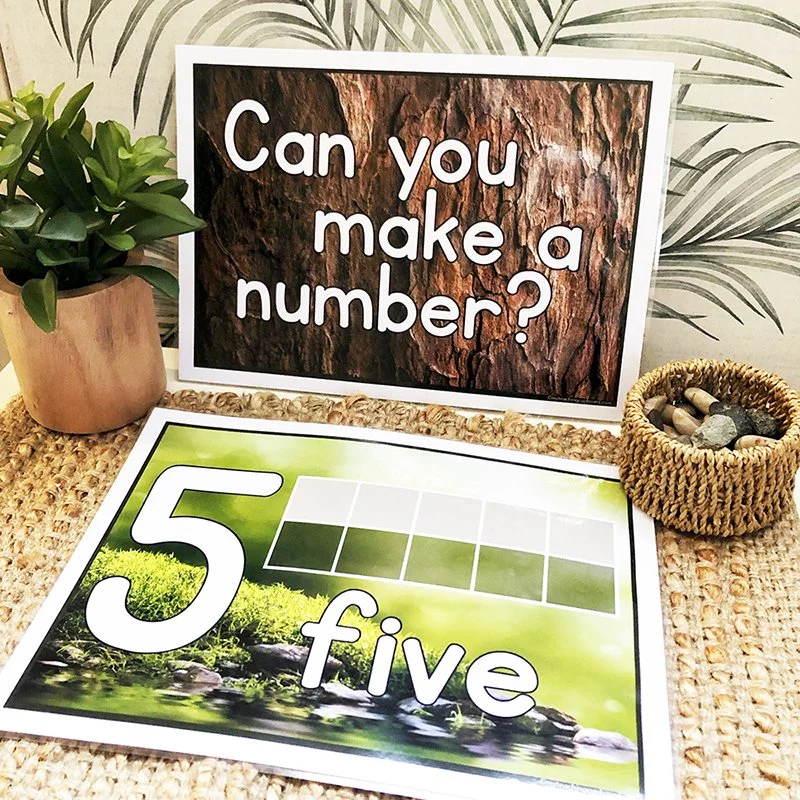
Save money and cover numerous curriculum learning objectives with this Nature-Themed Loose Parts Mats Bundle! Designed with real-life nature photos, this Reggio-inspired bundle includes 100 play mats and heaps of BONUS FREEBIES to help you successfully teach math and literacy concepts through engaging loose parts play activities.
Ideal for Preschool, Pre-K, Kindergarten, and First Grade, these mats encourage exploration, creativity, and deep learning with low-prep, high-impact activities.
What’s Included in the Loose Parts Mats Bundle:
26 Alphabet Mats in Australian & Elementary fonts
25 2D Shape Mats featuring common and uncommon shapes
25 Line & Pattern Mats for creative pattern exploration
20 Number Mats in both Australian & Elementary fonts
PLUS A FREE SET of 4 Organic Pattern Mats with open-ended designs for flexible use.
Each mat is A4-sized and best printed in colour to highlight the stunning nature backgrounds. I love these stunning images as they really make each provocation visually engaging.
Your Comprehensive Bundle Also Includes:
60 Loose Parts Ideas for endless setup options
16 Challenge Task Cards designed for 2D Shape exploration
8 Teacher Observation Checklists tailored for tracking student progress in numeracy, literacy, fine motor skills, and creativity
20 Student Recording Sheets to document learning and creativity
Teacher Cheat Sheet with Math Questions for guided, purposeful learning
Printable Loose Parts Posters to inspire and inform
Document Wallet Labels to keep all these resources organized and accessible
Whether you're looking to set up small group rotations, morning tubs, tabletop activities, STEM trays, or play-based centers, this bundle makes learning through play easy and effective.
Why Teachers Choose this Loose Parts Bundle:
Easy to Use: Just print, set up, and add loose parts—perfect for busy teachers.
Flexible Learning Opportunities: Use for early finishers, independent work, or as daily soft starts.
Hands-On and Play-Based: Supports age-appropriate multi-sensory learning, creativity, and problem-solving skills.
Aligned with Play-Based Pedagogy: Encourages students to explore loose parts in meaningful ways, helping them to meet benchmarks through exploration and play.
Save 25% by purchasing this bundle and get a full suite of Loose Parts Mats for literacy and numeracy. You’ll be able to use them over and over throughout the whole school year.
This set is one of my best sellers and a teacher favourite for engaging students in playful, curriculum-linked learning.
Low-Prep, High-Impact Activities
With these Loose Parts Mats, setting up engaging learning invitations has never been easier.
Each prompt is designed to be purposeful, helping you inspire creativity while supporting literacy and numeracy outcomes.
Download this bundle and bring some nature-inspired, play-based learning to your classroom!
📌 My Big Takeaway: These key considerations remind us that mathematics is about helping our children build the confidence, adaptability, and skills to use maths in everyday life. Both now and into the future. It’s so much more than covering content. It’s about building confident communicators of mathematics who can reason, solve problems, and apply their skills.
Key Connections Across the Curriculum
As we have already discussed, the Australian Curriculum Maths doesn’t sit in isolation. It connects strongly to the general capabilities that equip young Australians with the knowledge, skills, behaviours, and dispositions they need to live and work successfully.
These capabilities (along with the cross-curriculum priorities) support and deepen engagement with the learning area content, and when developed through maths, they give children meaningful opportunities to apply their skills in real-world contexts.
While literacy and numeracy capabilities are essential across all subjects, maths has a central role in developing numeracy. It also has strong connections to three other general capabilities: Critical and Creative Thinking, Digital Literacy, and Ethical Understanding.
Connections to Literacy
Mathematics relies heavily on language. Students need to learn the vocabulary, notation, and symbols that go with mathematical concepts and processes. They also need to understand that some everyday words, like equal or difference, have very specific meanings in a maths context.
Classroom Example: Teaching the difference between “equal to” and “same as” gives students the appropriate language to describe relationships accurately. Don’t be afraid to use correct mathematical terms and complicated maths language with young children. Explicitly teach the correct mathematical vocabulary so your students can confidently talk about maths.

👉 Teaching Tip: Embed maths vocabulary into your daily routine. Encourage children to explain their answers using mathematical metalanguage and complete mathematical sentences (“5 is greater than 3”). Make sure to explicitly teach and model this language yourself during lessons.
Connections to Numeracy
Numeracy is so much more than counting! It’s applying mathematical skills and knowledge in a wide range of contexts.
This includes financial literacy, health and wellbeing, design and construction, and decision-making in daily life. Maths provides the foundation for these applications through number, algebra, measurement, space, statistics, and probability.
Classroom Example: Exploring probability when discussing sun safety (e.g., “What are the chances of getting sunburnt without a hat?”) makes numeracy authentic and relevant.
👉 Teaching Tip: Look for opportunities to connect maths to other learning areas. Measuring during art projects, working with money in dramatic play shops, or collecting data in science lessons. Real-world experiences like these demonstrate the power of numeracy across the curriculum.
Connections to Critical and Creative Thinking
Mathematics naturally develops critical and creative thinking by asking students to evaluate information, identify patterns, and consider different approaches to problem-solving. Children learn to simplify problems, test ideas, and justify their reasoning.
Classroom Example: Ask, “Is there another way to solve this?” when a student shares a solution. This simple open-ended question opens up opportunities for creative strategies and alternative approaches.
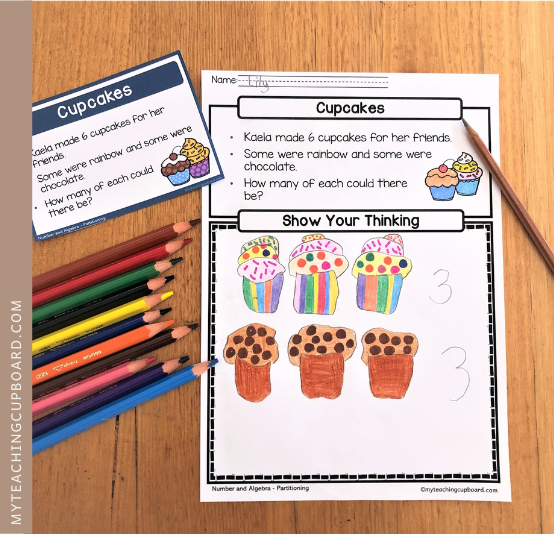
👉 Teaching Tip: Don’t rush to show the “best” method. Give time for your students to try, test, and explain their ideas. Comparing multiple strategies strengthens their reasoning and shows there’s more than one way to reach a solution.
Connections to Digital Literacy
Digital technologies provide powerful tools for investigating and communicating mathematical ideas. From creating graphs and simulations to exploring geometry through dynamic software, digital literacy in maths prepares students for an information-rich world.
Classroom Example: Use tablets for shape-sorting games or digital spinners to run quick probability experiments.
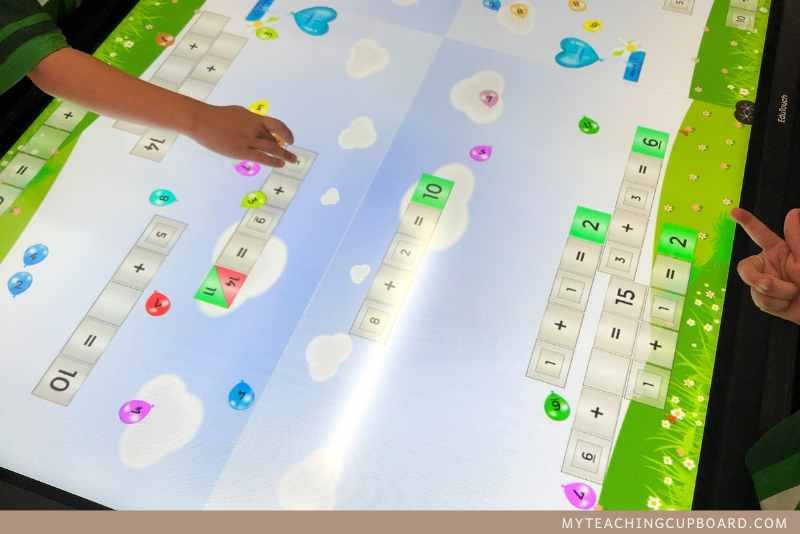
👉 Teaching Tip: Introduce digital tools gradually, alongside hands-on materials. For example, let children build graphs with counters first, then move to a graphing app. This ensures digital literacy grows from a strong conceptual foundation.
Connections to Ethical Understanding
Mathematics provides opportunities to explore fairness, accuracy, and decision-making. Even in the early years, children can begin to see how maths helps us make fair choices and why honesty matters when collecting or representing information.
Classroom Example: When sharing 12 counters among 4 children, the group can work together to decide how to divide them fairly. Or, during a class survey (e.g., “What’s your favourite fruit?”), you can highlight why it’s important to answer truthfully so the results show an accurate picture.
👉 Teaching Tip: Look for natural opportunities to link maths to fairness in everyday classroom routines. Whether that’s turn-taking, dividing materials, or comparing simple graphs. These types of meaningful conversations will help your children understand that maths isn’t just about numbers and that it’s also about making fair and responsible decisions.
📌 The big picture: These general capabilities remind us that when children communicate clearly, apply maths in other learning areas, think critically, use digital tools, and consider fairness, they’re developing skills that matter for life beyond the classroom.
Teacher Challenges and Practical Solutions
Teaching the Australian Curriculum Maths (F–2) can sometimes feel like a juggling act. Here are three common challenges many teachers face (and some practical solutions to make things easier in your classroom).
1. When the curriculum feels overwhelming
With so many content descriptions, achievement standards, and general capabilities to consider, it’s easy to feel buried under the paperwork.
Breaking the curriculum down into clear, student-friendly learning intentions makes it much more manageable. This not only helps you focus on what really matters but also makes the expectations clearer for your students.
👉 Practical Solution: Use my Illustrated Learning Intentions to quickly identify what to teach and communicate it in a way young children understand.

Use these illustrated learning intentions to explicitly teach your Prep, Kindergarten, and Preschool students what the Foundation Stage Math learning intentions are. The pictures will act as a visual prompt and help your students remember and better understand their WALT goals.
GRAB ALL THE FOUNDATION STAGE LEARNING INTENTIONS HERE AND SAVE
THIS SET CONTAINS:
90 visual WALT goals or Learning Intentions for the Number and Algebra strand
71 visual WALT goals or Learning Intentions for the Measurement strand
7 visual WALT goals or Learning Intentions for the Statistics and Probability strand
Content strand headings
WALT banner
Math headings
Effective mathematics learning intentions will improve your student’s numeracy understanding and learning.
Research indicates that students who regularly discuss and are made aware of their learning intentions are more
focused and for longer periods of time.
more motivated and active in their learning.
able to take responsibility for their own learning.
You will receive 162 illustrated Math learning intentions aligned to the ACARA Foundation Stage curriculum and when you use them in your classroom, you will be giving your young children the tools they need to take more responsibility for their own learning and achieve greater learning independence.
These learning intentions have been updated to Version 9 of the ACARA Foundation Stage curriculum.
In preschool and kindergarten, written learning intentions are somewhat ineffective because your young children are just not confident readers yet. When you refer to the written learning intention on display, all your little ones see is a collection of letters.
For this reason, I like to use illustrated learning intentions in my early childhood settings. Learning intentions with a pictorial representation will help your students remember and understand their learning goals.
Save yourself some time and lots of effort with these already done for you age-appropriate learning intentions.
If you like this illustrated learning intentions pack, you might be interested in my other ones:
Illustrated Learning Intentions for the ACARA Science Curriculum
Illustrated Learning Intentions for the ACARA HASS Curriculum
Illustrated Learning Intentions for the ACARA English Curriculum
OR GRAB THE BIG BUNDLE AND SAVE: Illustrated Learning Intentions BUNDLE – Australian Curriculum Foundation Stage
2. When there’s not enough time to prep
Between planning, teaching, and everything else on your plate, finding the time to create hands-on, engaging activities can feel impossible. But maths doesn’t have to mean hours of prep.
👉 Practical Solution: Try low-prep resources that are ready to use straight away. My Maths resources collection includes Loose Parts Mats, Math Provocations, and Open-Ended Problems that slot easily into your weekly program.
3. When assessing play-based maths learning feels tricky
Many teachers wonder how to collect meaningful evidence of maths learning during play. Assessments can feel subjective and time-consuming, especially when you’re juggling multiple students at once.
👉 Practical Solution: Use my FREE teacher observation checklist. This simple checklist makes it easy for you to capture mathematical progress in real time and still allows your children to stay immersed in their investigations.

Teaching ACARA Maths F–2 doesn’t have to be overwhelming.
With the right resources and strategies, you can feel confident that your students are meeting the achievement standards and still keep your maths hands-on, engaging, and age-appropriate.
How to Use My Resources to Teach Australian Curriculum Maths F–2
One of the hardest parts of teaching the Australian Curriculum Maths is finding the time to plan engaging lessons that also tick all the boxes for curriculum coverage and assessment.
That’s why I’ve created a range of resources designed specifically to align with ACARA (Version 9) for Foundation to Year 2.
Here are three examples that early childhood teachers love:
Math Provocations – Reggio-inspired prompts that spark curiosity and encourage exploration. These keep lessons hands-on while directly linking back to the content descriptions and achievement standards.
Illustrated Learning Intentions – A quick way to make the curriculum visible and accessible for young learners. These save you hours of planning while making expectations clear for both students and parents.
Loose Parts Mats – Flexible, open-ended resources that bring concepts like number, pattern, and shape to life. They keep children engaged while also making it easy to gather evidence of learning.
Together, these resources:
Save you planning time by providing ready-to-use lessons and prompts.
Keep maths hands-on and play-based, so children are actively involved in their learning.
Ensure curriculum coverage, with links to ACARA built in.
Provide evidence for reporting and assessment through recording sheets and checklists.
👉 Ready to make teaching ACARA Maths F–2 easier and more enjoyable?
Explore my full range of maths resources and find everything you need to feel confident, prepared, and supported.
Making the Australian Curriculum Maths Easy and Engaging
The Australian Curriculum Maths (F–2) may look complex on paper, but at its heart it has clear aims: helping children build confidence, fluency, reasoning, and problem-solving skills through meaningful learning.
The content is organised into six interconnected strands — Number, Algebra, Measurement, Space, Statistics, and Probability. They all work together rather than as six separate subjects.
When paired with a play-based pedagogy, these strands become practical, engaging, and achievable in the classroom. Through investigations, hands-on materials, and real-world connections, your young learners can meet the achievement standards while still experiencing maths as something fun and meaningful.
You don’t need to reinvent the wheel.
My blog posts and resources are designed to take the heavy lifting out of planning, giving you tools that save you time while still covering the curriculum content in ways that matter for your students.
👉 Next steps: Check out my blog post: Teaching the F-2 ACARA Math Learning Intentions Through Play for further information. It will show you how to teach ACARA Maths through play-based learning in Foundation to Year 2. It is full of hands-on strategies, activities, and resources all aligned with Version 9 of the Australian Maths Curriculum.