
Effective Strategies for Teaching Acara Foundation Stage in the Classroom
Discover effective strategies for teaching the Acara Foundation Stage through play-based learning, differentiation, and authentic assessment.
If you’re teaching the Acara Foundation Stage, you’ve probably felt the constant juggle. Between keeping up with assessments, meeting high curriculum expectations, managing behaviour challenges, and somehow finding time for your own family and wellbeing – well, it can feel soooo overwhelming.
Teachers often tell me they’re under pressure to “teach to the test.” Academic expectations are being pushed down younger and younger, leaving our children stressed, disengaged, and in some cases, acting out. Classrooms that should be full of joy and curiosity are instead becoming places where both children and teachers feel the strain.
But there’s a light at the end of the tunnel!
The Acara Foundation Stage doesn’t have to be taught this way.
In fact, the curriculum is designed to encourage holistic learning. Learning through exploration, creativity, and play. By weaving play-based strategies into your school day, you can still meet those benchmarks while supporting the developmental needs of your students.
Let’s explore how you can teach the curriculum while creating an engaging, inclusive classroom where not only children thrive but teachers do too.
What is the Acara Foundation Stage and Why It Matters
The Acara Foundation Stage is the starting point of the Australian Curriculum. It sets out what our youngest learners (typically in their first formal year of schooling) should be engaging with across all learning areas. While many people hear “curriculum” and think of checklists or rigid academic content, the truth is that the Foundation Stage is about so much more.
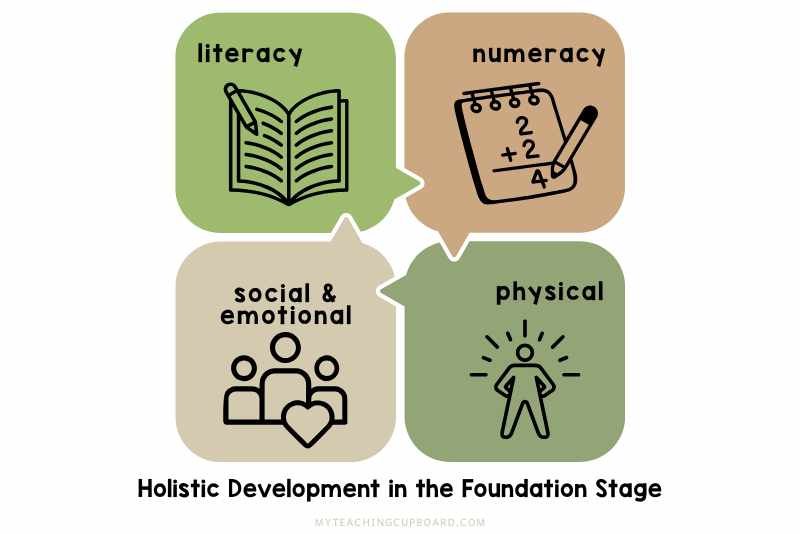
At its heart, the Acara Foundation Stage supports holistic development.
Yes, literacy and numeracy are core areas, but so too are social and emotional learning, physical wellbeing, and the capabilities children need to thrive as lifelong learners.
This is reassuring, because it means the curriculum recognises that children learn best when they are actively engaged and supported in all areas of development, not just the academic ones.
Research continually reminds us how important these early years are.
Neuroscience shows that 90% of a child’s brain growth happens before the age of five, and the quality of early learning experiences has a direct impact on long-term outcomes in education and wellbeing.
ACARA’s own framework emphasises this, highlighting that a strong start in the Foundation Stage builds the skills, dispositions, and confidence children need for future success.
The misconception we often face as teachers is that the Foundation Stage is simply about “getting children ready for Year One” by front-loading academics.
But that’s not the intent.
Instead, it’s about
laying down secure foundations
developing problem-solving skills
nurturing curiosity
encouraging communication
building physical coordination
supporting social relationships
These are the cornerstones that ensure children are not just prepared for the next grade, but equipped for the world.
For example, in my own classroom I’ve set up a loose parts maths provocation using buttons, pom poms, and natural materials.
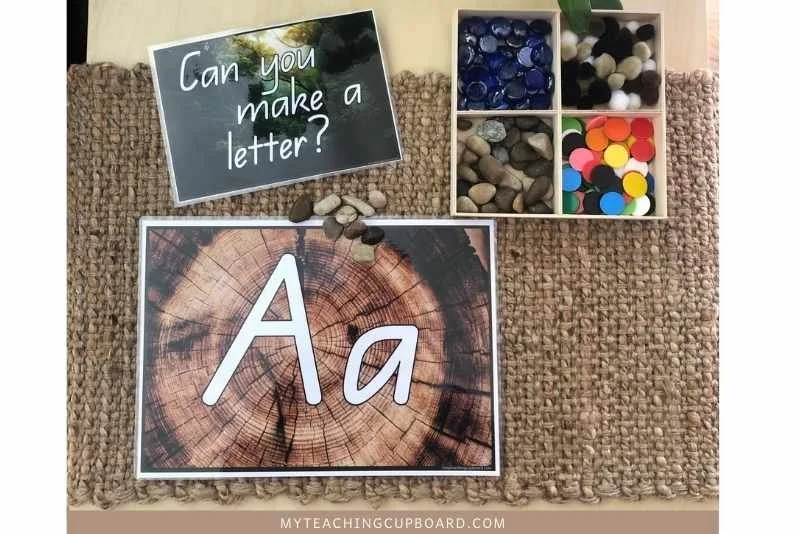
At first glance it might look like simple play, but children are actually:
sorting and classifying objects (early algebra),
counting and comparing quantities (number concepts),
describing what they see to peers (oral language),
and working side-by-side, negotiating space and sharing (social and emotional learning).
All of this fits neatly under the Acara Foundation Stage outcomes and all the while, my children remain deeply engaged because it feels meaningful to them.
When we approach the Acara Foundation Stage with a play-based lens, we can honour this intent while still meeting curriculum benchmarks.
Play-Based Learning: The Heart of the Acara Foundation Stage
Please don’t see play as an “extra” or a reward for finishing the real work!
Play is the very heart of how young children learn.

For those of us teaching the Acara Foundation Stage, play should not be optional. It’s the most effective way to meet those curriculum outcomes while still respecting the way children develop and thrive.
Research backs this up. The OECD’s International Early Learning and Child Well-being Study (2020) shows that children’s early competencies (across literacy, numeracy, self-regulation and social-emotional skills) are strongest when their learning experiences are engaging and meaningful, rather than narrowly academic.
And its 2018 report, The Power and Promise of Early Learning, reminds us that when children enjoy exploring their own interests and growing capabilities, it leads to positive well-being and academic outcomes later in life
Play-based learning not only improves problem-solving and engagement but also helps children transfer their learning into new situations. In other words, when children explore through play, they’re not just memorising facts. They’re building flexible thinking skills that they can use across all areas of the curriculum.
Yet I often hear teachers say, “I don’t have time for play with so many benchmarks to meet.”
I understand that pressure.
Between assessment deadlines and crowded timetables, it can feel like play is something you have to squeeze in when everything else is done. I used to feel like that too, but here’s the shift I made: play is the best way to teach literacy, maths, science, and HASS concepts. When children are curious, engaged, and using their hands and minds together, the learning really does stick. I’ve seen it over and over in the classroom!
Take block play as an example. In my classroom, block play often becomes an entire investigation in itself. As children build towers and bridges, they naturally explore
measurement (how tall, how long, how strong)
spatial awareness (balancing, stacking, creating symmetry)
and even early science concepts like gravity and stability

When a group of children once created a “city” in the block area, I noticed they were also building oral language and social skills. Negotiating roles, describing their structures, and solving problems when things didn’t go as planned. Each of these moments connected directly back to the Acara Foundation Stage outcomes, while the children remained deeply engaged because the learning felt purposeful and fun.
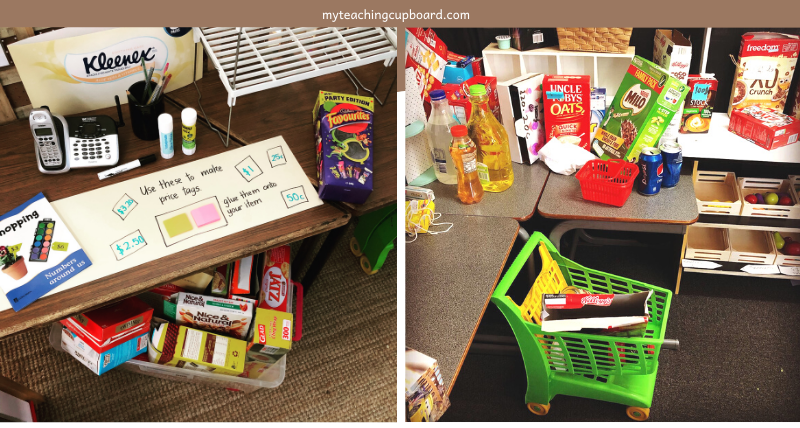
The same happens in dramatic play. A simple “shop” setup can cover
literacy (making signs, writing shopping lists)
numeracy (counting coins, recognising prices)
and HASS (understanding community roles).
All of this happens while children practise cooperation, communication, and problem-solving.
I know many teachers often worry about whether play really “covers the curriculum.” That’s why in my own planning, I always make sure investigations link directly back to ACARA V9 content descriptors. This gives me confidence that the activities are not just engaging, but purposeful too. It takes the guesswork out of aligning play with outcomes.
Wherever possible, my Investigations resources are designed with these links built in, so you can set up rich, playful experiences knowing they’re grounded in the curriculum.

When we see play as the pathway rather than the add-on, the pressure shifts. We can trust that children are not only meeting benchmarks but also developing confidence, creativity, and a genuine love of learning.
Creating an Engaging Classroom Environment for Acara Foundation Stage
The Acara Foundation Stage highlights the importance of engagement and inclusivity, and that starts with the way we set up our classrooms. A thoughtfully designed environment can do so much of the teaching for you - inviting your children to explore, collaborate, and discover while still aligning with curriculum outcomes.
Here are a few practical ways to make your classroom a place where your students feel excited to learn:
Defined learning areas → Create spaces that clearly signal what kind of learning can happen there. An investigation table for science, a maths area with hands-on materials, an inviting literacy nook, a creative arts space, and a dramatic play corner all help children understand the purpose of each area and also move between them with independence. Want to discover the 10 areas I think you need in a play based classroom? Check out this blog post: The 10 essential Areas of a Play Based Classroom

Flexible seating and accessibility → Foundation students learn best when they can move their bodies, sit in ways that are comfortable, and access resources independently. Low tables, cushions, floor spaces, and child-height shelving all encourage autonomy and make the environment inclusive for every learner.

Provocations aligned to ACARA outcomes → When you link provocations directly to curriculum goals, you can be confident that play and inquiry are meeting the benchmarks. For example, setting up a provocation with natural materials for sorting and classifying supports early maths outcomes, while an art provocation exploring textures supports science and literacy outcomes through descriptive language.

I’ve written more about this in my blog post on Creating an Effective Play-Based Learning Environment where I share detailed tips on designing spaces that spark curiosity and keep children engaged.
When your classroom environment is set up with intention, it not only makes learning more meaningful for students, but it also reduces teacher stress! Instead of constantly managing behaviour or directing children, the environment itself becomes the third teacher, encouraging exploration and independence.

Differentiated Instruction: Meeting the Needs of All Foundation Learners
Every Acara Foundation Stage classroom looks different because every child brings their own strengths, challenges, and experiences.
In Australian classrooms, this diversity is especially clear. We teach children with varying levels of school readiness, some children are learning English as an additional language (EAL/D), and other children might need extra support to settle into the routines of school.
ACARA is built on the principle that all students can succeed. To make this a reality, our teaching needs to be flexible, responsive, and inclusive.
Differentiation doesn’t mean planning thirty different lessons though!
It means providing entry points so every child can access the same concept in a way that makes sense for them.
Here are a few strategies that work well in Foundation classrooms:
Small-group rotations → Working in smaller groups allows you to provide targeted support, whether that’s phonics practice for children still mastering sounds, or challenging problem-solving tasks for those ready to extend their thinking.
Developmentally appropriate play and investigations → One of the simplest ways to differentiate is through play. In a block play area, one child might explore stacking and balancing, while another designs a complex bridge, and another records their structure with labelled drawings. Each child is working at their own level, yet all are developing mathematical, spatial, and problem-solving skills.
Teaching rules and routines explicitly → Many children entering school need to be taught how to use materials, share space, and manage transitions. Consistent routines and clear modelling create a safe, predictable environment where everyone can participate successfully.
Explicitly teaching social and emotional skills (SEL) → Skills like taking turns, managing frustration, and listening to others don’t always come naturally at this age. It is essential we explicitly teach and embed SEL into our daily routines. This will not only benefit our instructional lessons but it will also make collaborative play and investigations run a lot smoother for everyone.
Play-based learning naturally supports differentiation because children enter and engage at their own developmental level.
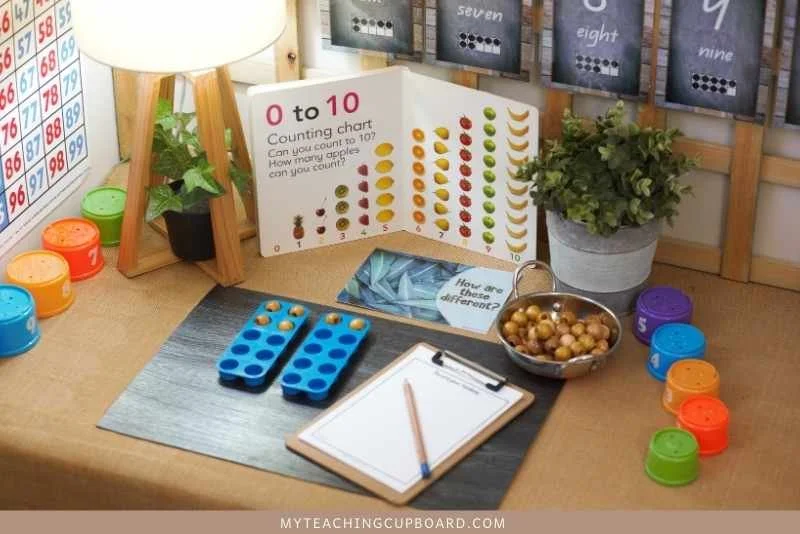
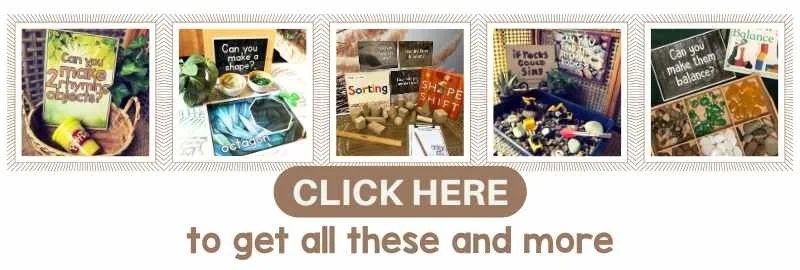
A maths provocation with loose parts, for example, might see one child simply counting objects, another grouping them by size or colour, and another creating patterns or solving addition problems. The task adjusts itself to the learner, without you needing to set three different activities.
Of course, having confidence that your investigations are curriculum-aligned makes differentiation easier too.
When I design provocations, I link them to ACARA V9 content descriptors so I know each child (whether they’re just beginning or already extending) is engaging with the intended outcomes.
My Investigations products are created with these links included – whenever possible, giving you ready-to-use activities that differentiate naturally while staying tightly connected to the Australian Curriculum.
When we embrace play as the vehicle for learning, we not only reduce planning stress but also create opportunities for all children to succeed within the Acara Foundation Stage framework.
Effective Assessment in the Acara Foundation Stage
Assessment in the Acara Foundation Stage can feel a bit daunting.
Have you ever asked yourself, How do I show evidence of learning when so much of what children do is through play?
Well, the key is to remember that assessment isn’t just about tests or worksheets. It is really about gathering a clear picture of each child’s growth over time.
ACARA encourages a balanced approach that recognises multiple ways of demonstrating learning. This is good news for play-based classrooms because it means observations, conversations, and student work samples are all valid forms of assessment.
Here are some strategies that work well in my Foundation classroom:
Observations → Watching how children engage with provocations or investigations gives me rich evidence of learning. A child sorting shells by size is showing classification skills (early maths), while another who explains their building process is demonstrating oral language and problem-solving. I use a simple checklist to capture these moments as they happen and I’ve created a Free Observation Checklist for you to download and use to make this process quick and practical in your own classroom.

Portfolios and recording sheets → Collecting samples of student work is essential so I make sure to include student recording sheets at every investigation area. These allow my children to capture their own thinking (through drawings, or written notes) which gives me concrete evidence of learning. Over time, these sheets build into portfolios that support my planning, provide documentation for parent-teacher conferences, and make reporting much easier.
Formative assessment → Quick checks like exit tickets, thumbs up/down, or “turn and talk” responses provide immediate feedback and help you adjust teaching on the spot. I also love using our reporter and photographer tasks during investigation time. This is when my students document or share what their peers are doing or work on specific tasks suited to their particular developmental needs. These tasks reveal both their understanding of concepts and their developing communication skills. You can read more about how I do this in these blog posts:
• Walker Learning Reporter Role
• The Classroom Photographer Child
Student voice and reflection → Encouraging children to talk about their own learning deepens understanding: “What did you discover?” “What was tricky?” “What are you proud of?” In my classroom, reflection time is built into every day. It’s one of the most important parts of a play based classroom routine and we never miss it. It’s when I ensure my children connect their play to the curriculum and begin to see themselves as capable learners. I’ve written more about this process in my blog post on Reflection Time in a Play-Based Classroom.
Play-based learning makes assessment easier, not harder.
For example, a dramatic play “shop” can reveal counting, turn-taking, and literacy skills in action, while a block construction can show geometry, collaboration, and persistence.
All of these moments are evidence you can map directly back to Acara Foundation Stage content descriptors and outcomes.
Assessment doesn’t have to pull children away from play or add hours of work to your day. With tools like my observation checklists and student recording sheets, you can capture learning as it happens, plan responsively, and confidently demonstrate progress to parents and leaders.
Strengthening Social and Emotional Development Through Acara Foundation Stage
The Acara Foundation Stage doesn’t just focus on literacy and numeracy.
It also embeds personal and social capability as a key area of learning. This is intentional, because research consistently shows that social and emotional learning (SEL) is critical to children’s success both now and in the future.
In fact, a landmark CASEL study found that children with strong SEL skills show an 11% higher academic achievement than those without.
When we prioritise SEL in the first year of school we’re setting our children up with the skills they need to access the curriculum more effectively. Foundation really is the time to establish these habits and skills.
Here are some practical ways to strengthen social and emotional development in your classroom:
Morning meetings and Tuning-in → A structured check-in builds community, sets a positive tone for the day, and teaches routines like listening, taking turns, and greeting others.
Cooperative investigations → Group projects in block play, science explorations, or dramatic play allow children to practise negotiation, problem-solving, and empathy as they work toward shared goals.
Role play → Dramatic play experiences (whether it’s a “shop,” a “hospital,” or a “home corner”) give children safe opportunities to explore emotions, relationships, and different perspectives.
Explicit SEL lessons → Skills like conflict resolution, managing frustration, or sharing don’t just “happen”. They need to be modelled, taught, and practised. Embedding SEL into every part of the day ensures children consistently see it as part of their learning.
In my classroom, I make SEL a visible priority. You can check out some of my favourite resources for doing this HERE

These all help my children identify and name positive behaviours, reflect on choices, and practise self-regulation. They are a big part of our everyday routines - whether it’s celebrating when a child helps a friend or guiding a discussion about what respectful behaviour looks like. They make social and emotional learning concrete and accessible for young children.
When we invest in SEL at the Foundation level, we are not only supporting student and teacher wellbeing but we are also laying the groundwork for academic achievement, resilience, and lifelong learning.
Partnering With Parents: Building Community Around Foundation Stage
Do you have parents just wanting to see worksheets and reading levels?
It can feel discouraging when families (and even other teachers and school leaders) don’t immediately understand the value of play-based learning. Sometimes they’re expecting to see more traditional “schoolwork” to prove their child is learning.
We can actively involve parents in the Acara Foundation Stage journey so they begin to see the depth of learning that happens through play. Building this understanding creates stronger partnerships, which benefits everyone - children, teachers, and families.
Here are some simple strategies that help:
Letters home → A short note at the start of term explaining your play-based approach reassures parents that their child will still be meeting benchmarks - in a way that’s developmentally appropriate.
Photos and portfolios → Visual evidence is powerful. Sharing photos of children engaged in investigation areas, or sending home snapshots of portfolio work, helps families see literacy, numeracy, and social learning in action.
Parent helpers in investigation areas → Inviting parents to join in as helpers during investigations or play based learning time so they can witness block play, science provocations, or art projects in action can give them first-hand experience of the learning that happens through play.
Take-home provocations → Small kits of materials or simple open-ended activities can go home with children. This not only strengthens learning but also helps parents engage with play-based learning in a tangible way.
To support this, I’ve created a Free Guide to Play-Based Learning that you can share with families. It’s a simple resource that explains the benefits of play and helps parents understand how it aligns with curriculum outcomes. Teachers often tell me that once parents see this, the questions about “worksheets” quickly disappear.
Partnering with parents builds trust and community. When families see the intentionality behind your teaching, they become allies in the process and that makes your job easier and your classroom stronger.

Ongoing Professional Development for Foundation Stage Educators
Teaching the Acara Foundation Stage is both rewarding and challenging. Staying confident with the curriculum takes ongoing professional development. The early years are constantly evolving as new research emerges, and professional learning helps us stay fresh, inspired, and equipped with strategies that actually work in real classrooms.
Some of the most valuable areas of PD for Foundation teachers include:
Play-based pedagogy → Understanding how to design provocations, document play, and map it back to curriculum outcomes gives you confidence that your children are meeting benchmarks without losing the joy of learning.
Differentiated instruction → PD that focuses on flexible grouping, scaffolding, and catering to diverse learners (including EAL/D students and those with additional needs) ensures every child has access to success.
Behaviour management → Strong SEL strategies, proactive routines, and classroom management tools help you create the safe, calm environment needed for play-based learning to thrive.
Professional development is often about courses or workshops but some of the richest learning comes from collaboration. Whether that’s being part of a Professional Learning Community (PLC) at your school, sharing ideas in online teacher communities, or simply connecting with colleagues who are also passionate about play-based pedagogy.
That’s one of the reasons I created my Free Resource Library and Email Group. It’s not just a place to grab freebies though. It’s a community of like-minded teachers learning together. Each week I share practical tips, classroom-tested ideas, and resources to help you feel more confident in your Foundation classroom.
When we invest in our own professional growth, we strengthen our practice and we also model lifelong learning for our students. And isn’t that exactly what the Acara Foundation Stage is all about?
[Insert infographic here: “Key PD Areas for Foundation Educators – Play-Based Pedagogy, Differentiation, Behaviour, Collaboration.”]
Reclaiming Joy in Teaching the Acara Foundation Stage
Teaching the Foundation Stage of the Australian Curriculum doesn’t have to mean endless worksheets, stressed children, and teachers stretched to breaking point.
At its core, the curriculum is designed to nurture the whole child - and I sincerely believe the most powerful way to do that is through play, differentiation, and authentic assessment.
When we embed play into our classrooms, we easily meet benchmarks in literacy, maths, science, and HASS while also protecting children’s wellbeing.
When we differentiate, every child (no matter their readiness or background) has a way into the learning.
And when we assess authentically, we capture the real progress children are making, not just what they can remember to put on a test.
I have seen this time and time again, year after year in my 25 years as an early childhood educator.
Most importantly though, we can reassure ourselves as teachers: it is possible to meet curriculum expectations and still create a classroom where children are engaged, happy, and thriving.
By embedding play-based strategies, you’ll feel less stressed, more connected to your students, and more confident that you’re teaching the Foundation Stage in a way that honours both the curriculum and the needs of young learners.
If you’re ready to take the pressure off and start planning with ease, download my FREE Play-Based Learning Guide today. You’ll also join my supportive teacher email community - a space where I share weekly tips, resources, and encouragement to help you thrive in your Foundation classroom.
