
How Play Based Learning Supports Childrens Holistic Development
See how play-based learning develops children’s physical, social, emotional, cognitive, and creative skills in meaningful, joyful ways.
In one corner of the classroom, children balance wooden planks, testing bridge designs and adjusting angles with the kind of focus adults often underestimate. Across the room, two friends negotiate the rules of a self-made board game. They are agreeing, disagreeing, problem-solving, and laughing. Nearby, a child carefully paints a bright yellow sign for her “pet rescue centre,” sounding out letters as she goes.
Everywhere you look, learning is happening - deep learning.
But if you’re an early years teacher and teach through play, you’ve probably felt the need to justify your play based pedagogy.
Parents ask, “Are they actually learning anything?”
Colleagues wonder whether play is just “what children do at lunchtime.”
And with academic pressure creeping earlier every year, it can be tempting to trade play for worksheets just to “prove progress.”
But I can confirm… Play-based learning is one of the most effective, research-backed approaches we have for children’s holistic development.
According to the Age-Appropriate Pedagogies research, young children learn best through approaches that are active, agentic, collaborative, creative, and joyful. These are the very conditions naturally created through meaningful play.
The AAP Foundation Paper also reinforces that play provides the “cognitive stretch,” social interaction, language growth, emotional regulation, and physical development children need in the early years. It also describes play as a holistic approach that nurtures the “whole child” - mind, body, emotions, relationships, and creativity.
This blog post unpacks how play-based learning supports children’s physical, social, emotional, cognitive, and creative development, helping them grow into confident, capable, and compassionate and well-rounded individuals – all while still meeting those mandated curriculum goals in ways that feel natural, meaningful, and age-appropriate.
The Whole-Child Approach in Play-Based Learning
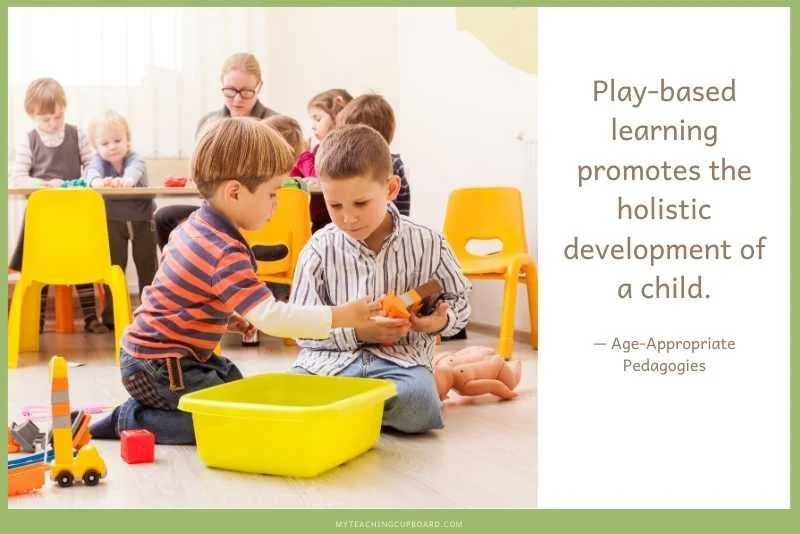
Play-based learning nurtures the whole child.
It nurtures all the key aspects of a child and their development.. and not just their academic skills, but their emotional well-being, physical growth, social confidence, and cognitive abilities. When you look at a thoughtfully designed and truly engaged play-based classroom, you can see that learning isn’t happening in isolated “subjects.”
Learning is unfolding through movement, talk, imagination, persistence, and connection.
The Age-Appropriate Pedagogies: Play-Based Learning paper describes high-quality play as active, agentic, collaborative, creative, and scaffolded. When these elements come together, children engage in learning that is meaningful, challenging, and developmentally appropriate.
In simple terms: Play is the bridge between what children already know and what they are ready to discover next.
During play, children test ideas, problem-solve, negotiate, self-regulate, and take risks in a safe environment.
This supports:
Confidence as they experiment and make decisions
Persistence as they try again, adapt, and refine their thinking
Empathy as they navigate social interactions and shared goals
Independence as they follow their interests and drive their own learning
These are the skills that underpin lifelong learning. The kind of learning that lasts well beyond the early years and into adulthood.
Physical Skills and Fine-Motor Development Through Play
Physical development is extremely important in early childhood education. It is the secret sauce in cognitive growth.
When young children climb, balance, dig, pour, build, thread, and move their bodies through space, they are strengthening the physical foundations that support every other aspect of learning.
In a play-based classroom, these skills develop naturally because movement and manipulation are woven into everyday activities.
Whether children are stacking blocks, threading beads, exploring loose parts outdoors, or engaging in other physical activities, they are developing:
Gross motor skills - balance, coordination, strength, spatial awareness
Fine motor skills - dexterity, finger strength, hand stability, pencil grip
Sensory processing — integrating visual, auditory, and tactile information to make sense of the world
The WA Department of Education paper: The Importance of Play-Based Learning confirms that outdoor play, construction experiences, and hands-on exploration directly support physical health, hand–eye coordination, and overall wellbeing. These experiences also strengthen neural pathways needed for language, numeracy, and problem-solving.
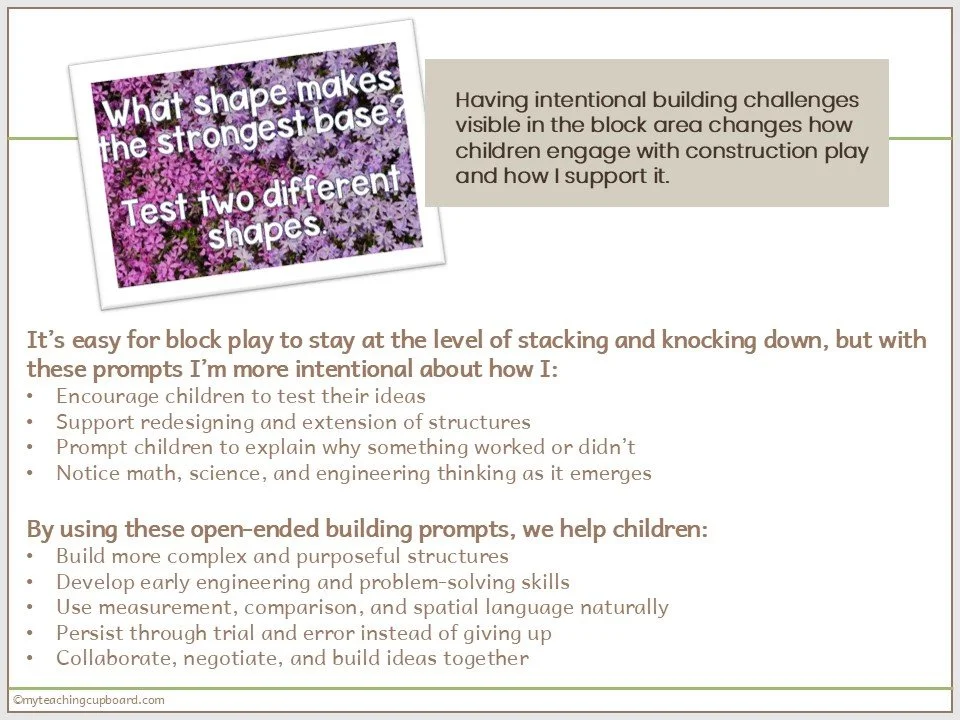
💡 Teacher Tip: Try adding movement provocation prompts such as “Can you build something taller than yourself?” or “How could you make this structure balance on one point?” to your construction areas. These simple prompts connect physical play to early maths and science concepts without interrupting the joy of discovery.
Get more prompts like these in this pack: 72 Block Play Building Prompts
Emotional and Social Development in Play-Based Learning
Play is where children learn how to understand themselves and others. In fact, this is often where I notice some of the most transformative growth. Not during completing a worksheet, but during a negotiation over who gets the stethoscope next or how many “patients” the vet clinic can take today.
In these everyday interactions, young children practise the core foundations of social and emotional development:
Self-regulation and emotional resilience
Empathy and compassion
Cooperation and teamwork
Leadership and problem-solving
Effective communication and perspective-taking
The Queensland Foundation Paper on Age-Appropriate Pedagogies emphasises that collaboration and shared decision-making during play are key drivers of confidence, emotional regulation, and social competence.
When children have agency in play, they learn to express their needs, navigate conflict, and adjust to the needs of the group. They do this all while feeling safe, connected, and valued.
Dramatic Play Classroom Example
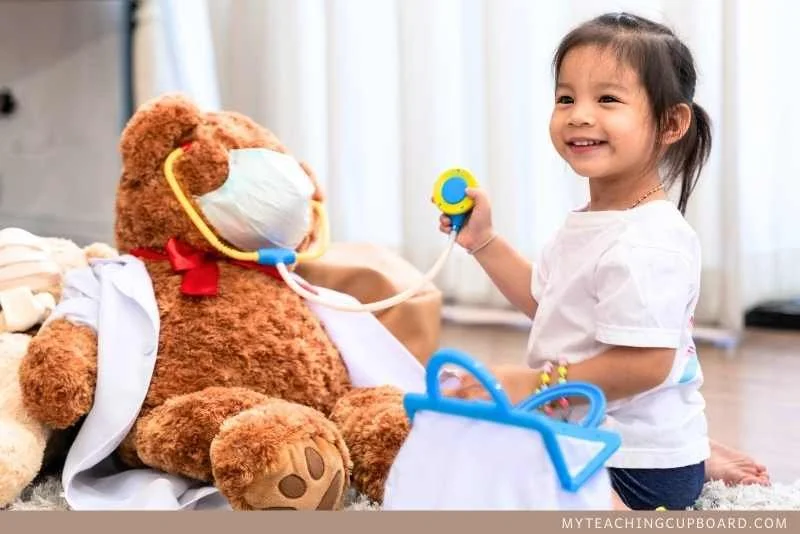
During dramatic play, a group of children set up a veterinary clinic. Without any prompting, they began creating rosters, comforting anxious “pets,” and managing the supplies table. One child became the receptionist, another the vet, and another the nurse.
As I watched, I noticed:
Empathy: comforting soft toys and checking on each other
Responsibility: allocating jobs and managing turn-taking
Collaboration: making decisions together (“We need more food bowls. Can someone make them?”)
In just ten minutes of imaginative play, they practised communication, leadership, emotional intelligence, and social problem-solving. These are important skills. Positive interactions like these have implications that reach far beyond the early years classroom.
💡 Teacher Tip: Use gentle, open-ended prompts to stretch emotional awareness and social problem-solving during play-based investigations:
“How could we make sure everyone has a turn?” - Encourages fairness, perspective-taking, and cooperation.
“What could you say if you disagree?” - Helps children build respectful communication skills.
“What feelings might your friend be having?” - Supports empathy, emotional literacy, and social awareness.
These small prompts nudge children to develop the emotional resilience, positive relationships, and social-emotional development that sit at the heart of holistic child development.
In today’s classrooms, where behaviours feel increasingly challenging and big emotions show up daily, teaching social skills and emotional skills isn’t optional; it’s the solution. When we intentionally model, scaffold, and explicitly teach these skills, we give our young children the tools they need to communicate, regulate, and thrive.
I cannot stress enough that the emotional and social development that happens during play based learning plays a crucial role in creating a happy, peaceful classroom.
Cognitive and Creative Growth – The Thinking Power of Play
If you’ve ever watched children completely absorbed in a challenge like testing which ramp makes a car go faster, sketching out plans for a new “city,” or negotiating the rules of a board game they’ve invented, you’ve witnessed cognitive development happening in its most natural form.
Play is one of the most powerful engines of thinking. It strengthens memory, attention, flexible thinking, and problem-solving skills because children are constantly organising, interpreting, and experimenting with ideas.
According to the Age-Appropriate Pedagogies framework, play helps children “organise, construct, manipulate, investigate, and make sense of their world,” integrating literacy, numeracy, scientific thinking, and reasoning in meaningful ways.
Here’s what it looks like in action:
How Play Builds Strong Thinkers
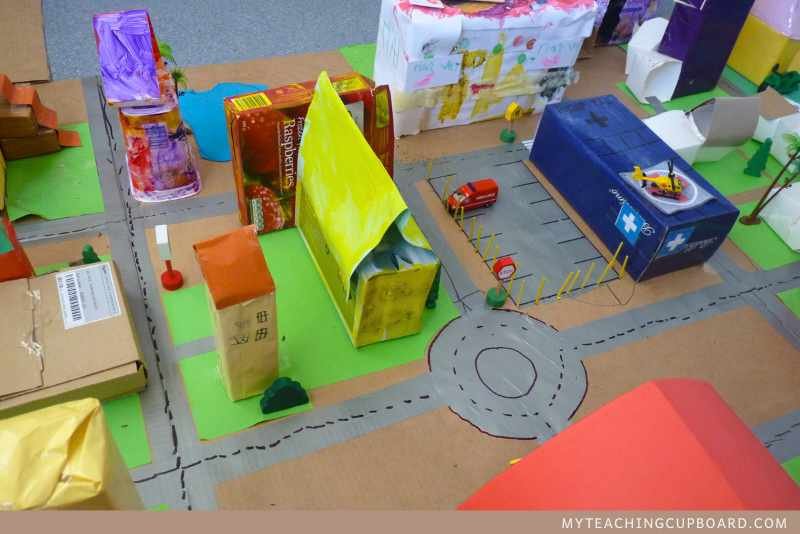
A child draws a map for a block town - They’re thinking spatially, symbolically, and narratively. Early literacy and geometry work together in a way that a worksheet could never replicate.
Two children test which materials float the best -They predict, hypothesise, test, adjust, and record. This is the core cycle of early science happening through joyful experimentation.
A group invents a new board game - They design rules, track scores, create storylines, and take turns, building critical thinking, creativity, and communication all at once.
These seemingly simple moments in my play based classroom are actually deep cognitive workouts. They show children developing intellectual abilities, problem-solving skills, and the confidence to try new things.
Creative Benefits: Why Imagination Matters
Play stretches children’s creative thinking in ways formal instruction never could. Through storytelling, make-believe scenarios, small world play, transient art, and loose parts, children learn to:
express ideas in many forms
experiment with possibilities
generate new solutions
communicate visually, verbally, and symbolically
innovate and take risks safely
Creativity should never be seen as a “nice extra” in our classrooms. It’s the foundation of innovation, flexible thinking, and resilience. When children are given time, space, and open-ended materials, they learn to see problems from different angles and express their ideas with confidence.
Linking the Domains – Why Holistic Development Matters
One of the most powerful things about play-based learning is that nothing develops in isolation.
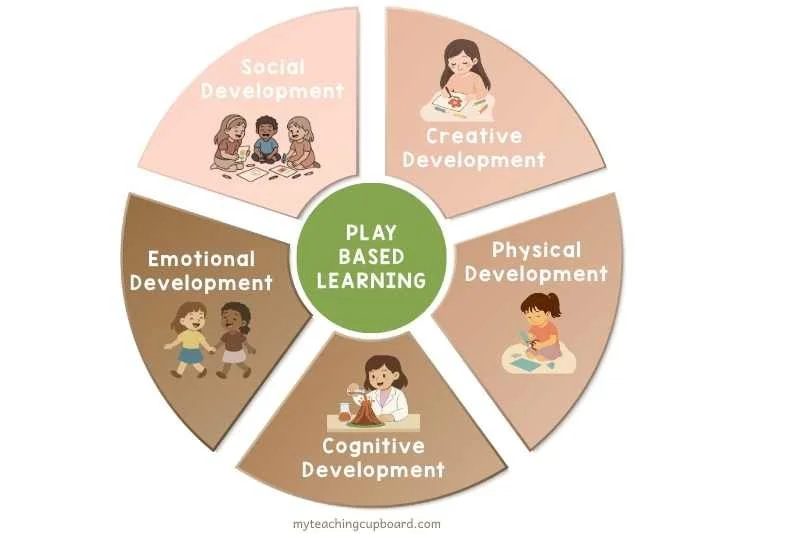
When young children play, every domain of holistic development (physical, social, emotional, cognitive, and creative) is activated at once.
That’s why a play-rich environment feels so alive.
Children are integrating new skills, practising old ones, and connecting ideas in ways that formal tasks rarely allow.
Holistic learning isn’t about teaching separate skills on separate days. Each domain strengthens the others:
Physical play fuels cognitive focus. When children climb, balance, build, or manipulate materials, they improve the motor control and sensory processing needed for writing, attention, and problem-solving.
Social interaction strengthens language and emotional intelligence. Negotiating roles in dramatic play or collaborating on a construction project naturally builds vocabulary, empathy, resilience, and communication.
Creative exploration nurtures flexible thinking. When children imagine, design, or innovate, they learn to approach problems from different angles — a foundation for critical thinking and lifelong learning.
This overlap is exactly why play is such an effective teaching strategy and a comprehensive approach. It mirrors the way the real world works - not as isolated subjects, but as interconnected experiences where children use their whole selves to learn, adapt, and grow.
The Teacher’s Role in Supporting Holistic Growth
Effective play-based learning doesn’t just magically happen. It flourishes when teachers
intentionally shape the environment
tune into children’s thinking
and gently guide learning forward.
In a holistic approach, you need to be constantly observing, listening, and making thoughtful decisions: Do I step back? Do I ask a question? Do I add a tool? Do I link this moment to a curriculum outcome?
When this happens, play becomes the perfect vehicle for meeting your academic goals and nurturing social, emotional, cognitive, physical, and creative development - the whole child.
Examples of Effective Teacher Strategies in Holistic Environments
• Modelling counting and measurement in construction play
Sometimes all it takes is picking up a tape measure and narrating your thinking: “This wall is 12 blocks long. I wonder how long the next one will be?”
Instantly, you’ve linked the play to numeracy concepts without interrupting the flow.
• Using questions to deepen problem-solving
Open-ended prompts help young children build flexible thinking: “What happens if you change just one thing?”
“How could you test your idea?”
• Provoking reflection and new possibilities
Reflection transforms play into learning: “Could there be another way to make it stronger?” “Which idea worked best and why?”
• Gradual release of responsibility
A gentle I do → We do → You do approach helps children develop confidence. For example, you might model how to record findings during a science provocation, try one example together, then leave clipboards in the play space for children to use independently during investigation time.
These teaching strategies are not loud, not intrusive, and not “taking over”
They are what turn a regular play session into a play-based learning environment that supports every domain of a child’s development.
💡 Teacher Tip: Use these quick reflective questions during your next planning session or at the end of your school day:
How am I balancing child-initiated and guided play?
Do my provocations support multiple areas of development?
Is there enough time for sustained play and deep thinking?
Am I documenting progress from more than one domain (e.g. cognitive + social + physical)?
Want some beautiful printable prompts you can display at your play based investigation areas?
👉 Download your FREE Teacher Prompts for Scaffolding Holistic Learning Through Play
You’ll get 30 free printable prompts with domain-linked questions to help you scaffold play intentionally across physical, social, emotional, cognitive, and creative development.
Access the Prompts for Scaffolding Play PLUS over 70 other free resources you can use instantly in my Free Resource Library.
Play Builds Whole, Happy, Capable Learners
Play-based learning is far more than fun.
Holistic education through play is a research-backed, developmentally appropriate pathway to whole-child growth and children's overall health. It really is the best way for early childhood educators to ensure a child's holistic development.
When we intentionally design environments that nurture curiosity, movement, creativity, and collaboration, our children thrive across every developmental domain.
When they feel supported in an intentionally designed supportive environment that values play, they build the confidence to try new things, the emotional resilience to persist, the social skills to work with others, and the cognitive flexibility to solve problems in meaningful ways.
These moments - the bridge building, the map drawing, the shared storytelling, the quiet concentration - are the learning!!
They form the strong foundation children need for academic achievement, lifelong learning, and overall well-being.
As early years educators, our role is to protect and champion play as the natural language of learning. When we observe, scaffold, question, and celebrate what we see, we turn everyday play into deep, powerful, holistic development.
Explore my Educational Activities and Play-Based Learning Resources to support your play-based learning journey and nurture the holistic development of all children in your care.
If you are interested in fostering holistic development through play based learning in your classroom but don’t know where to start, I have a blog post to help you.
Read How to Start with Play Based Learning and discover the strategies, tips, and lessons I’ve learned over the past 25 years to make implementing play-based learning simple and super effective.