
The Research on Play Based Learning in Early Childhood
Learn what the research says about play-based learning and why evidence shows it leads to stronger academic, social, physical, and cognitive development outcomes for children.
Think about a typical morning in an early childhood classroom.
On one side of the room, a small group is building a zoo with blocks and loose parts. They are negotiating roles, problem-solving, and explaining their ideas with the kind of rich language we wish they’d use in guided reading. On the other side, a child is writing “tickets” for the zoo, sounding out words, forming letters, and proudly handing them out to friends.
It’s meaningful, fun, developmentally appropriate learning.
But then comes the pressure we all know too well.
A parent asks, “Are they doing enough real work?”
A colleague whispers, “Play is fine at lunchtime, but you still need to keep them on track academically.”
A school leader suggests “more direct instruction” because results must improve.
Or you hear the classic one: “Play is messy, chaotic, and hard to supervise… and is it really worth the time?”
And suddenly, you find yourself torn between what you know is right for young children and what the system seems to demand.
Across Australia (and globally) early childhood teachers are navigating this exact tension. Curriculum expectations are increasing, school readiness is pushed down earlier, and academic learning is often prioritised over emotional development, cognitive development, and positive attitudes toward learning.
But here’s the truth the research makes undeniably clear:
👉 Play-based learning is not “extra.” It’s the most powerful, evidence-backed way young children learn.
This blog post unpacks what the research on play-based learning actually tells us — drawing on landmark studies like:
All of it points in the same direction: children’s play drives stronger academic success, social skills, executive function, communication skills, and long-term learning outcomes than early formal instruction alone.
As the growing body of research continues to show, young children learn through hands-on experiences, problem-solving, imaginative play, and collaboration.
The right play-based learning environment develops the language skills, social connections, self-regulation, and foundational academic skills needed for genuine school readiness.
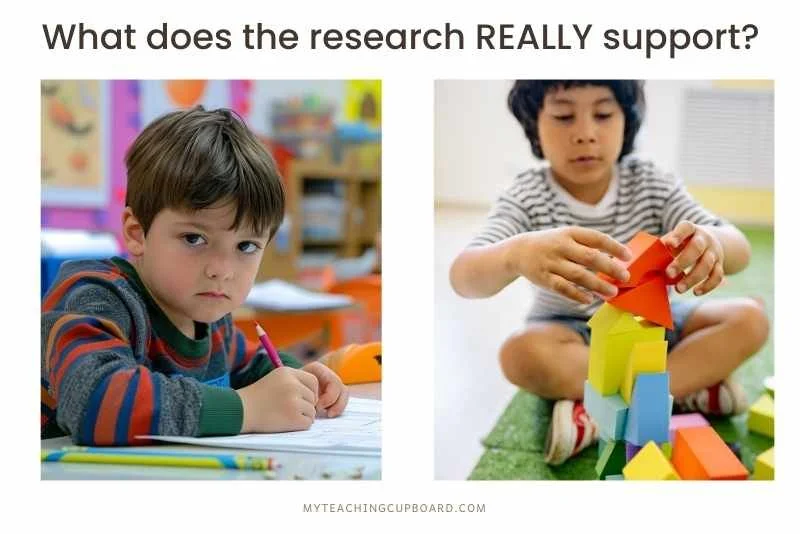
What the Studies Show About a Play-Based Approach to Learning
Across decades, countries, and pedagogical approaches, one finding stays remarkably consistent: play-based learning leads to stronger long-term academic, social, and emotional outcomes than early formal instruction alone.
Here’s what the major studies reveal and why they matter for your classroom today.
The EPPE Project (UK) – Balanced Pedagogy Brings Long-Term Benefits
The UK’s landmark Effective Provision of Pre-School Education (EPPE) study followed 3,000+ children over several years and delivered one of the strongest evidence bases we have in early childhood education.
Researchers found that children made the greatest academic and social gains when settings provided:
a balance of child-initiated play and intentional teaching,
warm, responsive relationships, and
rich, well-resourced play environments.
Children from play-rich environments demonstrated:
stronger vocabulary,
improved self-regulation, and
sustained engagement with school well into their primary years.
In addition, recent research on guided play (Hirsh-Pasek et al., 2022) confirms that children achieve the strongest learning outcomes when playful exploration is combined with intentional teacher scaffolding and shared thinking. Their research in this area suggests that children need more time both for free play and for guided play and that guided play could offer a promising new pedagogy that helps children thrive academically.
✅ Key takeaway: The research is clear. The best outcomes emerge from a blend of self-directed play and purposeful educator guidance.
The High/Scope Perry Preschool Study – Lifelong Gains from Early Play
This long-term U.S. study tracked children for over 40 years, making it one of the most influential early childhood projects in the world. The High/Scope approach is grounded in active learning, child-led experiences, and sustained shared thinking.
Participants who attended the play-based preschool were:
more likely to complete high school,
earn higher incomes,
have better employment stability, and
far less likely to need social services or be involved in crime.
✅ Key takeaway: Researchers concluded that purposeful play builds the foundational skills (executive functioning, motivation, resilience) that drive lifelong learning and wellbeing.
The Cambridge Primary Review – A Call for Balanced, Active Pedagogies
The Cambridge Review (2010) remains one of the most comprehensive examinations of children’s learning needs in the UK. It found that the most effective early learning environments combine:
direct teaching,
meaningful dialogue,
rich play environments, and
shared problem-solving.
The review emphasised the importance of imagination and symbolic play for cognitive development:
“Learning is primarily a social activity… Pretend play and imagination are vital for cognitive development.”
— Cambridge Primary Review (2010)
✅ Key takeaway: Play, alongside sustained shared thinking, was shown to significantly strengthen metacognition, self-regulation, and higher-order thinking.
The Crisis in Kindergarten – The Cost of Losing Play
The Alliance for Childhood report (Miller & Almon, 2009) highlighted a dramatic shift in U.S. kindergartens:
Playtime dropped 25–30%,
direct instruction and test-prep activities surged, and
worksheets replaced hands-on learning experiences.
The consequences were troubling:
higher stress levels,
reduced creativity,
poorer motivation, and
increased behavioural challenges.
✅ Key takeaway: Removing play in favour of rigid academics undermines emotional wellbeing, engagement, and long-term academic success.
Australian Research – Intentionality and the Play–Learning Balance
Australian evidence aligns strongly with international findings.
Reports from AERO and ACER demonstrate that play-based pedagogies:
improve early literacy and numeracy outcomes,
strengthen language development and social skills,
support emotional regulation,
boost executive function, and
deepen problem-solving skills.
Recent AERO studies (2023–2024) reaffirm that intentional play-based learning supports early literacy, numeracy, and executive function development when teachers actively scaffold and extend children’s thinking.
✅ Key takeaway: The common theme is intentionality: play is most effective when educators clarify learning goals and scaffold thinking through open-ended questioning, rich provocations, and well-designed environments.
Why Play Works – What the Research Says About the Brain
If you’ve ever watched a group of young children completely immersed in their play (building, negotiating, imagining, explaining), you’ve seen the young brain at its best.
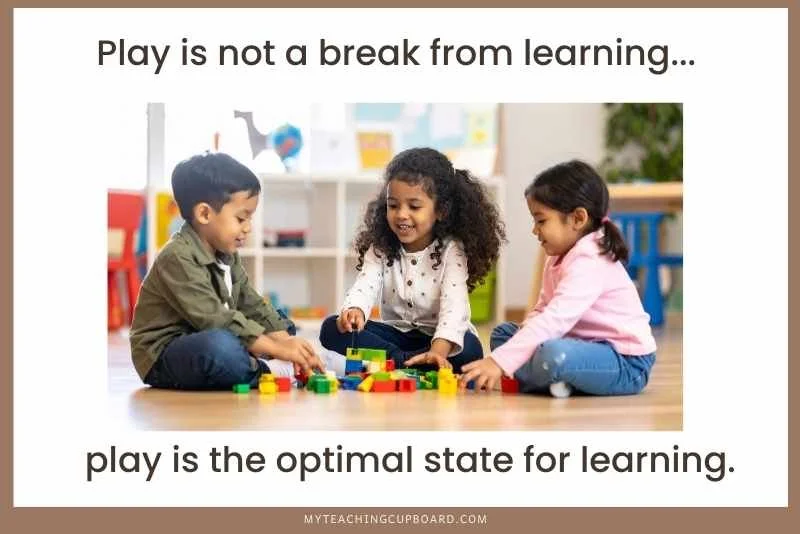
The research makes it clear: play is not a break from learning; play is the optimal state for learning.
Here’s what neuroscience and developmental science reveal.
Neurological Evidence
Modern neuroscience has finally caught up with what early childhood teachers have known for decades: children learn more deeply and more efficiently when they are actively engaged in play.
Key findings from brain research show that:
Play activates the prefrontal cortex — the part of the brain responsible for executive function skills like planning, flexible thinking, and impulse control.
Joyful, repeated play experiences strengthen neural pathways, making it easier for children to store and retrieve information.
Movement-rich and sensory-rich play boosts focus and emotional regulation, helping children adapt to challenges and manage stress.
Hands-on exploration increases synaptic growth, improving memory, language acquisition, and cognitive development.
Contemporary executive function research (Diamond, 2020) highlights that playful, socially interactive learning environments strengthen cognitive flexibility, working memory, and inhibitory control. These are all critical predictors of later academic success.
The American Academy of Pediatrics sums it up powerfully:
“Play is brain-building. It supports the development of executive function, language, and emotional regulation.” — The Power of Play, AAP (2018)
Emotional and Social Foundations
Researchers emphasise that emotional safety and social connection are prerequisites for academic success and play is where these foundations develop naturally.
Through pretend play, collaborative investigations, and even simple free-play routines, children learn to:
negotiate roles,
take turns,
solve interpersonal problems,
interpret emotions, and
regulate their own behaviour.
These are not “extra” skills! They are predictors of long-term academic achievement, stronger mental health, and positive attitudes toward learning.
A major review on play and regulation found that:
“Play supports children’s self-regulation by integrating emotional, cognitive, and social domains simultaneously.” — Play as Regulation, 2017
When children regulate emotions, collaborate effectively, and persist through challenge, they are primed for deeper thinking and stronger academic learning.
How Free Play Supports Child Development Across All Domains
Research consistently shows that free play is a powerful driver of child development across cognitive, social, emotional, and physical domains. During free play, children make independent choices, test ideas, move their bodies, and interact with peers in ways that integrate multiple areas of development simultaneously.
From a brain development perspective, self-directed play activates neural pathways linked to executive function, creativity, and flexible thinking. These repeated playful experiences strengthen connections in the prefrontal cortex, supporting planning, memory, and emotional regulation.
Free play also contributes significantly to physical development. Whether children are building with blocks, engaging in dramatic play, or exploring outdoor environments, they refine fine motor skills, coordination, balance, and spatial awareness. Movement-rich play experiences are strongly associated with improved focus and cognitive readiness for academic tasks.
When we view play through a child development lens, it becomes clear that play is not separate from learning. It is in fact the natural context in which children develop the skills, dispositions, and understandings that formal instruction later builds upon.
👉 For a deeper look at the benefits of play-based learning across social, emotional, physical, and academic domains, you might like to read this blog post: Benefits of Play Based Learning in Early Education.

How Play Connects to Learning Outcomes
When you look closely at children playing, you’ll see the building blocks of literacy, numeracy, and social-emotional learning all taking shape right before your eyes.
Research on play-based learning shows that children aren’t just “having fun”. They’re developing the cognitive, language, and problem-solving skills that underpin academic success throughout school and life.
Literacy and Language Development
In play-based classrooms, literacy grows naturally through storytelling, symbolic play, and dramatic play. As children share ideas, invent stories, and represent their thinking through drawings or symbols, they develop:
Oral language fluency — using new vocabulary in context
Phonemic awareness — hearing and playing with sounds in words
Print and symbol knowledge — recognising that marks, signs, and letters carry meaning
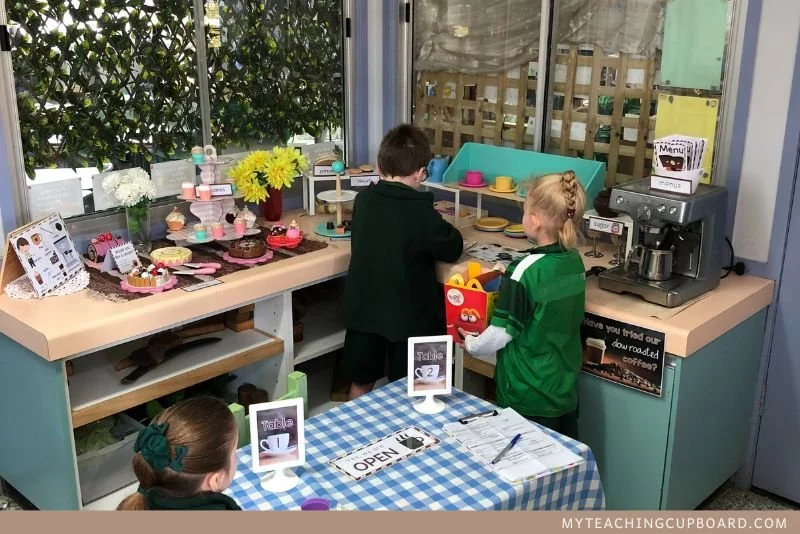
When a child writes a “menu” or labels their tower, that’s literacy in its most authentic form. Purposeful, connected, and owned by the learner.

Numeracy and Scientific Thinking
Mathematical thinking also thrives in playful settings. During block play or loose-parts exploration, children naturally engage with key mathematical and scientific concepts:
Counting, sorting, and comparing materials
Measuring height, length, or quantity
Investigating cause and effect — predicting, testing, and adjusting their designs
Every time a child says, “I need one more block,” they’re practising number operations. When they experiment with balance or weight, they’re learning about physics and measurement. So many mathematical skills and concepts are explored and learned all through hands-on, natural play.
If you’d like to discover exactly how to teach the ACARA Maths curriculum through play-based learning, I have a blog post that shares hands-on strategies, activities, and resources all aligned with Version 9 of the Australian Curriculum.
👉 Blog Post:Teaching the F-2 ACARA Math Learning Intentions Through Play

Higher-Order Thinking and Social-Emotional Learning (SEL)
Play invites children to plan, negotiate, and reflect. These are vital parts of both critical thinking and social-emotional growth. Through collaboration and imaginative play, children learn to:
Think creatively and flexibly
Manage emotions and persist through challenges
Take turns, share leadership, and see other perspectives
These skills form the foundation for lifelong learning, giving children the resilience and curiosity to thrive beyond the classroom.
The Role of the Teacher in Play-Based Pedagogy
Teachers should not be bystanders in play. For effective play based learning to happen, teachers must be the bridge between curiosity and the curriculum.
The research on play-based learning consistently highlights that effective teachers are intentional facilitators, guiding children’s discovery through observation, open-ended questioning, and subtle scaffolding.
According to the Age-Appropriate Pedagogies Foundation Paper and research from the Australian Education Research Organisation (AERO), high-quality play-based pedagogy blends freedom and focus. It values the child’s agency while ensuring learning outcomes are met.
In these environments, teachers:
Use open-ended questions and model reflective thinking to stretch ideas.
Create environments rich in choice, agency, and collaboration where every child feels confident to explore.
Connect play to curriculum goals without taking away the ownership, creativity, or joy of discovery that makes play meaningful.
When you lean into this role, you start seeing the deeper thinking happening beneath the surface. A child adjusting their block tower isn’t just “playing”. They’re problem-solving, measuring, and hypothesising.
Want to learn more about your role in play based learning? I have a blog post all about it: The Teacher’s Role in Play-Based Learning: How to Observe and Scaffold Play. In this blog post you’ll discover more about the teacher’s role and get practical strategies to help you observe, scaffold and co-play the right way.
The teacher’s role is to notice, name, and nudge that learning forward. Knowing how to ask the right question in the moment can make all the difference. The best play-based learning happens when you use open-ended, higher order questions that encourage reflection, reasoning, and creativity.
Instead of telling children what to do next, I use prompts that invite them to think more deeply, problem-solve, and articulate their ideas. The right questions can help you connect play to literacy, numeracy, and social-emotional learning outcomes effortlessly.
💬 Example Teacher Prompts from my Higher Order Thinking Prompts pack:
“What would happen if you changed one thing?”
“How could you make this idea even better?”
“What could you do differently next time?”
Each of these simple but powerful questions transforms a playful moment into an opportunity for critical thinking and reflection. When you use these in your classroom, you’ll notice how easily they help children move from surface-level answers to deeper, more meaningful learning conversations.
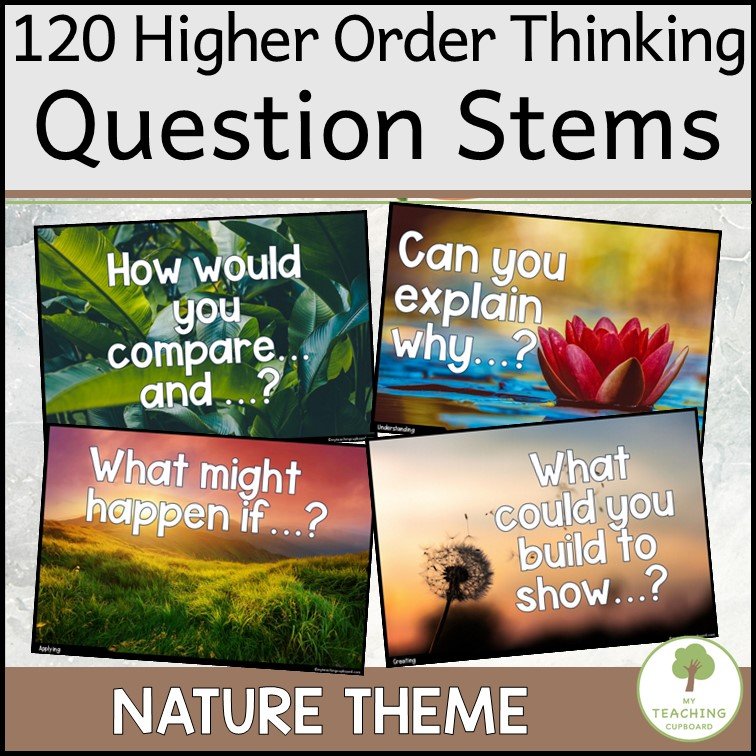
Build deeper thinking across your day with these printable higher order thinking prompts based on Bloom’s Taxonomy - perfect for Kindergarten, Prep, and Foundation teachers using play and inquiry-based learning.
Do your students give surface-level answers when you know they're capable of more? These Higher Order Thinking Prompts will help you ask the right kinds of questions – the ones that get them thinking, talking, and truly understanding.
Spark Deeper Thinking With These Higher Order Thinking Prompts
This comprehensive toolkit makes it easy to bring Bloom’s Taxonomy to life in real-world classrooms - without hours of prep or stress for you! Whether you’re guiding a maths investigation, a STEM challenge, or a group reflection session, you’ll have the perfect question ready to go.
A Time-Saving Way to Add Depth to Learning
This resource helps you move beyond “what happened?” to “why do you think that happened?” and “how could we improve it next time?”
It saves you precious planning time while also helping your students develop:
Deeper understanding across literacy, maths, and science
Richer language for sharing and justifying their ideas
Confidence to think creatively and reflect independently
Stronger reasoning and problem-solving skills
Designed for Real Classrooms and Real Conversations
You won’t find generic question posters here. These beautiful nature-themed prompts were thoughtfully written and classroom-tested during real play-based lessons, reflection times, and provocations.
Each level of Bloom’s Taxonomy is represented, from remembering and understanding to creating and evaluating. Use them flexibly - on display, in planning, or as part of inquiry-based learning.
This Higher Order Thinking Prompts Pack Includes:
120 Higher Order Thinking Posters (nature-themed, A4 size)
120 Printable Prompt Cards (four to a page)
Planning Template for intentional questioning
Teaching Notes with examples for Literacy, Maths & Science
Bloom’s Taxonomy At-a-Glance Poster
Suggested Prompts for Reflection Time
Observation Checklists for documenting student thinking
Document Wallet Label for organisation
A printable Master List of All the Question Stems
Use These Prompts to Support Deeper Conversations and Curriculum Goals
Perfect for:
Literacy, maths, and science blocks
Investigation areas and provocations
Group reflections and partner tasks
Inquiry learning, STEM, and makerspace challenges
Assessment and documentation during play
These prompts align with both the Australian Curriculum v9 and the Common Core, helping you confidently plan and assess higher order thinking skills.
Make Higher Order Thinking Part of Everyday Learning
Imagine being in the middle of a science provocation and hearing your students ask: “What would happen if we changed just one material?” That’s the power of intentional questioning - and it all starts with you.
With this set of higher order thinking prompts, you'll feel ready to guide meaningful learning through every subject, lesson, and play invitation.
These printable cards and posters make intentional questioning easy. Each prompt is grounded in Bloom’s Taxonomy and designed for real early years classrooms, helping you spark curiosity, scaffold thinking, and make every play-based moment count.
Addressing Misconceptions About Play-Based Learning – What the Research Actually Shows
If you’ve ever heard comments like “They’re just playing,” or “When does the real learning start?” - you’re not alone. Many early childhood teachers face pressure to justify play in a world still focused on worksheets and standardised testing. But decades of research tell a different story.
Across global and Australian studies, from the High/Scope Perry Preschool Study to the Age-Appropriate Pedagogies Foundation Paper, the evidence is clear: play is the real learning. It’s how young children develop the foundational cognitive, social, and emotional skills that formal instruction builds upon later.
Let’s look at a few of the most common misconceptions and what the research actually shows.
“Play is a free-for-all with no structure.”
High-quality play-based learning is intentionally planned and facilitated. Teachers use scaffolding, questioning, and environmental design to connect play to curriculum outcomes. (AERO, 2022)
“Children won’t meet academic benchmarks through play.”
Studies like the EPPE Project (UK) and Learning Through Play at School (ACER) show that children in play-rich classrooms achieve equal or higher academic outcomes than peers in direct-instruction programs and they do it with stronger motivation and engagement.
“Play doesn’t prepare children for ‘real school.’”
Longitudinal research (e.g. Perry Preschool Study) shows that play-based learners demonstrate greater persistence, problem-solving, and social confidence. These are all key predictors of long-term academic success.
“Teachers don’t teach during play.”
The teacher’s role is active and intentional - observing, scaffolding, and connecting play to explicit literacy, numeracy, and SEL goals. It’s a partnership, not a hands-off approach. (Age-Appropriate Pedagogies Foundation Paper)
💡 Teacher Tip: When parents or colleagues question the value of play, share photos or anecdotes that make the learning visible. Documentation like a labelled construction plan, a pretend shop tally sheet, or a group negotiation in action. Evidence doesn’t always need to be a worksheet. It just needs to show thinking.
Play vs Early Formal Instruction
One of the biggest tensions early childhood teachers face is the pressure to replace play with earlier and earlier formal instruction. Worksheets, scripted curricula, and tightly controlled lessons can feel like the “safer” option when academic results are under scrutiny. But what does the broader research base actually say?
Large-scale reviews and meta-analyses comparing play-based learning with early formal instruction provide an important insight. While direct instruction can sometimes produce short-term gains in isolated academic skills, play-based approaches are linked to stronger long-term outcomes in motivation, conceptual understanding, and self-regulation.
Research synthesised by Weisberg et al. (2016), Zosh et al. (2018), and Hirsh-Pasek and colleagues (updated across 2020 and beyond) highlights that playful learning environments support deeper, more durable learning. Children are not only more engaged in the moment, they are more likely to transfer knowledge, persist with challenges, and develop the executive function skills needed for later academic success.
In contrast, when formal instruction is introduced too early and replaces rich, hands-on experiences, children may learn specific skills quickly but show reduced curiosity, lower intrinsic motivation, and weaker problem-solving flexibility over time.
This does not mean explicit teaching has no place in early childhood classrooms. Rather, the research consistently points to a more powerful model: intentional, well-timed instruction embedded within meaningful play contexts. When children explore concepts through play first, and teachers then scaffold and extend that learning, understanding becomes deeper and more connected.

✅ Key takeaway: Early formal instruction may accelerate short-term performance, but play-based learning builds the long-term foundations (motivation, conceptual thinking, and self-regulation) that sustain academic success throughout the years of schooling that follow.
What This Means for Your Classroom
The research is undeniable: play-based learning isn’t an optional extra.
It’s the evidence-based foundation of effective early childhood education.
When you embrace a balanced pedagogy, blending guided teaching with child-led exploration, you’re not just covering curriculum outcomes. You’re nurturing the creative, confident problem-solvers our world needs.
Play-based programs:
• build strong literacy, numeracy, and thinking foundations,
• foster emotional wellbeing and social confidence, and
• prepare children for lifelong learning, not just short-term tests.
It’s time to move beyond the misconception that play and rigour can’t coexist because the evidence proves they do. Protecting play isn’t about stepping back. It’s about teaching smarter, with intention and heart.
Play Is Proven, Powerful, and Worth Protecting
When children are given the time and space to explore, imagine, and create (with thoughtful teacher support) they don’t just meet academic benchmarks.
They thrive as thinkers, communicators, and collaborators.
✨ Free Download: Your Free Educator’s Guide to Play-Based Learning

This is a practical, easy-to-follow guide that helps you confidently plan, document, and implement play based learning in your classroom. Perfect if you’re ready to put all this research into action and make play purposeful every day.
📘 Next Step: Read this blog post: How to Start with Play-Based Learning. This blog post is your step-by-step roadmap for transforming theory into classroom practice with real examples, routines, and tips.