
Free List of CVC Words for Kindergarten
Looking for an easy way to teach CVC words for kindergarten? Download my free CVC word list with decodable sentences in this blog post and discover engaging, hands-on activities to build phonics and reading fluency.
Tired of using the same cvc words over and over?
If you’re anything like me, you’ve probably defaulted to “cat,” “dog,” and “pig” more times than you can count when teaching CVC words. They’re simple, familiar, and easy to work with, but let’s be honest - using the same three-letter words on repeat isn’t doing our students any favours when it comes to developing real phonemic awareness or fluency.
It can be frustrating, especially during a small group reading session or when setting up a literacy centre, to try and come up with fresh, decodable text on the spot. Your brain goes blank, and you find yourself recycling the same short vowel sounds just to get through the activity. I’ve been there, too.
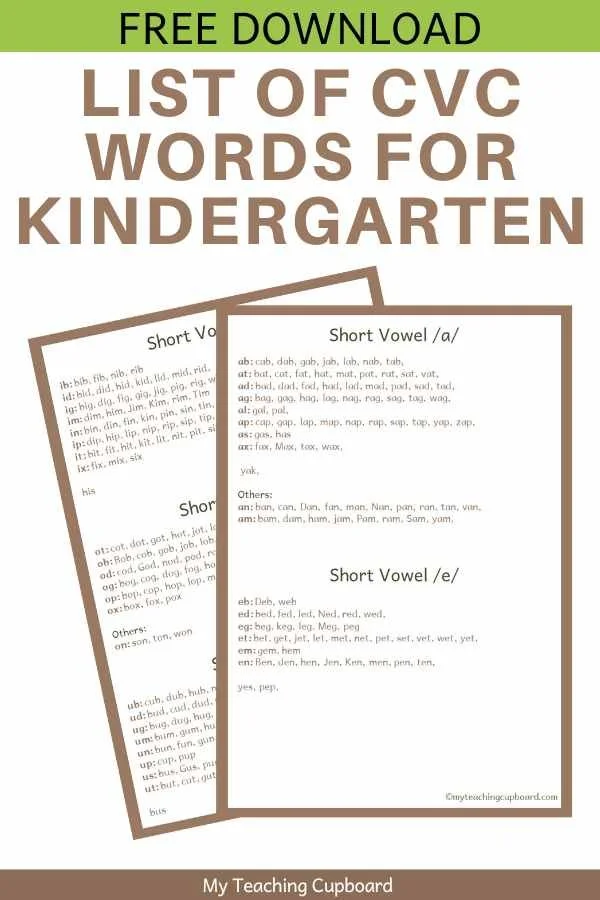
That’s exactly why I created this comprehensive free list of CVC words for kindergarten. It includes a wide variety of short vowel words, organised by sound, and even comes with 12 decodable sentences to help your students practise reading in context.

Whether you're focusing on consonant-vowel-consonant word patterns, phonics skills, or just want a go-to list that supports your lesson plans and planning, this free printable resource will save you time and get your students decoding with confidence.
It’s a great way to support beginning readers as they develop the important skills needed for reading success. Skills like identifying letter sounds, blending individual sounds, and understanding how to apply simple phonics rules.
You'll also find it handy for reinforcing sight words, practising spelling skills, and providing meaningful independent practice during literacy centres or rotations.
Grab your free CVC word list (with decodable sentences) here and also get instant access to over 70 other free classroom resources designed especially for young children in play-based and structured literacy classrooms.
This one small step might just be the best way to make your reading block feel easier - and more effective!
What Are CVC Words in Kindergarten?
CVC words are three-letter words that follow a simple consonant-vowel-consonant pattern—like cat, hat, sun, or bed.
They’re often the first words we introduce to young children when teaching them to read because they’re made up of the simplest phonics rules: each letter makes a single, regular sound, and when blended together, the result is a real word.
These words form the foundation of early phonics instruction. They’re an ideal starting point for teaching short vowel sounds, consonant sounds, and blending skills in a way that’s both manageable and meaningful for kindergarten students.
When children learn to decode CVC words, they’re building their phonemic awareness and that’s essential for more complex reading later on.
CVC word activities and printable worksheets can be used during small group time, literacy centres, or as part of hands-on activities. They offer the easiest way to help beginning readers move from identifying individual letters and individual sounds to blending those sounds together into real words. It’s the first step toward becoming a confident reader.
And when we look at how children actually learn to read, the Science of Reading backs this up. Research shows that explicit, structured teaching of phonics skills, including decoding consonant-vowel-consonant words, is one of the most effective ways to support early literacy.
You can read more about how this works and see the research in this blog post: Science of Reading Decoding Strategies with CVC Words.
Why Are CVC Words So Important for Beginning Readers?
It’s no exaggeration to say that CVC words are the first step in helping young readers crack the code of written language. Because each word follows a regular phonics pattern, they’re ideal for teaching segmenting and blending - the two most important decoding skills in early reading.
When children can segment a word into its individual sounds (like /c/ /a/ /t/) and then blend those sounds together to say the word “cat,” they’re developing a deep understanding of how words work. This builds their phonemic awareness and sets them up for success with more complex word patterns, sight words, and even spelling skills later down the track.
CVC words also support automaticity and fluency. The more students practise with familiar short vowel word families, the faster and more confidently they begin to read.
That’s why I’ve included 12 decodable sentences in the free CVC word list. Download them now and give your children the chance to see those words in action and practise fluent reading in a meaningful way.

And while repetition is important, so is variety.
Offering your students access to a comprehensive list of CVC words (rather than relying on the same few examples of dog, cat, or red) can make a big difference in how quickly they progress.
It keeps your
your reading practice fresh
your lesson plans focused
and your students engaged.
Curious about how CVC sentences can support fluency?
Head over to this blog post: Use CVC Sentences to Develop Decoding Fluency in Reading to find out how I use them in my own classroom.
Free Printable List of CVC Words for Kindergarten
I created a free CVC word list. After years of scrambling to think of new words during my literacy sessions, I took the time to create a handy list that I keep close by on my clipboard.
If you've ever found yourself relying on the same few words (hello cat, pig and bed), this list will be a game changer!
I’m happy to share it with you – it’s designed to give you easy access to a wide variety of consonant-vowel-consonant words. All sorted by short vowel sounds - so now you can always have new options at your fingertips too.
This printable resource includes:
A comprehensive list of CVC words organised by short vowel
PLUS 12 decodable sentences for fluency practice
Here’s a quick sample of what you’ll find:
Short A CVC Words: bat, mat, dad, jam, tag, nap
Short E CVC Words: bed, red, leg, net, pen, web
Short I CVC Words: pig, fin, lid, zip, dig, win
Short O CVC Words: dog, pot, fox, log, mop, hop
Short U CVC Words: sun, jug, mud, cub, gum, run
My big list is perfect for literacy centres, CVC word games, independent practice, or quick lesson plan prep.
Whether you're working with kindergarten students, 1st grade learners, or even young children in need of early support, this list will save you planning time while also giving your students meaningful reading practice.
Download your free CVC word list here and get access to my entire library of over 70 free printables, including CVC pictures to print, sight word and high frequency word activities, phonics activities, and more! It’s the best way to support your students without adding to your workload.
How Many CVC Words Should a Kindergartener Know?
This is one of the most common questions I get asked - and the answer might surprise you.
When it comes to CVC words for kindergarten, it’s not about how many words a child can rattle off from memory. What really matters is mastery - how confidently and accurately a child can decode, blend, and use those three-letter words in their reading and writing.
That said, a good benchmark for kindergarten students is being able to recognise and read around 20 to 50 common CVC words by the end of the year. These include short vowel words like sun, bed, hop, gum, and lid, which follow a consistent consonant-vowel-consonant pattern and are ideal for developing phonics skills and phonemic awareness.
Children build fluency through exposure and repetition. Not just during explicit instruction, but through a variety of hands-on, engaging contexts. That might include:
Playing CVC word games in literacy centres
Practising with CVC word worksheets or sentence-building tasks
Reading and writing simple stories using high frequency words and short vowel word families
Using decodable texts during small groups or guided reading time
Exploring nonsense words and real words side-by-side for decoding practice

Most importantly, children should feel a sense of success and progress.
Whether they’re working with individual letters, reading simple words, or decoding CVC word lists during independent practice – it is important your children are confident with letter-sound relationships before you expect them to tackle CVC words.
If you’re wondering what the actual progression of phonemic awareness is, check out this comprehensive blog post: Teaching Phonological Awareness and Phonemic Awareness or download my free guide from my resource Library.

Fun and Effective Ways to Teach CVC Words
Let’s be honest - phonics instruction can get a little dry when it relies too heavily on cvc worksheets, flashcards and repetition. If your students start to lose interest during reading time, it might not be the words, it might be the way we’re teaching them.
I’ve been in that spot where it feels like you’re doing all the right things, but your young students still aren’t engaged. They tune out. They guess at words. And they definitely don’t get excited when you bring out “another worksheet.” That’s why I started looking for fun and engaging hands-on activities that still teach those critical phonics skills but in a way that feels like play.
Here are five of my favourite ways to make CVC word activities more engaging - without sacrificing learning:
I use these playdough mats to combine fine motor skills with phonemic awareness. Afterall, most kids LOVE playdough. It is always a popular activity in our classroom. With these mats, the children roll and shape letters to form CVC words. It’s a fun way to help them not only reinforce the connection of letter sounds to individual letters but to also practise decoding, spelling, and blending CVC words.

These play dough CVC word mats are perfect for practicing decoding, spelling, and blending CVC words.
Use this fun hands-on activity and harness the benefits of sensory play to teach your students CVC words.
Download 98 CVC word cards that include real-life photo illustrations so your children can easily relate to them.
THIS SET CONTAINS:
98 CVC Play Dough Word Mats (A5 size)
2 CVC Word Learning Invitation Prompts
2 Recording Sheets
Best ever Playdough Recipe
Playdough Center Set up Ideas
Students decode the word and then build it with play dough.
HOW TO USE:
There are 3 photos on each card but only one of these illustrates the CVC word.
Students roll the playdough and create the CVC words and can then make balls of playdough and squash them over the illustrations that don’t belong.
Set up an engaging hands-on literacy center your Kindergarten kids will LOVE!
Actually, these CVC play dough cards could be used for preschool right up to first grade!
Use sensory play to engage your students and help them to retain so much more.
Your kids will love to practice their consonant-vowel-consonant words with this fun hands-on activity.
They will be learning important early literacy skills and developing their fine motor skills all at the same time!
CVC Words Included:
20 short a words
16 short e words
18 short i words
20 short o words
24 short u words
BOTH AMERICAN AND AUSTRALIAN SPELLING INCLUDED
Just print, laminate and cut.
Easy prep and you’ll have a literacy resource you can use over and over.
Perfect for:
hands-on literacy investigation areas
literacy centers
small group literacy rotations
reading stations
word work
fine motor centers
busy bags
early finishers
morning tubs
or for informing your assessment grades
When learning is fun and meaningful, the learning sticks, so harness the benefits of play based learning in your classroom with this simple to prep literacy activity.
Aligned to The Science of Reading:
Teaching your students to decode and blend CVC words means they will learn the sounds that letters make and be able to use that knowledge to read words correctly. It starts with early literacy skills like recognising the letter-sound relationships in CVC words. The science of reading research strongly supports using CVC (Consonant-Vowel-Consonant) words as a foundational element in early phonics and reading instruction.
2. Hot Wheels Drive & Blend Game
This one’s always a hit. Kids “drive” their little car across the letters, blending as they go. After we have used these cards in our small group literacy lessons, I use them to set up a little investigation learning centre for continued practice. This fun activity turns blending and segmenting consonant-vowel-consonant words into an activity my kids flock to.

Help build decoding skills and reading fluency with these CVC Word Blending Cards. Practice segmenting and blending phonemes with this fun hands-on activity. These Drive and Blend cards provide a visual, kinesthetic, and tactile way to practice blending and segmenting the sounds in CVC (consonant-vowel-consonant) words.
Develop orthographic mapping skills.
Students drive a toy car along the reading road to segment and blend each CVC word. As they practice, they will build their reading fluency and drive a little faster each time.
The cards help students identify and blend the beginning, middle, and ending sounds in CVC words. The road visuals are not only engaging, but they help students with directionality too!
Being able to easily segment CVC words and blend sounds is crucial for successful decoding and reading fluency.
These CVC Word Blending Cards are perfect for
hands-on literacy investigation areas
literacy centers
small group literacy rotations
reading stations
reading intervention
word work
busy bags
homework
early finishers
morning tubs
or for informing your assessment grades
This engaging decoding activity is one of the most requested in our class.
If you want to make your phoneme blending activities interactive, engaging, and age-appropriate for kindergarten students, you really need to be using movement, manipulatives, and games. These Phoneme Blending Activities will help you do just that.
4 DIFFERENTIATED SETS to meet the diverse needs of your students.
Use the picture card set to focus on segmenting CVC words. Students identify the picture and then drive their car on the road, stopping in each road box to segment the word into 3 sounds.
Use the letter card set to focus on blending sounds and reading CVC words. Have the students place a toy car on GO, and as they drive from left to right, blend the 3 sounds to decode and read the CVC word. These cards are best for CVC word decoding practice and building fluency.
BONUS self-correcting cards are also included. Students blend the phonemes to decode the CVC word and then flip the card over. They can check their accuracy because the picture on the back of each card make this activity self-checking.
Use the CVC word card set with matching pictures to support your beginning readers. These cards are useful for students needing a visual picture prompt. They will also help students self-check their decoding.
THIS SET CONTAINS:
100 CVC Drive and Blend Picture Cards
160 CVC Drive and Blend Letter Cards
100 CVC Drive and Blend Self-correcting Word Cards
100 CVC Drive and Blend Word Cards with a supporting picture
8 printable cars
A Drive and Blend Learning Center Header Poster
3 Learning Prompts
4 “I can” statements to print and display.
4 recording sheets (A5 size) to use on mini clipboards
Tile printing instructions
Play-based learning ideas
100 CVC Picture Cards
26 for short a
18 for short e
16 for short i
16 for short o
26 for short u
160 CVC Letter Cards
32 for short a
18 for short e
22 for short i
18 for short o
20 for short u
100 Self-correcting CVC Word Cards
26 for short a
18 for short e
16 for short i
16 for short o
26 for short u
100 CVC Word Cards with a supporting picture
26 for short a
18 for short e
16 for short i
16 for short o
26 for short u
Easy Prep! Just print and laminate for a set of blending cards you can use over and over.
BOTH Australian and American spelling included.
I use matchbox sized cars with this activity and prefer larger A4-sized cards. If you have smaller cars and want to save on paper, instructions are included for you to tile print the cards.
Quick to set up and easy to differentiate, these card games make great literacy centre activities. They encourage repetition in a low-pressure format and work beautifully in small groups or with partners.

Looking for an easy prep CVC word family activity?
Develop the phonemic awareness skill of rhyming with these fun and engaging CVC Word Family Card Games. These beginner rhyming card games will have your students listening for sounds within CVC words and learning all about rhyming word families in no time AND they will have so much fun doing it.
Use these engaging CVC word family card games to teach, practise and revise basic rhyming word families containing only consonant-vowel-consonant (CVC) words.
Perfect for literacy groups, literacy rotations, word work activities, explicit teaching lessons and literacy centers or play based investigation areas.
THIS RESOURCE CONTAINS:
36 illustrated CVC rhyming playing cards with labels
36 illustrated CVC rhyming playing cards without labels
4 printable backing pattern sheets – 2 standard and 2 ink saving
printable instructions for 6 different card games
You will receive a .pdf file containing 72 beautiful word family playing cards containing only cvc words. There are 9 cards to each A4 sheet. I recommend printing them onto card stock. Print in colour and at a high quality as the pictures are real life photos so your students can easily relate to them.
Word Families included: _at _ et _en _og _an _ap _ip _un _ug
Printable instructions explaining how to play 6 easy card games are also included and there are 4 bonus printable backing sheets to make your card games look professional.
DIFFERENTIATE:
EASY - Use the cards with labels to help students SEE that rhyming words have the same ending.
DIFFICULT - Use the cards without labels to encourage students to HEAR the rhyme.
You might prefer a more difficult level of word family cards. Check out the Word Family Card Games Pack.
I love these CVC word cards because they are self-checking. They are such a fantastic way to build decoding skills and fluency. Each card features a CVC word on one side and a real-life photo on the reverse so students can independently check their reading accuracy.
We use them in buddy reading, literacy centres, or small groups. My students love the “flip it!” part – it really makes reading feel like a game.
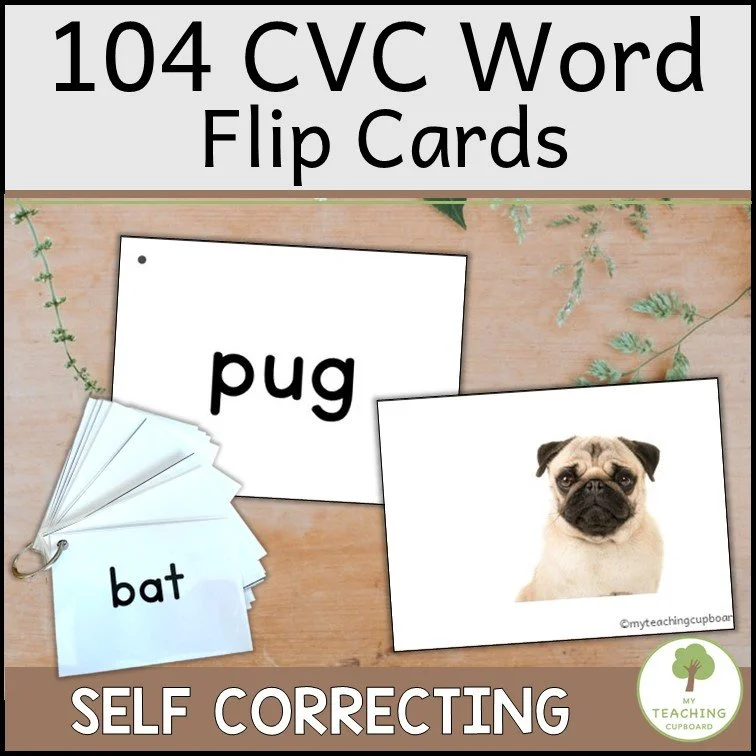
These engaging CVC word flip cards have been designed to build reading fluency and decoding skills in children. This set provides your students with a fun way to practice reading 104 unique short vowel CVC words. There are matching real-life photo illustrations that make this easy for students to self-check their reading accuracy.
What’s Included:
104 CVC word strips, each illustrated with corresponding real-life photos.
Use these CVC cards in your classroom when your students have mastered their single-letter sounds and are ready to move on to phonetically decoding CVC words.
The cards develop reading fluency by helping students to identify and blend the beginning, middle, and ending sounds of CVC words. Plus, they're self-checking. Each card has a CVC word on one side and a matching picture on the other, enabling students to check their reading accuracy independently.
How to Use these CVC Cards in the Classroom:
This is an essential reading activity for my kindergarten students. Primarily used for buddy reading, children pair up and practice reading and decoding CVC words. One child reads the CVC word while their partner listens.
If the partner thinks the word has been decoded and read correctly, they tell the reader to “flip it”. When the reading child flips the CVC card over, the matching picture is revealed and gives the children an opportunity to self-check their reading accuracy.
The children can then swap roles with the listening partner, becoming the reader and decoder.
I have used the CVC Word Cards for:
Interactive literacy centres
Small-group literacy rotations
Buddy reading sessions
Reading stations
Word work exercises
Activities for early finishers
Morning tubs
Homework tasks
Assessment grade insights
AVAILABLE IN BOTH AUSTRALIAN AND AMERICAN SPELLING
Simply print, cut, fold, and laminate, and you can turn these into flip cards by placing them on a binder ring.
An easy-prep literacy resource you'll return to again and again!
CVC Words Featured in This Set:
26 short a words
16 short e words
17 short i words
20 short o words
25 short u words
These cards are not only fun and engaging but are also aligned with the Science of Reading. They help students in decoding and blending CVC words by focusing on phonics, allowing children to grasp the individual sounds made by letters.
The Science of Reading research confirms the use of CVC words as an essential component in teaching early phonics and reading. Use these cards to help your children apply their understanding of letter sounds and develop their overall reading proficiency.
Classic, effective, and full of soooo much fun!! Use this game for revision, reinforcement, or even as a warm-up. It’s the easiest way to sneak in lots of repetition while keeping kids focused and excited.

If you are looking for a fun and educational way to practice CVC words, don’t go past my CVC Word Bingo Game. This engaging game is a class favourite. It’s perfect for whole class and small group literacy lessons. CVC Bingo will boost your student’s reading fluency of Consonant-Vowel-Consonant (CVC) words.
What Do You Get?
Two Complete Sets: Each set contains 30 bingo cards, giving you the flexibility to use this resource with a small group or the whole class. There are two sets, so you can choose to play a shorter or longer bingo game.
Set 1: Created with 50 unique CVC words. It includes a calling card and is great if you are looking for a quicker bingo game to play.
Set 2: Features 100 different CVC words and comes with its corresponding calling card too. Choose this set if you want to play a longer game.
Why Choose My CVC Word Bingo Game?
Nature-Themed Design: Calming graphics that suit any classroom décor.
Build Reading Confidence: Designed to develop accurate CVC word reading fluency.
Requested By Students: CVC Bingo is a class favourite that not only supports early literacy skills but is just fun to play!
How to Use the CVC Word Bingo Game
Just print, laminate if you wish, and the game is on!
This literacy resource is so easy to prepare, and you’ll be able to use it over and over in your classroom.
Aligned with the Science of Reading
My CVC Word Bingo Game is in line with the latest Science of Reading research. This research suggests that teachers should first start with phonics lessons, and when students can recognise and blend single-letter sounds, they will be ready to decode and read CVC words. A focus on learning CVC words will build student confidence and strengthen decoding skills.
CVC Bingo is the perfect game for practising accurate decoding and reading of CVC words. It’s a great way to consolidate single letter sounds too.
How To Play CVC Word Bingo
Give each child a printed bingo card.
The teacher calls out a CVC word from the calling cards. Call one word at a time.
The children listen for the words they have on their cards and mark them with a small counter if one of their words is called.
The first child to get all nine of their CVC words covered shouts out "Bingo!" and is the winner. If you have the time, your kids can rotate their bingo cards with their classmates and play another round.
If you're looking for more inspiration (or want to see these ideas in action), head over to this blog post: 5 Best CVC Words Activities and Games for Kindergarten for tips and printables that will have your students reading and smiling at the same time!!
Browse all my CVC teaching resources here → CVC Words Collection
Using CVC Sentences to Support Fluency
Once your students are confidently decoding CVC words in isolation, the next step is helping them apply that knowledge to sentence reading. Shifting to CVC word practice is crucial. It’s where real reading fluency starts to develop.
Reading CVC words within decodable sentences provides children with much-needed context. They begin to make meaning from what they read. That’s a powerful and exciting milestone for beginning readers.
In my classroom, I use simple consonant-vowel-consonant sentences to build both fluency and confidence. These sentences combine short vowel words with high frequency sight words and help my children read naturally and with purpose.
Here are a couple of examples taken from my free printable lists:
I can hop on the bed.
The cat is on the mat.
These sentences are easy to decode, developmentally appropriate, and designed to help children feel successful. When students see that they can read a complete sentence all by themselves, it’s such a huge boost to their confidence.
To support this in your own classroom, and discover nine easy ways to practice reading cvc words in sentences you can adfopt for your classroom, head over to this blog post: Decodable Sentences with CVC Words for Kindergarten for practical ideas and research-backed strategies.

How to Best Use Your Free CVC Word List in Your Literacy Program
Your free printable CVC word list can become a planning lifesaver. Whether you’re setting up your literacy centres, prepping guided reading groups, or refreshing your word work activities, this list gives you exactly what you need to teach CVC words consistently, confidently, and with minimal effort.
Here are some of my favourite ways to use it:
Word Work Activities – Select a set of short vowel words to focus on each week and pair them with hands-on activities like magnetic letters, CVC word cards, or mini whiteboards.
Morning Tubs or Rotations – Add laminated flashcards made from your list to morning tubs with letter tiles or playdough for an independent start to the day.
Independent Centresand Investigation Areas – Pop the list into your independent practice tubs so students can choose words to read, build, or write during literacy centres.
Guided Reading Support – Use the list as a go-to when planning texts, games, or blending activities that reinforce targeted short vowel sounds and simple phonics rules.
Sentence Building & Writing Prompts – Encourage students to select two or three words from the list and create their own sentences, or use them in decodable sentence tasks.
This resource will save you hours of planning time and prevent you from defaulting to the same three-letter words over and over again. You’ll be able to rest easy knowing that all the short vowels are covered in the cvc activities you have planned and that your young learners are getting the repetition and variety they need to truly master phonics skills.
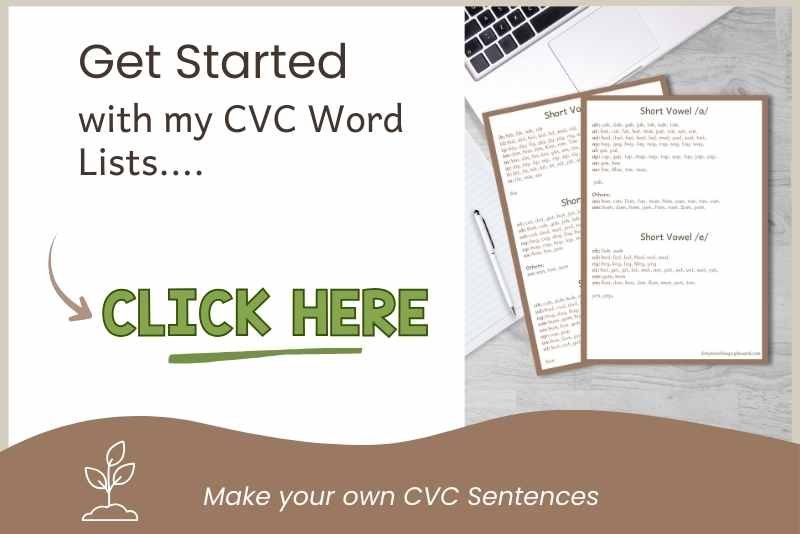
Download your free printable list + decodable sentences now and feel confident knowing you have a powerful, ready-to-use tool that supports your students' reading success - and your sanity!
Frequently Asked Questions About CVC Words for Kindergarten
What are 5 examples of CVC words?
CVC words are simple, three-letter words that follow a consonant-vowel-consonant pattern. Some common examples include cat, bed, pig, log, and sun. They are perfect for introducing short vowel sounds and early phonics skills to beginning readers.
How do I teach CVC words in a fun way?
The key is to make it hands-on and engaging. I like to use CVC playdough mats, self-checking word cards with real-life photos, CVC Bingo games, and interactive flip-it reading activities. These methods make phonics practice feel like play, while still building essential decoding fluency.
Where can I download free CVC word lists?
You can grab a free CVC word list with 12 decodable sentences in my free resource library. The list is organised by short vowel sound, making it easy to find just the right words for your lessons. Plus, it saves loads of planning time.
Why are CVC words used in kindergarten literacy?
CVC words help children practise blending and segmenting individual sounds in a controlled, predictable way. They’re a great starting point for building phonemic awareness, introducing simple phonics rules, and helping children experience success early in their reading journey.
Say Goodbye to Repetitive CVC Word Struggles
Teaching CVC words doesn’t have to be repetitive or time-consuming. With the right tools, it can be simple, purposeful, and even enjoyable.
My free CVC word list gives you a ready-to-use resource that covers all short vowel words and supports your students through structured, meaningful decoding practice. Instead of scrambling to come up with examples, you’ll have a complete guide to support reading, writing, and phonics - all in one place.
CVC word activities like the ones shared in this post help children move beyond memorising words and into real reading. They learn to blend, segment, and recognise patterns and lay the foundation for confident, fluent reading.
For more ideas on building early reading fluency, don’t forget to check out these related blog posts: