Open Ended Questions for Reading Comprehension in Literacy
Open ended questions for reading comprehension help young readers think deeply, infer, and explain ideas. Learn practical examples, tips, and free prompts.
Some days in literacy, it can feel like you’re the one doing all the talking.
Have you ever asked, “Who was your favourite character?” only to get a chorus of single-word answers? Or the same hands shoot up every time you ask a question because the kids know there is only one correct answer and they think the game is to guess it quickly.
Meanwhile, you notice a few quieter or struggling readers sitting back, watching the confident kids do all the answering.
No deeper thinking.
No rich discussion.
Just quick responses so we can move on to the next activity.
If this sounds familiar, rest assured - you’re definitely not alone.
Classroom teachers in primary schools are under pressure to “cover” content, assess reading comprehension passages, and fit everything into our already jam-packed timetables.
It’s so easy to fall into closed, detail questions just to check if children were actually listening. But those types of questions don’t build comprehension skills, and they don’t help young readers make sense of the main idea or connect with the text in a meaningful way.
This is where I have found that open ended questions for reading comprehension can change everything.
Open-ended questions invite young children to think, wonder, justify, and explain.
Instead of hunting for key words or guessing what the teacher wants, students learn to share their own ideas. They begin asking their own questions, engaging more deeply with the text, and developing genuine critical thinking.
You’ll hear “thicker responses” instead of one-word answers, and you’ll see deeper understanding grow in both your confident and struggling readers.
In my play-based classroom, I’ve seen this over and over again. Whether I’m reading a short story on the mat, exploring picture books with small groups, or using literacy provocations during investigation time, when I intentionally shift from single choice questions to open-ended comprehension questions, the entire learning experience changes.
Children talk more.
They listen to each other.
They connect the text to their own lives.
In this blog post, we’re going to look at how to use open-ended questions in the early years classroom. You’ll discover not just what these types of questions are, but also get some practical examples you can use tomorrow, ideas for guided reading and independent work, and a simple questioning strategy you can copy and use across your English language arts lessons.
My goal is simple: to help you feel confident using open-ended questions so your students’ understanding (and love of reading) continues to grow.
What Are Open-Ended Questions in Literacy?
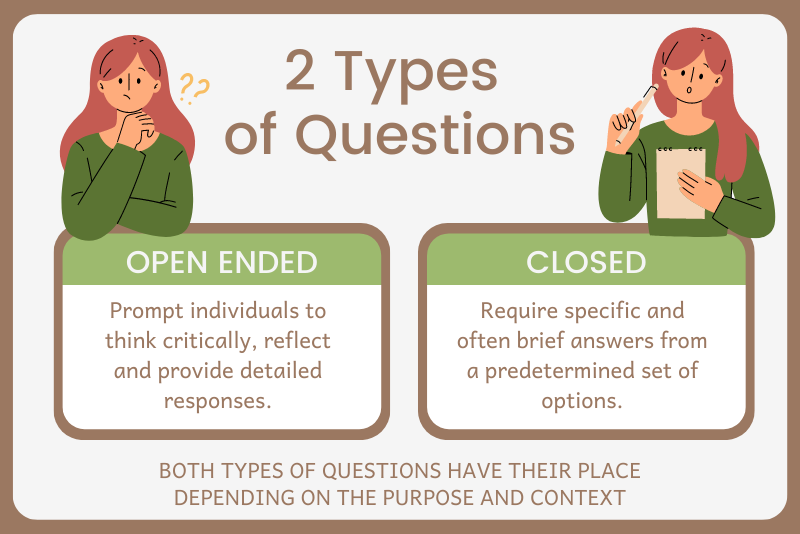
Open-ended questions in literacy are questions that do not have one right answer. Instead of prompting children to recall a single detail, they encourage students to think, explain, and justify their ideas in their own words.
These kinds of questions support deeper reading comprehension because they invite discussion and require children to use evidence from the text and their own experiences.
A simple way to think about them is this:
If a question can be answered with one word, it is probably closed.
If a question invites thinking, talking, or more than one possible response, it is open-ended.
Closed vs open literacy questions
Here are some clear examples you can use with your class or when you’re planning lessons:
Closed question: What colour was the dog?
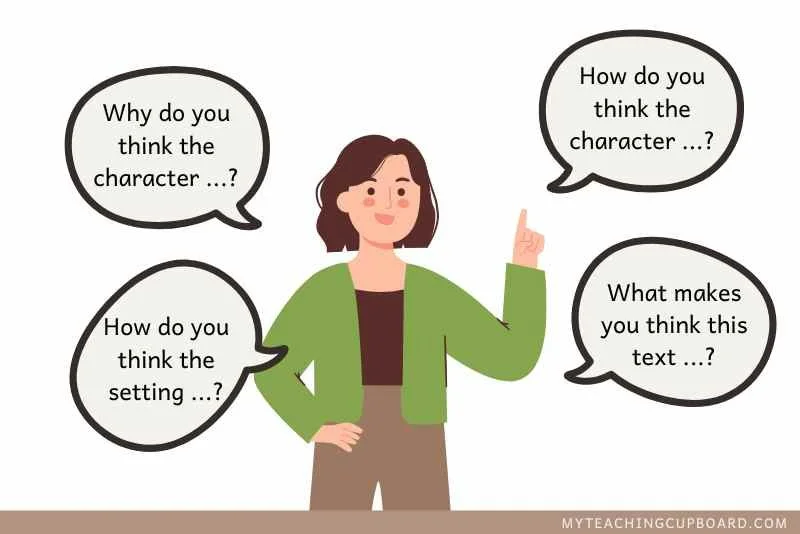
Open-ended question: Why do you think the dog made that choice?Closed question: Did the character find the treasure?
Open-ended question: How do you think the character felt when that happened?Closed question: Was the story setting - where did it happen?
Open-ended question: How does the setting change what the characters do?Closed question: Is this fiction or non-fiction?
Open-ended question: What makes you think this text is fiction or non-fiction?
You can see the difference straight away. Closed questions usually check small pieces of information. Open-ended questions invite children to think about the main characters, motives, feelings, the main idea, and the author’s message.
Why yes/no questions limit thinking
Yes/no or short-answer questions have a place in teaching - especially when checking recall or basic reading skills, but if they dominate classroom talk, they can unintentionally:
shut down conversations
reward fast recall instead of thoughtful responses
encourage guessing rather than student's understanding
allow quieter or unsure students to opt out
keep comprehension at surface level
With closed questions, children are often focused on finding the correct answer.
With open-ended questions, they are focused on making meaning.
When we shift from detail questions to open-ended comprehension questions, your young readers will be encouraged to:
explain their thinking
use evidence from the text
share personal connections
listen to different perspectives
build stronger comprehension strategies
In other words, open-ended questions help children move beyond remembering what happened to developing a deeper understanding of the text. They also build oral language, confidence, and social skills as children learn to express ideas and respond respectfully to others.
How Open-Ended Questions Improve Reading Comprehension
Open-ended questions do far more than keep the discussion going. They will directly strengthen reading comprehension.
When we invite our children to explain, justify, and expand on their ideas, we are actually teaching the core comprehension strategies that good readers use every day. Instead of simply recalling facts, young children learn to think beyond the text and make meaning from it.
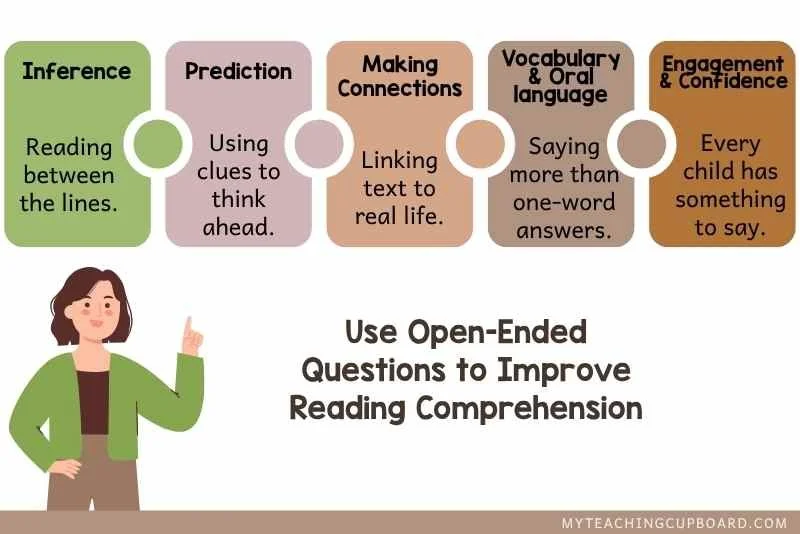
Here’s 5 ways open-ended questions can support key areas of comprehension.
Inference – reading between the lines
Inference is at the heart of strong comprehension. It’s the skill children use to work out what the author hasn’t said outright. Open-ended questions can be used to prompt students to use clues from the text along with their own background knowledge to make sense of what is happening.
For example:
Why do you think the character did that?
What makes you think the character was feeling worried?
These types of questions encourage children to combine text evidence with life experience and that leads them to a deeper understanding of both the story and the main characters.
2. Prediction – using clues to think ahead
Open-ended questions also encourage children to make thoughtful predictions. Instead of guessing wildly, they are prompted to justify their thinking using evidence from the text or illustrations.
For example:
What do you think might happen next?
Why do you think that?
I have found that when I ask my students to predict, they stay actively engaged in the reading process and are more invested in checking whether their ideas were right.
Predicting really helps to keep reading interactive too. Whether they are listening to a picture book, reading short stories together or working with specific reading comprehension passages in small groups – predicting type questions are fantastic!
3. Connection making – linking text to real life
One of the most powerful comprehension strategies we teach in early years is helping children to make connections. Open-ended questions can invite children to relate the text to their own lives, other books or stories and to the wider world.
For example:
Has anything like that ever happened to you?
Does this story remind you of another book we’ve read?
These types of conversations will help your students move past just recalling events toward a deeper understanding of the author’s message and the main idea.
4. Vocabulary and oral language – saying more than one-word answers
When students answer open-ended questions, they must use language to explain their thinking. This naturally develops:
vocabulary
sentence structure
oral language confidence
Instead of short answer responses such as “yes”, “no”, or a single word, children practise forming complete thoughts, using new words from the text, and clarifying what they mean.
This supports English language arts learning across grade levels and helps build strong comprehension skills for our young readers.
5. Engagement and confidence – every child has something to say
Open-ended questions change the feel of the lesson. Instead of searching for the right question with one correct answer, children soon realise that their ideas matter.
This is especially powerful for quieter students or a struggling reader who may not always recall exact details but can talk about feelings, ideas, or opinions.
You will notice:
more students participating
richer classroom conversation
children listening and responding to each other
growing confidence in sharing ideas
Reading becomes less about “getting it right” and more about making meaning, which is exactly what comprehension is really all about.
Curriculum Alignment: Why Open-Ended Questions Matter
Open-ended questions directly support the curriculum you are already responsible for teaching. When you use them during shared reading, guided reading, literacy rotations, or literacy provocations, you are helping your students meet key outcomes in both ACARA and the Early Years Learning Framework.
ACARA English V9 — comprehension, inference, vocabulary, and thinking
ACARA English Version 9 places strong emphasis on students:
understanding texts at literal and inferential levels
making and justifying predictions
explaining the main idea and key events
building vocabulary and language knowledge
thinking critically about characters, setting, and author intent
Open-ended questions support these aims beautifully.
When you ask questions such as:
What makes you think that?
How do you know the character is feeling this way?
Why do you think the author included that part?
you are prompting students to make inferences, justify their thinking with evidence, and engage in higher-level comprehension and not just basic recall of facts.
You’re also supporting the shift from “right/wrong answers” toward genuine reasoning and reflection. That’s exactly what ACARA expects as students progress through Foundation to Year 2.
EYLF Outcome 5 — children are effective communicators
In the Early Years Learning Framework, Outcome 5 states that children:
engage with texts and get meaning from them
express ideas through language
interact verbally with others
use language to make sense of their world
Open-ended questions directly nurture this.
When young children are encouraged to talk, explain, negotiate meaning, and listen to others’ ideas, they develop the oral language skills that sit underneath strong reading comprehension.
They are not just answering comprehension questions though, they are learning to be effective communicators who can share opinions, ask for clarification, and build on others’ ideas.
This is particularly powerful in play-based classrooms, where discussions arise naturally during investigations in dramatic play or at the literacy area in book-making. Of course these types of questions are also vital in both whole class and small-group reading lessons.

Bloom’s Taxonomy — moving beyond recall
Bloom’s Taxonomy reminds us that not all questions are equal.
At the lowest level, children simply remember and recall information.
Higher levels include:
understanding - explaining ideas
analysing - comparing, contrasting, noticing patterns
evaluating - forming opinions and justifying them
creating - imagining new endings or solutions
Closed questions usually sit at the remembering level.
Open-ended questions naturally move children upward through Bloom’s Taxonomy.
For example:
Why do you think the character made that choice?
→ analysis and evaluationHow else could the problem have been solved?
→ evaluation and creationCan you think of another ending to the story?
→ creation
By intentionally choosing open-ended questions, don’t think that you’ll be making your job harder or adding extra content. You are just simply changing the type of question you ask so that it targets the higher-order thinking that is already embedded in the curriculum.
Open-Ended Questions for Reading Comprehension: Practical Examples
I have found that open-ended questions are most powerful when they are woven naturally into everyday reading experiences. You can use them before, during, and after reading a text, whether you are sharing a picture book on the mat, reading short stories in small groups, or working on targeted reading comprehension skills.
Below are some practical classroom examples you can use straight away.
Before reading – activating thinking from the very beginning
Before reading, open-ended questions help children use prior knowledge, notice clues, and begin forming predictions. This prepares them for deeper comprehension while they listen or read.
You might ask:
What do you notice on the front cover?
What do you think this story might be about? Why do you think that?
What do the pictures make you wonder?
What do you already know about this topic? (great for informational text)
Who do you think the main characters might be?
These questions invite children to begin thinking straight away.
During reading – keeping thinking active
During reading, open-ended questions encourage students to monitor their understanding, clarify ideas, and adjust their predictions. This is a key part of strong comprehension.
You might ask:
What do you think will happen next?
How is the character feeling right now? What makes you think that?
What part is confusing? What questions do you have?
Why do you think the character made that decision?
What do you think the most important thing that just happened was?
These types of questions encourage students to slow down, reflect, and engage in close reading rather than racing through for a quick “finish”.
After reading – reflecting, evaluating, and responding
After reading, open-ended questions support reflection, evaluation, and deeper meaning making. They move children past retelling toward interpretation and opinion.
You might ask:
What was the main idea of this story?
How would you feel if that happened to you?
What lesson or message do you think the author wanted us to learn?
Which part stood out to you most? Why?
What questions are you still thinking about?
These are also excellent prompts for oral discussion, independent work, small groups, or reading journals, even with young children at this grade level.
Character, plot, setting, and vocabulary — focused comprehension questions
Open-ended questions can also target specific elements of comprehension without turning them into “test-style” comprehension questions.
Character
Why did the character act that way?
How did the character change from the beginning to the end?
Plot
What was the biggest problem in the story? How was it solved?
What do you think was the most important event?
Setting
Where is the story set, and how does the setting affect what happens?
How would the story change if it happened somewhere else?
Vocabulary and language
What’s another way to describe this character or place?
Which words helped you make a picture in your head?
Questions like these encourage students to think about the structure of the text, not just isolated facts or short answers. They gently guide your children toward comprehension strategies used by good readers, while still allowing multiple valid responses rather than a single correct answer.

What Open-Ended Questioning Looks Like in Your Classroom
It’s one thing to read about open-ended questions, and another to picture exactly how they sound in your real-life busy classroom.
Below are three scenarios from my everyday literacy lessons to show you how simple changes in questioning can completely change the level of thinking and engagement.
Guided reading group example
You’re sitting with a small guided reading group. Everyone has the same short story. In the past, it might have sounded like:
“What did the dog find?”
“Where were they?”
Children answer quickly and wait for the next turn. This checks recall, but not much more.
Now the same lesson using open-ended questions goes more like this -
You pause mid-page and ask:
“What do you think the most important thing that just happened was?”
“Why do you think the character did that?”
“What makes you think he’s feeling worried here?”
Students start:
turning back to the text
justifying ideas
gently disagreeing or building on each other’s thinking
One child might say, “I think he’s worried because his eyes look small and the author said he was shaking.” Another adds, “And he lost his backpack earlier, so that made it worse.”
You’re no longer just hearing short answers. You’re listening to children explain their thinking, make inferences, and use text evidence. That’s exactly what we want in guided reading.

2. Whole-class story time on the mat example
At the end of the day I always try to fit reading a picture book in as we all sit on the mat. In the past, you might finish the last page and automatically feel the urge to ask:
“Who was your favourite character?”
“What happened at the end?”
Those questions are familiar and quick but I have seen time and time again, they usually produce one-word replies.
Instead, next time try:
“How did this story make you feel?”
“What do you think the main idea or message was?”
“If you could change one part of the story, what would you change and why?”
When I do this, I see a sea of hands go up for many different reasons.
Children share personal connections: “That happened to me when my friend wouldn’t share.” “I think the author was trying to tell us to be brave.”
You’ll still be meeting curriculum outcomes for comprehension, but you’ll also build:
oral language
confidence
social skills
deeper understanding
And best of all, story time turns into a real conversation rather than a quick “question–answer–move on” routine.
3. Literacy provocations and rotations
Open-ended questions fit beautifully into play-based learning - especially during literacy provocations or rotations.
Think about setting up learning invitations with:
puppets
picture books
speech bubbles
story stones
character cards
Instead of worksheet-style comprehension questions, you can ask:
“What do you think this character might say next?”
“How could you change this story?”
“What problem is your character trying to solve?”
“How would your ending be different?”
Children:
retell and adapt stories
discuss main characters and problems
negotiate meaning with peers
build narratives through play
You can also add prompt cards to your provocations or literacy centres so your students have their own questioning strategy to draw on, even when you’re working with a small group elsewhere.
This is where your literacy resources come in handy — particularly:
story prompts
character cards
open-ended question cards
book response templates
They make it easy to set up purposeful literacy play that still meets reading comprehension goals - without needing hours of prep!!
Teacher Tips for Success with Open-Ended Questioning
Shifting to open-ended questions doesn’t mean you need to overhaul your whole literacy block. Often, it’s small tweaks in how we ask questions, and how long we give children to respond that make the biggest difference.
These 4 simple strategies will help open-ended questions work smoothly in your classroom.
Give wait time (and then a little more)
It’s tempting to jump in when a child hesitates, but real thinking takes time. When you ask an open-ended question, pause deliberately. Count slowly in your head. You’ll notice:
more hands go up
quieter students join in
answers become fuller and more thoughtful
If children say, “I don’t know,” try:
“Take a moment - what do you think now?”
“What part is tricky? Let’s look back together.”
Wait time signals to your students that thinking is valued more than speed.
2. Prompt deeper responses
Sometimes students start with a short answer and that’s fine. Your follow-up question is where the deeper comprehension happens.
Use simple prompts like:
“Tell me more about that.”
“What makes you think that?”
“Can you show me the part in the book that helped you decide that?”
Encourage your students to justify ideas, use evidence from the text, and clarify their thinking. Remember, you are gently nudging them from recall toward explanation and reasoning.
3. Encourage multiple perspectives
Open-ended questions become powerful when students realise that there can be more than one good answer. You can model this by asking:
“Does anyone have a different idea?”
“Who agrees or disagrees? Why?”
“What else could be true?”
This helps children see that readers can interpret texts in different ways and still be thoughtful, respectful, and correct in their own reasoning. It also builds social skills as they listen and respond to each other’s ideas.
4. Pair questions with visual prompts or story props
As we all know, young children think best when they can see and touch something while they talk. Pairing your questions with props or visuals can make their responses richer, especially during shared reading or literacy provocations.
You might use:
puppets or soft toys to act out characters
story stones or sequence cards
pictures from the text
simple speech bubbles
key words on prompt cards
Holding a puppet and asking, “What might this character be thinking right now?” often elicits far more language than asking the same question without support. Visuals and props really can take the pressure off and give your students a concrete starting point for their ideas.

Recording Responses and Assessing Comprehension
Open-ended questions don’t just deepen discussion, they also give you so much rich assessment information. The way children talk about texts can tell you far more about their comprehension than a page of tick-box answers.
With a few simple systems in place, you can easily capture what your students are saying and use it for future planning and reporting.
Anecdotal notes
Anecdotal notes are one of the simplest and most powerful tools you can use. During guided reading, whole-class discussions, or literacy rotations, jot down:
the question you asked
a brief summary of the child’s response
what it showed you about their comprehension
You don’t need to write paragraphs. I just write short notes like:
Identified main idea independently.
Needed support to justify answer.
Made strong personal connection to text.
These are enough to notice patterns over time. Anecdotal notes will help you plan next steps, form flexible groups, and provide evidence of student progress in comprehension strategies.
Student voice samples
Student voice is incredibly powerful as assessment evidence.
You can capture it by:
writing down exact student quotes during discussions
using sticky notes in the book or on a recording sheet
making quick audio recordings (where appropriate at your school)
For example: I think the character was scared because his hands were shaking and he was hiding.
This tells you more than any “yes/no” response ever could. Student voice samples show how they are thinking, not just what they remember.
They are also wonderful to share at parent meetings because families can literally see (and even hear) their child’s thinking develop over time.
Use observation checklists and simple tools
Observation tools can make it easier to track comprehension without adding extra testing or paperwork to your already heavy load. These might include:
comprehension strategy checklists
guided reading record sheets
open-ended question prompts attached to clipboards
simple rubrics for oral responses
You can link your anecdotal notes and student voice samples to these tools to build a clear picture of each child’s strengths and next steps.
If you already use play-based literacy provocations, these tools are especially useful. You can observe children during play, note the language they use about stories, characters, and information texts, and capture authentic evidence of their understanding and you can do it all without interrupting the learning experience.
Resources and Next Steps
If you’re feeling excited to try more open-ended questioning in your literacy block, you don’t need to overhaul everything you’re already doing. A few intentional changes (and some ready-made supports) can make it easier to get started straight away.
Read this next: The Power of Open-Ended Questions for Kids
If you’d like to go a little deeper into the “why” behind this approach, my comprehensive blog post: The Power of Open-Ended Questions for Kids is a great next step.
It explores how open-ended questions support critical thinking, social development, and deeper understanding across so many learning areas — these types of questions are not just essential for reading comprehension.

This is the perfect companion read if you’re building your questioning strategy across your whole classroom.
Use open-ended questions in literacy provocations and rotations
If you’re already running literacy rotations or literacy provocations, open-ended questions can really fit in beautifully.
You can use them alongside:
reading and retell stations
story stones or puppets
picture book baskets
small-world play connected to stories
simple writing or drawing responses
My literacy resources are designed to save you prep time while still keeping the learning purposeful and play-based. Many include prompts and visual supports so your students can respond in different ways and not just with short answers. They can also help while you work with small groups elsewhere.
Want a full system for questioning?
Have you ever found yourself stuck thinking:
“What should I ask next?”
“How do I move beyond simple comprehension questions?”
“How do I keep discussions going?”
Me too!! That’s exactly why I created my 120 Higher Order Thinking Question Stems.
These aren’t just questions for reading comprehension. This comprehensive set gives you a ready-to-use bank of prompts that help you:
guide deeper discussions in guided reading
extend thinking during story time
support literacy provocations and play-based learning
build confidence in your questioning across ALL subjects
Instead of planning questions from scratch every lesson, you’ll always have the right prompt ready to go.
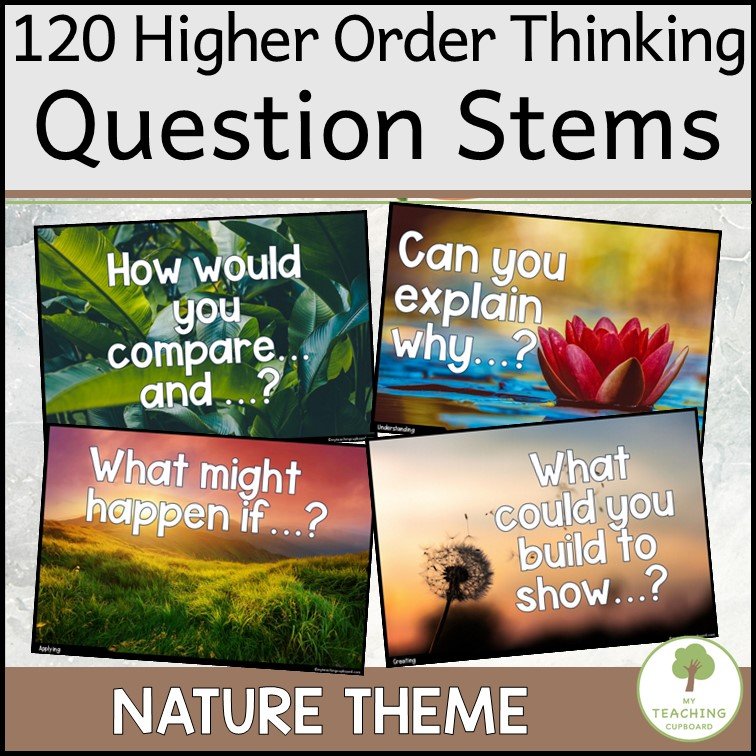
Build deeper thinking across your day with these printable higher order thinking prompts based on Bloom’s Taxonomy - perfect for Kindergarten, Prep, and Foundation teachers using play and inquiry-based learning.
Do your students give surface-level answers when you know they're capable of more? These Higher Order Thinking Prompts will help you ask the right kinds of questions – the ones that get them thinking, talking, and truly understanding.
Spark Deeper Thinking With These Higher Order Thinking Prompts
This comprehensive toolkit makes it easy to bring Bloom’s Taxonomy to life in real-world classrooms - without hours of prep or stress for you! Whether you’re guiding a maths investigation, a STEM challenge, or a group reflection session, you’ll have the perfect question ready to go.
A Time-Saving Way to Add Depth to Learning
This resource helps you move beyond “what happened?” to “why do you think that happened?” and “how could we improve it next time?”
It saves you precious planning time while also helping your students develop:
Deeper understanding across literacy, maths, and science
Richer language for sharing and justifying their ideas
Confidence to think creatively and reflect independently
Stronger reasoning and problem-solving skills
Designed for Real Classrooms and Real Conversations
You won’t find generic question posters here. These beautiful nature-themed prompts were thoughtfully written and classroom-tested during real play-based lessons, reflection times, and provocations.
Each level of Bloom’s Taxonomy is represented, from remembering and understanding to creating and evaluating. Use them flexibly - on display, in planning, or as part of inquiry-based learning.
This Higher Order Thinking Prompts Pack Includes:
120 Higher Order Thinking Posters (nature-themed, A4 size)
120 Printable Prompt Cards (four to a page)
Planning Template for intentional questioning
Teaching Notes with examples for Literacy, Maths & Science
Bloom’s Taxonomy At-a-Glance Poster
Suggested Prompts for Reflection Time
Observation Checklists for documenting student thinking
Document Wallet Label for organisation
A printable Master List of All the Question Stems
Use These Prompts to Support Deeper Conversations and Curriculum Goals
Perfect for:
Literacy, maths, and science blocks
Investigation areas and provocations
Group reflections and partner tasks
Inquiry learning, STEM, and makerspace challenges
Assessment and documentation during play
These prompts align with both the Australian Curriculum v9 and the Common Core, helping you confidently plan and assess higher order thinking skills.
Make Higher Order Thinking Part of Everyday Learning
Imagine being in the middle of a science provocation and hearing your students ask: “What would happen if we changed just one material?” That’s the power of intentional questioning - and it all starts with you.
With this set of higher order thinking prompts, you'll feel ready to guide meaningful learning through every subject, lesson, and play invitation.
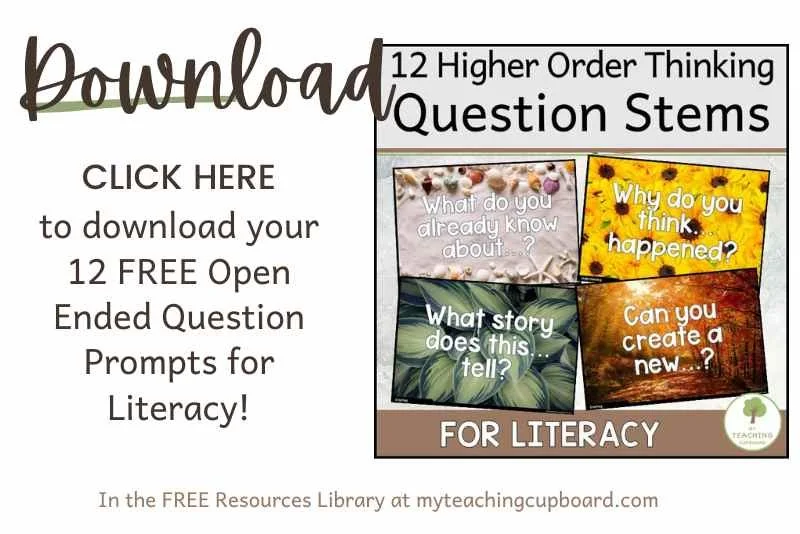
Get a Free Download Sample: 12 Open-Ended Question Prompts for Reading
👉 Take a look at my free resources library - there are over 70 freebies you can use in your classroom. If you're ready to try open-ended questions in your classroom but don’t want the full set yet, you can download a free set of 12 Open-Ended Question Prompts for Literacy from the library - print and use them tomorrow.
They’re perfect for:
guided reading
whole-class story time
literacy rotations and provocations
Pop them on a ring or keep them beside your chair and you’ll never be stuck for the right question again.