
A Guide to Introducing Yoga in the Classroom
Discover how to easily introduce yoga in the classroom - even if you're a beginner! Learn the benefits of yoga for kids, get time-saving tips, and explore my ready-to-use classroom yoga resources to support mindfulness, focus, and self-regulation in your early years classroom.
It’s the middle of the school day, and your students are getting restless. They’re fidgeting on the carpet, calling out instead of raising their hands, and struggling to focus on the lesson. You’ve tried brain breaks and movement activities, but they don’t seem to settle the kids down for long.
What if there was a simple, effective way to help your students reset, refocus, and regulate their emotions - all while promoting healthy habits?
That’s where yoga in the classroom comes in.
Yoga is a powerful tool that supports young children’s physical health, emotional intelligence, and social skills.
It gives students an opportunity to pause, breathe, and move with intention, creating a supportive learning environment that helps them navigate big feelings and the demands of the school day.
Adding yoga to your classroom routine doesn’t have to be overwhelming. Whether you’re a seasoned kids yoga teacher or an absolute beginner, you can introduce simple yoga poses, breathing exercises, and mindfulness activities that easily fit into your daily schedule.
We all have time constraints in our busy classrooms, but yoga aligns beautifully with early childhood learning goals. It supports
academic performance
self-regulation skills
and social-emotional development.
In this blog post, I’ll walk you through a practical, step-by-step guide to implementing yoga in your kindergarten classroom.
You’ll learn how to set up your own inviting classroom yoga area, introduce fun and engaging yoga sequences, and weave yoga into transition times and daily routines so you don’t have to worry about trying to fit it into your busy schedule.
By the end, you’ll feel confident about introducing and practising yoga in the classroom and your students will have the tools they need to be calm and focused. And if you’ve never practised yoga before, don’t worry – I’ve got something to help you!

Why Yoga is Beneficial for Kindergarten Classrooms
As teachers, we’re always looking for a great way to help our young children focus, self-regulate, and engage in purposeful learning. Yoga is one of those powerful tools that so easily integrates into an early years classroom, you’ll wonder why you haven’t used it sooner.
The benefits of yoga extend way beyond the yoga mat. Whether you’re a kids yoga teacher or a classroom teacher new to yoga, these benefits make it worth incorporating into your daily routines.
Cognitive Benefits
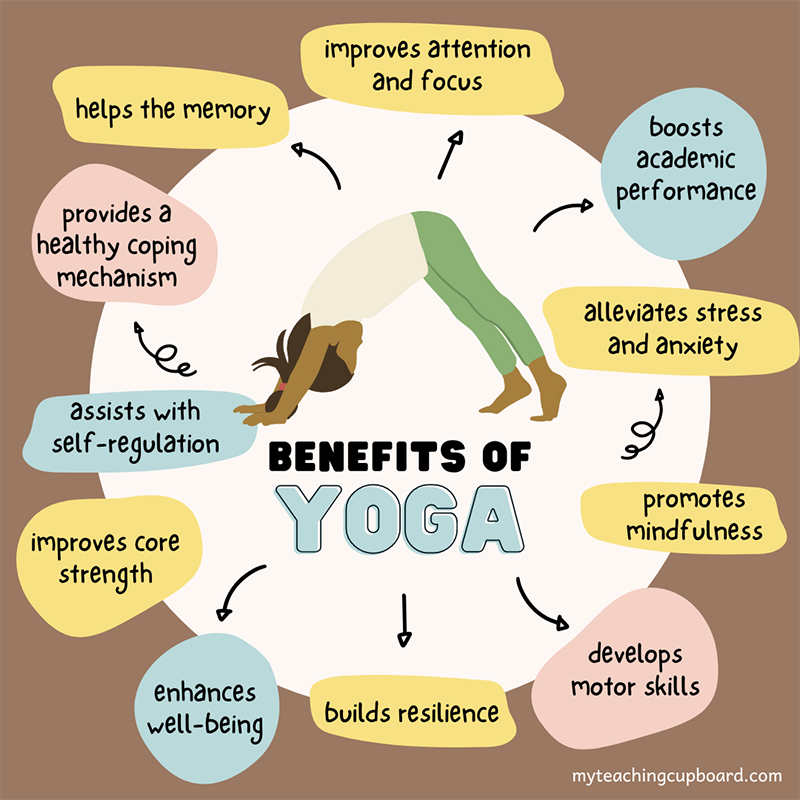
Yoga is a practice that enhances problem-solving, learning readiness, and academic success. Through breathing exercises, mindful movement, and relaxation, your students will develop stronger focus and memory skills, making it easier for them to engage with new concepts and lessons.
Research has shown that yoga can support academic performance by improving attention span and reducing distractions, which is especially valuable during structured learning times.
Physical Benefits
From mountain pose to tree pose, yoga helps build physical movement awareness, strength, and flexibility in a safe place where children can explore their bodies.
It promotes healthy habits and body control, helping young children develop essential gross motor skills needed for balance, coordination, and endurance.
A well-structured yoga sequence ensures that movement is engaging and appropriate for this age group.
Emotional & Social Benefits
Yoga plays a huge role in building self-regulation skills and supporting emotional intelligence in my classroom.
By practising mindfulness activities and breathing exercises, children learn to manage their own anxiety, frustration, and excitement, leading to stress relief and improved classroom behaviour.
It also fosters a sense of community, as students learn to move together, listen to each other, and respect personal space.
Yoga also encourages positive social skills, such as taking turns, being kind, and supporting one another.
In large groups of kids, structured yoga lessons help create a supportive environment where everyone feels included.
Research and Evidence
Studies in educational settings, including public schools and even high school, have shown that yoga helps reduce stress, improve mental well-being, and create a positive way to approach learning.
Research has also linked yoga to improvements in classroom routine and behaviour, particularly when incorporated into transition times or used as brain breaks.
In short, adding yoga to your classroom is not only a fun activity, but it’s one that is research-backed. A strategy for fostering happier, healthier, and more engaged students. And we all want that!
Want to explore the research? Check out my blog post: 11 Amazing Yoga Benefits for Children
How to Introduce Yoga in a Kindergarten Classroom
Bringing yoga into your classroom doesn’t have to be complicated!
With a few simple strategies and my ready-to-use resources, you can start implementing yoga in the classroom - even if you’re an absolute beginner!
1. Choose Age-Appropriate Poses
When introducing yoga to young children, it is a good idea to start with simple and engaging poses that encourage movement, balance, and relaxation.
Some great beginner-friendly poses include:
Downward Dog – Builds strength and flexibility while being fun for kids.
Cobra Pose – Encourages gentle stretching and deep breathing.
Mountain Pose – A great way to teach stability and body awareness.
Standing Pose – Helps develop concentration and balance in a playful way.
Want a FREE resource to help your students learn these poses?
Grab my FREE "Let's Do Yoga" Printable It covers all these poses and more! Perfect for introducing yoga with clear visuals and simple instructions.
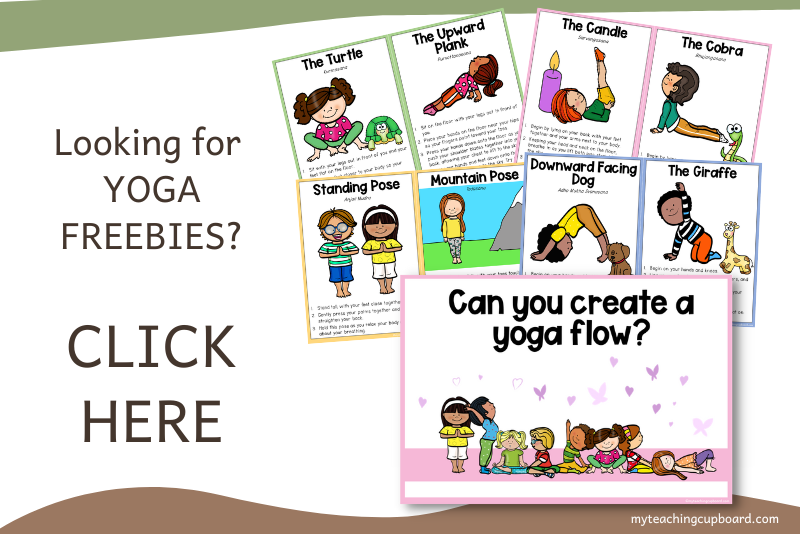
For even more structured support, check out my 70 Illustrated Yoga Pose Cards and BONUS Yoga Flow Posters. These illustrated yoga cards and yoga flow posters are ideal for teachers who want to bring yoga into their classroom.

Do you want to engage and calm your students while promoting physical fitness and mindfulness?
Then these 70 Illustrated Yoga Cards and Yoga Flow Posters are just what you need!
Designed specifically for the early years classroom, these yoga cards feature fun, age-appropriate illustrations of yoga poses that will help your students improve their balance, coordination, and concentration.
Each card includes clear, simple instructions and child-friendly illustrations that are easy for young children to follow.
They are perfect for teachers who want to incorporate yoga into their classroom routine but don't have a lot of experience with yoga themselves. The clear illustrations and easy-to-follow instructions make it easy to teach yoga even if you're not a yoga expert!
THIS SET CONTAINS:
70 illustrated yoga cards. Each card is A5 size and organised according to the types of positions. They are colour coded. (22 standing poses = yellow cards, 18 kneeling poses = blue cards, 16 sitting poses = green cards and 14 laying down poses = pink cards)
4 blank A4 sized yoga flow posters - also colour coded.
8 short 5-step illustrated yoga flow posters in A4 size.
SAVE MONEY AND GRAB ALL MY YOGA RESOURCES HERE AT A 30% DISCOUNT
In addition to promoting physical health, yoga can also help reduce stress and anxiety in young children. Incorporating yoga into your classroom routine can help your students feel calmer and more focused, making it easier for them to learn and focus in class activities.
Research suggests Yoga in the classroom …
improves student attention and focus.
helps with the memory and retention.
boosts academic performance.
alleviates stress and anxiety.
builds resilience.
provides a healthy coping mechanism.
improves core strength and motor skills.
assists with self-regulation.
promotes mindfulness.
enhances overall well-being.
These illustrated yoga cards are also a great tool for teachers who are looking for ways to incorporate movement breaks into their daily routine. The easy-to-follow instructions and illustrated poses will help your students quickly and easily master basic yoga poses. They are perfect for short breaks between lessons or as transitions too.
HOW TO USE THESE CARDS IN YOUR CLASSROOM:
To help set up a designated Yoga Investigation area.
Use them in your calm down space.
As movement and brain breaks.
To transition between lessons.
Circle time activity.
As a homework activity.
In outdoor play.
Give your students the gift of yoga!
If you like this resource, you might be interested in my other classroom yoga resources.
This set contains:
70 illustrated yoga cards (colour-coded positions: standing, kneeling, sitting, lying down).
4 blank A4 flow posters to easily create your own yoga sequences.
8 pre-made 5-step yoga flow posters to guide structured yoga sessions.
These yoga cards and posters make it easy to teach yoga in a fun and stress-free way!
2. Create a Calm and Peaceful Environment
To get the most out of yoga, create a safe and inviting space where your students can relax and focus. You don’t need a dedicated yoga room though.
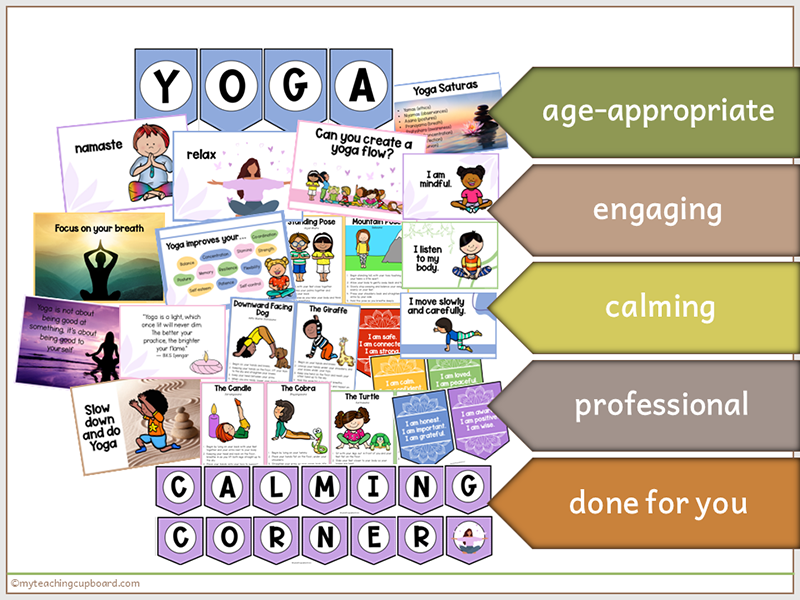
Set up a Yoga or Calm Down Corner – Use my Classroom Yoga Investigation Area Printables to create a calm corner or yoga area.
Transform a small classroom space into a peaceful retreat for self-regulation and mindfulness.

Set up a Yoga Investigation Area in your classroom and transform it into a peaceful space where children will learn to self-regulate and calm down. This beautiful classroom yoga pack includes everything you need to create a calming and inviting Classroom Yoga Investigation Area. A space for your students to practice yoga and mindfulness.
Included in this pack are printable posters and signs to help guide your students through their yoga practice, including basic poses and breathing exercises.
But that's not all! I’ve also included pastel-coloured and calming visuals to decorate your yoga corner, including bunting, banners, and inspirational quotes to inspire and motivate your students.
THIS SET CONTAINS:
A Large Yoga flag banner
12 peaceful Yoga Provocation posters
8 easy-to-follow Illustrated cards for Yoga Poses
6 Affirmation Meditation Flags
Small banners for a Calming Corner or Calm Down Corner
Ready to create a mindful yoga area in your classroom?
With these resources, you can provide your students with the tools they need to enhance their physical and mental well-being.
Research suggests when students practice Yoga in the classroom, they …
improve their attention and focus.
heighten their memory and retention.
boost their academic performance.
alleviate stress and anxiety.
build healthy coping strategies.
develop their resilience.
improve their core strength and motor skills.
build self-regulation strategies.
learn to be mindful.
enhance their overall well-being.
Your students will have everything they need to incorporate yoga and mindfulness into their daily routines. A peaceful space to relax, recharge and refocus and start reaping all the benefits yoga can bring.
If you like this resource, you might be interested in my other classroom yoga resources.
SAVE MONEY AND GRAB ALL MY YOGA RESOURCES HERE AT A 30% DISCOUNT
Use soft lighting and music – Dim the lights slightly and play calming music to help your students transition into a relaxed state.
Incorporate deep breathing exercises – Teach balloon breaths or ocean breathing to help students manage big emotions.
Display positive affirmations – My Classroom Yoga Area Printables Pack includes affirmation flags and printable posters to encourage mindfulness, confidence and emotional well-being.
3. Make Yoga Fun & Engaging
Yoga seems to be naturally fun and engaging for young children but if you are having trouble keeping your students interested you might like to try these strategies:
Use Storytelling to Guide Yoga Sequences – Read a book and have your students act out the story using yoga poses. This is a great way to combine literacy and movement.
Try Yoga Games – Play Cosmic Kids Yoga, yoga card games, or a fun "Yoga Freeze" game where students hold a pose when the music stops.
These simple activities make yoga feel like play, and will help your students stay engaged while learning important self-regulation skills.
4. Set Clear Expectations for Students
Just like any classroom activity, yoga works best when students know what to expect. Establish a few simple ground rules to create a safe and respectful practice:
✅ Listen to the teacher – Follow along with instructions.
✅ Respect personal space – Keep hands and feet to yourself.
✅ Use a quiet voice – Yoga is a time for calm, not loud talking.
✅ Stay focused on your own poses – No comparing or distracting others.
✅ Take care of your body – If something feels uncomfortable, it’s okay to modify or rest.
✅ Most importantly—have fun!
Keeping sessions short and structured makes yoga manageable for younger students and more effective for large groups of kids.
5. Integrate Yoga into the Classroom Daily Schedule
One of the biggest challenges kindergarten teachers face is finding time to fit yoga into an already packed day.
The good news?
You don’t need a full yoga lesson. Instead, you can weave yoga naturally into your existing classroom routine.
Morning Mindfulness Routine – Start the school day with a few deep breaths and simple stretches.
Brain Breaks Between Lessons – Use a short yoga sequence to help reset focus when students are feeling restless.
Transition Times – Instead of rushing between activities, use yoga to calm and refocus students before the next task.
Short Breaks Throughout the Day – A few minutes of movement can help students self-regulate and stay engaged.
Yoga Flow Sessions – Lead a structured yoga sequence using my Yoga Flow Posters to promote physical health and stress relief.

By embedding yoga naturally into the day, it becomes a consistent and familiar part of your classroom culture!
With just a few small changes, you can easily bring yoga into your classroom, helping your students develop self-regulation skills, focus, and emotional well-being.
Whether you're using my FREE Yoga Printable or investing in the 70 Fun & Easy Printable Yoga Poses for Kids, you’ll have all the resources you need to get started right away!
Ready to transform your classroom with yoga? Grab your resources here:

Addressing Common Challenges & Teacher Concerns
Many kindergarten teachers love the idea of adding yoga in the classroom, but they worry about time constraints, making yoga meaningful, and ensuring student safety.
Yoga is flexible, adaptable, and doesn’t require a lot of time to make a big impact!
Let’s tackle some common concerns and their practical solutions.
1. “I Don’t Have Time for Yoga in My Schedule”
One of the biggest concerns for teachers is fitting yoga into an already packed day. But yoga doesn’t have to be a separate lesson. It can be woven into daily routines in short, focused bursts.
Just 5-10 minutes of yoga can help students refocus and reset. Try:
Morning mindfulness – A quick breathing exercise to start the school day.
Brain breaks – Use a simple yoga pose between activities to re-energize students.
Transition times – A short yoga flow before switching subjects keeps students engaged.
Good News! You don’t need to teach yoga from scratch. My 70 Fun & Easy Printable Yoga Poses for Kids gives you ready-to-use pose cards and yoga flows that you can use with no prep!
2. “How Can I Make Yoga Meaningful?”
Yoga can reinforce academic concepts and build essential social-emotional skills.
Literacy & Storytelling – Connect yoga to books and storytelling. Read a kids’ yoga story and have your students act out the poses.
Math & Counting – Try counting breaths or using yoga for shape recognition (eg. making “triangle” poses with their bodies).
Social-Emotional Learning (SEL) – Teach students about mindfulness, self-regulation, and positive affirmations with my Calm Down Corner Resources.
Multitasking Activities – Combine movement, learning, and mindfulness to maximise student engagement.
3. “Will My Administrators & Parents Support Yoga?”
Some teachers worry about getting approval for yoga in the classroom. Here’s how to gain support from your administrators and parents:
Highlight the Benefits – Share research on how yoga improves focus, academic success, and emotional well-being.
Tie Yoga to Curriculum Goals – Connect yoga to social-emotional learning (SEL), physical education, and mindfulness practices.
Communicate with Parents – Send a letter home explaining how yoga supports self-regulation and stress relief in a positive way.
Showcase Success Stories – Share student progress and engagement with parents and school staff.
When presented as a learning tool instead of just a fun activity, yoga becomes an easy addition to any classroom setting.
4. “How Do I Keep Yoga Safe?”
Safety is key when practising yoga with younger students and large groups of kids.
Teach Proper Form – Use visual cues like yoga cards or posters so students can see and copy safe poses.
Provide Modifications – Let students adjust poses to match their comfort level.
Encourage Listening to Their Bodies – Remind children that yoga should never hurt and that they can opt out of any pose.
Focus on Mindfulness – Emphasize breathing, relaxation, and self-awareness over perfection.
My Calm Down Corner Resources include illustrated yoga pose cards and mindfulness posters to help students practice safely and effectively!
5. Setting Clear Expectations for Students
For yoga in the classroom to be successful, your students will need clear guidelines on how to participate. Before starting, establish and stick to these simple rules:
Listen to the teacher – Follow along with instructions.
Respect personal space – Keep hands and feet to yourself.
Use a quiet voice – Yoga is a time for calm and focus.
Stay focused on your own poses – No comparing or distracting others.
Modify poses if needed – Yoga should feel good, not uncomfortable.
Have fun! – There’s no absolute “right” or “wrong” way to do yoga.
Making Yoga Work for You & Your Students
You don’t need to be a yoga expert - just start small and keep it simple.
Implement short yoga sessions (5-10 minutes) are enough to make a difference.
Use visual resources like my Yoga Pose Cards & Posters.
Make yoga fun with stories, games, and movement activities.
Get support from administrators and parents by highlighting yoga’s learning benefits.
With the right approach, yoga can become a stress-free and effective tool that benefits both you and your students!
How to Introduce Classroom Yoga to Your Students – A Step-by-Step Lesson
Introducing yoga in your classroom doesn’t have to be overwhelming.
In fact, with my Introduction to Yoga PowerPoint Lesson, you’ll have everything you need to confidently guide your students through a structured and engaging yoga practice - even if you’re brand new to teaching yoga!
This ready-to-use PowerPoint lesson takes the guesswork out of teaching yoga, providing clear visuals, simple instructions, and a step-by-step routine that makes yoga accessible and enjoyable for both teachers and students.

This Introduction to Yoga PowerPoint presentation is the perfect resource for teaching the basics of yoga to your students. When you introduce yoga to your students with this easy-to-follow Powerpoint lesson, you’ll discover the transformational benefits yoga can have in your classroom.
With clear, easy-to-follow slides, this presentation covers everything from the history of yoga to the physical and mental benefits of regular yoga practice.
Your students will learn how to perform basic yoga poses, improve their flexibility and balance, and reduce stress and anxiety.
THIS 43-SLIDE PRESENTATION INCLUDES:
An introduction to the history and philosophy of yoga.
An overview of the physical and mental benefits of yoga
The 3 main parts of Yoga – breathing, poses & mindfulness.
A description of Yoga Asanas with examples.
An introduction and explanation of Yoga Flows.
Detailed instructions and visuals for performing 8 basic yoga poses.
This presentation is perfect for use in physical education classes, wellness programs, or as a stand-alone lesson on health and fitness. It's also a great resource if you are looking to incorporate mindfulness and stress reduction or self-regulation techniques into your classrooms.
SAVE MONEY AND GRAB ALL MY YOGA RESOURCES HERE AT A 30% DISCOUNT
WHY TEACH YOGA IN THE CLASSROOM?
Yoga can
improve attention and focus
help the memory
boost academic performance
alleviate stress and anxiety
build resilience
provide a healthy coping mechanism
improve core strength
develop motor skills
assist with self-regulation
promote mindfulness
enhance well-being
I created this Yoga PowerPoint Lesson because I wanted to create a calmer classroom and give my students strategies to help them with their self-regulation. Yoga became a valuable calm-down tool we could use after lunch breaks and whenever the classroom energy was running too high.
If you are feeling stressed and overwhelmed like I was, yoga practice may be just what you need in your classroom too.
By improving your student’s flexibility and core strength, as well as calming their minds, yoga can help them feel more centered and focused. With yoga, students can learn to stay present and in the moment, tune out distractions, and improve their concentration.
Create a calm, mindful classroom by downloading this presentation and easily introduce the transformative power of yoga to your students!
If you like this resource, you might be interested in my other classroom yoga resources.
Let’s take a look at how you can implement a simple classroom yoga routine using this interactive and visually engaging resource:
1. Introduce Yoga
Start your lesson by introducing what yoga is, where it comes from, and why it’s beneficial.
Discuss the
Origins of Yoga – Teach students that yoga originated in India and is an ancient practice that connects the mind and body.
Sanskrit & Asanas – Introduce students to Sanskrit, the language of yoga, and the meaning behind common asanas (poses).
Mindfulness & Tradition – Explain how yoga promotes inner calm and focus, and introduce the significance of the classic Buddha statue as a symbol of peace and mindfulness.
With my PowerPoint Lesson, your students will get clear, engaging visuals that make these concepts easy to understand and relate to!

2. Practise Breathing Exercises
Before jumping straight into yoga poses and movement, start with breathing exercises to help your students settle their minds and prepare their bodies for yoga.
Start with:
Deep Belly Breathing – Guide students to place one hand on their belly and take slow, deep breaths.
Balloon Breaths – A fun way to introduce breath control, imagining they are inflating a balloon with each inhale and deflating it with each exhale.
Why Breathing Matters – Teach your students how breathwork reduces stress, improves focus, and supports mental well-being.
My PowerPoint Lesson provides step-by-step breathing exercises, making it easy for teachers to follow along and demonstrate these techniques in a fun and accessible way.
3. Learn Correct Stretching & Warm-Ups
Once your students are focused, guide them through some gentle movements to warm up their bodies. Try:
Neck & Shoulder Rolls – Loosens tension and encourages relaxation.
Side Stretches & Forward Bends – Prepares students for more active poses.
Mindful Movement – Emphasize listening to the body and moving with intention.
My PowerPoint Lesson has easy-to-follow images so your students can see exactly how to move safely and effectively during stretching and warm-ups.

4. Fun Yoga Poses
Now it is time to introduce your students to a variety of engaging beginner yoga poses. I like to group them by type:
Seated Poses – Cross-legged breathing, butterfly pose.
Kneeling Poses – Child’s pose, cat-cow stretch.
Standing Poses – Mountain pose, warrior poses, tree pose for balance.
Lying Down Poses – Starfish pose for relaxation.
Teachers love this PowerPoint because it provides colourful, easy-to-follow instructions for each of the eight beginner yoga poses. It makes introducing and teaching yoga simple, even without prior yoga experience!
5. Mindfulness & Relaxation
As your lesson draws to a conclusion, encourage your students to slow down and reflect.
You can use:
Guided Visualisation – Ask students to close their eyes and imagine a peaceful place.
Being Present – Help students develop mindfulness, focus on their breathing and feel calm in the moment.
The PowerPoint includes a structured sequence making it easy for teachers to lead relaxation and yoga activities with confidence!
6. A Yoga Closure Ritual: The Meaning of ‘Namaste’
Wrap up the session with a traditional yoga closing reflection:
Teach the Meaning of ‘Namaste’ – Explain how this traditional greeting represents respect and kindness.
Self-Reflection – Ask students to think about how they feel after their yoga session.
Encourage Daily Practice – Let students know that yoga can be practised anytime, anywhere!
My PowerPoint lesson makes it easy to close your introductory session with purpose, reinforcing the benefits of mindfulness and self-care.

The Easy Way to Bring Yoga into the Classroom
Bringing yoga into your classroom can transform student behaviour, focus, and emotional well-being.
Whether you use it for brain breaks, transitions, or full mindfulness sessions, yoga is an easy and effective way to create a calm, focused, and engaged learning environment.

Why Classroom Teachers Love My PowerPoint Yoga Lesson
If you’re new to teaching yoga or just want a structured, easy-to-follow approach, my Introduction to Yoga PowerPoint Lesson is the perfect solution!
🔹 No prior yoga experience needed! This resource guides you through every step with clear instructions and visuals.
🔹 Perfect for whole-class instruction! Display it on your interactive whiteboard or print it for small group activities.
🔹 Aligned with classroom needs! Supports self-regulation, mindfulness, and physical health in an age-appropriate way.
🔹 Engaging and interactive! Uses movement and relaxation to keep students engaged.
Teachers love this resource because it makes implementing yoga EASY and EFFECTIVE!
Get Started Today!
Get your Introduction to Yoga PowerPoint Lesson and start teaching yoga with confidence!

Yoga is one of the most powerful tools you can use to support student well-being and focus. With the right resources, you can make yoga a natural and valuable part of your classroom routine!