
The Rotation Schema
The rotation schema is one of the nine play schemas you will observe in young children. When young children explore and interact with the world around them, they naturally engage in play schemas that help them develop essential cognitive, social, and emotional skills.
If you notice your little ones spinning, twirling, and turning objects or themselves, they will no doubt be exploring the rotation play schema. This type of play can be observed in children as young as eight months old and will continue into the early childhood classroom.
This blog post explores the rotation play schema in detail and gives you 46 engaging activities you can use to support this play schema in your classroom.
What Are Play Schemas?
Play schemas are repeated patterns of behaviour that children do when they play. There are nine play schemas commonly observed in young children.
The Connecting Play Schema
Transforming Schema
Orientation Schema
Trajectory Play Schema
Rotation Schema
Enveloping Schema
Enclosing Play Schema
Positioning Schema
Transporting Play Schema
When we talk about schema play, we are referring to observable repeated play patterns evident when a child plays and explores learning resources or their environment. It isn’t a specific type of play like dramatic play or sensory play. You will observe play schemas happening in all areas of your classroom.
For example, you might notice a child exploring the rotation play schema at block play when they experiment with ways the blocks can roll or spin. You might also see this same child mark-making in a circular motion at the writing table.
While these may seem like different forms of play in very different scenarios, overall, the play schema remains the same.
Once you’ve observed a child displaying a specific play schema, you will often notice them repeating that same action schematically using various objects or even their own bodies.
If you want to learn more about the nine play schemas, you might like to check out my Guide to Play Schemas in Early Childhood Education.

This comprehensive blog post is about the nine play schemas and how you can use them to effectively teach the children in your class.
Why Are Play Schemas Important in a Play-Based Classroom?
Jean Piaget introduced the theory of play schemas over 50 years ago. In recent years, other researchers like Chris Athey, Tina Bruce, and Cathy Nutbrown have explored play schemas and their importance in modern early childhood education.
The more recent research around brain development supports the idea that early childhood teachers need to understand play schemas and use their knowledge and observations of play schemas to deliver age-appropriate and purposeful learning experiences.
Play schemas are the building blocks to all future learning, so understanding them and being able to support them is critical to the success of your early childhood classroom. When you know the play schemas your students are developing, you will:
Understand your students and their developmental needs.
Deepen your understanding of how children learn.
Be able to tap into your student’s interests.
Increase engagement.
Know how to encourage your students to be more curious.
Extend the learning and the intensity of your student’s play.
Make the right observations to inform your planning.
Be able to quickly differentiate the learning experiences you offer.
Being able to recognise and use play schemas is crucial to the success of any play-based classroom.
When you understand play schemas, you can use this knowledge to help you make informed observations. You’ll be able to document what and why the children are demonstrating certain behaviours during investigative playtime.
Understanding play schemas will also help you gain insights into your children’s passions and interests.
You will be armed with the necessary information to adapt the curriculum and plan for appropriate, engaging, and purposeful learning experiences.
Understanding play schemas can also help you understand what can sometimes be seen as undesirable classroom behaviours. For example, you might have a child constantly spinning themselves or objects in the dramatic play area. This behaviour might be seen as undesirable as it would be pretty annoying for you and all the other children trying to play there. When you understand that this behaviour comes from a child exploring the rotation schema, you can set up a learning invitation to accommodate this schema and turn the undesirable behaviour into a desirable one.
When you understand why certain behaviours happen, you realise children do not simply misbehave. There’s always a reason for desirable and undesirable behaviours; sometimes, play schemas can be that reason.
What is The Rotation Schema?
The rotation play schema is closely related to the trajectory schema. Both of these play schemas are about how things move.
Children will often be interested in multiple play schemas at any one time. This combination is often referred to as a schema cluster or the co-ordination of a set of schemas. It is common for early childhood students to be interested in the trajectory and rotation schemas simultaneously.
While young children can sometimes be observed paying attention to a particular schema, older children’s learning involves co-ordination of schemas. Co-ordination and connection mark significant progression in learning at all stages where combinations and co-ordinations of schemas develop into higher-order concepts. Cathy Nutbrown
The trajectory schema concerns direction, force and motion, and cause and effect. Children exploring the trajectory schema are attracted to observing and creating movement and being moved and moving their own bodies. They are fascinated by how things move horizontally, vertically, or diagonally, and they like to investigate what happens when objects are thrown or pushed.
The rotation schema is focused on movement too, but it is more about children exploring how objects or their bodies turn, spin, or rotate. Children interested in the rotation schema will also love to explore circles and curved lines.

Often children exploring the rotation schema will be those rotating objects or themselves. You might see them
playing at the taps turning them on and off.
rolling themselves around on the floor.
interested in things that spin, twist, or turn.
spinning around in circles to make themselves dizzy.
winding and unwinding string.
chasing hoops around the playground.
twisting up the swings, so they spin around.
The rotational play schema is at the core of these popular childhood behaviours.
Young children developing this play schema often ask questions about the function of turning and twisting tools and machines. They will be interested in how geared objects work and will benefit from tinkering learning invitations where they can pull apart and re-assemble simple machines.
The rotation schema is a play schema commonly observed in the early years classroom. It can be supported through so many different play-based learning invitations.
Read on to discover some tried and tested rotation schema activities you can use to support children interested in rotation.
What are Children Learning?
When children explore the rotation play schema, they are learning about how objects and themselves move and developing an understanding of cause-and-effect relationships.
These inquisitive learners will notice how force and motion affects objects and even how objects look different and feel different in their hands when they are spinning or being rotated.
Children developing the rotation schema are also developing their fine and gross motor skills. They fine-tune their visual tracking skills and grow in their body awareness too. These children will also be working on scientific skills like observing and predicting.
As children mature and develop their rotation schema further, you might notice them beginning to explore their spatial awareness and extending their positional language.
They become interested in shapes like circles and ovals. They use their understandings of curved lines to explore open and closed shapes, position and location, and paths.

These children will also start to record their thinking through mark-making and drawing. You will notice them making rotational marks in the form of circles, ovals, and round scribbles.
As their understandings mature, children will begin to understand the infinity inherent in circles. They will start to build concepts needed to understand everything from rotational symmetry in mathematics to rotating magnetic fields in high school physics.
Their developing understandings of the rotation play schema will assist them in performing dance moves at the school disco and playing circle games like pass the parcel at a birthday party.
What Vocabulary Supports the Rotation Schema?
Fly, spin, twirl, twist
Round, circle, oval, curved, spiral
Faster, dizzy
46 Rotation Schema Activities for a Play-Based Classroom
3 Block Play Activities for the Rotation Schema
Add toy vehicles with wheels to your block play area. Think about toy cars, trucks, and trains. You will be able to recognise the children interested in the rotation play schema because they are the ones…
lying down at the level of the wheels so they can see them turning.
experimenting with rolling the vehicles over different surfaces.
making ramps for the vehicles to roll down.
spinning the wheels with their hands, just to watch them spin!
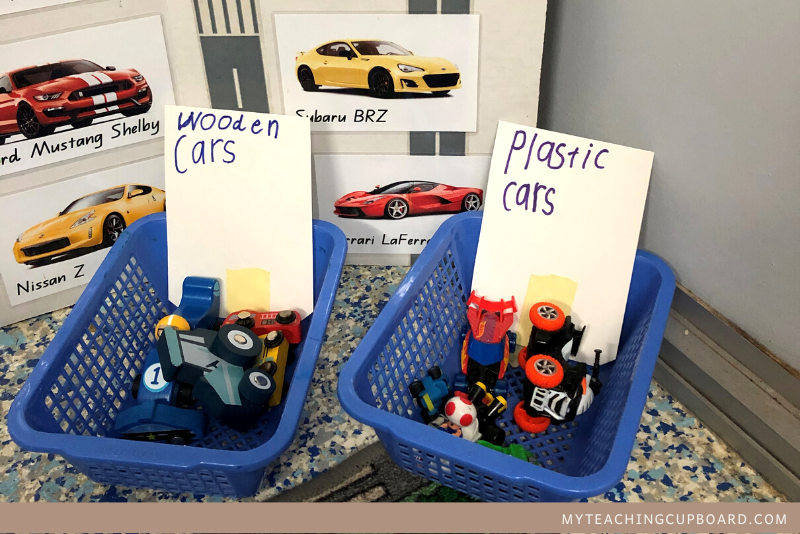
2. Add ramps to encourage children to investigate rolling objects. Ramps can be made from wooden planks, sturdy cardboard, plastic guttering, large cardboard tubes, or pool noodles cut in half lengthwise.
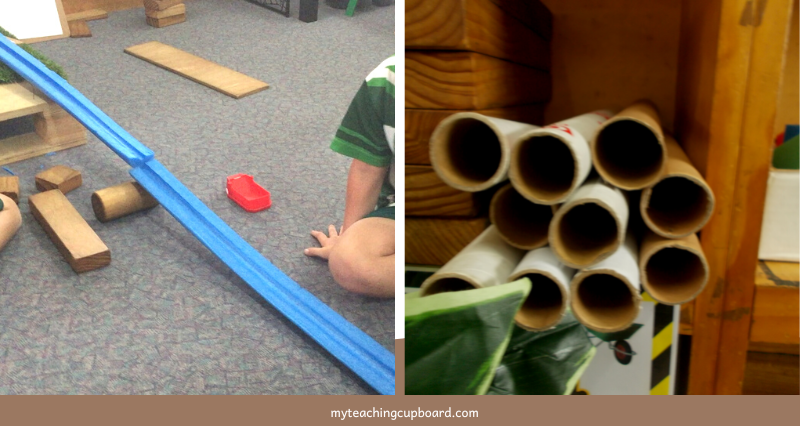
3. Add round and rolling loose parts. Things like small balls, 3D wooden shapes like cylinders & spheres, cotton reels, corks, marbles, and cardboard tubes.
3 Rotation Schema Ideas for Dramatic Play
Add bandages to a doctor or vets dramatic play setup. Children with a rotating play schema love wrapping things around objects, so they will enjoy putting bandages on toy animals and dolls. You can see how to make some easy play bandages here: DIY Play Bandages.
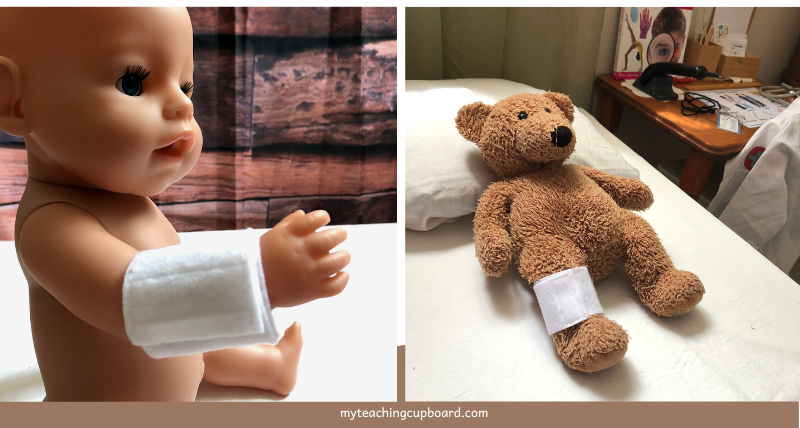
2. Add bangles and bracelets to your dress-ups.
3. Add rolling props like prams and strollers to a home corner dramatic play area or small shopping carts to a little grocery store.
5 Ideas for Supporting the Rotation Schema at the Tinkering Table
Construction toy sets like mobilo, constructa-straws, gear sets, or duplo contain rotating parts children exploring their rotation schema will enjoy investigating and building with.
Keep the rotating schema in mind when choosing items for children to dismantle at your tinkering table. A lot of electrical items have rotating parts that children will enjoy investigating. We have found sewing machines, microwaves, record players, CD, and DVD players are good options.
Add an old pushbike or scooter to your tinkering area. The children developing their rotation play schema can explore the big wheels, cogs, and chains.

4. One of our most popular tinkering activities is this locks and keys setup. The children love the challenge of finding which key unlocks each lock. It’s a great fine motor activity too.
5. Include tools that require twisting and turning. Children with the rotating schema will love to work with spanners, screwdrivers, and hand drills.

These printables will help you setup a beautiful Tinkering area in your classroom.
Tinkering is a valuable learning experience for children. They learn through doing and it teaches children valuable lessons by helping them develop fine motor skills, problem solving abilities and peer relationships.
This Tinkering Display Pack includes:
· a large Tinkering banner sign
· information poster for parents and educators
· 28 vocab cards illustrated with real life images
· safety glasses signs
· under construction signs
· Tinkering word clouds
· 2 illustrated Tinkering quotes
· 12 Tinkering prompt cards
Give your children a hands-on experience where they can explore and invent. Your children will be developing fine motor skills as they manipulate authentic tools and they will develop a trial and error-based process where persistence and resourcefulness are rewarded. Critical and creative thinking are nurtured through their explorations in a Tinkering space too.
These printables will help your children engage in open-ended experiences that allow them to question, design, collaborate, and construct knowledge as they go. Tinkering promotes deep engagement in scientific and engineering practices. It gives the learner an opportunity to take part in multiple cycles of design and discovery.
By using these printables to help you setup a Tinkering space, children will be equipped with lifelong skills that can be used in all areas of learning.
If you want to set up an amazing Tinkering area in your classroom, you will want to check out my Tinkering Display Pack.
This Tinkering Display Pack includes:
a large Tinkering banner sign
information poster for parents and educators
28 vocab cards illustrated with real life images
safety glasses signs
under construction signs
Tinkering word clouds
2 illustrated Tinkering quotes
12 Tinkering prompt cards
Tinkering is a valuable learning experience for children. It isn’t just for children exploring the rotation play schema. Tinkering has benefits for ALL the children in your class. Children learn through doing and tinkering develops fine motor skills, teaches problem solving skills and encourages peer relationships.
Give your children the hands-on experience of tinkering so they can explore and invent as they manipulate authentic tools. Watch them develop a trial-and-error-based process where persistence and resourcefulness are rewarded and critical and creative thinking skills are nurtured.
These printables will help your children engage in open-ended experiences that allow them to question, design, collaborate, and construct knowledge as they go. Tinkering promotes deep engagement in scientific and engineering practices. It gives the learner an opportunity to take part in multiple cycles of design and discovery.
Can you tell how much I love Tinkering? It really is a valuable classroom learning area. Grab these printables HERE if you want to set up a Tinkering space where your students will be equipped with lifelong skills that can be used in all areas of learning.
13 Rotation Schema Activities for the Makerspace and Art Area
The children with a rotation play schema will naturally make spiral or circle patterns in the art area. Just supply a variety of mark-making tools for them to experiment with. Some of our favourites are crayons, chalk, markers, or paint.
2. Adding a salad spinner to the art area will delight any child developing their rotating play schema. Place the salad spinner on a large sheet of paper and drop in some dobs of paint. Then start spinning. Your children will be fascinated with the spattering and spinning paint effects. Don’t limit this rotation tool to just the art area either. You can add salad spinners to a mud kitchen, the dramatic play space, and even to the blocks area. Children exploring the rotation schema will love investigating salad spinners!
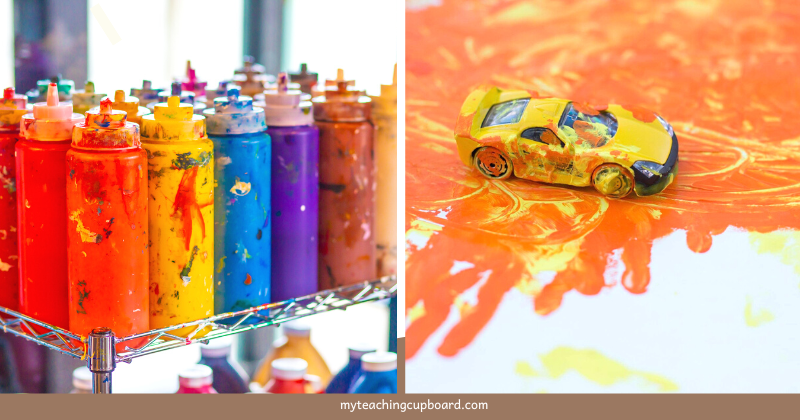
3. Painting with rolling objects like marbles or cars is always a favourite for children developing their rotation play schema. Put some small rolling objects (marbles, ping pong balls, or toy cars) in a tray lined with paper. Add some paint so the children can explore making marks with the rolling objects.
4. Add paint rollers and paint if you want to encourage children to explore the rotation schema in your makerspace or art area. Paint rollers come in all different sizes and textures. They are the perfect rotating tool for this learning area.
5. You can easily make textured rolling pins to add to your painting area. Just wrap a rolling pin in bubble wrap or corrugated cardboard so your children can create paint patterns by rolling it through blobs of paint. Textured rolling pins are also a great addition to your playdough table.
6. Set up a learning invitation for children to make paper helicopters. Paperclip helicopters are always a favourite in our classroom.
7. Another popular learning invitation we often set up when learning about force and motion for the Movement Science Unit is a floating pop stick boat. This simple boat has a rotating paddle. Check out this YouTube clip for some inspiration.
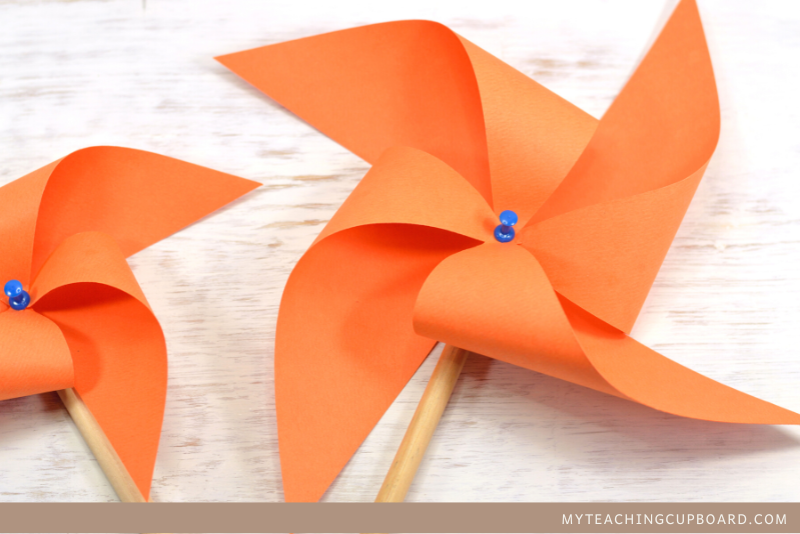
8. Make an engaging learning invitation by inviting children to make simple paper windmills or pinwheels. If you add a bead to hold the pinwheel off the straw, the pinwheel will spin freely. Put the bead on the pushpin between the wood skewer and the paper.
9. Providing cardboard circles, bottlecaps, old CDs, round lids, and split pins for the children to use in your makerspace will have them constructing all manner of rolling toys.
10. This is a fun activity for children exploring the rotation play schema. Tape markers to the backs of toy cars. Your students will have so much fun making marks as they drive them around on large sheets of paper.
11. Children developing the rotation play schema love wrapping objects in string. Invite your students to make some magic wands from sticks collected in the playground. Supply wool, yarn, ribbons, string, or pipe cleaners for the children to wrap around and around and around the sticks. They will love it, and it’s a great fine motor activity too.
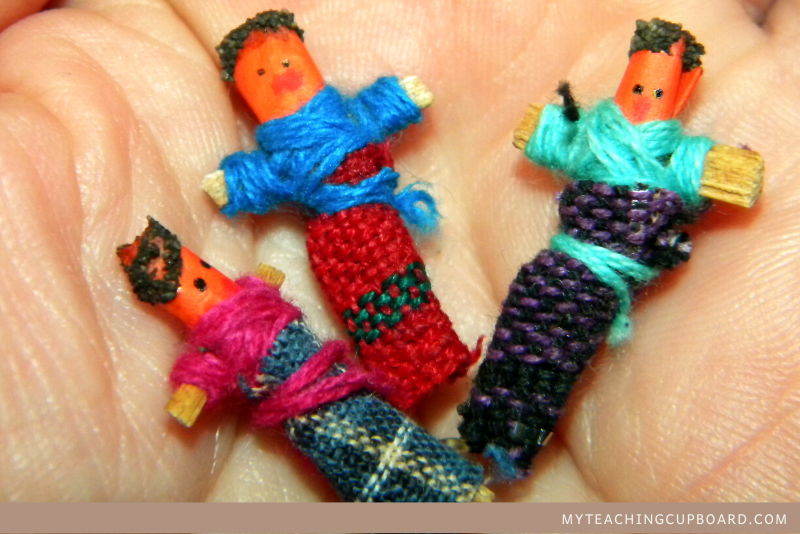
12. Here’s another wrapping activity for the rotation play schema. Make worry dolls by winding yarn around sticks or wooden pegs. Worry dolls are a Guatemalan tradition. Children tell their worries to their dolls and place them under their pillows when they go to bed that night. The tradition has the worry doll taking the child’s worries away while they sleep.
13. Invite children to explore the rotation schema to make their own pompoms. You will be surprised at how engaging this activity is. Your students will develop their fine motor skills and explore their rotation play schema as they wind the wool around a cardboard pompom template. The pompoms can be added to the collage trolley or adorn pencil cases and school bags.

Whether you call it a Makerspace, Collage Area, Box Construction or even the Creation Station, this Makerspace classroom display pack has EVERYTHING you need to set up a hands-on, creative play center in your classroom. If your students love to build things like mine do, give them a well-designed and inviting area to combine boxes and other collage materials into creative projects.
What is a Classroom Makerspace?
A classroom Makerspace is a dedicated creative area where children construct three-dimensional projects using various collage materials. It develops creativity and critical thinking, making it an essential addition to every play based learning preschool, kindergarten, and early years classroom.
Makerspace Learning Resources
These engaging and beautiful resources will make setting up your classroom Makerspace quick and easy.
With the original printables included in this resource, you’ll have a beautiful well-designed creation station set up in your classroom in no time. It will be organised and purposeful.
This Makerspace pack makes for a simple and easy-to-set-up learning area your students will flock to.
The Makerspace Display Pack Contains:
Makerspace Banner Sign.
Comprehensive suggested list of materials for your Makerspace.
EDITABLE letter to send home asking for boxes and other useful recyclables to stock your area.
A large Box construction sign.
Kid’s planning and recording worksheet.
68 illustrated Makerspace vocabulary cards illustrated with photo images. You can print these cards to make a Word Wall or turn them into resource labels to keep your area tidy and organised.
4 EDITABLE Makerspace vocabulary cards in case you want to add extra resources.
Large Work in Progress poster sign.
2 Small Work in Progress signs.
An information poster for parents and visiting educators.
8 inspirational Poster quotes to decorate your space.
16 Makerspace prompt cards for creative STEM projects.
You will instantly receive a .pdf file containing absolutely everything you need to create a stunning and productive Makerspace or Box Construction area for your classroom.
The resources in this pack include detailed real-life photos so your students can easily relate to them.
Why You Need a Classroom Makerspace
If you are keen to cover cross-curricular topics and ensure your children are learning vital higher-order thinking skills like creative thinking and problem-solving, you need a Makerspace in the classroom!
There are numerous benefits for early childhood teachers and their students. Your students will:
Enhance Creative Thinking Skills through open ended artistic explorations.
Develop Critical Thinking Skills through the exploration of materials and the evaluation of their ideas.
Learn Social Skills and Effective Communication Skills through teamwork and the sharing of ideas and resources.
Build Problem-solving Skills and Resilience by tackling construction challenges.
Boost self-esteem and Confidence when projects are successfully completed.
Develop Gross and Fine Motor Skills through hands-on learning activities.
Encourage Sustainability Practices by promoting the recycling and reusing of materials.
Reinforce Literacy and Numeracy Skills by embracing STEAM and STEM education, integrating science, technology, engineering, art, and math concepts naturally.
Easily Differentiate Your Makerspace Learning Center
Makerspaces are versatile and suited to different age groups and abilities. They are successful learning centers in preschool right through to high school. Hey, I even have my very own Makerspace at home – it’s called my craft room!
Check out what other teachers are saying…
5 Star Reviews ⭐️⭐️⭐️⭐️⭐️
“It was great for organising my makerspace and the prompts gave some direction for students, rather than them just sticking a bunch of objects together like they sometimes do. Thanks!“
“This is so visually beautiful! It really fits the themes and has so many useful additions to the package. Kids love it too!”
Whether you call it a Makerspace, Collage Area, Box Construction or even the Creation Station, this pack has EVERYTHING you need to set up a hands-on, play based learning center in your classroom where children can combine boxes and other collage materials together into creative projects.
There are many beneficial learning outcomes for children in the early years education setting if you give them the opportunity to use cardboard boxes and classroom collage supplies to build and create with. The Makerspace is not just for children with the rotation play schema. Every child needs this creative opportunity so they can…
Enhance their Creative Thinking Skills
Learn Social Skills
Build Problem-solving Skills and Resilience
Strengthen their Self-esteem
Develop Gross and Fine Motor Skills
Reinforce Sustainability Practices
Consolidate Literacy and Numeracy Skills
THIS MAKERSPACE PACK CONTAINS:
Makerspace Banner Sign
Comprehensive list of materials for your Makerspace
EDITABLE Letter to send home asking for boxes and other useful recyclables
Large Box construction sign
Planning worksheet
68 illustrated Makerspace vocabulary cards illustrated with photo images—tile print these cards to make a Word Wall and turn them into resource labels to keep your area tidy and organised.
4 EDITABLE Makerspace vocabulary cards
Large Work in Progress Label
2 Small Work in Progress signs
Information Poster for parents and educators
8 inspirational Poster quotes
16 Makerspace prompt cards
Check out ALL the Makerspace printables HERE
5 Sensory Play Ideas for the Rotation Schema
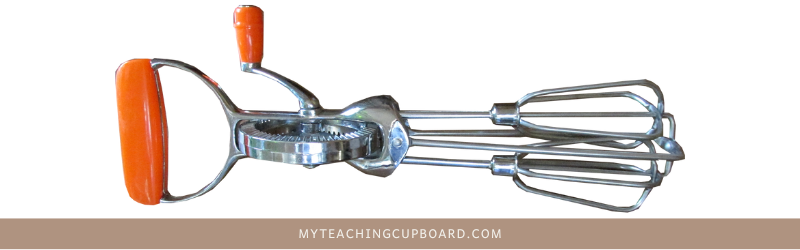
To make frothy, bubbly water, use hand mixers and rotary whisks with detergent or bubble bath mixed with water. Add a few drops of food colouring and essential oils to enhance the sensory aspect. Children exploring the rotation schema love mixing and stirring. The old egg-beater style whisks are great for children with a rotating play schema so if you ever see one at the shops, make sure to grab one!
2. Mixing and stirring with spoons, whisks, and other kitchen utensils can also be an activity for water play, the sand pit, or the mud kitchen. Children with a rotation play schema will learn a lot by investigating different sized bowls and various stirring utensils.
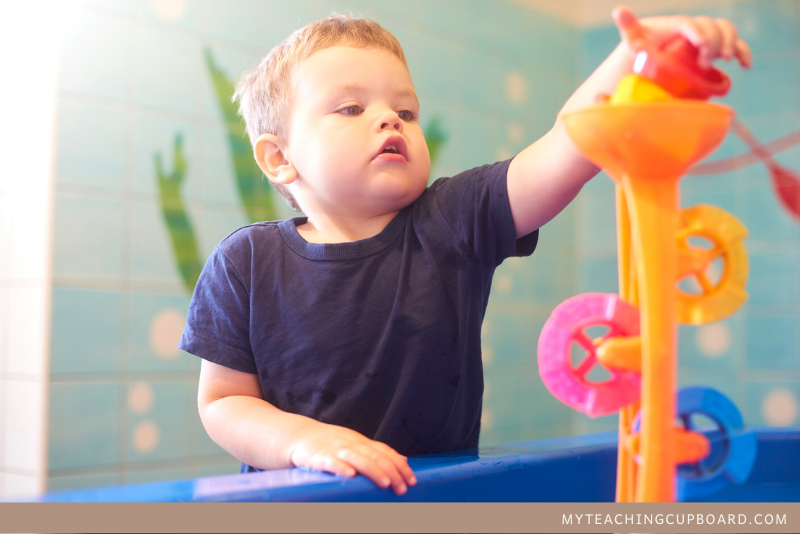
3. Those spinning water and sand wheels will captivate the interest of children with a rotation play schema too. These spinning toys can be added to water or sand trays for young children to explore and learn about cause and effect.
4. Adding rolling pins and pizza cutters to your playdough table is another idea you might like if you want to support those students with a rotation play schema.
5. Add stamping or cutting circle shapes to kinetic sand, clay, or playdough. It’s surprising how many circular items you will find already in your classroom. Think about paper towel rolls, circular lids of all sizes, tree branch cookies, cups, corks, and straws.
4 Activities Using the Rotation Schema to Teach Science
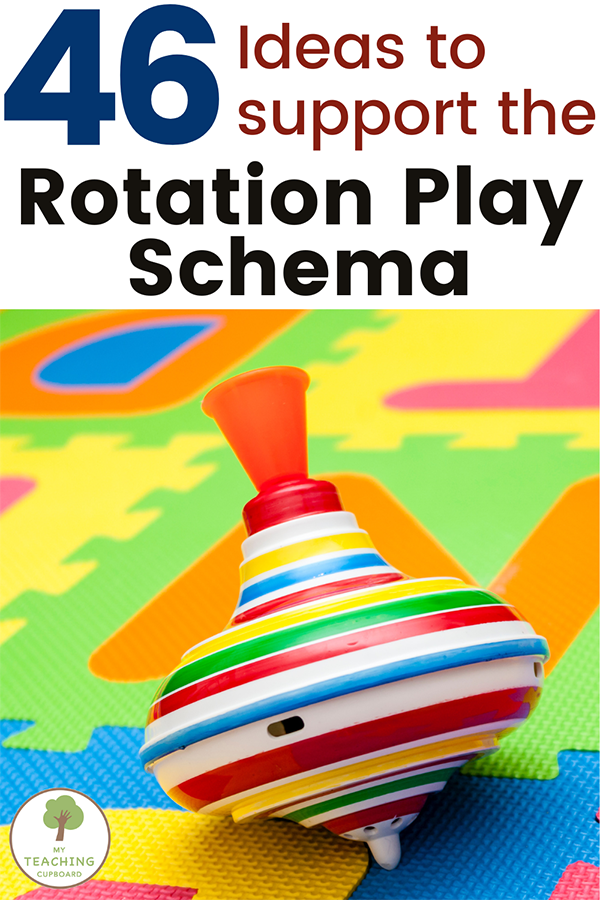
It is common for young children to be interested in how things move. The rotation play schema can be observed in most early years classrooms, and that’s why the physical science units on movement or force and motion are so incredibly engaging. Add wind-up toys, spinning tops, rotating and spinning tools and utensils, and things like music boxes and pulleys to a science inquiry table in your play-based classroom. These items will make excellent additions to a science table where the focus is on machines and toys that move. Items with rotating parts are fascinating to children exploring the rotation schema.
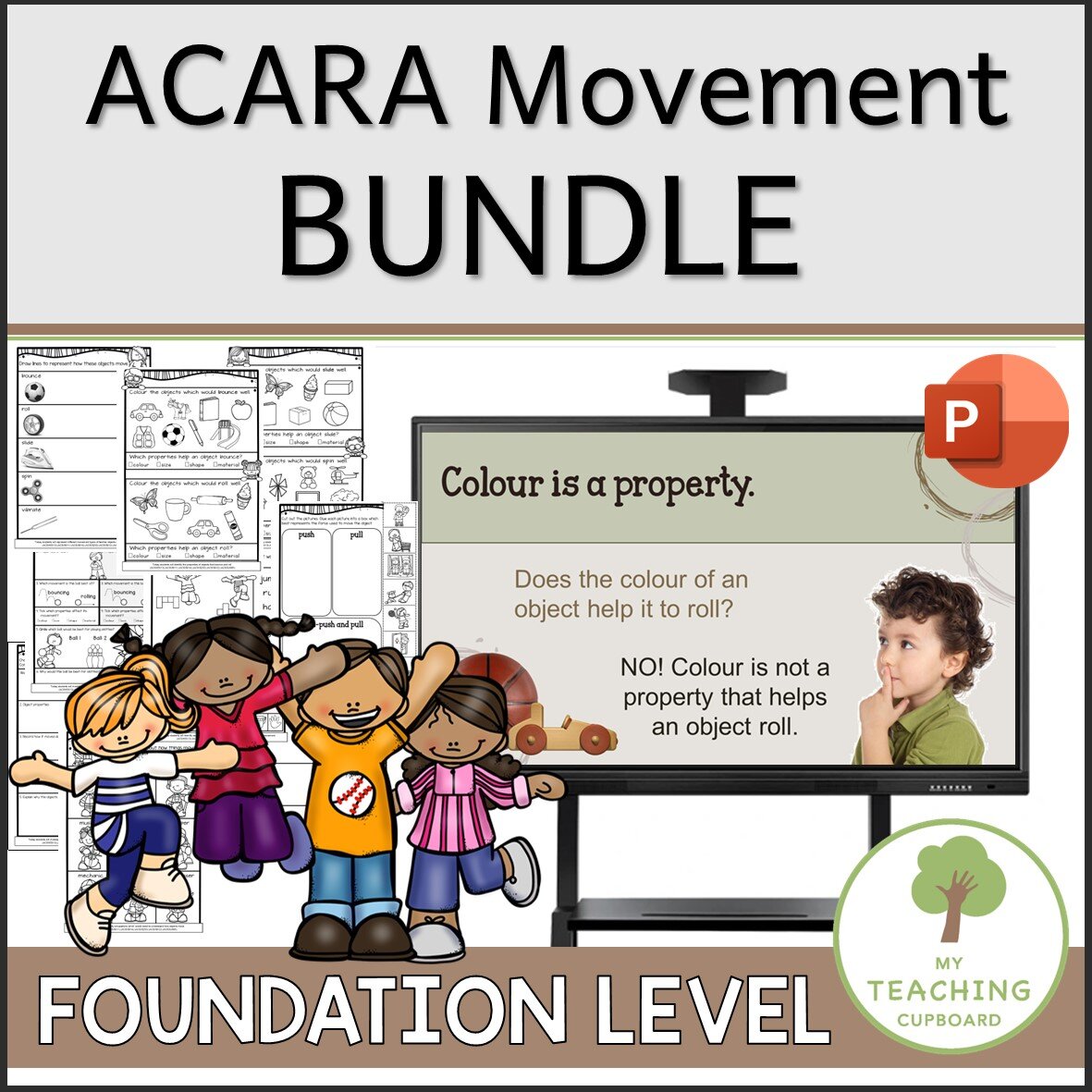
This HOW THINGS MOVE UNIT BUNDLE includes 10 PowerPoint lessons and a corresponding student Science Journal. You will have everything you need to teach the ACARA Version 8 Movement Unit for the Foundation Stage Physical Sciences Curriculum.
The highly engaging lessons and the age appropriate journal activities are carefully aligned to the ACARA Version 8—Foundation Stage. All the content descriptors from the Foundation Physical Sciences strand are covered.
I am currently working on the Version 9 Science units, so I’ve decided to heavily reduce all my Version 8 Science resources. Grab yourself a bargain and check them all out here: ACARA Version 8 Science Resources ON SALE
Each page in the student journal corresponds with each of the 10 PowerPoint lessons. The specific ACARA content descriptors addressed in each activity are listed at the bottom of each journal page.
Students will be able to use the journal to record and represent their knowledge and understandings and it could also be used as evidence of learning and to inform assessment grades.
The professional PowerPoint lessons include quality real life photos and interactive aspects perfect for large screen display and interactive panels. There are animated pictures, links to video clips, interactive slides , experiments and movement music throughout the presentations.
Keep your students highly engaged as they learn all about HOW THINGS MOVE
THIS BUNDLE CONTAINS:
10 PowerPoint Lessons
Lesson 1: Exploring How We Move. Students will observe and describe how our bodies move. (29 slides)
Lesson 2: Exploring How Objects Move. Students will describe the movement of familiar objects and identify factors affecting their movement. (41 slides)
Lesson 3: Exploring How Objects Roll and Bounce. Students will describe the properties of objects that roll and bounce. (33 slides)
Lesson 4: Exploring How Objects Slide and Spin. Students will describe the properties of objects that slide and spin. (30 slides)
Lesson 5: Exploring How Objects Move Down A Ramp. Students will describe, record and discuss how different objects move down a ramp. (39 slides)
Lesson 6: Exploring Movement of Balls. Students will identify, record, describe and compare the properties and movement of balls. (39 slides)
Lesson 7: Exploring Force and Motion of Objects. Students will describe and compare the forces of pulling and pushing. (34 slides)
Lesson 8: Exploring Objects with Multiple Moving Parts. Students will describe and compare objects with more than one moving part. (34 slides)
Lesson 9: Exploring the Movement of Animals and Plants. Students will describe how animals and plants move. (37 slides)
Lesson 10: Reflecting on How the Properties of an Object Influence Movement. Students will apply their understandings of how things move and the properties that influence movement. (39 slides)
Student Science Journal
10 pages of scientific worksheets and activities
printable front cover
I usually compile the pages of the journal into a booklet for the children.
You might like to just select and print individual pages as follow-up or extension lesson activities to accompany the PowerPoint lessons.
Sometimes I enlarge a journal page to A3. After we watch the related PowerPoint lesson, we complete the poster size journal activity together as a whole class. Of course the whole journal could be printed at A3 size and used as a whole class learning journal.
Get your whole term’s Science Curriculum sorted with this MOVEMENT UNIT. There is a PowerPoint Lesson and matching activity/worksheet for each week of a 10 week term.
Grab this HOW THINGS MOVE UNIT BUNDLE and have everything you need to teach the ACARA Movement Unit for the Foundation Stage Physical Sciences Curriculum.
There are 10 highly engaging lessons and a matching student journal with all the lessons and activities carefully aligned to the ACARA—Foundation Stage Physical Sciences strand. ALL the content descriptors are covered.
Rest easy knowing you can confidently teach the science unit and keep your students highly engaged as they learn all about HOW THINGS MOVE. Click HERE if you want a closer look.
2. The Science Weather Unit also has opportunities to harness the students’ interests in movement and rotating objects by investigating spinning and turning weather ornaments like windmills and wind socks. Encourage your children to make some for outside your classroom or to decorate your playground. Children exploring the rotation play schema will not only enjoy making them but will also learn a lot by observing and interacting with them.

This BUNDLE includes 10 PowerPoint lessons and a corresponding student Journal. You will have everything you need to teach the ACARA Version 8 Weather Unit for the Foundation Stage.
The lessons and the journal activities are related and carefully aligned to ACARA Version 8—Foundation Level. All the content descriptors from the Foundation Earth and Space Sciences strand are covered.
I am currently working on the Version 9 Science units, so I’ve decided to heavily reduce all my Version 8 Science resources. Grab yourself a bargain and check them all out here: ACARA Version 8 Science Resources ON SALE
Each page in the student journal corresponds with each of the 10 PowerPoint lessons. The specific ACARA content descriptors addressed in each activity are listed at the bottom of each journal page. Students will be able to use the journal to record and represent their knowledge and understandings and it could also be used as evidence of learning and to inform assessment grades.
The highly engaging PowerPoint lessons include quality real life photos and interactive aspects perfect for large screen display and interactive panels.
Lesson 1: Observing and Recording the Weather. Students will observe and record the weather. (23 slides) Available as a free download sample HERE.
Lesson 2: Changes and Effects of Weather. Students will identify how the weather changes and effects us. (49 slides)
Lesson 3: Exploring Sunny and Windy Weather. Students will recognise the effects of sunshine, wind and temperature.(31 slides)
Lesson 4: Exploring Clouds. Students will recognise cloudy, foggy, rainy and stormy weather. (64 slides)
Lesson 5: Choosing Clothes and Activities. Students will share ideas of how weather affects our choice of clothes and activities. (24 slides)
Lesson 6: Houses and Climates. Students will share ideas of how houses protect us from the weather. (22 slides)
Lesson 7: Weather Effects Animals. Students will share ideas of how animals are effected by the weather. (30 slides)
Lesson 8: Weather Effects Plants. Students will share ideas of how plants are effected by the weather. (33 slides)
Lesson 9: Weather Effects All Living Things. Students will share ideas of how living things are effected by the weather. (28 slides)
Lesson 10: Weather Effects Living Things—Unit Revision. Students will revise the unit and share ideas of how all living things are effected by the weather. (21 slides)
I usually compile the pages of the journal into a booklet for the children.
You might like to just select and print individual pages as follow-up or extension lesson activities to accompany the PowerPoint lessons.
Sometimes I enlarge a journal page to A3. After we watch the related PowerPoint lesson, we complete the poster size journal activity together as a whole class. Of course the whole journal could be printed at A3 size and used as a whole class learning journal.
This WEATHER BUNDLE includes 10 PowerPoint lessons with quality real life photos and interactive aspects perfect for large screen display and interactive panels.
There’s also a corresponding student Journal so you will have everything you need to teach the ACARA Weather Unit for the Foundation Stage Earth and Space Sciences strand.
All the content descriptors from the Foundation strand are covered and listed at the bottom of each journal page. Take the worry out of teaching Science with these high quality lessons and activities. Click HERE if you want a closer look at this educational unit.
3. Adding circular and spiral objects from nature will interest children with the rotation play schema. Consider adding objects like spiral shells, snails, wood cookies, bamboo pieces, helicopter leaves (winged leaves like those on the Rosewood tree), pinecones, acorns, and round pebbles to your classroom nature table.

4. Children with the rotation schema are also fascinated with kaleidoscopes, so if you can get your hands on any, they are well worth grabbing. Add them to your Science interest table to visually delight any children with the rotating play schema.
2 Rotation Schema Ideas to Teach Literacy
Circular mark-making is often observed in children ready to start formal writing. Pre-writers need many experiences exploring the rotation play schema to understand the directionality necessary to form the letters of the alphabet. Beginning writers will make squiggles and circular marks and lots and lots of dots as they explore. Make sure to provide various writing tools and different writing surfaces to encourage children to explore the rotation schema through mark-making.
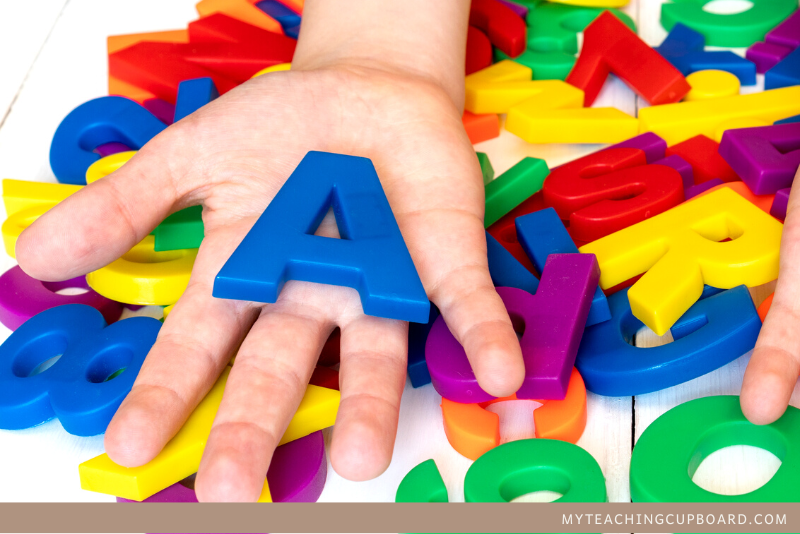
There are many circle literacy games children with the rotation play schema will enjoy. One of our favourites is Pass the Sound. This phonics game is a bit like Pass the Parcel, but you pass around a letter instead of the parcel. Play music as you pass a letter card or magnetic letter around the circle. When the music stops, whoever is holding the letter has to say a word starting with that sound.
4 Ideas for Using the Rotation Schema to Teach Maths
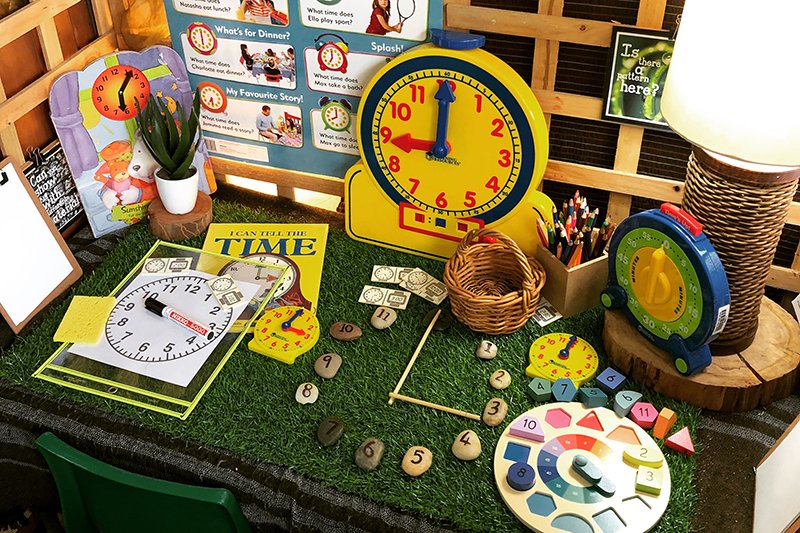
Measurement tools like clocks and scales with hands and winders will be of interest to children with a rotating play schema. Including these math resources in a few investigation areas will encourage children to explore them further and can lead to some productive math discussions.
2. Add some loose parts to printed or drawn loose parts mats to encourage counting, sorting, and pattern making. Ensure the mats include spirals, circles, and ovals if you want to support children with the rotation play schema.

3. An abacus and bead strings are other math resources that interest children exploring the rotating schema. They will love spinning and rotating the beads as they count.
4. I like to add 3D wooden shapes like cylinders and spheres to the block play area. Children with the rotation schema enjoy experimenting with rolling and spinning them down ramps. Make sure to include all different types of 3D shapes (cubes and prisms too), so your students begin to understand the properties a shape needs to roll or slide. 3D shapes can be included in other investigation areas. You will be surprised at how your students explore them if you offer them in other learning areas.
Add a basket of 3D shapes to your library area with a book on shapes.
Encourage children to stamp with them at the playdough table.
Children will enjoy tracing around the faces of 3D shapes at the writing table.
Use them as storytelling props in a small-world setup.
The Rotation Schema and 7 Outdoor Play Activities
Attach ribbons or streamers to sticks (we use rulers) to make twirling sticks. Children with the rotation play schema will enjoy making big circles in the air and watching them twirl around in the wind.
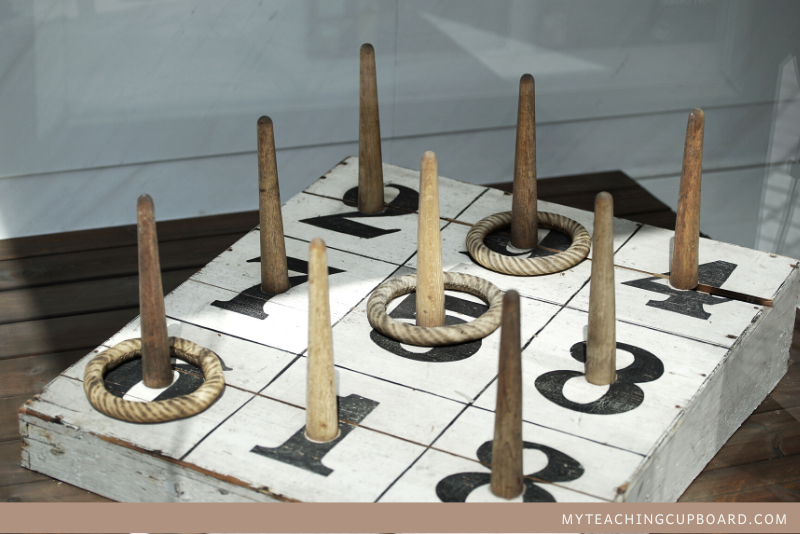
2. Add a game of quoits to your outdoor play space. Children with the rotating play schema will probably enjoy rolling the quoits along the ground more than playing the game the correct way though.
3. Ensure you offer large hoops, tyres, balls, and cable reels for children with the rotating schema to roll around the playground.
4. Hang spinning objects from the trees in your playground. Children exploring the rotating schema find it just as fascinating to watch spinning objects as it is to make them spin.

5. You can pinpoint the children with a rotational play schema in the playground. They are often the ones twisting the swing to spin around instead of swinging in the traditional back-and-forth motion. Adding different types of swings will delight these children. See if you can suspend an old tyre from a sturdy branch for swinging and spinning on.
6. Slippery slides can be used as large ramps to roll balls down for children exploring the rotation play schema.
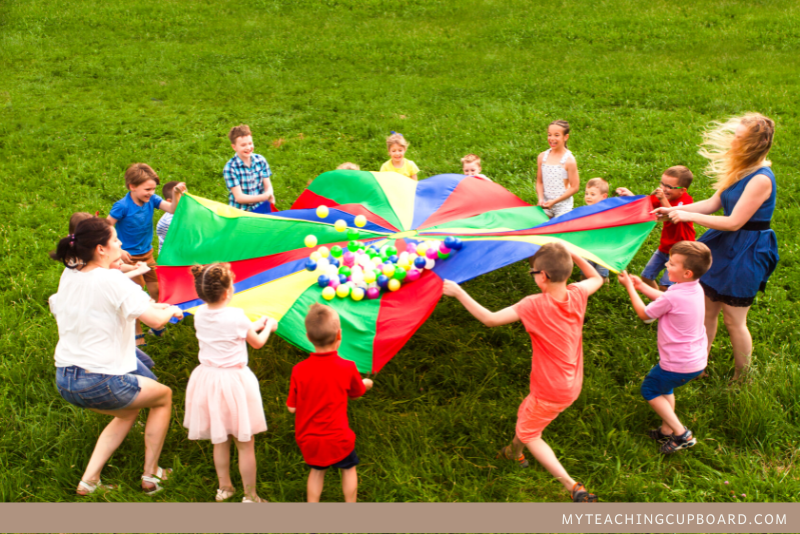
7. Circle games involving running and moving around in a circle are great activities to support the rotational play schema. Some of our favourites are Duck-Duck-Goose, Ring-a-ring-a-roses, and Here We Go Round The Mulberry Bush.
Resources to Support the Rotation Schema
Loose Parts: corks, beads, bamboo pieces, wood cookies, marbles, bangles, hoops, wheels, tubes, nuts & bolts, washers, spools, circular blocks, bobbins, baubles, hair rollers, circular containers with lids.
Natural Loose Parts: wood cookies, bamboo pieces, helicopter leaves (winged leaves like those on the Rosewood tree), pinecones, acorns, round pebbles,
Large Loose Parts: cable reels, wheels, tyres, tree stumps, hose reels, wooden planks & guttering to make ramps, barrels, tunnels, hoops, swings, and pendulums.
Toys: Balls in all different shapes, textures, weights, and sizes, spinning tops, toys with wheels, wind ornaments, wind-up toys, frisbees, yo-yos.
Other Resources: paint rollers, rolling pins, rolling cutters – like pizza cutters, round paper plates, whisks, spoons & bowls, lazy susans, pottery wheels, spirographs.
Tinkering Resources: clocks, fans, record players, CD and DVD players, bikes, Turning tools like screwdrivers, spanners, drills, locks, and keys.
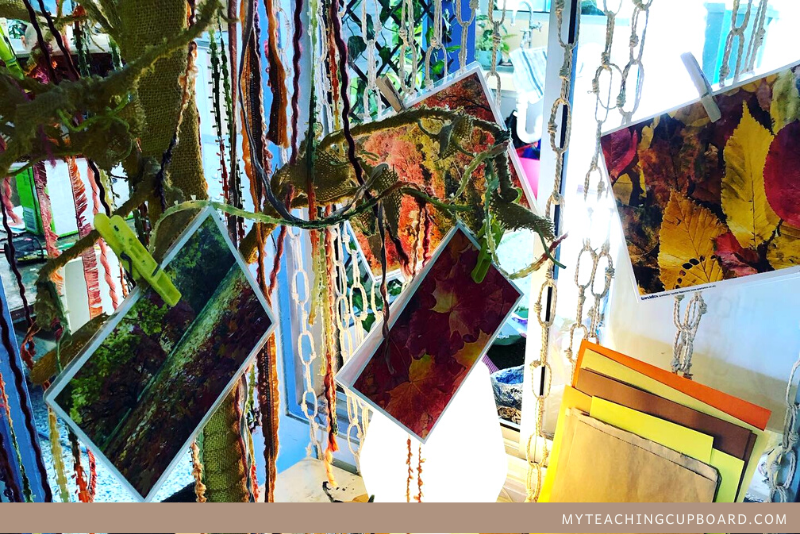
Children exploring the rotation schema don’t just need hands-on activities. Try adding spinning objects like disco balls or mobiles to a learning space. Children interested in the rotation play schema will be visually attracted to the space and will be fascinated by how the object moves and the changing light reflections.
Purposeful teacher observations are the key to supporting the rotation play schema in your classroom. When you observe all the different types of rotational play experiences in your classroom, you will be able to support and extend the students and their learning. For example, if you notice children consistently mixing loose parts in a bowl at dramatic play, they will also enjoy mixing paint in the art area or sand and water in a mud kitchen. Add different types of utensils like whisks and beaters to these areas too.
The rotation play schema begins in babies when they first notice a dropped object rolling away and continues to fascinate them and develop throughout childhood. This engaging play schema will definitely be evident in your early childhood classroom.
So now you know how to identify and support the rotation play schema, you can effectively plan and deliver lessons and activities that developmentally support your students in an age-appropriate way.
If you enjoyed this blog post on The Rotation Schema and found some helpful ideas and activities here, please consider sharing it.
Just CLICK the sharing box below.👇