Age-appropriate pedagogies explained for early childhood teachers. Learn how to balance play-based learning, curriculum demands and intentional teaching.
If you are an early years teacher, then I know that you are juggling the curriculum, academic benchmarks, and assessment demands. We all are!
So many early years classrooms are feeling rushed, too formal, and really developmentally misaligned.
And the impact shows.
No doubt you've seen it in disengaged children, heightened behaviours, fragile emotional development, and learning that just doesn’t seem to stick. Over the years, I’ve sadly watched classrooms shift further and further away from how children actually learn best in the early years of schooling.
We early childhood teachers instinctively know deep down that our young children need more play, movement, connection, and time to learn.
Yet even when we know better, the push to meet curriculum expectations can quietly override what we know is best for the little ones in our early years classrooms.
This is where age-appropriate pedagogies come in. They give teachers a way to step back and ask: What is the right approach for this purpose, for these children, in this context?
Rather than relying on one method or feeling pulled in a dozen directions, age-appropriate pedagogies help us choose from various teaching approaches (play-based, inquiry, explicit, project-based, and more) all based on our children’s needs, the learning intention, and the learning environment.
Grounded in the evidence base outlined in the Age-Appropriate Pedagogies Foundation Paper and supported by recent research across early childhood education and primary school settings, these pedagogical practices recognise that learning in the early years is active, relational, and deeply connected to emotional development and critical thinking. They reflect what we know about early learning, how children build new concepts, and the important drivers of children’s long-term engagement and lifetime success.
In this blog post, I’ll unpack:
what age-appropriate pedagogies actually are
the seven key pedagogical approaches used in Australian early years and ECE settings
how these approaches work together in classroom practice rather than competing with each other
and how you can confidently justify a play-based learning approach within the Australian Curriculum and your day-to-day teaching decisions.
Now don't panic! This is not about adding more to your plate or chasing the latest trend.
It’s about building a clearer understanding of the approaches you’re already using, recognising their different characteristics, and making intentional choices that support active learning in the key stage of early childhood.
If you’ve ever felt torn between what you know children need and what you’re expected to deliver, this post is for you.
What Are Age-Appropriate Pedagogies?
Age-appropriate pedagogies are teaching approaches designed to align with how young children actually learn in the early years. Rather than pushing children into formal, one-size-fits-all instruction too early, these pedagogies recognise children’s developmental needs and support learning in ways that are engaging, meaningful, and sustainable.
At their core, age-appropriate pedagogies:
align with how young children learn best
support holistic development — social, emotional, physical, and cognitive
balance academic learning with wellbeing, agency, and play
are grounded in research on early childhood development and early learning
In Australia, these approaches are supported by a strong evidence base, including the Age-Appropriate Pedagogies Foundation Paper, which draws on recent research and classroom practice across early years and primary school contexts.
The key message is clear: there is no single “right” way to teach in the early years. Effective teaching comes from selecting the right approach for the right purpose.
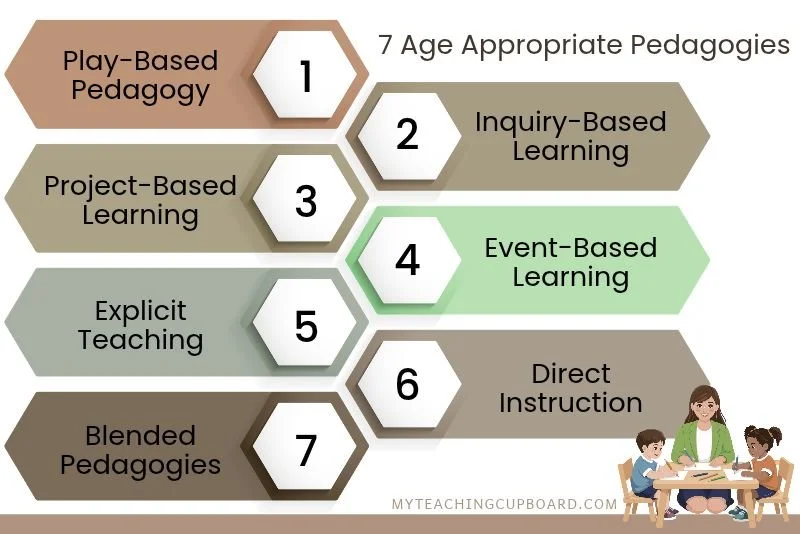
Below are the seven age-appropriate pedagogies commonly used in early years classrooms. You’ll likely recognise that you already use many of these. The real power comes from understanding why and when to use each one.
1 Play-Based Pedagogy
Play-based pedagogy is the cornerstone of age-appropriate pedagogies in early childhood education. It is:
child-initiated and often open-ended
exploratory, imaginative, and hands-on
centred on learning through doing, creating, pretending, and experimenting
Through a play-based approach, children actively construct understanding, practise social skills, develop language, and explore new concepts in ways that feel purposeful and motivating. Play is not seen as a break from learning - it is the learning, particularly in the early years classrooms where agency and engagement matter most.
2 Inquiry-Based Learning
Inquiry-based learning builds on children’s natural curiosity. In this approach:
children investigate questions, problems, or wonderings
learning is driven by exploration and discovery
teachers guide thinking through questioning and discussion
Inquiry supports critical thinking, problem-solving, oral language, and deeper understanding. It works particularly well when children are encouraged to ask questions about the world around them and test ideas through active learning.
3 Project-Based Learning
Project-based learning involves extended investigations over time. These projects:
emerge from children’s interests or real-world contexts
integrate multiple learning areas
allow children to revisit ideas, refine thinking, and build depth
In early learning settings, projects might span days or even weeks and often combine play-based learning, inquiry, and explicit teaching. This pedagogy supports collaboration, persistence, and the ability to connect different things across the curriculum.
4 Event-Based Learning
Event-based learning grows from meaningful real-life experiences. This might include:
excursions or visitors
cultural celebrations
seasonal events or community experiences
Because the learning is anchored in something real and relevant, engagement is naturally high. Event-based learning is especially powerful for building language, social understanding, and emotional development in authentic contexts.
5 Explicit Teaching
Explicit teaching plays an important role within age-appropriate pedagogies. It should be used intentionally. It involves:
short, focused instruction
modelling skills, language, or strategies
making learning intentions clear
In the early years of schooling, explicit teaching is most effective when used with play-based learning rather than replacing it. Used well, it helps children grasp key ideas and apply them meaningfully during play.
6 Direct Instruction
Direct instruction is a more teacher-led approach focused on specific skills. It can be useful:
in small doses for targeted skill development
when children need clarity or repetition
Within age-appropriate pedagogies, direct instruction is not the default mode of teaching. Instead, it is one of several pedagogical practices teachers draw on, using professional judgement to decide when it best supports learning.
7 Blended Pedagogies
Blended pedagogies reflect the reality of effective early years classrooms. Rather than choosing one approach, teachers:
move flexibly between pedagogies
respond to children’s needs, interests, and readiness
adjust the learning environment and instruction accordingly
A single learning experience might begin with explicit teaching, unfold through play-based learning, deepen via inquiry, and be revisited through reflection. This blended approach allows teachers to support wellbeing, agency, and academic growth without sacrificing one for the other.
Understanding these age-appropriate pedagogies gives you a shared language for your classroom practice. It also gives you the confidence to explain why and how your teaching choices are developmentally sound, evidence-informed, and right for the children you teach.
Why Play-Based Learning Sits at the Heart of Age-Appropriate Pedagogies
If age-appropriate pedagogies are about choosing the right approach for the right purpose, then play-based learning sits firmly at the centre - especially in the early years.
High-quality play is not random, nor does it happen accidentally. Research consistently shows that effective play-based learning is:
active – children are physically and mentally engaged
agentic – children make decisions and influence their learning
collaborative – learning happens through social interaction
creative – children imagine, design, and represent ideas
scaffolded – teachers intentionally extend thinking and skills
Through play, children develop so much more than academic knowledge. They build social competence, emotional regulation, language, physical coordination, and cognitive flexibility. These are all essential foundations for learning in the early years and beyond.
Play is how our young children make sense of their world. It’s where new concepts are tested, ideas are revisited, and understanding deepens through experience.
In any well-designed early years classroom, play becomes the vehicle for critical thinking, problem-solving, communication, and lifelong learning.
Addressing Common Misconceptions About Play
One of the biggest challenges I hear from early childhood teachers is how they have to justify play-based learning in their classrooms. I believe much of this comes from misunderstandings about what play really is.
Play is not a free-for-all. Intentional play is thoughtfully planned, carefully observed, and purposefully extended. The learning environment, materials, and teacher interactions all shape the experience.
Play is not a lack of rigour. Play often demands more cognitive effort than any worksheet-based tasks. Children plan, negotiate, test hypotheses, revise ideas, and persist through challenge. These are all markers of deep learning.
Play is not the absence of teaching. Teachers play a pivotal role during play. They observe closely, ask strategic questions, introduce new language or tools, and link children’s experiences back to curriculum intentions.
When play-based learning is correctly understood and implemented well, it becomes the strongest expression of age-appropriate pedagogies there is. It balances well-being, engagement, and academic learning without forcing children into developmentally misaligned expectations.
👉 If you’d like a deeper look at the research and long-term benefits behind this approach, check out this blog post: Benefits of Play-Based Learning in Early Education
In this comprehensive blog post I unpack how play supports children’s social, emotional, physical, and academic development and don’t you worry - I have the evidence to back it up!

Play isn’t something we add on after the real learning. In the early years, play is the real learning, and that’s exactly why it sits at the heart of age-appropriate pedagogies.
Choosing the Right Pedagogy for the Purpose
One of the most empowering shifts teachers can make is recognising that pedagogy is a professional decision - not a fixed rule or a one-size-fits-all approach. Age-appropriate pedagogies give teachers permission to choose deliberately.
Instead of asking “What approach should I always use?”, effective early years teachers ask these types of questions:
What is the learning intention right now?
What do my learners need at this point in their development?
Which pedagogical approach best supports this moment in learning?
When you frame pedagogy this way, play-based learning, explicit teaching, inquiry, and project work stop competing with each other and they become related tools in your essential teaching toolkit.
What This Looks Like in Practice
In real early years classrooms, pedagogies naturally flow into one another:
Explicit teaching might be used briefly to introduce a new concept, skill, or piece of language.
Play-based learning then gives children time to explore that concept in meaningful, self-directed ways.
Inquiry-based learning allows children to ask questions, test ideas, and investigate deeper.
Reflection helps consolidate learning, surface thinking, and inform next steps.
For example, you might explicitly model how to measure length using informal units. That skill is then applied during block play, extended through an inquiry about which structures are most stable, and finally reflected on during circle time. Each approach serves a purpose, and the teacher moves between them intentionally.
A Reassuring Truth for Teachers
You do not need to choose one pedagogy and defend it at all costs. What you need is a responsive toolkit grounded in professional judgement, knowledge of your learners, and a clear understanding of your curriculum goals.
Age-appropriate pedagogies support this flexibility by recognising that different moments call for different approaches - especially in the early years, where development varies widely.
When you can confidently explain why you chose a particular approach, you’re no longer just “doing play” or “doing explicit teaching”. You’re teaching with intention and that’s the heart of any high-quality early childhood practice.
How Age-Appropriate Pedagogies Work Together in Real Classrooms
In effective early years classrooms, age-appropriate pedagogies interweave across the day and week, responding to children, curriculum goals, and what’s happening in the room. A balanced, play-based classroom might include all of the following within a single week:
A short explicit phonics mini-lesson to introduce or revisit a skill
Play-based literacy investigations where children apply that skill through writing, storytelling, or symbolic play
An inquiry provocation in science, sparked by children’s questions or discoveries
Project work that unfolds over several weeks, integrating multiple learning areas
Ongoing reflection and documentation to make learning visible and guide next steps
You see, none of these approaches replaces the others. Instead, they all work together to create depth, continuity, and purpose.
Why Balance Matters So Much
When pedagogy leans too far in one direction, teachers often feel the impact straight away:
Too much formal instruction can lead to disengagement, restlessness, and surface-level learning
Too much unstructured time can result in missed teaching moments and unclear learning intentions
Age-appropriate pedagogies help teachers strike a middle ground where learning is both intentional and responsive. This balance supports:
stronger engagement
deeper thinking and sustained focus
clearer links to curriculum outcomes
Children benefit from knowing what they’re learning and having enough time and space to explore how that learning unfolds.
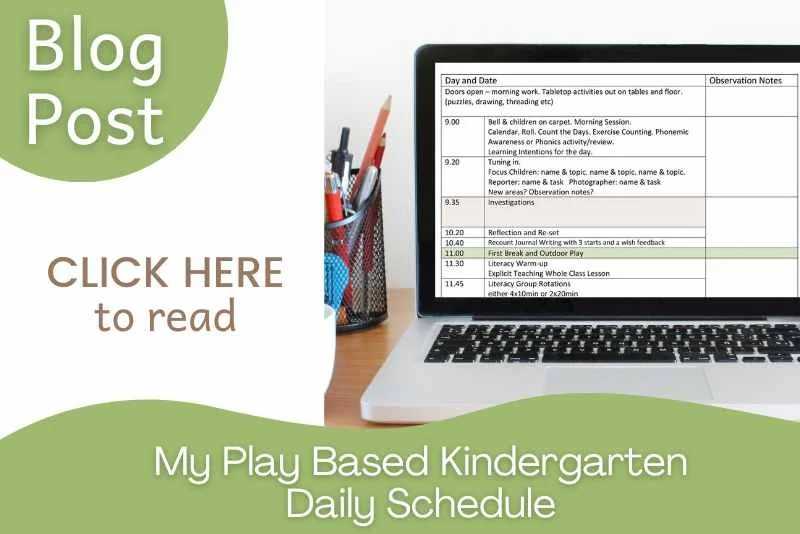
If you’d like to see how this balance works across a real school day, you’ll find it helpful to explore this blog post: My Play Based Kindergarten Daily Schedule
You’ll get a practical look at how explicit teaching, investigations, play, and reflection all fit together in a way that feels calm, achievable, and curriculum-aligned. Seeing how pedagogies blend in practice often gives teachers the confidence to trust their professional judgement and to stop feeling like they have to choose between play or rigour.
Characteristics of High-Quality Age-Appropriate Pedagogies
High-quality age-appropriate pedagogies share a common set of characteristics. When these are present, learning feels purposeful, engaging, and developmentally aligned. You can use the following list as a helpful self-check when reflecting on your classroom practice.
Active
Children learn by doing and hands-on practice.
Example: children build, role-play, investigate, sort, test, move, and manipulate materials during learning time rather than completing only paper-based tasks.
Agentic
Children have voice, choice, and influence over their learning.
Example: students choose which investigation area to work in or how to show their understanding (drawing, building, explaining, acting it out).
Creative
Children are encouraged to imagine, design, and think flexibly.
Example: open-ended art, loose parts, and construction experiences where there is no single “right answer.”
Collaborative
Learning is social and happens through interaction with others.
Example: children negotiate roles in dramatic play, co-construct block designs, or solve a shared problem together.
Explicit
Teachers intentionally model, explain, and demonstrate key skills and concepts.
Example: a short mini-lesson on how to measure length, followed by children applying that skill during construction play.
Language-Rich
Learning environments are saturated with purposeful talk.
Example: teachers model rich vocabulary, ask open-ended questions, and encourage children to explain their thinking during play.
Learner-Focused
Planning begins with children, not just the program.
Example: investigations are designed around observed interests, strengths, and needs rather than pre-set activities alone.
Narrative
Learning is connected through stories, meaning, and context.
Example: children create storylines in small world play or explain the “why” behind their designs and decisions.
Playful
Play is recognised as a legitimate and powerful learning mode.
Example: literacy, numeracy, and science outcomes are embedded within play-based investigations rather than taught only through worksheets.
Responsive
Teachers adapt in real time based on what they notice.
Example: adding a new tool, prompt, or challenge when children are ready, or stepping back when deep play is happening.
Scaffolded
Support is intentional and temporary, not controlling.
Example: asking a well-timed question, modelling a strategy, or introducing a resource and then releasing responsibility back to the children.
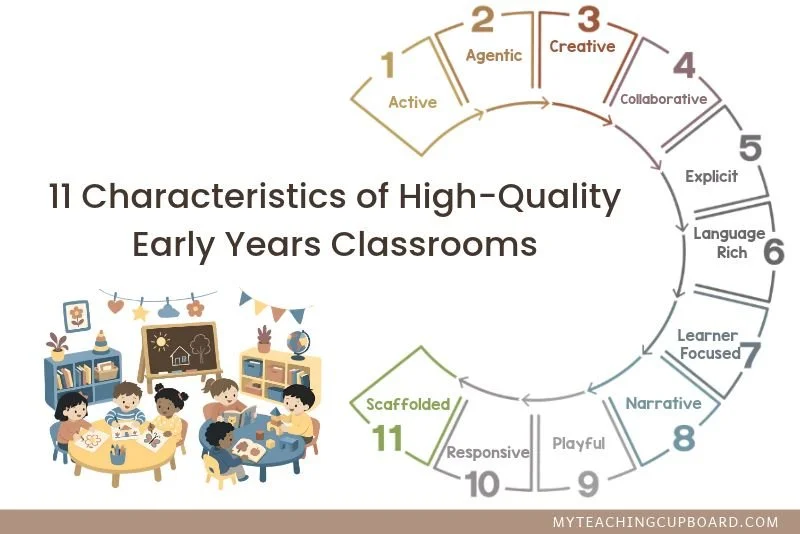
When these characteristics are present, age-appropriate pedagogies become visible in everyday classroom practice. They help teachers balance curriculum expectations with what young children genuinely need to learn - all through play, connection, and meaningful experiences.
Common Challenges Teachers Face (And How to Solve Them)
If you feel that age-appropriate pedagogies make sense in theory but think that it is just too hard to implement in practice, well, you’re not alone. These are the most common concerns I hear from early years teachers. And the good news is, each one has a clear, practical solution.
“I’m under pressure to push academics earlier”
Believe me, I know firsthand that this pressure is real. Curriculum demands, data expectations, and comparison with older year levels can create a sense that learning needs to look more formal - earlier and earlier.
The problem is that push-down academics often backfire. When young children are expected to sit longer, complete abstract tasks too soon, or engage in learning that isn’t developmentally aligned, we see the opposite of the intended outcome: disengagement, behaviour challenges, anxiety, and shallow learning.
Age-appropriate pedagogies protect what research tells us works best in the early years - active learning, movement, play, language, and connection.
When play-based learning is intentional and well scaffolded, children still develop strong academic foundations, but in ways that support long-term success rather than short-term compliance.
“I don’t know how to plan for play”
Many teachers want to teach through play but feel stuck when it comes to planning:
How do I link play to curriculum outcomes?
How do I stay intentional without over-directing?
How do I know what to plan next?
The key shift is understanding that planning for play looks different from planning a traditional lesson. Instead of scripting activities, teachers plan:
learning intentions,
provocations and environments,
likely skills and concepts, and
flexible ways children might engage.
This is where play-based planning tools make a huge difference. Clear frameworks, observation-informed planning, and ready-to-use investigation resources will help you feel confident, organised, and purposeful.
“I struggle to assess learning in play”
This is one of the biggest misconceptions about age-appropriate pedagogies - that play is hard to assess. In reality, play provides some of the richest assessment evidence you’ll ever see. During play, children naturally demonstrate:
problem-solving and reasoning,
language and communication,
social and emotional development,
creativity and persistence.
The challenge is knowing what to look for and how to capture it. Simple strategies like observation checklists, anecdotal notes, photo documentation, and reflection conversations make learning visible and help link directly back to your curriculum expectations.
Once teachers become confident with observing and documenting play, assessment feels less like an extra task and more like part of everyday teaching.
Please don’t think that age-appropriate pedagogies remove academic rigour! They actually reframe how learning is planned, supported, and assessed in ways that truly work for young children.
What This Means for Your Classroom Practice
Understanding age-appropriate pedagogies is about making clearer, more confident decisions about how you teach. When pedagogical approaches are aligned with how young children actually learn best, classrooms feel calmer, learning feels more purposeful, and engagement improves naturally.
In practice, age-appropriate pedagogies help you to:
Protect childhood - Play, movement, curiosity, and connection aren’t “extras”. They are essential drivers of learning in the early years. When these are protected, children feel safe, capable, and ready to learn.
Improve engagement - Children are more motivated when learning is active, hands-on, and meaningful. They participate more deeply when they can explore ideas in different ways rather than being rushed through tasks that don’t yet fit their developmental stage.
Support curriculum outcomes - Play-based and inquiry approaches don’t sit outside the curriculum. When used intentionally, they strengthen language, problem-solving, critical thinking, and foundational academic skills in ways that are more likely to stick.
As a teacher, your role also shifts. Not away from teaching, but into more intentional forms of teaching. You become:
an observer, noticing what children can already do and what they’re ready for next
a facilitator, scaffolding learning through questions, materials, and well-timed support
an intentional decision-maker, choosing the right pedagogy for the right purpose, rather than defaulting to one approach
This is what confident early years teaching looks like. It is responsive, informed, and grounded in evidence.
👉 Ready to take the next step? If you’re just beginning on this journey or want to refine your approach, I recommend starting here with this blog post: How to Start with Play Based Learning.
It is a practical guide that breaks down how to move from the theory into real everyday classroom practice.

Resources That Support Age-Appropriate Pedagogies
Knowing what age-appropriate pedagogies look like is one thing, but having the time and tools to implement them well is another. Most early years teachers don’t lack ideas. What they lack is time.
Time to plan intentional provocations. Time to align play with curriculum outcomes. Time to document learning in ways that feel manageable, not overwhelming.
This is where my done-for-you resources make a real difference. High-quality, play-based resources can:
Save planning hours - Instead of starting from scratch, you can begin with thoughtfully designed prompts, provocations, and planning tools that are ready to use.
Support intentional teaching - Well-designed resources support you and your students. They help you scaffold play, ask better questions, and extend learning at the right moment.
Align play with curriculum - The right resources make it easier to link children’s interests to curriculum outcomes, giving you confidence that learning through play is purposeful and effective.
Teaching With Purpose, Balance, and Confidence
There is no single right way to teach young children, and that’s exactly the point. Age-appropriate pedagogies give you a professional framework for choosing the right approach for the right purpose.
When teaching is responsive, flexible, and informed by how young children actually learn, classrooms begin to feel different. Planning becomes clearer and easier. Decisions feel justified. The tension between play and curriculum starts to ease. And most importantly, children become more engaged, settled, and confident learners.
After more than 30 years teaching in early childhood classrooms, I’m convinced play-based learning isn’t an optional extra or a soft alternative. It’s an essential, evidence-based foundation that sits at the heart of effective early years practice. It can work in your classroom too.
When it’s combined with intentional teaching, reflection, and professional judgement, it supports both wellbeing and learning outcomes.
You don’t need to overhaul everything at once either. You just need the confidence to choose pedagogies with purpose and the tools to make them work, of course!
FREE DOWNLOAD: Guide to Play-Based Learning
Want to learn how to implement age-appropriate pedagogies the right way? With confidence and clarity?
Get…
✔ Practical strategies you can use straight away
✔ Real classroom examples
✔ Clear guidance for planning, teaching, and observing through play
✔ Plus access to 70+ free resources inside my Free Resource Library